artificial-intelligence
-

The adult education market is evolving into a crucial sector for workforce resilience, valued at USD 52.6 billion in 2024 and projected to reach USD 84.16 billion by 2033. A skills-first approach drives growth amid rising demand for reskilling, especially in healthcare and technology, despite pandemic challenges in delivery methods.
-

The accounting and payroll services sector is evolving rapidly, blending compliance with strategic advisory roles. Successful firms in 2026 must leverage technology, understand global trends, and navigate complex regulations. The shift toward subscription pricing and specialized niches, alongside the adoption of AI, is reshaping industry growth and operational strategies.
-

Digital transformation is evolving towards agentic AI, moving beyond optimization to disruptive autonomy. Despite high AI usage, many organizations falter in achieving tangible value due to legacy systems. This shift calls for a fundamental re-architecture, fostering decentralized data frameworks and multi-agent ecosystems to enhance productivity, efficiency, and innovation in business processes.
-

The corporate strategy landscape in 2026 is influenced by volatility and technological advancements, leading case studies to evolve into diagnostic tools for executives. This shift emphasizes sustainability and operational adjustments in legacy industries while introducing new metrics for evaluating case impact. Companies leverage AI and sustainability for transformative strategies, focusing on resilience amid global challenges.
-
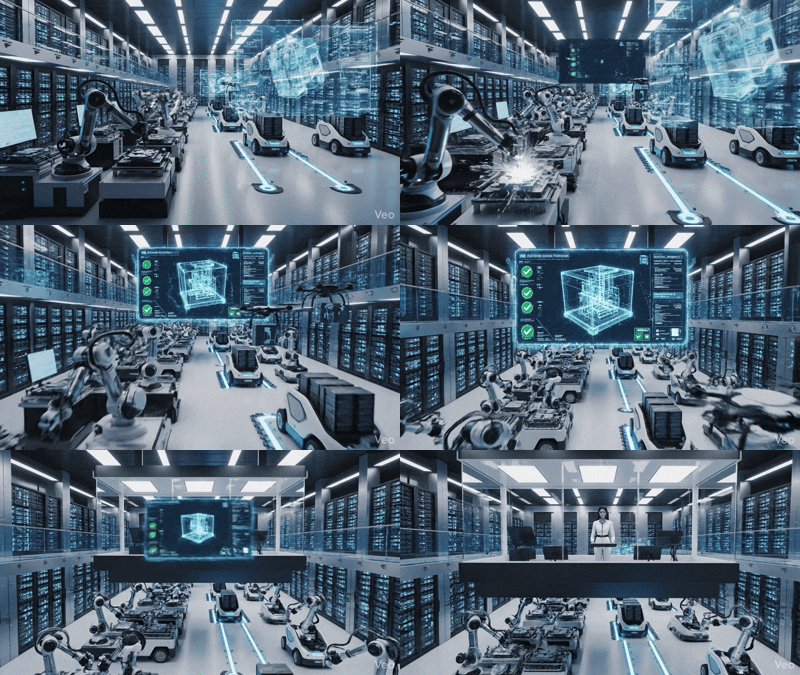
Project optimization is crucial for maximizing resource efficiency within the constraints of time, cost, and scope, as highlighted by the Project Management Triangle. In 2025, the integration of methodologies like Lean Six Sigma, CPM, and AI-driven analytics transforms project management from reactive to proactive, enhancing predictability and strategic alignment while mitigating risks like scope creep…
-
Pip: Welcome to Journal for Policy and Market Research — where the topics range from who owns your neighborhood to who owns the concept of knowledge itself, which is either a very broad editorial mandate or a sign that Administrator has not slept in weeks. Mara: Administrator has been busy. This episode covers the structural…
-

In late 2025, AI has transitioned from “generative experimentation” to “agentic execution,” marking a shift to autonomous systems capable of multi-step planning. Innovations include enhanced memory frameworks and reason-and-search loops, while hardware is evolving towards custom accelerators. The socio-economic impact involves workforce transformation and stringent regulatory developments guiding AI’s future.
-

The global labor market is projected to experience structural disequilibrium until 2040, driven by technology, demographics, and economic shifts. By 2030, 170 million jobs may be created, but 92 million will be displaced, exposing a significant skills gap. Reskilling and adapting to evolving workplace values will be crucial for workforce resilience.
-

By 2026, the global economy relies on a symbiotic relationship between multinational corporations and small-to-midsize businesses (SMBs), which generate 44% of U.S. economic activity. Small firms leverage AI, digital tools, and ecosystem lending from large companies, fueling innovation and competitiveness. Challenges persist, but optimism and educational support drive small business growth.
-

The transition from an industrial to a knowledge-based economy emphasizes the value of knowledge workers over physical labor. Organizations must establish robust knowledge repositories to enhance productivity and decision-making. This involves creating shared protocols, effective information architecture, and a culture of knowledge sharing, supported by appropriate technological infrastructure.
 Journal for Policy & Market Research