chatgpt
-

The integration of artificial intelligence (AI) in Human Capital Management (HCM) revolutionizes talent acquisition, development, and retention by enhancing operational efficiency, reducing costs, and ensuring fairness. Organizations must strategically adopt AI while addressing ethical challenges and regulatory compliance to achieve long-term value and organizational trust in AI-driven decisions.
-

The integration of Generative AI in content creation revolutionizes workflows by automating tasks, enhancing speed, and facilitating scalability. The market for Generative AI is projected to grow significantly, yet challenges exist around factual accuracy and legal risks tied to copyright issues. A structured quality control framework is essential for risk mitigation.
-

The professional services sector is undergoing a transformative shift due to rapid advancements in Artificial Intelligence, projected to reach $3.68 trillion by 2034. The competitive edge hinges on strategic AI integration, with firms needing to automate workflows and address global regulatory challenges. Successful organizations must evolve structures while enhancing workforce capabilities to capture AI’s potential.
-

The growing integration of AI, particularly Generative AI, is transforming professional services, with U.S. private AI investments hitting $109.1 billion in 2024. Organizations are increasingly recognizing AI as a core strategy for competitive advantage, necessitating leadership involvement for effective adoption. However, risks around governance, accountability, and ethical considerations must be addressed to maximize AI’s potential.
-

Artificial Intelligence (AI) is rapidly becoming essential infrastructure for enterprises, marked by a significant increase in adoption and ROI, with 74% of organizations seeing measurable returns within a year. However, scaling AI remains a challenge due to governance, workforce transformation, and integration barriers. Focus on MLOps, ethical governance, and upskilling is crucial for success.
-
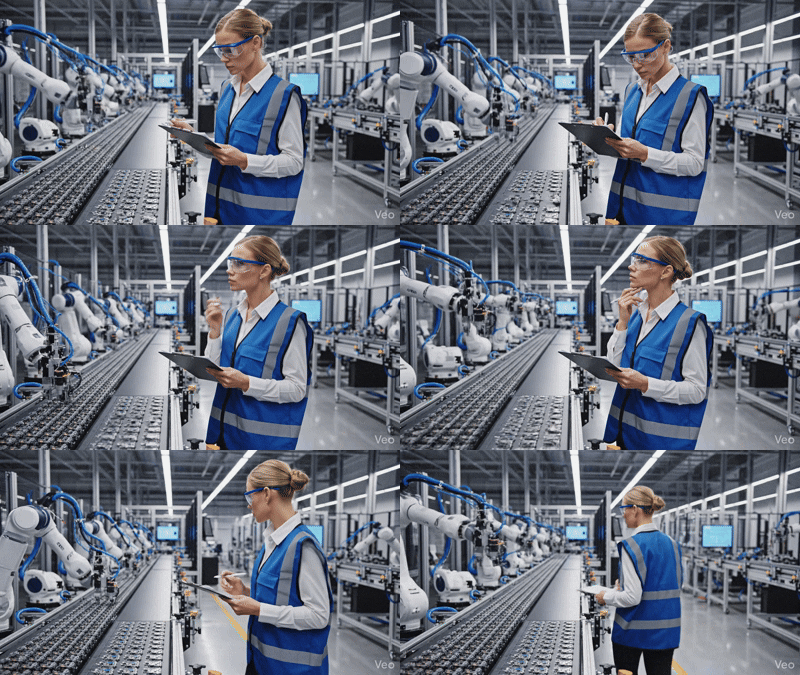
In today’s fast-paced business environment, organizations are integrating advanced process intelligence and hyperautomation to achieve operational efficiency. The synergy of technologies such as Robotic Process Automation (RPA), Artificial Intelligence (AI), and Digital Twins optimizes workflows, enhances decision-making, and ensures better governance, ultimately fostering innovation and resilience in enterprise transformation.
-

The report discusses the transition from traditional digital workflows to AI-integrated systems within organizations, highlighting a significant gap between employee familiarity with AI and its deployment. It introduces the “AI Workathon,” an experiential learning model aimed at bridging this gap through practical applications, while detailing necessary planning, execution, and assessment strategies.
-

The library landscape is evolving from passive information custodianship to active knowledge facilitation, largely due to AI integration. Libraries now utilize AI for resource management, metadata creation, and user personalization, transforming traditional services. This shift not only improves efficiency and user experience but also redefines the role of librarians in navigating the digital world.
-

Knowledge institutions are facing significant disruptions due to advanced technologies, economic pressures, and declining public trust. This report highlights the impact of Generative AI on academic integrity, the financial strain on higher education, and a crisis of authenticity due to deepfakes. Proactive governance reforms are essential for resilience and trust in knowledge systems.
-

The ongoing AI transformation, particularly through Generative AI and LLMs, is reshaping various sectors, accelerating market growth and worker skills demands. While it may displace some jobs, forecasts suggest a net gain of millions of new roles, emphasizing the need for continuous reskilling. Firms face strategic risks tied to infrastructure, compliance, and talent shortages.
 Journal for Policy & Market Research