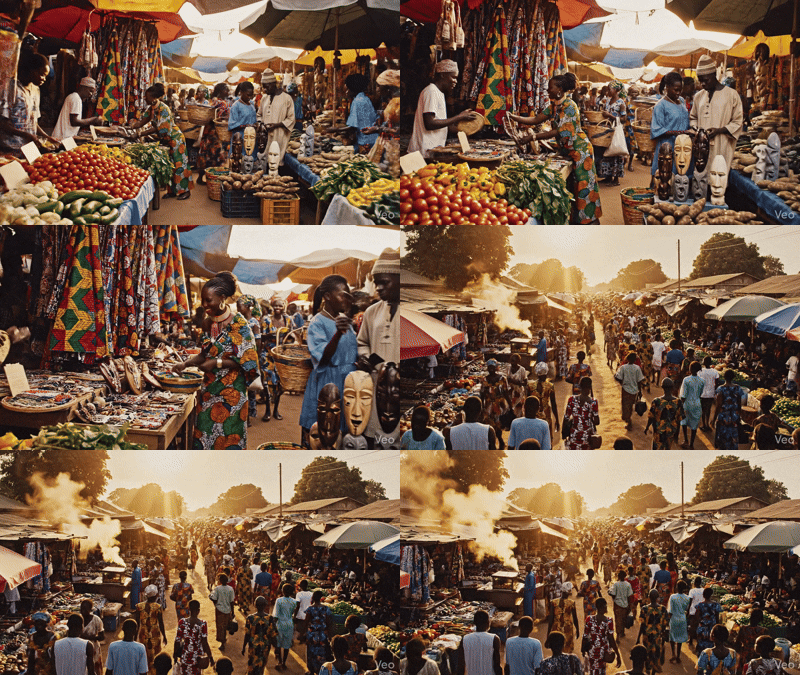
Executive Summary: The Invisible Engine of African Economies
The informal economy of Africa is not a marginal activity but a dominant, foundational component of economic life, acting as the primary absorber of labor and a significant contributor to regional GDP. The structural scale of informality—encompassing approximately 61.2% of total employment and constituting an average of nearly 38% of Sub-Saharan Africa’s GDP—places the continent at the apex of global informality.[1, 2] This sector is characterized by profound regional heterogeneity, ranging from low informality states like South Africa (20–25% of output) to high informality environments like Nigeria and Tanzania (50–65% of output).[2]
The informal entrepreneur, predominantly female and youth, is driven by a complex mix of necessity and opportunity, deeply rooted in family and community networks.[3, 4] However, this vital sector faces crippling systemic constraints, primarily stemming from profound financial exclusion—only 20%–30% of MSMEs access formal credit—and pervasive regulatory friction.[5] These constraints create structural bottlenecks that prevent high-potential informal enterprises from scaling, contributing to persistent poverty, income inequality, and severe deficits in decent work and social protection.[6]
Effective formalization strategies must move beyond punitive regulation toward integrated, incentive-based roadmaps. These strategies require tiered financial inclusion models to address the critical gaps in working capital and equipment credit, coupled with the strategic deployment of digital platforms to simplify business management and regulatory compliance. The ultimate objective is to transform the informal sector from a survival mechanism into a secure pathway for sustainable job creation, aligning with the principles of ILO Recommendation 204.[1]
——————————————————————————–
Chapter 1: Defining the Scope and Scale of Informality in Africa
1.1. Conceptual Framework and Definitional Heterogeneity
The analysis of Africa’s informal economy requires precise conceptual definitions, as measurement and policy application hinge on clear boundary setting. The International Labour Organization (ILO) and other institutions typically apply both size and compliance criteria to delineate the informal sector.[7]
Informal enterprises are generally defined as active, non-governmental, non-agricultural businesses that fail to fully comply with four main legal requirements: obtaining a requisite license, formal business registration, paying the necessary taxes, and maintaining regular accounts.[7] This non-compliance is widespread, as evidenced by statistics showing that the vast majority of micro, small, and medium enterprises (MSMEs) employing 2 to 9 persons are informal, at 90.4%.[1] For the smallest owner-managed units, own-account workers, the figure is even higher, with 94.4% operating informally.[1] Informal employment, conversely, refers to private sector work that is not covered by a legal contract or social security provisions.[7]
The fact that formality is the exception, rather than the rule, within Africa’s MSMEs carries profound implications for the overall economy. MSMEs are widely recognized as the backbone of low-income economies, responsible for driving approximately 80% of regional employment.[5] When over 90% of these employment-generating units are structurally constrained by their informality, it means that the growth constraints affecting the sector are directly undermining the vast majority of regional employment prospects, thereby exacerbating the decent work deficits and hindering strategies aimed at sustainable poverty alleviation.[3, 6]
1.2. The Macroeconomic Footprint: GDP and Employment Contributions
The size of Africa’s informal economy, particularly in terms of labor market participation, is globally unique. Africa exhibits the highest share of informal employment among all regions, with approximately eight out of every ten workers engaged in informal activities.[1] Total informal employment, encompassing both agricultural and non-agricultural activities, is estimated at 61.2% for the region.[1]
While the labor absorption capacity is massive, the informal sector’s contribution to measured output varies significantly. Estimates suggest that the share of informal economic activity in Sub-Saharan Africa (SSA) remains among the largest in the world, averaging nearly 38% of GDP during the 2010–2014 period.[2] While this share has demonstrated a very gradual decline, the pace of formal job creation remains insufficient to absorb the rapidly increasing youth population, leading to the sustained high share of informality.[1]
The level of informality is intrinsically linked to the overall economic development of a country. Informality generally falls as the level of income rises, reflecting greater government capacity and improved incentives toward formality in higher-income nations.[2] For instance, SSA low-income countries exhibit an average informality rate of 40% of GDP, whereas SSA middle-income countries average 35%.[2] Furthermore, structural drivers beyond simple income level play a crucial role. Oil exporters and fragile countries, regardless of their per capita income, are more likely to harbor informality, with economic activity well above 40% of GDP in the informal space.[2] This heterogeneity underscores that structural drivers, such as institutional failure, political instability, and weak governance, often override standard economic development indicators in dictating the prevalence of informality. Consequently, policies must prioritize governance reform and stability in these specific contexts to realize meaningful reductions in informal economic activity.
1.3. Regional Divergence: Analyzing Informality in Sub-Saharan, North, and Southern Africa
The perception of a monolithic African informal economy must be challenged by recognizing significant regional divergence and country-level heterogeneity.
The spectrum of informality is vast:
• High Informality Contexts: Countries like Benin, Tanzania, and Nigeria demonstrate high levels of informality, ranging significantly from 50% to 65% of formal sector output.[2] The Central African Republic (CAR) presents an extreme case, where the informal sector represents 57% of GDP and an overwhelming 96.7% of total employment.[8]
• Lower Informality Contexts: States with more mature institutions and higher income levels, such as Mauritius, South Africa, and Namibia, exhibit significantly lower levels of informality, typically ranging between 20% and 25% of output.[2]
Within the broader regions, Northern Africa (where 77.9% of MSMEs are informal) and Southern Africa (64.4% of MSMEs informal) tend to report less informal activity than the SSA average.[1] Nevertheless, Sub-Saharan Africa as a whole maintains the highest informal sector employment globally, estimated at about 60% of total employment.[8] In some SSA countries—including Mozambique, Benin, Burundi, and the Democratic Republic of Congo—informal employment accounts for over 90% of total employment.[8] This high rate is often attributed to the enduring predominance of the agricultural sector, which typically features lower levels of formal organization.[8]
The data on regional divergence reinforces the idea that institutional strength and political stability are paramount determinants of formalization.
Table 1: African Informal Economy: Estimated Size and Regional Heterogeneity (Circa 2010-2021)
| Metric/Region | Informal Employment (% of Total) | Informality (% of GDP/Output) | Significance |
|---|---|---|---|
| — | — | — | — |
| Africa (Regional Average) | 61.2% (circa 2016 estimate) [1] | ≈ 38% (SSA unweighted average 2010-2014) [2] | Highest global average, gradually declining [1, 2] |
| Sub-Saharan Africa (SSA) | ≈ 60% (Informal Sector Employment) [8] | 35% – 40% (Low vs. Middle Income) [2] | Primary global concentration of informal employment [8] |
| High Informality States (e.g., Nigeria, Tanzania, Benin) | >90% in some cases (e.g., Mozambique, Benin, DRC) [8] | 50% – 65% [2] | Correlates highly with fragility and resource dependence [2] |
| Low Informality States (e.g., South Africa, Mauritius, Namibia) | Less than 40% [8] | 20% – 25% [2] | Reflects stronger institutional capacity and higher income [2] |
1.4. Key Sectors of Informal Dominance
Informal economic activities permeate all major sectors of African economies. Activities are dominant across primary sectors such as agriculture, livestock, forestry, and mining.[8] Given the crucial role of agriculture in many national economies, the informal sector’s dominance here serves as a primary source of livelihood in rural areas.[8]
In urban and semi-urban environments, the informal economy is heavily concentrated in the tertiary sector, which already dominates Africa’s total formal GDP contribution at an estimated 55%.[9] Key informal activities include trade, commercial services, craft production, arts and crafts, and construction.[8] The critical role of the informal sector in services and trade demonstrates that it is deeply embedded in the most economically significant verticals. Beyond providing primary labor absorption, it plays a vital role in value chain development in urban areas by providing goods and services, often filling gaps left by an inadequate or inefficient formal private sector.[8]
——————————————————————————–
Chapter 2: The African Informal Entrepreneur: Profiles and Motivations
2.1. Demographic Segmentation: Youth, Gender, and Migration Patterns
The demographic profile of the informal entrepreneur in Africa is shaped by demographic pressures and limited formal opportunities. The youth population in Africa is experiencing rapid expansion, projected to increase by 105 million people by 2030, with 94 million of those residing in Sub-Saharan Africa.[1] This demographic tsunami creates immense pressure on formal employment generation, making the informal sector an essential, though often unstable, mechanism for absorbing labor surpluses and sustaining livelihoods.[1, 8]
A significant gender disparity exists within this labor absorption dynamic. Women and youth constitute a disproportionate share of informal traders across the continent.[6] This concentration is often a result of limited access to formal employment opportunities and restricted incomes.[6] The reliance of women on informal entrepreneurship is compounded by traditional cultural and social roles, which necessitate engagement in flexible economic activities to balance familial responsibilities.[10]
2.2. The Necessity-Opportunity Continuum: Drivers of Informal Enterprise Creation
The motivational factors driving informal enterprise creation can be mapped onto a dual model of ‘necessity’ (push factors) and ‘opportunity’ (pull factors).[3, 11] While the generation of income for profit or sustaining family livelihood is a universal driving force [3], the balance between these factors differs significantly across demographics.
Necessity-Driven Entrepreneurship: This category is primarily focused on survival, with the fundamental goal of generating income to sustain family livelihoods.[3] Women informal entrepreneurs, in particular, tend to be more necessity-driven.[10] For this group, the choice of informality is often compelled by the need to balance business activities with primary caregiving roles, which makes the flexible, unregistered nature of informal work an economic imperative.[10]
Opportunity-Driven Entrepreneurship: This segment is motivated by achieving profit, financial independence, and growth.[3, 10] While both men and women pursue entrepreneurship for financial independence, opportunity-driven motivations are often more prominently observed among male entrepreneurs.[10]
The disparity in primary motivation, with women being disproportionately necessity-driven, exposes a critical vulnerability in the overall human capital and growth potential of the informal sector. Necessity-driven enterprises typically operate with lower margins, less financial investment, and limited scale due to the inherent constraints of balancing business with domestic and familial demands.[10] If a large segment of the workforce is constrained by necessity, the entire sector sacrifices potential innovation, market expansion, and productivity gains. This scenario contributes to the persistent issue of small-scale informal businesses struggling to mature into high-growth formal MSMEs, underscoring the need for targeted policy support, such as microfinance linked to social protection, for this vulnerable segment.
Table 2: Motivational Drivers and Gender Segmentation of Informal Entrepreneurs
| Motivational Factor | Primary Driver Type | Prevalence in Women | Contextual Interpretation |
|---|---|---|---|
| — | — | — | — |
| Sustaining Livelihood/Poverty Alleviation | Necessity (Push) | High [3, 10] | Indicates vulnerability and reliance on income for immediate survival. |
| Balancing Familial Responsibilities | Structural Necessity (Push) | Exclusive/High [10] | Constraints on scale and location; structural barrier to expansion. |
| Financial Independence/Profit | Opportunity (Pull) | Moderate to High [3, 10] | Demonstrates entrepreneurial aspiration beyond mere survival. |
| Skills/Generational Learning Logic | Contextual/Survival | High [4] | Reliance on non-formalized training and family networks.[4] |
| Job Creation/Social Impact | Community Logic (Pull) | High [4] | Highlights the informal entrepreneur’s internalized social welfare function. |
2.3. Societal and Community Logic: The Role of Social Capital
Informal entrepreneurship in Africa is profoundly shaped by non-codified, community-centric logic, which functions as a vital substitute for weak or absent formal institutional support.[4]
Skills and Generational Learning: Many businesses rely on a “skills and talent logic,” where operations are centered around deeply “rooted skills” and generational learning within family structures.[4] This specialized, non-formalized knowledge base can sometimes create an unwillingness among entrepreneurs to seek other economic opportunities, cementing their presence in the informal structure.[4]
Community Engagement and Social Impact: The “community logic” is a critical feature, demonstrating that business decisions often extend beyond pure profit maximization. Entrepreneurs engage in business not just for personal gain but also to contribute positively to society and the lives of others.[4] They actively aspire to contribute to job creation, internalizing social welfare functions that the state often fails to provide.[4]
Critically, the use of these informal networks within the community serves to overcome formal barriers, such as complex regulatory hurdles or difficulty accessing formal credit.[4] This utilization of trust and social capital is essential for survival. Any successful formalization strategy must respect and leverage this pre-existing social architecture, integrating it rather than attempting to replace it with abstract formal institutions that lack the same level of trust and accessibility. The failure to recognize the importance of family and community logic often leads to the failure of top-down policy initiatives.
——————————————————————————–
Chapter 3: Systemic Constraints to Growth and Formalization
3.1. Financial Exclusion: Barriers to Credit and Capital Access
Financial exclusion represents perhaps the single most significant impediment to the growth and successful formalization of African informal enterprises. Only an estimated 20% to 30% of MSMEs in Sub-Saharan Africa manage to access formal credit.[5] This credit gap stifles the growth of businesses that collectively drive 80% of regional employment, preventing expansion, hiring, and resilience against economic shocks.[5]
The Hierarchy of Financial Needs: The most common and significant constraint cited by informal entrepreneurs is inadequate finance.[12] This problem is magnified for smaller enterprises.[12] Specifically, half of the financial problems are associated with inadequate working capital (essential for day-to-day operations) and poor access to credit for equipment purchase.[12] Without medium-term financing for equipment, businesses are forced to rely on older, less productive technology.[12]
Institutional Risk Aversion and Market Fragmentation: Traditional financial institutions are deterred from lending to MSMEs primarily due to a confluence of institutional risks and structural factors.[12] High transaction costs are prohibitive, as the small loan requirements of SMEs make the fixed costs of processing loans high relative to the loan amount.[12] Furthermore, assessing the risk of new, unproven ventures is difficult, particularly because these informal firms lack the necessary formalized records or verifiable track history.[12] Consequently, high loan rejection rates prevail; entrepreneurs often attribute the rejection to a lack of good collateral, with up to two-thirds of microenterprise loan applications likely to be turned down.[12]
A critical feature of this constraint is the fragmentation of African financial markets.[12] These markets are highly segmented, serving distinct client groups with little interaction among segments. This structural deficiency means there is a notable dearth of medium-term financing, and capital markets remain rudimentary, forcing private businesses to rely almost exclusively on expensive, short-term bank credit.[12] This misallocation of risk prioritizes short-term liquidity over productive, long-term enterprise investment, ensuring capital is not efficiently channeled to its highest marginal return use, thereby limiting the overall profitability and scaling potential of the informal sector.
The Scaling Constraint: The problem of financing is inversely proportional to enterprise size, becoming more acute the smaller the firm is.[12] For microenterprises, the constraint on working capital is paramount, whereas medium-sized firms tend to face more problems related to market demand.[12] This inverse relationship highlights a structural “valley of death” for firms attempting to scale: a micro-firm that survives on informal credit hits a barrier when it needs significant medium-term investment (like equipment) to expand into a small firm, yet formal finance remains inaccessible due to collateral and regulatory requirements.[12]
Table 3: Hierarchical Analysis of Constraints on African MSME Growth
| Constraint Category | Specific Barrier | Significance Level | Source/Evidence |
|---|---|---|---|
| — | — | — | — |
| Financial/Capital Access | Inadequate Working Capital / Credit for Equipment | Most significant for smaller firms [12] | Half of financial problems cited; stifles growth, reduces crisis resilience [5, 12] |
| Financial/Institutional | Lack of Collateral / High Transaction Costs for Banks | Major Deterrent | Leads to two-thirds of microenterprise loan applications being rejected [12] |
| Regulatory/Policy | Inadequate Policy Frameworks / Administrative Procedures | High for Expansion/Exports | Impediment to private investment response and export potential [12] |
| Structural/Market | Poor Demand for Products (“customers had no money”) | Significant (especially for medium/large firms) | Limits profitability and signals macroeconomic consumption weakness [12] |
3.2. Regulatory and Institutional Friction
Beyond finance, the relationship between the informal sector and the state is fraught with institutional friction. Unregulated informal activities contribute significantly to broader governance challenges.[13] Empirical evidence, such as a study across 13 West African economies, demonstrates that the indicator for the size of the informal economy has a negative and statistically significant effect on tax revenue, with an average coefficient of −0.3.[13] This implies that informal economic activities directly undermine national tax collection capacity.
Entrepreneurs consistently cite inadequate policy frameworks and poor administrative procedures as significant impediments to growth and, particularly, to initiating exports from non-traditional product sectors (e.g., handicrafts, wood products).[12] This lack of a supportive institutional ecosystem impedes the vigorous response of private investment to economic reforms.[12]
Paradoxically, even while governments fail to formalize the sector, they implicitly recognize its economic activity by deriving revenue from it. Unregistered enterprises often contribute significantly to government tax and non-tax revenues through levies collected at trade corridors, by government agencies, and via local authority taxes.[8] For example, in CAR, about 12% of government revenue is generated this way.[8] This mechanism is highly transactional: the entrepreneur pays a fee linked to an immediate activity (e.g., selling in a market, moving goods) but receives no reciprocal, comprehensive benefit such as social security or contract law enforcement.[6] This fragmented relationship hinders trust and voluntary formalization. However, it also suggests that improving the monetary efficiency of the taxing authority can have a positive impact on tax revenue, even in the presence of a large informal sector.[13]
3.3. Structural Deficits
Structural market deficits also limit the potential of informal firms. While smaller firms prioritize access to credit, constraints shift for scaling enterprises.[12] A crucial non-financial constraint identified, especially for medium/large firms, is poor demand for products, often attributed to customers lacking disposable income.[12] This market weakness ties enterprise-level constraints back to macro-level issues of poverty and stagnant incomes, confirming that informal growth is limited by both supply-side constraints (credit) and demand-side poverty.[6]
Additional structural constraints involve inadequate knowledge of markets, product quality requirements, investment options, and technical know-how.[12] Furthermore, the lack of adequate export infrastructure and poorly developed private sector organizations to protect member interests present substantial hurdles for any informal enterprise seeking to expand into larger markets.[12]
——————————————————————————–
Chapter 4: The Socio-Economic Impact and Policy Imperative
4.1. Impacts on Poverty, Inequality, and Decent Work Deficits
While the informal economy provides essential livelihoods, its widespread dominance structurally limits national socio-economic progress. A large body of evidence suggests that a larger informal economy is linked to higher overall poverty and income inequality within a country.[6] Furthermore, high informality correlates with smaller declines in poverty over time.[6] This phenomenon results from the severe decent work deficits inherent in informal labor.
Informal workers systematically lack basic labor protections, decent quality jobs, and access to crucial social protection programs.[6] This vulnerability makes millions of Africans susceptible to economic shocks and illness, necessitating a policy focus on the transition to formality to address these severe deficits.[1]
4.2. Competitiveness and Trade Implications
The structure of the informal economy also acts as a structural bottleneck for national competitiveness and integration into global value chains. Countries with a larger informal sector tend to exhibit lower levels of trade openness.[6] This correlation exists because informality often implies lower production quality controls, reliance on older equipment, and limited capacity for formalized contracts or large-scale, consistent production required for international markets.[12]
The difficulty in meeting export standards and accessing international markets limits investment in productivity gains across the economy. Addressing this requires targeted policy interventions aimed at improving product quality, standardization, and providing institutional support specifically designed for non-traditional, small-scale exporters.[12, 14]
4.3. The Youth Employment Challenge and the Labor Sponge Effect
Given the unrelenting demographic expansion in Africa, the informal sector functions as an indispensable labor absorber, fulfilling a necessary social function by providing livelihoods for the millions of youth whom the formal sector cannot accommodate.[1, 8] The youth population growth, particularly the 105 million projected increase by 2030, means high informality will remain a profound challenge in the near future.[1]
Acknowledging this function means that policy must transcend simple regulatory enforcement. Integrated and coherent policy implementation is required, necessitating a reorientation of growth and investment strategies, as well as Poverty Reduction Strategies that specifically target and include the informal economy.[15] The goal must be to transition economic units into the mainstream economy by promoting formal employment growth alongside institutional policies for formalization.[1]
——————————————————————————–
Chapter 5: Pathways to Transformation: Policy Strategies and Innovation
5.1. Integrated Formalization Roadmaps
The transition from informality to formality is a complex institutional and economic process that demands integrated and coherent policies, as emphasized by ILO Recommendation 204.[1] Successful formalization episodes witnessed in some African countries were driven primarily by strong economic growth coupled with deliberate institutional policies promoting formality.[1]
These roadmaps require a multi-pronged approach that extends beyond business registration. Key policy areas must include employment generation initiatives, the systematic extension of social protection to informal workers, the establishment of a favorable regulatory environment, the promotion of fundamental labor rights, enhanced entrepreneurial and skill support, and strengthened social dialogue.[1, 15]
5.2. Regulatory Simplification and Incentive-Based Strategies
The consensus among analysts is that formalization should be pursued gradually.[13] This involves strengthening and fundamentally simplifying regulatory frameworks.[13] An attempt to enforce sudden, complex formalization often proves counterproductive, driving entrepreneurs further underground.
Policies must adopt an incentive-based approach. This includes catering expressly to the needs of specific groups, such as small-scale cross-border traders, by providing necessary market information, promoting direct engagement with their representatives, linking them directly with international markets, and ensuring their unique needs are factored into policy and legislation development.[14] Case studies from countries like Uganda, Rwanda, Ghana, and Liberia have highlighted the successes achieved through such targeted, inclusive approaches.[14] National policy development for transformation, often centered on specific sectors like transport or booming youth-dominated businesses, is a critical strategic intervention.[16]
5.3. Financial Inclusion Models
Given that financial exclusion is the most pervasive growth constraint, innovative financing mechanisms are indispensable. These mechanisms must bypass the high-cost, high-risk aversion typical of traditional banks.[12]
The tiered nature of financial constraints demands tiered solutions:
1. Micro-Working Capital: Designing accessible credit mechanisms focused on immediate working capital needs for the smallest enterprises, recognizing that this is their greatest constraint.[12]
2. Medium-Term Equipment Credit: Developing products specifically for small, scaling enterprises to fund equipment purchase, helping them transition out of the “valley of death” where informal finance is insufficient for productive investment.[12]
Addressing the collateral crisis requires innovative financial technology (FinTech) solutions, such as digital registration systems for movable assets or leveraging transaction data generated by mobile money or e-commerce platforms as a basis for credit scoring.
5.4. Technological Acceleration: The Role of Digital Platforms
Digitalization presents a powerful, parallel pathway to formalization by addressing the lack of records and transaction history that hinders access to finance and regulatory compliance. Digital platforms and Software-as-a-Service (SaaS) products are increasingly viewed as essential tools to help African entrepreneurs formalize, manage, and expand their businesses online.[17]
Companies like Gebeya, which focus on empowering Africa’s service economy—from stylists and tutors to consultants—offer suites of software tools.[17] These platforms provide a functional equivalent of formal business management and transaction records. By empowering freelancers and service providers to manage their work digitally, they create a verifiable trail of economic activity, bridging the gap between purely informal operations and digital commerce. This process offers a degree of formality and professionalism without imposing the complex, burdensome requirements of government registration upfront, effectively acting as an institutional substitute that fosters trust and efficiency.[17] Scaling these platforms is a critical intervention for absorbing the rapidly growing digital workforce and accelerating the transition to productive, manageable economic units.
——————————————————————————–
Conclusion and Forward-Looking Recommendations
The African informal economy is a complex, dynamic system characterized by enormous labor absorption capacity and severe structural limitations. Its continued dominance is not merely an economic preference but a function of institutional failure, financial exclusion, and demographic pressure. The gradual decline in informality is insufficient to offset the impending growth of the youth population, necessitating decisive policy action.
The primary conclusion derived from this analysis is that voluntary formalization requires the state to offer a clear, reciprocal value proposition. If the state continues to implicitly tax informal activities via levies and fees without providing commensurate benefits, trust will remain low, and informality will persist.
Based on the systemic constraints and observed successes, the following integrated policy recommendations are essential for fostering a productive transition:
1. Integrated Social Contract and Regulatory Reform
Policymakers must adopt an Integrated Policy Framework that links regulatory simplification directly to the extension of social protection. Regulatory streamlining must be comprehensive and gradual.[13] This includes creating simplified, tiered registration processes where compliance requirements are commensurate with firm size and revenue. Simultaneously, the state must implement systems for the universal extension of social protection (e.g., healthcare access, retirement savings) to registered informal workers.[1, 15] This creates a voluntary social contract, giving entrepreneurs a tangible incentive—security—in exchange for formalizing.
2. Capital Market Restructuring and Tiered Financing
Structural deficiencies in financial markets must be addressed through Capital Market Restructuring. This necessitates the development of secondary financing structures beyond short-term bank credit to overcome the dearth of medium-term financing.[12] Development institutions should spearhead the creation of guarantee mechanisms and specialized funds dedicated to equipment and inventory financing for small- and medium-sized enterprises.[12] To resolve the prevalent collateral crisis, national frameworks should prioritize the adoption and scaling of digital collateral registries that allow movable assets (such as machinery or accounts receivable) to be used as security, thereby expanding credit access beyond traditional land or property ownership.[12]
3. Leveraging Digitalization as Institutional Support
The state should actively promote and potentially subsidize the scaling of Digitalization as an Institutional Substitute. By supporting platform technology companies that provide Software-as-a-Service tools for informal business management [17], governments can facilitate basic record-keeping, transaction tracking, and digital payments. This approach allows informal workers to build a verifiable business history and digital footprint that can be used for credit scoring and simplified tax reporting, offering a pathway toward formality without the immediate burden of full bureaucratic compliance. This strategy effectively utilizes technology to bridge the governance gap and foster trust among entrepreneurs.
——————————————————————————–
1. The Transition from the Informal to the Formal Economy in Africa – International Labour Organization, https://www.ilo.org/media/390136/download
2. The Informal Economy in Sub-Saharan Africa: Size and …, https://www.imf.org/en/-/media/files/publications/wp/2017/wp17156.pdf
3. (PDF) Motivational factors affecting informal women entrepreneurs in North-West Province, https://www.researchgate.net/publication/364679299_Motivational_factors_affecting_informal_women_entrepreneurs_in_North-West_Province
4. Chapter 6: Reframing the Notion That Informal Entrepreneurs in Africa are Necessity-Driven, https://www.emerald.com/books/edited-volume/17448/chapter/95217532/Reframing-the-Notion-That-Informal-Entrepreneurs
5. Barriers to credit for MSMEs: Why access remains elusive and why it matters – FinMark Trust, https://finmark.org.za/knowledge-hub/blog/barriers-to-credit-for-msmes-why-access-remains-elusive-and-why-it-matters?entity=blog
6. Formalizing Africa’s Informal Sector Through the AfCFTA: An Opportunity for Economic Transformation | Journal of Public and International Affairs, https://jpia.princeton.edu/news/formalizing-africas-informal-sector-through-afcfta-opportunity-economic-transformation
7. Working Paper – African Development Bank Group, https://www.afdb.org/fileadmin/uploads/afdb/Documents/Publications/Working_paper_-_Addressing_informality_in_Egypt.pdf
8. BASELINE STUDY OF INFORMAL ECONOMY IN THE AFRICAN, CARIBBEAN, AND PACIFIC REGIONS Global Report, https://www.undp.org/sites/g/files/zskgke326/files/2025-06/informal_economy-global_report.pdf
9. Economy of Africa – Wikipedia, https://en.wikipedia.org/wiki/Economy_of_Africa
10. Informal entrepreneurs and their motives: A gender perspective – ResearchGate, https://www.researchgate.net/publication/241359943_Informal_entrepreneurs_and_their_motives_A_gender_perspective
11. Full article: Informal entrepreneurship and women’s empowerment: An asset-based perspective on the lived experiences of Swati women, https://www.tandfonline.com/doi/full/10.1080/0376835X.2025.2474240
12. Informal Finance for Private Sector Development in Africa – African …, https://www.afdb.org/fileadmin/uploads/afdb/Documents/Publications/00157616-EN-ERP-41.PDF
13. Regulatory Efficiency and Informal Economy: Impact on Tax Revenue in West Africa | African Journal of Management and Business Research, https://afropolitanjournals.com/index.php/ajmbr/article/view/608
14. Formalization of informal trade in Africa – Trends, experiences and socio-economic impacts, https://globalinitiative.net/analysis/formalization-of-informal-trade-in-africa-trends-experiences-and-socio-economic-impacts/
15. The informal economy in Africa: Promoting transition to formality: Challenges and strategies – International Labour Organization, https://www.ilo.org/media/338761/download
16. BASELINE STUDY OF INFORMAL ECONOMY IN THE AFRICAN, CARIBBEAN, AND PACIFIC REGIONS The case of Central African Republic – United Nations Development Programme, https://www.undp.org/sites/g/files/zskgke326/files/2025-06/baseline_study-car.pdf
17. From Coding Dreams To The Service Economy: How This Platform Tech Company Is Helping Reimagine Africa’s Digital Workforce, https://www.forbesafrica.com/current-affairs/2025/12/02/from-coding-dreams-to-the-service-economy-how-this-platform-tech-company-is-helping-reimagine-africas-digital-workforce
 Journal for Policy & Market Research
Leave a comment