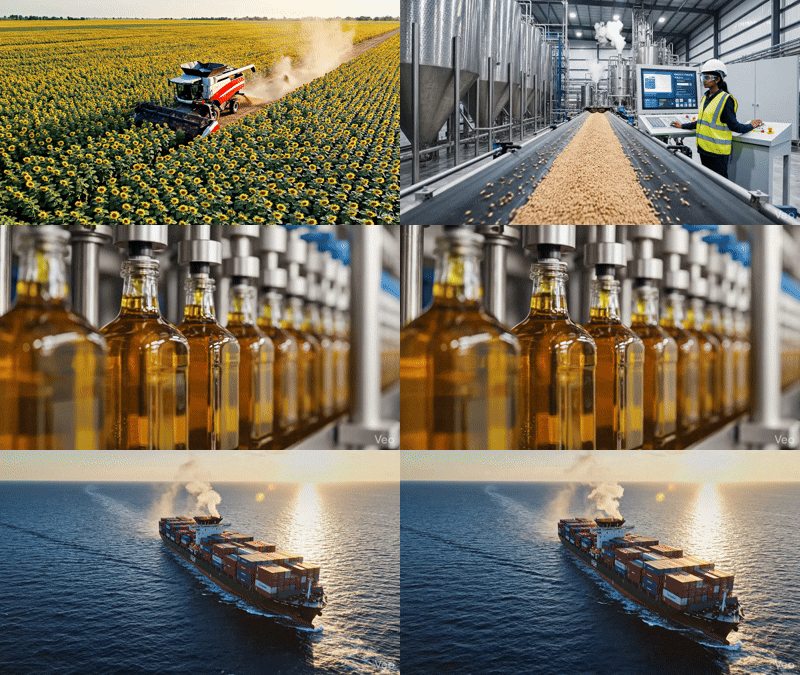
The global agribusiness landscape in 2025 represents a complex intersection of traditional commodity production and high-technology innovation, necessitating a fundamental recalibration of how growth is funded. As the world confronts the simultaneous pressures of population growth, dietary shifts, and the escalating impacts of climate change, the financial mechanisms supporting the agricultural value chain have transitioned from simple debt-based models to sophisticated, multi-layered capital structures. This shift is characterized by a “triple win” philosophy promoted by international organizations, seeking to align financial returns with improved livelihoods, environmental restoration, and climate resilience.[1] The current funding environment is defined by an unprecedented convergence of public subsidies, private equity, venture capital, and developmental finance, all increasingly governed by rigorous environmental, social, and governance (ESG) mandates and the burgeoning potential of natural capital markets.[2, 3]
The Macroeconomic Framework of Agricultural Investment
The global agricultural sector is currently supported by approximately $650 billion in annual government support, yet a significant portion of this capital has historically driven unsustainable production patterns, leading to land degradation and increased greenhouse gas emissions.[1] In 2025, a systemic “repurposing” of these funds is underway, spearheaded by the Global Policy Dialogue for Sustainable Agriculture and the World Bank. The objective is to transition from untargeted subsidies to strategic investments that deliver additional value—currently, only 35 cents of every dollar of traditional support generates additional agricultural output.[1] This transition is reflected in the diversifying profiles of those providing capital. Institutional investors, including pension funds and endowments, are drawn to the counter-cyclical nature and tangible security of farmland, while family offices and high-net-worth individuals increasingly view investment farming as a vehicle for generational wealth preservation.[2]
Geopolitical risks and recent supply chain disruptions have further renewed the emphasis on domestic food security, prompting fresh capital into agribusiness infrastructure and supply chain control.[2] For instance, sovereign wealth funds are executing global mandates to secure food supplies, particularly in key U.S. states and emerging markets where vertical integration and smart irrigation systems offer operational stability.[2] This investment is underpinned by the rapid digitalization of the sector, where precision agriculture, satellite imaging, and real-time analytics have become standard requirements for transparency and risk mitigation in agriculture investment funds.[2]
Institutional Private Equity and Venture Capital Dynamics
Private equity and venture capital firms have become the primary engines of innovation in the agribusiness sector, particularly in the “ag-tech” domain. By September 2025, the investment landscape has matured, with a clear focus on “climate-smart” agriculture and precision farming tools that optimize resource use.[4, 5]
Leading Venture Capital and Private Equity Investors in Ag-Tech
The competitive landscape for agribusiness growth capital is dominated by specialized firms that offer not only funding but also strategic, sector-aligned support. The following table identifies the most active investors in the agricultural and ag-tech sectors as of late 2025, highlighting their specific focus areas and geographic reach.
| Investor/Firm | Core Focus and Investment Thesis | Notable 2025 Activity and Initiatives |
|---|---|---|
| SOSV (IndieBio) | Deep-tech, climate-related ag-innovation, and biotech. | Leading the market with 77+ active investments in 2025.[4, 5] |
| SVG Ventures | On-farm digital transformation, IoT, and precision drones. | Executed 68+ investments; focused on farm automation scalability.[5, 6] |
| Omnivore | Smallholder-centric ag-tech, rural fintech, and marketplaces. | Managing 64+ investments; critical player in the Indian and South Asian markets.[4, 5] |
| AgFunder | Global agri-food tech, AI integration, and biotechnology. | Provided over $80 million in funding across multiple 2025 rounds.[4, 6] |
| S2G Ventures | Multi-stage investment in sustainable food systems. | Managing $900 million in assets; backed Indigo Ag and Beyond Meat.[4, 6] |
| SP Ventures | Latin American agri-tech and data-driven crop management. | Cumulative investments exceeding $200 million; focused on Brazil and Argentina.[6] |
| Anterra Capital | Food safety, digital agriculture, and supply chain tools. | Backed Prospera and CropX to enhance field-level transparency.[4] |
| Syngenta Group Ventures | Corporate VC focused on crop protection and digital ag. | Strategic focus on digital agriculture and sustainable farming technologies.[4] |
| Ospraie Ag Science | Sustainable crop innovations and soil health biotech. | Investing in molecular agriculture and soil microbial solutions.[4] |
| Temasek (Farmland) | Large-scale land ventures and global sustainable landscapes. | Managing a food and ag division with a portfolio value exceeding $2 billion.[6] |
These firms are increasingly moving away from “growth at all costs” toward a model of milestone-based progress. Funding is often released in tranches only as startups hit specific technical, regulatory, or commercial benchmarks.[7] This pragmatic approach is a response to the “ESG backlash” and geopolitical uncertainty of 2025, with investors demanding defensible intellectual property, proprietary AI models, and clear regulatory roadmaps.[7, 8]
Federal Funding and National Policy Incentives
Government-backed schemes remain a vital component of the agribusiness capital stack, offering subsidized interest rates, repayment guarantees, and risk-sharing mechanisms that commercial lenders are often unwilling to provide. In the United States, the USDA’s fiscal year 2025 budget represents a comprehensive effort to stabilize the agricultural economy while fostering innovation.[9]
USDA Fiscal Year 2025 Budget and Financial Programs
The USDA’s budget request for 2025 totals $213.3 billion, covering both mandatory and discretionary programs.[9] A significant priority is placed on the Farm Service Agency (FSA), which provides direct and guaranteed loans to farmers who cannot obtain credit from traditional banks.[10]
| Program/Item | 2025 Budget/Program Level | Strategic Objective |
|---|---|---|
| Direct Farm Ownership Loans | $1,967 Million | Supporting ~6,000 farmers; reduced experience requirements.[9] |
| Guaranteed Farm Ownership Loans | $3,500 Million | Facilitating commercial lending for larger operations.[9] |
| Direct Conservation Loans | $300 Million | Funding affordable NbS and soil health initiatives.[9] |
| Farmer Bridge Assistance (FBA) | $11 Billion (Row Crops) | Offsetting 2025 crop year losses and high input costs.[11, 12] |
| Rural Business-Cooperative | $59 Million (S&E) | Supporting rural economic diversity and job creation.[9] |
| Supplemental Disaster Relief | $6 Billion (Current) | Addressing losses from extreme weather in 2023–2024.[11] |
The Farmer Bridge Assistance (FBA) program is particularly noteworthy in 2025. It provides $12 billion in ad hoc relief to offset losses from unfair trade practices, high inflation, and input cost volatility.[11] Payment rates are calculated using a uniform formula based on FSA-reported planted acres and Economic Research Service (ERS) cost estimates, with corn estimated at $46 per acre and rice at $134 per acre.[12] This program serves as a critical liquidity bridge until traditional ARC/PLC payments are received in late 2026.[12] To improve borrower success, the 2025 budget also proposes reducing the experience requirement for ownership loans from three years to one year and increasing the microloan limit from $50,000 to $100,000.[9]
The EU Common Agricultural Policy (CAP) and Reform Proposals
The European Union’s agricultural funding, administered through the CAP, remains the largest single budget item in the EU, with €386.6 billion set aside for 2021–2027.[13] By late 2025, the European Commission has introduced a new “simplification package” to ease the burden on farmers.[13]
The proposed post-2027 CAP vision seeks to combine the traditional two-pillar system—income support and rural development—into unified national and regional partnership plans.[14] A ring-fenced budget of at least €300 billion will ensure income and crisis support is maintained, while a “starter pack” for young farmers aims to accelerate generational renewal.[14] This reform reflects a shift toward “public money for public goods,” incentivizing agroecology and a just transition away from industrial models.[15]
Brazil’s Plano Safra and the “ABC+” Sustainable Credit Model
Brazil’s Plano Safra 2024/2025 earmarks a record R$475.5 billion (approximately USD 70 billion) in rural credit.[16] Agribusiness, which is expected to generate 29% of Brazil’s GDP in 2025, relies heavily on this plan to fund day-to-day operations and capital investments.[17] The plan is increasingly integrated with the ABC+ Plan, which offers differentiated (lower) interest rates for producers who implement low-carbon practices, such as no-till farming and biological nitrogen fixation.[16, 18] Despite its scale, the basic interest rate in Brazil rose from 10.55% in mid-2024 to 14.75% by May 2025, making the subsidized credit under Plano Safra even more critical for producer viability.[19]
Sustainable Finance, Carbon Markets, and Natural Capital
By 2025, over 60% of global agribusinesses are expected to adopt ESG frameworks, as sustainability has transitioned from a compliance requirement to a core driver of financial value.[20] This maturation is evidenced by the rise of “ESG-linked financing,” where banks offer improved loan terms to farms that demonstrate high ESG scores or meet specific biodiversity and water stewardship benchmarks.[20]
ESG Scoring and Performance Metrics
The agribusiness sector uses a variety of scoring models to provide the transparency required by institutional investors. These models aggregate field-level data on labor conditions, governance, and resource use efficiency.
| Scoring Model/Framework | Adoption/Prevalence | Key Performance Indicators (KPIs) |
|---|---|---|
| Farm-Level ESG Scoring | 36% Adoption [20] | Resource efficiency, soil moisture, labor safety. |
| SAI Platform FSA 3.0 | 32% Adoption [20] | Global benchmarking for sustainable production. |
| Sustainalytics Risk Rating | 28% Adoption [20] | Exposure to climate and regulatory risks. |
| GRI Agri Standard | 23% Adoption [20] | Multi-stakeholder transparency and reporting. |
| Regenerative Organic | 16% Adoption [20] | High-tier certification for soil carbon and ethics. |
Agribusinesses that adopt these frameworks report up to 30% higher resource efficiency, which enhances long-term profitability and unlocks premium markets.[20] Advanced technologies, such as satellite-based soil organic carbon (SOC) mapping—achieving 90–95% accuracy—allow for the cost-effective validation of these sustainability claims without the need for expensive manual sampling.[20]
The Evolution of Carbon Sequestration Markets
The global agriculture carbon sequestration market is projected to reach USD 374.73 million by 2033, growing at a compound annual growth rate (CAGR) of 9.70% from its 2024 valuation.[21] Using the standard CAGR formula:CAGR=(VinitialVfinal)t1−1Where Vfinal is the $374.73 million projected for 2033, Vinitial is the $152.57 million in 2024, and t is the 9-year period, the growth reflects a rapid monetization of environmental services.[21]
A significant development in late 2025 is the integration of voluntary carbon market infrastructure with national climate goals through the Article 6.2 Crediting Protocol. Published by Singapore, Verra, and the Gold Standard, this protocol allows governments to use existing independent crediting programs to certify emission reductions, avoiding the need for redundant national standards.[22]
| Standard Feature | Verra (VCS) | Gold Standard |
|---|---|---|
| Core Philosophy | High volume, rigorous GHG accounting.[23] | Qualitative, holistic SDG co-benefits.[23] |
| Primary Requirement | Additionality and permanence of GHG removal. | Mandatory stakeholder engagement and social impact. |
| Market Position | 70-80% of cumulative voluntary credits.[23] | Premium pricing for community-based projects.[23] |
| Latest Updates | VCS Standard v5.0 issued Dec 2025.[24] | Article 6.2 labeling in registries.[22] |
Verra’s first “CCP-labeled” credits under Improved Forest Management (IFM) methodologies were issued in December 2025, signaling a new era of standardized, high-integrity credits that can be used by corporations to meet Scope 3 emissions targets.[22, 25]
Development Finance Institutions and Blended Finance Models
Development Finance Institutions (DFIs) are government-owned entities that provide the “Third Pillar” of international development policy, alongside traditional aid and multilateral banks.[26] Their role is to provide risk capital and technical assistance to agribusiness projects in developing countries that are too risky for commercial lenders.[26, 27]
The African Development Bank and the ADF-17 Replenishment
The African Development Bank (AfDB) achieved a historic milestone in December 2025 by raising $11 billion for the African Development Fund (ADF-17), a 23% increase over the previous cycle.[28, 29] This replenishment is characterized by a new model centered on “African ownership,” with 23 African countries contributing directly to the fund.[29]
The AfDB projects that the use of AI in African agriculture could contribute to a $1 trillion GDP increase by 2035.[30] The Bank’s 2025–2027 “ignition phase” focuses on expanding access to energy and strengthening food systems through large-scale infrastructure projects. For example, the Rice Value Chain Development Project (RIVACREP) in Mozambique is a $22.8 million initiative designed to quadruple rice yields—from 1 ton per hectare to 4 tons—and nearly double annual household incomes for 30,000 smallholder farmers.[31]
EBRD and Blended Finance for Infrastructure
The EBRD Food and Agribusiness Strategy 2025 emphasizes the use of blended finance to incentivize the adoption of new technologies.[32] By combining concessional funding with private capital, the EBRD de-risks early-stage projects in areas such as urban food logistics, alternative proteins, and precision irrigation.[32] The Bank also collaborates with agencies like NASA Harvest to implement satellite-based farmland monitoring, which is more efficient than traditional land-based techniques for managing vast agricultural tracts.[32] Every $1 of concessional funding through programs like the Global Agriculture and Food Security Program (GAFSP) leverages approximately $6.50 in additional private sector funding, demonstrating the high catalytic power of the DFI model.[33]
Debt Structures: Senior, Mezzanine, and Supply Chain Finance
As agribusinesses mature, they require more complex financing than simple bank loans. The “capital stack” in 2025 typically includes senior debt at the base, followed by mezzanine financing, and finally equity.[34]
Mezzanine Financing in the Agribusiness Capital Stack
Mezzanine debt is a hybrid tool that bridges the gap between senior debt and equity. It is often used for acquisitions, buyouts, or major expansions because it minimizes equity dilution while providing significant growth capital.[35] In 2025, mezzanine returns for agribusinesses generally range from 12% to 20% per year, though they can reach 30% for high-growth ventures.[34]
| Feature | Senior Debt | Mezzanine Debt |
|---|---|---|
| Priority | Highest (Senior position) | Subordinated to senior lenders.[36] |
| Security | Secured by physical property/assets.[34] | Often unsecured; cash flow or equity pledge. |
| Cost | Lower interest rates. | High interest + “Equity Kickers” (Warrants).[34] |
| Amortization | Requires monthly principal payments. | Interest-only; “Bullet” principal payment.[36] |
| Maturity | Short to medium-term. | Longer term (5 to 7 years).[34] |
One innovative feature of 2025 mezzanine structures is the “Pay-In-Kind” (PIK) interest. For example, a $10 million loan with 2% PIK interest allows the extra $200,000 to be added to the principal and paid at maturity, helping the borrower preserve cash during critical growth phases.[34]
Supply Chain Finance (SCF) for MSMEs
Supply Chain Finance has emerged as a necessity for agribusiness MSMEs navigating input inflation and delayed receivables. Unlike traditional loans, SCF is transaction-based and tied to actual trade flows.[37] It allows suppliers to get paid earlier (at a small discount) by leveraging the creditworthiness of the larger buyer. Digital SCF platforms like Agriwise integrate satellite data and mobile-first assessments to reach the “last mile” of the supply chain, turning every invoice into a growth opportunity for aggregators, input dealers, and processors.[37]
Blue Finance: Water Stewardship and Aquaculture
Blue finance—the financing of water security, marine conservation, and sustainable aquaculture—has become a rapidly growing segment of sustainable investment in 2025.[38] The market for blue bonds and loans has tripled in size over the last decade, surpassing €13 billion by late 2024.[39]
Blue Bonds and Loans: Case Studies in 2025
The momentum behind blue finance is driven by large-scale sovereign and corporate issuances aimed at protecting aquatic ecosystems and securing freshwater resources.
- Thai Union Blue Loan ($150M): In May 2025, the Asian Development Bank (ADB) signed a blue financing agreement with Thai Union to enhance the sustainability of the shrimp supply chain.[40] The loan includes a technical assistance grant to train farmers on climate resilience and financial literacy.[40]
- CABEI Lake Yojoa Bond (€30M): The Central American Bank for Economic Integration issued a blue bond in May 2025 dedicated to restoring the largest natural lake in Honduras.[39]
- Banco do Brasil Blue Repo ($95M): This 2025 issuance focuses on financing the bank’s water and sanitation portfolio, demonstrating that blue finance now encompasses a variety of financial instruments beyond traditional bonds.[38]
Blue finance instruments are typically aligned with the Green Bond Principles of the International Capital Market Association (ICMA).[38] They often incorporate sustainability-linked performance indicators (KPIs), such as the percentage of seafood certified under the Aquaculture Stewardship Council (ASC) or reductions in industrial wastewater.[40, 41]
Inclusive Finance and Microfinance for Smallholders
For millions of smallholder farmers, traditional banking remains inaccessible due to a lack of documented credit history and collateral. Microfinance, supported by digital innovation, has filled this gap, growing at an annual rate of 7.46% globally.[42]
The Role of Fintech in inclusive Agri-Finance
Indian startup Farm Infinity and other digital platforms are reshaping the sector by using alternative data for risk assessment. Their algorithms analyze satellite-derived data on crop health and soil quality to generate credit scores, enabling banks to make informed lending decisions.[42] The “Banking-as-a-Service” (BaaS) model allows for real-time portfolio monitoring, which has helped reduce default rates and expand access to affordable financial services.[42]
In Ethiopia, the National Agri-Finance Implementation Roadmap (NAFIR) 2025–2030 introduces “game-changers” like the National Agri-Finance Accelerator (NAFA) to de-risk capital flows and the Farmer Access to Streamlined Financial Services (FAST) to reduce transaction costs.[43] This roadmap represents a collaborative effort between the Ministry of Agriculture and the National Bank of Ethiopia to build an inclusive financing system tailored to the needs of marginalized populations.[43]
Investment Due Diligence and Professional Readiness
As capital flows into agribusiness become more sophisticated, the due diligence process has expanded to include deep dives into technological feasibility and ESG compliance. In 2025, investors favor companies with “strong fundamentals and clear paths to commercialization”.[7]
The 2025 Agribusiness Due Diligence Checklist
| Diligence Pillar | Key Items for Review | Strategic Objective |
|---|---|---|
| Financial Health | Audited 3–5 year financials, EBITDA historical performance, cost structure stress testing.[44, 45] | Validate the purchase price and ensure accurate costing for decision-making. |
| Market Position | TAM, SAM, SOM analysis; validated demand through LOIs or paying customers.[45, 46] | Assess growth potential and competitive defensibility. |
| Technology & IP | Software stack, IP protection, product roadmap, and cybersecurity protocols.[45, 47] | Validate technological feasibility and avoid “greenwashing” or scientific fraud. |
| Operational Scalability | Supply chain workflows, use of automation, and facility/equipment condition.[45, 48] | Confirm the business model can grow revenue faster than costs. |
| ESG Compliance | Carbon footprint baseline, water stewardship metrics, labor and social inclusion audits.[20, 49] | Align with institutional mandates and regulatory requirements (CSRD). |
| Leadership & Team | Background of key executives, track record, and ownership stakes.[45, 48] | Evaluate the capability of the team to deliver on the stated strategy. |
Investors in 2025 are increasingly utilizing AI and data-driven dashboards to monitor their portfolio companies post-investment. Real-time satellite imagery and IoT data allow for “dynamic” risk monitoring, where default rates can be predicted based on crop health trends months before harvest.[50]
Synthesis and Strategic Outlook for 2026
The agribusiness financing landscape of 2025 and 2026 is defined by a shift from extractive to regenerative capital models. The traditional reliance on subsidized loans and land-based collateral is being augmented by a sophisticated array of natural capital instruments, mezzanine debt, and blue finance bonds. These mechanisms are designed to address the unique risks of the sector—including weather volatility and commodity price fluctuations—while incentivizing the sustainable intensification required to feed a global population.
For agribusinesses seeking to secure growth capital, the path forward requires a dual mastery of agricultural operations and digital transparency. The “digital audit trail”—from field to fork—is no longer an optional feature but a prerequisite for institutional investment. As government support is repurposed toward public goods and DFIs continue to catalyze private capital into emerging markets, the sector is positioned for a decade of transformative growth, underpinned by the professionalization of sustainability and the maturation of ag-tech innovation. The convergence of these trends suggests that the most successful agribusinesses of 2026 will be those that can demonstrate a measurable “triple win”: financial profitability, environmental restoration, and social equity.
——————————————————————————–
- Repurposing Agricultural Support: 2025 Policy Compendium – The World Bank, https://thedocs.worldbank.org/en/doc/ad6c0134dbaa5f166202d6a808b0c0b9-0320012025/original/repurposing-agricultural-support-2025-policy-compendium.pdf
- US Agriculture Investment Funds: Top 2025 Growth – Farmonaut, https://farmonaut.com/usa/us-agriculture-investment-funds-top-2025-growth
- Impact Investing in Agriculture | Special Report – Agri Investor, https://www.agriinvestor.com/impact-investing-in-agriculture/
- Top 15 Agriculture Investors in 2025 | Peony Blog, https://www.peony.ink/blog/top-15-agriculture-investors-in-2025
- Top 50 Agriculture (agtech) Startup Investors in September 2025 – Shizune.co, https://shizune.co/investors/agriculture-agtech-investors
- Top Agriculture Venture Capital Firms & Farmland Ventures – Farmonaut, https://farmonaut.com/blogs/top-agriculture-venture-capital-firms-farmland-ventures
- Crowdfunding for AgriTech Startups: Platforms, Models & Success Tips, https://qubit.capital/blog/crowdfunding-platforms-agritech-innovations
- 5 Sustainable-Investing Trends to Watch in 2026 – Morningstar, https://www.morningstar.com/sustainable-investing/5-sustainable-investing-trends-watch-2026
- 2025 Budget Summary – USDA, https://www.usda.gov/sites/default/files/documents/2025-usda-budget-summary.pdf
- U.S. Department of Agriculture (USDA) | Grants.gov, https://www.grants.gov/learn-grants/grant-making-agencies/u-s-department-of-agriculture-usda
- Trump Administration Announces $12 Billion Farmer Bridge Payments for American Farmers Impacted by Unfair Market Disruptions | USDA, https://www.usda.gov/about-usda/news/press-releases/2025/12/08/trump-administration-announces-12-billion-farmer-bridge-payments-american-farmers-impacted-unfair
- Impact of Estimated Farmer Bridge Assistance on 2025 Farmer Return Projections, https://farmdocdaily.illinois.edu/2025/12/impact-of-estimated-farmer-bridge-assistance-on-2025-farmer-return-projections.html
- The EU Common Agricultural Policy, its reform and future in brief – European Parliament, https://www.europarl.europa.eu/topics/en/article/20210916STO12704/the-eu-common-agricultural-policy-its-reform-and-future-in-brief
- The next chapter for the CAP – Agriculture and rural development – European Union, https://agriculture.ec.europa.eu/media/news/next-chapter-cap-2025-07-17_en
- Common Agricultural Policy – GFGF 2025 / Good Food Good Farming, https://goodfoodgoodfarming.eu/common-agricultural-policy/
- Safra Plan 2024/2025 – Climate Policy Database, https://climatepolicydatabase.org/policies/safra-plan-20242025
- Agribusiness 2025 – Brazil | Global Practice Guides | Chambers and Partners, https://practiceguides.chambers.com/practice-guides/agribusiness-2025/brazil/trends-and-developments
- Sustainable finance and low-carbon agriculture: pathways to COP30 – BVRIO, https://www.bvrio.org/sustainable-finance-and-low-carbon-agriculture-pathways-to-cop30/
- Draft case study: Assessing the implementation of Brazil’s Plano Safra on just transitions in the agricultural sector – UNFCCC, https://unfccc.int/sites/default/files/resource/KCI13_04d_Draft%20case%20study%20Plano%20Safra%20Brazil.pdf
- ESG Agriculture: 2025 Models For Sustainable Farming – Farmonaut, https://farmonaut.com/blogs/esg-agriculture-2025-models-for-sustainable-farming
- Agriculture Carbon Sequestration Market Size, Share, Trends and Forecast by Raw Material, Application, and Region, 2025–2033 – IMARC Group, https://www.imarcgroup.com/agriculture-carbon-sequestration-market
- Singapore, Gold Standard, and Verra Publish Article 6.2 Crediting Protocol, https://verra.org/singapore-gold-standard-and-verra-publish-article-6-2-crediting-protocol/
- Verra vs. Gold Standard: Which Certification is Right for Your Project? – AQUILA.is, https://aquila.is/2025/verra-vs-gold-standard-which-certification-is-right-for-your-project/
- VCS Program Details – Verra, https://verra.org/programs/verified-carbon-standard/vcs-program-details/
- 2025 climate action for value chains and carbon markets – Sustain Cert, https://www.sustain-cert.com/news/what-to-expect-in-2025-for-climate-action-in-value-chains-and-carbon-markets
- The Growing Role of the Development Finance Institutions in International Development Policy – FinDev Gateway, https://www.findevgateway.org/sites/default/files/publications/files/mfg-en-paper-the-growing-role-of-the-development-finance-institutions-in-international-development-policy-2009.pdf
- Development Finance Institutions in Developing Countries: A Literature Review – Ferdi, https://ferdi.fr/dl/df-PEB2xSVyKUWpAMYzK9ctySHE/ferdi-wp350-development-finance-institutions-in-developing-countries-a.pdf
- AfDB Raises $11bn to Support Africa-Led Development Projects – allAfrica.com, https://allafrica.com/stories/202512190093.html
- African Development Fund mobilises a historic $11 billion, marking a new era of African ownership and investment-led development – African Development Bank Group, https://www.afdb.org/en/news-and-events/press-releases/african-development-fund-mobilises-historic-11-billion-marking-new-era-african-ownership-and-investment-led-development-89755
- Africa’s AI Revolution: African Development Bank report projects $1 trillion in additional GDP by 2035 with use of AI to enhance productivity, https://www.afdb.org/en/news-and-events/press-releases/africas-ai-revolution-african-development-bank-report-projects-1-trillion-additional-gdp-2035-use-ai-enhance-productivity-89619
- African Development Bank Group Approves $22.8 Million Grant to Boost Mozambique’s Rice Production and Build Climate Resilience, https://afdb.africa-newsroom.com/press/african-development-bank-group-approves-228-million-grant-to-boost-mozambiques-rice-production-and-build-climate-resilience?lang=en
- Food and Agribusiness Strategy 2025 | EBRD, https://www.ebrd.com/content/dam/ebrd_dxp/assets/pdfs/agribusiness/agribusiness-strategy/EBRD+Food+and+Agribusiness+Strategy+2025.pdf
- Blended Finance Solutions for Agribusiness and Food Security, https://www.ifc.org/en/what-we-do/sector-expertise/blended-finance/blended-finance-agribusiness
- Mezzanine Debt Explained: How It Fits Into The Capital Stack | Primior Group, https://primior.com/mezzanine-debt-explained-how-it-fits-into-the-capital-stack/
- Mezzanine Debt: What it is and when to use it – Carta, https://carta.com/learn/startups/fundraising/debt-financing/private-credit/mezzanine-debt/
- Understanding Mezzanine Financing: How It Works and Its Uses – Investopedia, https://www.investopedia.com/terms/m/mezzaninefinancing.asp
- Leveraging supply chain finance for small agri MSMEs – Agriwise, https://www.agriwise.com/leveraging-supply-chain-finance-for-small-agri-msmes/
- The Rise of Blue Finance – Natixis Corporate & Investment Banking, https://home.cib.natixis.com/the-rise-of-blue-finance
- Blue Horizons: the rise of blue bonds in sustainable investment – Groupe BNP Paribas, https://group.bnpparibas/en/news/blue-horizons-the-rise-of-blue-bonds-in-sustainable-investment
- ADB, Thai Union Sign the First Blue Loan for Sustainable Aquaculture in Thailand, https://www.adb.org/news/adb-thai-union-sign-first-blue-loan-sustainable-aquaculture-thailand
- Guidelines for Blue Finance, https://www.ifc.org/en/insights-reports/2025/guidelines-for-blue-finance
- Microfinance Industry Report 2025: Key Data & Innovation Insights, https://www.startus-insights.com/innovators-guide/microfinance-industry-report/
- NATIONAL AGRICULTURAL FINANCE IMPLEMENTATION ROADMAP (NAFIR) 2025-30, https://nbe.gov.et/wp-content/uploads/2025/07/NAFIR.pdf
- Due diligence checklist: 7 critical steps | Our Insights – Plante Moran, https://www.plantemoran.com/explore-our-thinking/insight/2025/10/due-diligence-checklist
- Investment due diligence checklist – Ideals Virtual Data Rooms, https://www.idealsvdr.com/learnings/app/uploads/2025/10/Investment-due-diligence-checklist.pdf
- Investor readiness checklist: Your 2025 Golden Ticket – OpStart, https://www.opstart.co/investor-readiness-checklist/
- Biotech Due Diligence: Investor Checklist for Startup Success – Qubit Capital, https://qubit.capital/blog/biotech-startup-due-diligence-checklist
- 2025 Venture Capital Due Diligence Checklist – 4Degrees, https://www.4degrees.ai/blog/2025-venture-capital-due-diligence-checklist
- ESG Compliance Rules for Agriculture 2025 | Council Fire, https://www.councilfire.org/guides/esg-compliance-rules-for-agriculture-2025/
- Farm Credit Financing: Top 2026 Strategies For Growth – Farmonaut, https://farmonaut.com/blogs/farm-credit-financing-top-2026-strategies-for-growth
 Journal for Policy & Market Research
Leave a comment