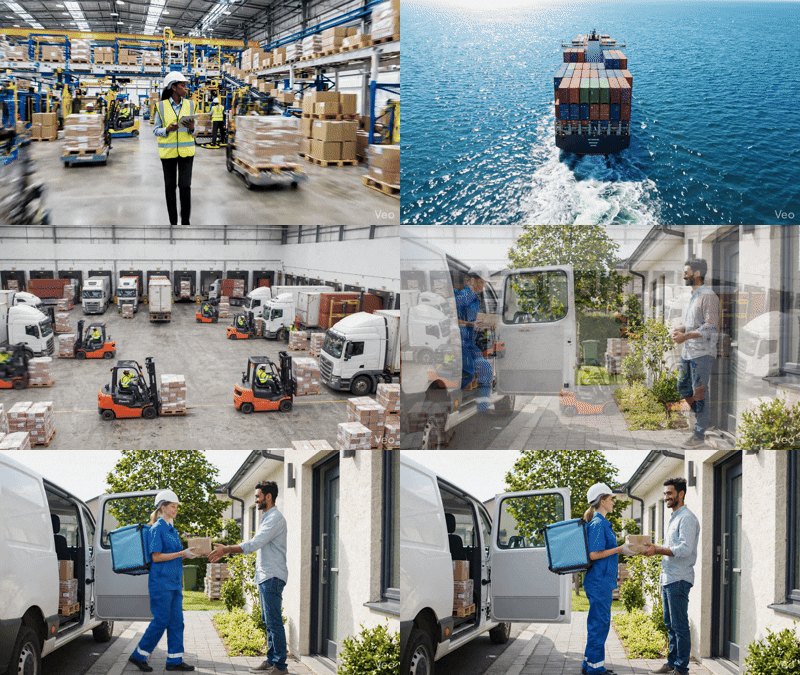
The global retail and wholesale market in 2026 stands as a colossal economic engine, valued at approximately $90.7 trillion and projected to grow to nearly $120 trillion by 2029.[1, 2] This sector is currently undergoing its most profound transformation since the industrial revolution, driven by a triad of forces: a radical shift in consumer and business buyer psychology, the maturation of generative artificial intelligence into a core operational utility, and a complex, volatile regulatory environment characterized by aggressive trade tariffs and mandatory sustainability reporting.[3, 4, 5] As traditional boundaries between wholesale and retail dissolve, the industry is witnessing the emergence of a unified commerce model where the distinction between business-to-business and business-to-consumer transactions is secondary to the imperative of frictionless, data-driven fulfillment.[6, 7]
Macroeconomic Foundations and the Consumer Value Paradigm
The 2026 economic landscape is defined by a delicate balance between post-pandemic stabilization and new inflationary stressors. In the United States, real GDP growth is expected to maintain a steady pace of 2.4%, outperforming many peer advanced economies despite a gradual moderation from the highs of 2024.[8] This growth is anchored by a resilient labor market, where unemployment hovers around 4.2% and payrolls continue to expand at a rate of approximately 180,000 jobs per month.[8] However, the real story of 2026 lies in the persistent tension between easing inflation and the cumulative effect of price increases on the household and business budget.
The personal consumption expenditure inflation rate has receded to approximately 2.3% as of late 2024, a significant improvement from the 7.2% peak in 2022, yet the psychological scars of the inflationary spike remain deeply embedded in market behavior.[8] Real average hourly earnings have begun to grow at 1.2%, finally outpacing inflation and providing a modest boost to purchasing power, yet the retail and wholesale sectors are not seeing a return to the unchecked spending of previous cycles.[8] Instead, 2026 is the year of the “value-seeking consumer,” a demographic spanning all income groups that has fundamentally prioritized affordability and promotional timing over brand loyalty.[8, 9]
The Mechanism of the Flipped Decision Tree
One of the most significant insights generated in 2026 is the “flipping” of the traditional decision tree for both individual and corporate buyers. In traditional market models, consumers prioritized brand affinity and quality, with price acting as a secondary filter. In the current environment, the process begins with a hard budget constraint, followed by a search for the highest value within that bracket, often resulting in the displacement of established national brands by high-quality private labels or “dupe” products.[4] This shift is particularly visible in the grocery sector, where 88% of shoppers still utilize supermarkets but a surging 42% now also patronize wholesale clubs to stretch their budgets through bulk purchasing.[10]
The following table illustrates the core macroeconomic indicators influencing retail and wholesale strategies in 2026:
| Indicator | Value/Forecast for 2026 | Strategic Implication for Retail/Wholesale |
|---|---|---|
| Real GDP Growth (US) | 2.4% [8] | Steady demand but necessitates competitive differentiation. |
| PCE Inflation Rate | 2.3% [8] | Easing price pressure allows for strategic price resets. |
| Consumer Spending Growth | 3.1% [8] | Positive outlook for volume, specifically in durables. |
| Durable Goods Spending | 4.7% [8] | High growth in furniture, tech, and appliances. |
| Fed Funds Rate Target | 3.75% – 4.00% [8] | Lowering capital costs for warehouse expansion. |
| Real Wage Growth | 1.2% [8] | Marginal recovery in discretionary purchasing power. |
The impact of this economic realignment is further complicated by the polarization of spending habits. While lower and middle-income groups are trading down to discount retailers like Walmart or off-price stores, higher-income consumers remain resilient, continuing to support premium and luxury segments, albeit with a heightened focus on the “experience” of the purchase rather than just the goods themselves.[4, 8] This divergence forces wholesalers and retailers to adopt bifocal strategies: providing extreme value and efficiency at the volume end of the market while investing in high-touch, experiential service for the premium end.[4, 11]
Structural Convergence: The Hybrid Model as the New Standard
The binary distinction between wholesale and retail business models has largely collapsed in 2026, replaced by a sophisticated hybrid framework that seeks to maximize reach while maintaining granular control over the customer experience.[7, 12] Wholesalers are increasingly adopting direct-to-consumer (DTC) digital interfaces, while traditional retailers are launching their own wholesale divisions or third-party marketplaces.[6, 13]
Defining the Hybrid Ecosystem
The hybrid retail model is characterized by the seamless mixing of traditional brick-and-mortar storefronts with advanced e-commerce platforms, often blurring the line between a store and a distribution center.[6] A physical location in 2026 is rarely just a point of sale; it serves as a product showroom, a localized distribution hub, a service center, and even an entertainment venue designed to foster brand loyalty.[6] This transformation is driven by the rise of “omnichannel behaviors,” where consumers expect to browse products online and pick them up in-store within hours, or vice-versa.[6, 14]
For manufacturers and wholesalers, the transition to hybrid models often involves establishing private online portals for business clients. These portals provide real-time inventory visibility, account-specific pricing, and self-service reordering capabilities that mimic the ease of a consumer shopping experience.[3, 15] This “Amazon effect” on B2B commerce means that a professional buyer now expects the same speed and navigation simplicity from a heavy equipment wholesaler that they get from a personal electronics retailer.[3, 15]
The table below delineates the functional differences between pure-play wholesale, retail, and the emerging hybrid models:
| Operational Feature | Pure Wholesale | Pure Retail | Hybrid Model |
|---|---|---|---|
| Core Customer | Businesses, Resellers [16] | Individual Consumers [16] | Mixed B2B and B2C [12] |
| Pricing Logic | Tiered/Negotiated [7] | Fixed Markup [17] | Dynamic/Segmented [7] |
| Transaction Vol. | Low frequency, high value [18] | High frequency, low value [18] | Variable and Integrated [6] |
| Fulfillment Hub | Centralized Warehouse [18] | Backroom/Storefront [18] | Multi-node/Dark Store [6] |
| Sales Interface | Relationship-led/Portals [12] | POS/E-commerce [12] | Unified Commerce Plat. [7] |
| Inventory Mgmt. | Bulk/Pallet level [19] | SKU/Unit level [18] | Real-time/Total Visibility [20] |
The shift toward hybridity is not merely a technical upgrade but a fundamental change in how labor is deployed. Retailers are now utilizing “hybrid employees” or “omni-associates” who can seamlessly transition from in-store assistance to fulfilling online orders or providing virtual consultations via live-streaming platforms.[6, 14] This flexibility allows brands to maintain high service levels during peak periods while optimizing labor costs during slower foot-traffic hours.
Technological Vanguard: The Era of AI-Driven Distribution
In 2026, artificial intelligence has moved beyond the “hype cycle” and is now the primary driver of operational efficiency in the retail and wholesale sectors.[8] Seven out of ten retail executives report having AI capabilities in place to personalize experiences and optimize supply chain routes.[8] This technological integration is essential for managing the increased complexity of the hybrid model, where inventory must be tracked across a fragmented network of stores, warehouses, and dark stores.[3, 6, 20]
Predictive Forecasting and Autonomous Planning
The most dramatic application of AI is in demand forecasting and inventory management. Unlike traditional models that relied on historical sales data, AI systems in 2026 integrate massive, real-time datasets including social media trends, local weather patterns, and shifting economic indicators to predict demand spikes before they occur.[21] For wholesalers, this means the ability to flag slow-moving SKUs before they become a liability and to optimize size runs and assortments with surgical precision.[3]
The effectiveness of these systems is measurable: companies utilizing AI-powered demand forecasting report a 30% to 50% reduction in forecasting errors and a 65% reduction in product unavailability.[21] For a large-scale wholesaler, these efficiencies translate into billions of dollars in saved capital that would otherwise be tied up in stagnant inventory.[18, 21] Furthermore, AI-driven “dynamic reorder points” allow systems to adjust automatically based on real-time lead times from international suppliers, providing a buffer against the supply chain volatility that has become a constant in the 2020s.[19]
Automation and Robotics in the Warehouse
The physical warehouse has also been reimagined. Modern distribution centers are no longer simple storage facilities but are sophisticated “robotic ecosystems”.[20] Automated storage and retrieval systems (AS/RS) allow for high-density shelving that maximizes every cubic foot of space, while autonomous mobile robots (AMRs) handle repetitive picking and sorting tasks.[19, 22]
Key warehouse technologies in the 2026 landscape include:
- Logimax Intelligent Assistants (LIA): AI-powered interfaces that allow warehouse staff to interact with complex Warehouse Management Systems (WMS) through natural language, reducing training time and accelerating report generation.[19]
- Machine Learning Sortation: Used in Material Recovery Facilities (MRFs) to improve the accuracy of recycling and returns processing, ensuring that returned products are quickly refurbished or reintegrated into the sales cycle.[22, 23]
- IoT and Digital Twins: Internet of Things sensors provide real-time visibility into the health of machinery and the status of inventory, creating a “digital twin” of the warehouse that managers can monitor from any location.[21, 22]
Competitive Dynamics: The Global Retail and Wholesale Titans
The competitive landscape of 2026 is dominated by entities that have successfully married massive physical scale with advanced digital capabilities. The retail and wholesale market is characterized by a “winner-takes-most” dynamic, where the top players leverage their vast data sets to continuously refine their operations and pricing.[1, 24]
The Global Tier: Walmart, Amazon, and Costco
Walmart Inc. remains the world’s largest retail and wholesale entity by revenue, reporting over $693 billion in the fiscal year ending mid-2025.[25] Its dominance is rooted in its massive physical footprint (over 5,300 stores in the US) and its aggressive expansion into the digital space, where it has seen a 7% growth rate.[26] Walmart’s strategy centers on everyday low prices (EDLP) and a robust grocery division that provides a steady stream of traffic even in inflationary periods.[27]
Amazon.com follows closely with a revenue of $670 billion, but leads the world in market capitalization at $2.29 trillion.[25] Amazon’s competitive edge in 2025 is its Amazon Business platform, which has effectively captured a significant portion of the B2B wholesale market by providing a consumer-grade purchasing experience for corporate buyers.[12, 25] Amazon’s dominance is further bolstered by its 37.6% share of the total US e-commerce market.[24]
Costco Wholesale Corporation holds the third position among retail leaders, with $275 billion in revenue.[25] Costco represents the peak of the membership-based wholesale club model, focusing on a limited number of high-quality SKUs and high inventory turnover to maintain industry-leading efficiencies.[25, 28]
The following table benchmarks the performance and reach of the world’s leading retail and wholesale companies:
| Company | Worldwide Sales (2024/25) | Market Cap (2025) | Reach/Stores | Key Strategic Focus |
|---|---|---|---|---|
| Walmart | $675.58 Billion [26] | $848.87 Billion [25] | 10,500+ Worldwide [26] | Omnichannel, Grocery [28] |
| Amazon | $391.40 Billion (Retail) [26] | $2.29 Trillion [25] | 584 Physical Stores [26] | B2B, AI, Prime Logistics [25] |
| Costco | $244.89 Billion [26] | $410.22 Billion [25] | 800+ Warehouses [28] | Member Loyalty, Bulk Value [28] |
| Schwarz Group | $172.24 Billion (€172B) [29] | Private | 12,600 Stores [29] | Lidl/Kaufland Discount [30] |
| Home Depot | $157.57 Billion [26] | $387.89 Billion [25] | 2,300+ Stores [26] | Pro-Services, DIY [26] |
| Alibaba | $130.50 Billion (Net) [24] | $238.10 Billion [31] | 939M Active Users [24] | AI-driven E-commerce [32] |
| JD.com | $152.80 Billion (Net) [24] | $45.94 Billion [25] | 601M Active Users [24] | Logistics, EU Expansion [32] |
Regional Leadership and Specialized Players
In Europe, the Schwarz Group has emerged as the largest supermarket and discount retailer, leveraging its Lidl and Kaufland brands to dominate the value-conscious European market.[29] In the specialized wholesale sector, Metro AG remains the preeminent cash-and-carry wholesaler in Germany and much of Western Europe, commanding a 25% market share in Germany by focusing exclusively on the professional HoReCa (Hotel, Restaurant, and Catering) segment.[33]
In the Asia-Pacific region, which accounts for 57% of global e-commerce revenue, the competition between Alibaba and JD.com defines the market.[34] Alibaba continues to reign in terms of user base (939 million active users), while JD.com has excelled in revenue generation through its superior logistics network and a strategic push into Europe via the acquisition of CECONOMY in July 2025.[24, 32]
Pricing Strategies and the Impact of Global Trade Policy
Pricing in 2026 has become a highly technical discipline, influenced by fluctuating raw material costs, labor shortages, and an increasingly aggressive tariff environment.[4, 35] The traditional method of static markups is being replaced by dynamic pricing models that allow wholesalers and retailers to protect margins in real-time.[4, 8]
Navigating the Tariff Landscape
Late 2025 was marked by a “roller coaster” trade policy environment. New tariffs on imports of steel, aluminum, semi-finished copper, and medium-duty vehicles have fundamentally altered the cost-of-goods-sold (COGS) for a wide range of categories.[5, 35] For example, as of October 2025, steel and aluminum imports face a 25% duty, while semi-finished copper products are hit with a 50% tariff.[35]
The strategic response to these tariffs has been twofold. Large retailers are utilizing “front-running” strategies, where they accelerate imports ahead of tariff implementation, leading to temporary surges in trade flows—U.S. imports ran 25% above trend in the first quarter of 2025 for this reason.[36] Smaller players, lacking the capital for such stockpiling, are increasingly utilizing foreign trade zones (FTZs) to defer duty payments and reduce merchandise processing fees.[5]
The following table summarizes the primary tariff impacts across key sectors in late 2025:
| Sector | Tariff Rate / Policy | Strategic Business Response |
|---|---|---|
| Automotive | 10% – 25% on medium/heavy trucks [35] | Nearshoring of parts production to USMCA countries. |
| Metals | 25% on Steel/Aluminum; 50% on Copper [35] | Utilization of FTZs for deferral of duties.[5] |
| General Goods | $800 daily de minimis threshold met [35] | Informal/formal entry requirements for small shipments. |
| China-Origin | 10% – 20% general rates [35] | Diversification of supply chains to India and SE Asia. |
Shrinkflation, Mini-Versions, and Value Communication
To mitigate the need for “sticker-shock” price increases, many brands have turned to “shrinkflation”—reducing product size while keeping the price constant. However, as consumers become more skeptical, a more successful 2026 strategy has been the introduction of “mini-versions” or smaller, clearly labeled versions of products at lower price points.[4] This approach allows brands to maintain price-point accessibility for budget-conscious shoppers without the deceptive connotations of shrinkflation.
The Sustainability Imperative and Circular Economy
Sustainability has transitioned from a marketing elective to a core operational and regulatory requirement in 2025.[23, 37] This shift is catalyzed by the implementation of Extended Producer Responsibility (EPR) laws across several U.S. states and the EU’s Packaging and Packaging Waste Regulation (PPWR), which entered into force in February 2025.[23, 38]
Regulatory Shifts and the Circular Economy
Under the new EPR framework, manufacturers and retailers are legally responsible for the end-of-life management of their packaging. This has led to the adoption of “eco-modulation” in fee structures, where companies pay lower rates for packaging that is mono-material, readily recyclable, or part of a return-refill loop.[23, 39]
Strategic innovations in packaging for 2025 include:
- Mono-Material Formats: Shifting from complex multi-layered plastics to single-material polyethylene (PE) or polypropylene (PP) pouches that are easier for automated systems to sort and recycle.[38]
- Reuse-as-a-Service: Brands are increasingly treating packaging as a managed asset rather than a consumable, using returnable containers that are tracked digitally and recollected for cleaning.[38]
- Bio-based Feedstocks: The use of seaweed-based foams and films is scaling, offering a low-carbon alternative to traditional petroleum-based plastics.[23]
The consumer’s role in this transition is also evolving. While 51% of consumers rank environmental impact as a top consideration in their purchases, they are increasingly focused on the “circularity” of the packaging—specifically whether it is recyclable or made from recycled content—rather than just the material type (glass vs. plastic).[40] This consensus on recyclability as the primary indicator of sustainability is now global, with high scores across diverse markets like Japan, Sweden, and Brazil.[40]
Sourcing and Scope 3 Emissions
Wholesale sourcing strategies in 2026 are dominated by the need to map and reduce “Scope 3” emissions—the indirect emissions that occur in the upstream and downstream value chain.[37] Suppliers are now being selected based on their ability to provide verified carbon footprint data and show year-over-year improvements in energy intensity.[37] This push for transparency has led to the widespread adoption of “Digital Product Passports” (DPPs) and blockchain-based traceability tools that allow buyers to verify the origin and sustainability of materials like cotton, timber, and minerals.[37, 38]
Operational Excellence and Efficiency Models
Maintaining low overhead in a high-inflation, high-tariff environment requires relentless focus on operational efficiency. Wholesale retailers in 2025 have adopted several standardized “best practices” to optimize their supply chains and protect their margins.[19]
Lean Inventory and Fulfillment Strategies
- Just-In-Time (JIT) 2.0: The modern JIT model uses AI to minimize excess stock while maintaining enough buffer to prevent stockouts during supply chain disruptions.[19]
- Cross-Docking: Incoming goods are immediately transferred to outbound shipping, minimizing storage costs and handling time. This is particularly vital for the fast-growing grocery and fresh food delivery segments.[19, 20]
- Strategic Zoning and Vertical Space: Modern warehouses utilize high-density shelving and mezzanine systems to maximize cube utilization, allowing for higher inventory density without expanding the facility’s footprint.[19]
- Wave and Batch Picking: Fulfillment centers group similar orders together into “waves” to balance workloads across shifts and minimize the travel time of picking staff or robots.[19, 22]
The Human Element and Workforce Transformation
Despite the focus on automation, the human element remains the “backbone” of successful distribution in 2026.[20] The challenge for warehouse managers is creating an environment that promotes both efficiency and safety while addressing the persistent labor shortages in the logistics sector.[8, 20] Comprehensive training programs now incorporate the technical skills needed to operate automated storage and retrieval systems alongside traditional safety protocols for equipment like forklifts and conveyors.[19, 22]
Future Outlook: Trends to 2029
As the retail and wholesale industries look toward the end of the decade, several emerging trends are expected to define the next wave of competition.
- Ubiquitous E-commerce: Global e-commerce share of retail sales is projected to grow from 20.1% in 2024 to 22.6% by 2027.[34] The fastest growth will occur in emerging markets like India, which currently has only 8% penetration but is growing at a rate of 25% annually.[34]
- Generative AI for Personalized Sourcing: In the wholesale sector, AI will move beyond inventory management to act as a “strategic sourcing assistant,” helping buyers negotiate contracts and identify new suppliers in real-time based on shifting geopolitical risks.[8]
- The Rise of Q-Commerce and Localized Hubs: The demand for “speedy” delivery is driving a shift away from over-sized, expensive real-estate toward smaller, localized dark stores and ghost kitchens that can fulfill orders within hours.[6]
- Standardization of Sustainability Reporting: ESG (Environmental, Social, and Governance) reporting will move from voluntary disclosures to standardized, third-party verified data that will influence a company’s ability to secure financing and trade in international markets.[39, 41]
Conclusion
The 2026 global retail and wholesale market is a testament to the power of digital transformation in an era of economic and geopolitical uncertainty. The entities that have flourished in this environment are those that have recognized the fundamental “flipping” of the consumer decision tree and responded with hybrid models that prioritize value, speed, and transparency. As AI and robotics continue to mature, the physical supply chain will become increasingly autonomous, yet the human element—specifically in strategic decision-making and high-touch customer service—will remain the ultimate differentiator. The next five years will be defined by the successful integration of these technological capabilities with a new, mandatory commitment to circular economy principles and supply chain resilience. The path to the $120 trillion market of 2029 requires not just scale, but a surgical level of data-driven agility that was unimaginable just a decade ago.
——————————————————————————–
- Retail And Wholesale Market Report 2025 – Outlook, Scope By 2034, https://www.thebusinessresearchcompany.com/report/retail-and-wholesale-global-market-report
- Retail and Wholesale Market Report 2025, https://www.researchandmarkets.com/reports/5939074/retail-wholesale-market-report
- Here’s a List of Wholesale Trends We Saw in 2025 – RepSpark, https://www.repspark.com/blog/heres-a-list-of-wholesale-trends-we-saw-in-2025
- The Top 2025 Global Trends and Their Impact on Pricing for the Consumer Goods Industry, https://revenueml.com/insights/articles/the-top-2025-global-trends-and-their-impact-on-pricing-for-the-consumer-goods-industry
- Impact of tariffs on tax and trade in 2025 – Thomson Reuters, https://tax.thomsonreuters.com/blog/impact-of-tariffs-on-tax-and-trade-tri/
- What is Hybrid Retail? – eduMe, https://www.edume.com/blog/hybrid-retail
- Hybrid Ecommerce Serves B2C and B2B, https://www.practicalecommerce.com/hybrid-ecommerce-serves-b2c-and-b2b
- 2025 US Retail Industry Outlook | Deloitte Insights, https://www.deloitte.com/us/en/insights/industry/retail-distribution/retail-distribution-industry-outlook.html
- U.S. Inflation Trends and Consumer Behavior | Lipper Alpha Insight | LSEG, https://lipperalpha.refinitiv.com/2025/08/u-s-inflation-trends-and-consumer-behavior/
- How Inflation is Reshaping Grocery Shopping in 2025 – Snipp, https://www.snipp.com/blog/inflation-reshaping-grocery-shopping-survey
- The Real Impact of Inflation on Consumer Spending in 2025 – Highlight, https://www.letshighlight.com/blog/the-real-impact-of-inflation-on-consumer-spending-in-2025
- Retail vs Wholesale: Key differences in Pricing, Inventory, and Customer management, https://qoblex.com/blog/retail-vs-wholesale-key-differences-in-pricing-inventory-and-customer-management/
- 8+ Best B2B Wholesale Platforms in 2025 for Maximum Profitability – Avada Commerce, https://avada.io/blog/b2b-wholesale-platform/
- Hybrid Retail Model – Sngular, https://www.sngular.com/insights/169/insight-hybrid-retail-model
- B2B eCommerce in 2025: Trends, Challenges, and Opportunities – Appnova, https://www.appnova.com/b2b-ecommerce-trends-challenges-and-opportunities/
- Wholesale vs. Retail: 7 Key Differences Explained – Cleverence, https://www.cleverence.com/articles/business-blogs/wholesale-vs-retail-7-key-differences-explained/
- Wholesale vs Retail: Key Differences Explained for Ecommerce (2025) – Finaloop, https://www.finaloop.com/blog/wholesale-vs-retail-key-differences-explained-for-ecommerce-2025
- Wholesale vs. Retail: What’s the Big Difference? (2025) – Shopify, https://www.shopify.com/retail/wholesale-vs-retail
- Top Warehouse Management Best Practices for 2025 – Logimax, https://www.logimaxwms.com/blog/warehouse-management-best-practices/
- The Complete Guide to Warehouse Distribution: Strategies for Success in 2025, https://www.commonwealthinc.com/insights/the-complete-guide-to-warehouse-distribution-strategies-for-success-in-2025
- Warehouse Management: 10 Best Practices for 2025 – JIT Transportation, https://www.jittransportation.com/posts/warehouse-management-10-best-practices-for-2025
- Warehouse Management: A Complete Guide (2025) – Hopstack, https://www.hopstack.io/guides/warehouse-management-guide
- 2025 Sustainable Packaging Trends Report, https://sustainablepackaging.org/wp-content/uploads/2025/04/2025-Packaging-Innovations-Trends-Report_SPC_03_compressed.pdf
- Top Ecommerce Markets Worldwide: 2025 – Analyzify, https://analyzify.com/hub/biggest-ecommerce-markets
- 10 Biggest Retail Companies – Investopedia, https://www.investopedia.com/articles/markets/122415/worlds-top-10-retailers-wmt-cost.asp
- NRF Top 100 Retailers 2025 List | NRF – National Retail Federation, https://nrf.com/research-insights/top-retailers/top-100-retailers/top-100-retailers-2025-list
- Top 10 Retail Chains in the World by Market Capitalization – GlobalData, https://www.globaldata.com/companies/top-companies-by-sector/retail-wholesale/global-retail-chains-by-market-cap/
- Retail Market Competition Analysis 2025: How Players Are Shaping Growth – EIN Presswire, https://www.einpresswire.com/article/876146881/retail-market-competition-analysis-2025-how-players-are-shaping-growth
- The 20 Biggest Supermarkets in Europe in 2025 – GourmetPro, https://www.gourmetpro.co/blog/biggest-supermarkets-in-europe
- Europe Wholesale Market Size with Top Companies – 6Wresearch, https://www.6wresearch.com/market-takeaways-view/europe-wholesale-market-size-with-top-companies
- The 10 Largest Companies in Asia (2025) – Hantec Markets, https://hmarkets.com/blog/largest-companies-in-asia/
- Alibaba vs. JD.com: Which Chinese E-Commerce Stock Has Better …, https://www.tradingview.com/news/zacks:d39bd3cdf094b:0-alibaba-vs-jd-com-which-chinese-e-commerce-stock-has-better-upside/
- What is Competitive Landscape of Metro Company …, https://portersfiveforce.com/blogs/competitors/metroag
- Global Ecommerce Share of Retail Sales (Latest 2025 Data) – Red Stag Fulfillment, https://redstagfulfillment.com/what-share-of-global-retail-sales-is-ecommerce/
- 2025 Tariffs and Their Impact on Global Trade | UPS Supply Chain Solutions – United States, https://www.ups.com/us/en/supplychain/resources/news-and-market-updates/2025-us-tariffs-impact-global-trade
- How are tariffs changing global trade in 2025? – Bessemer Trust, https://www.bessemertrust.com/insights/beyond-peak-uncertainty-navigating-a-new-era-of-tariffs
- 7 Product Sourcing Sustainability Initiatives in 2025, https://sourceoneltd.com/7-product-sourcing-sustainability-initiatives-in-2025/
- Sustainable Packaging: Top 20 Innovations for 2025 – Earth5R, https://earth5r.org/sustainable-packaging-top-20-innovations-for-2025/
- Sustainable Packaging Trends of 2025 – EcoEnclose, https://www.ecoenclose.com/blog/sustainable-packaging-trends-of-2025
- Sustainability in packaging 2025: Inside the minds of global consumers – McKinsey, https://www.mckinsey.com/industries/packaging-and-paper/our-insights/sustainability-in-packaging-2025-inside-the-minds-of-global-consumers
- Global trade is changing. Here is how companies can stay ahead | World Economic Forum, https://www.weforum.org/stories/2025/09/trade-rules-are-changing-here-is-what-companies-can-do-to-stay-competitive/
 Journal for Policy & Market Research
Leave a comment