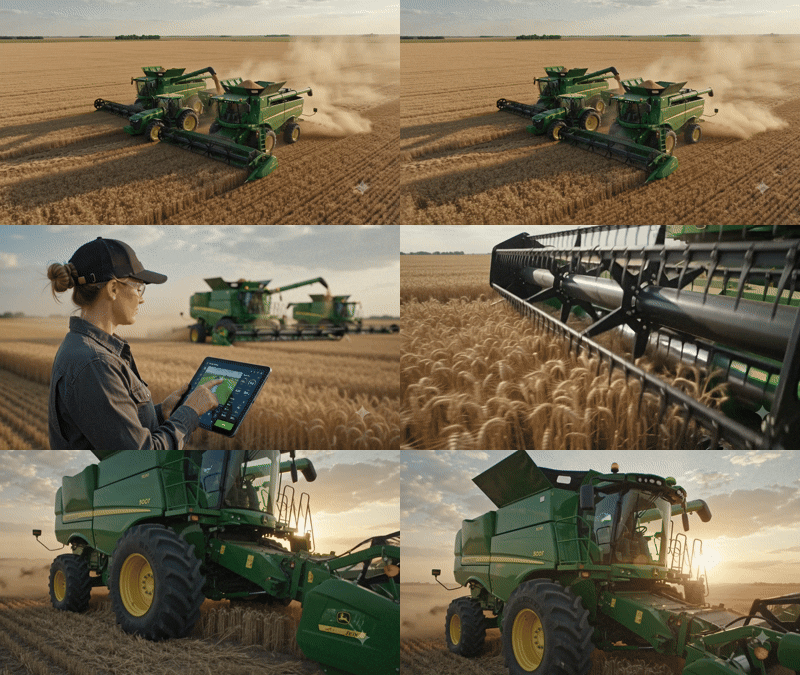
The global agricultural machinery sector is currently navigating an unprecedented transformation, characterized by the convergence of high-level artificial intelligence, autonomous robotics, and a radical shift toward carbon-neutral power systems. By 2026, the agricultural robotics market is projected to surpass a valuation of $20 billion, driven primarily by the rapid integration of artificial intelligence into field operations.[1] This evolution signifies more than a mere incremental improvement in mechanical efficiency; it represents a fundamental restructuring of the agricultural value chain. For entrepreneurs and established firms, the challenge of starting and growing a business in this domain requires a sophisticated understanding of capital-intensive manufacturing, complex regulatory compliance, and the shifting “trusted advisor” relationship with the modern farmer.[1, 2, 3]
The primary catalyst for this shift is a global labor shortage combined with an urgent requirement for sustainable, data-driven crop production.[1, 4] As manual labor becomes increasingly scarce and expensive, the adoption curve for autonomous machinery is accelerating, with farms across North America and Europe deploying drones, robotic weeders, and autonomous tractors to maintain operational viability.[1, 4] This analysis explores the multi-dimensional facets of the modern farming equipment industry, providing a roadmap for strategic business development through the lens of technological innovation, financial engineering, and regulatory mastery.
The Technological Paradigm: AI, Robotics, and Precision Agriculture
The definition of agricultural equipment has expanded from purely mechanical implements to include autonomous or semi-autonomous machines capable of executing tasks once reserved exclusively for human labor.[1] Modern machines are now equipped with advanced sensor arrays, computer vision, and real-time AI-driven data analytics that allow them to adapt to the highly dynamic environments of open-field farming.[1, 5] The transition to AI-driven automation is transforming practices globally, moving from broad-acre treatments to plant-level management where every individual seed and weed is treated as a unique data point.[1, 6]
Transformative Applications of Ag Robotics in 2026
The 2026 landscape is defined by specific robotic applications that have moved from experimental prototypes to commercial deployments. Autonomous seeders utilize GPS and AI to ensure optimal depth and spacing for every seed, adjusting patterns based on real-time soil analysis.[1] Robotic weeders leverage computer vision to distinguish between crops and weeds with surgical precision, applying either mechanical removal or micro-doses of herbicide that can reduce chemical usage by up to 90%.[1, 6]
| Technology Category | Core Functionalities | Estimated Yield Impact | Labor Reduction Potential | Sustainability Benefits |
|---|---|---|---|---|
| Autonomous Tractors | Tillage, Planting, Spraying | 10–15% Improvement | 40–60% | Up to 20% fuel and chemical savings [1] |
| AI-Powered Drones | Scouting, NDVI Mapping, Aerial Spraying | 5–10% Improvement | High (Monitoring tasks) | Reduced chemical runoff and early disease detection [5, 7] |
| Robotic Harvesters | Picking strawberries, apples, and tomatoes | High (Quality and consistency) | 70–90% (Process specific) | Reduced food waste through precision grading [5, 6] |
| Precision Seeders | Site-specific variable rate seeding | 15–20% Improvement | Moderate | 20% reduction in seed and fertilizer waste [7] |
| Connected Controllers | Automated moisture and nutrient sensing | 10–18% Improvement | High (Management) | Significant water consumption reduction [7] |
The rise of robotic harvesting is particularly significant because it addresses one of the most labor-intensive processes in the agricultural cycle.[5] Platforms like SWEEPER and FFRobotics are testing soft-touch end effectors and real-time vision systems that allow machines to pick delicate fruits with the same care as a human hand while simultaneously grading the produce for quality.[5] These systems are no longer just tools; they are integrated data platforms that provide yield estimations and health analytics to the farmer in real-time.[5]
Precision Agriculture and Digital Agronomy
The integration of artificial intelligence with the Internet of Things (IoT) has launched the era of digital agronomy. Currently, approximately 61% of North American farmers utilize digital agronomy tools to optimize their operations.[4] These systems combine satellite imagery, soil-monitoring sensors, and drone technology to create a comprehensive digital twin of the farm environment.[4, 8] This allows for the precise allocation of resources, maximizing yield while minimizing the environmental footprint. The Asia-Pacific market for precision fertilizers, for example, is expected to grow at a rate of 16% through 2025, reflecting a global drive toward input efficiency.[4]
Strategic Business Models for Industry Entrants
Aspiring entrepreneurs in the agricultural equipment sector must navigate a choice between three primary business models: Original Equipment Manufacturing (OEM), professional dealership and distribution, or the emerging software-as-a-service (SaaS) and technology-as-a-service (Agri-TaaS) models.[3, 4] Each model carries a distinct capital profile and risk-reward ratio.
Original Equipment Manufacturing (OEM)
The OEM model involves the design, assembly, and marketing of physical machinery. This segment ranges from large multinational corporations like John Deere and Kubota to specialized regional manufacturers focusing on specific niche implements.[3] The modern OEM is no longer just a mechanical engineer; they must be a software integrator.[7] In 2025, over 60% of new agricultural machinery is expected to feature autonomous or semi-autonomous capabilities, requiring OEMs to manage a complex supply chain of hydraulics, engines, and advanced electronics.[3, 7]
Successful OEMs coordinate closely with Tier-1 suppliers to ensure a smooth flow of components, but they also maintain deep relationships with their dealer networks.[3] While some manufacturers have experimented with “going direct” to large institutional buyers, the dominant global model remains the authorized dealer network due to the critical nature of local service and technical support.[2, 3]
The Professional Dealership Model
The dealership serves as the vital link between the manufacturer and the farmer. In agriculture, loyalty is built on “uptime”—the ability of a machine to perform during the narrow windows of planting and harvest.[2] When equipment breaks down, it is the local dealer who provides the technicians, parts, and expertise required to return the machine to the field.[2]
| Dealership Revenue Stream | Margin Potential | Business Impact | Key Success Factor |
|---|---|---|---|
| New Wholegoods Sales | High Volume / Moderate Margin | Drives market share and brand presence | Relationship-based selling and ROI demonstration [9, 10] |
| Used Equipment Sales | High Margin / Variable Volume | Appeals to price-sensitive buyers; handles trade-ins | Certified refurbishment and auction expertise [9, 10] |
| Service & Repair | High Margin / Recurring | Provides stable, predictable cash flow | Certified technicians and mobile repair capabilities [9, 10] |
| Parts Inventory | Moderate Margin / Consistent | High customer satisfaction and repeat business | Inventory management and supply chain logistics [9, 10] |
Unlike many retail businesses, agricultural dealerships are resilient during economic downturns because farmers still require parts and service to maintain productivity even when they are not purchasing new machines.[9] For a new business, the dealership model provides a clear roadmap for financial success, provided they can meet the high equity requirements and territory standards set by major manufacturers.[11, 12]
Agriculture Technology-as-a-Service (Agri-TaaS)
The Agri-TaaS model is an emerging disruptive force that addresses the high upfront costs associated with modern technology.[4] By offering advanced machinery on a subscription or per-acre basis, Agri-TaaS providers allow small and medium-sized farms to access the latest innovations without massive capital expenditure.[4, 7] The Agri-TaaS market is projected to exceed $3 billion by 2025, indicating a significant shift in how agricultural technology is consumed.[4] This model is particularly effective for specialized, seasonal equipment like robotic harvesters or autonomous sprayers, where the utilization rate might not justify outright ownership for an individual farm.[13]
Financial Architecture and Capitalization Strategies
The agricultural equipment industry is characterized by high barriers to entry, primarily due to the massive capital requirements for manufacturing facilities and inventory.[14, 15] A startup in this sector must possess a robust financial plan that accounts for long development cycles and seasonal sales patterns.[15]
Manufacturing Startup Costs
Launching a tractor manufacturing operation in 2025 is a massive financial undertaking. The total initial Capital Expenditure (CAPEX) for a Phase 1 manufacturing plant is estimated at over $285 million.[14] This investment covers everything from core plant equipment to R&D facilities and initial logistics fleets.
| CAPEX Category | Estimated Cost (USD) | Purpose and Timing |
|---|---|---|
| Manufacturing Plant Equipment | $15,000,000 | Essential for Phase 1 volume production; required upfront [14] |
| R&D and Prototyping Gear | $7,500,000 | Required to validate fuel efficiency and durability [14] |
| IT and Software Infrastructure | $2,200,000 | Perpetual licenses for ERP/CAD and design validation [14] |
| Logistics Fleet | $2,000,000 | Securing vehicles for initial product distribution [14] |
| Management Payroll (Year 1) | $1,140,000 | Salaries for 6 key full-time employees (FTEs) [14] |
| Runway Cash Reserve | $4,378,000 | Non-negotiable cash for inventory and OpEx through first year [14] |
| Lease Prepayment | 600,000–1,200,000 | 3-6 months upfront for factory and R&D facilities [14] |
For smaller manufacturing businesses focusing on specialized components or implements, the costs are lower but still significant, ranging between $550,000 and $1.35 million.[16] These costs are largely driven by factory remodeling, machinery installation, and the need for a high-quality control apparatus.[16]
Dealership Financial Requirements
Entering the dealership space with a mainline brand like John Deere requires massive liquid equity. For an Agricultural and Turf equipment dealership, the minimum equity requirement typically ranges from $35 million to $45 million.[12, 17] These requirements ensure the prospective buyer has sufficient resources to represent the brand, maintain a multi-million dollar parts inventory, and invest in the specialized tools and training required for modern machinery.[17, 18]
The Evolving Funding Landscape: Beyond Venture Capital
While venture capital has been a traditional driver of AgTech, the sector has seen a 70% drop in VC funding over the past three years.[19, 20] Investors are now more selective, prioritizing startups with proven business models and measurable impact over pure growth plays.[19] Consequently, modern AgTech founders must diversify their funding strategies.
- Federal and State Grants: Programs like Small Business Innovation Research (SBIR) and Small Business Technology Transfer (STTR) provide non-dilutive capital for R&D.[20] Rural Business Development Grants (RBDG) specifically support projects that deploy precision tools in underserved areas.[20]
- Corporate Venture Capital (CVC): Established giants like BASF and John Deere invest directly in startups through CVC arms, providing not just capital but also market access and regulatory expertise.[21, 22]
- Impact Investing and ESG Funds: Startups that can demonstrate clear metrics for carbon sequestration, water conservation, or soil health are highly attractive to impact investors.[21]
- Equipment Leasing: Startups can leverage equipment leasing to preserve cash and manage the long sales cycles inherent in agriculture.[15]
- Equity Crowdfunding: Platforms like AgFunder allow non-accredited investors to support agricultural innovation, providing a source of capital that also validates market demand.[20]
Regulatory Compliance and Functional Safety Standards
The transition to autonomous and semi-autonomous machinery has shifted the regulatory focus from basic mechanical safety to the complex realm of functional safety for electronic control systems.[23, 24] Compliance with international standards is now a prerequisite for market entry and a critical component of risk management.
ISO 25119: The Benchmark for Ag-Safety
ISO 25119 is the definitive standard regulating the development of safety-related parts of control systems (SRP/CS) for tractors and machinery used in agriculture and forestry.[23] It replaces the more generic IEC 61508 standard, offering an industry-specific implementation that addresses the unique hazards of farming environments.[23, 25]
The standard defines the Agricultural Performance Level (AgPL), which evaluates the ability of a component to perform safety-related functions in critical situations. There are five levels—a, b, c, d, and e—with “e” representing the highest performance requirements.[24]
| AgPL Level | Typical Applications | Safety Requirement Intensity |
|---|---|---|
| AgPL a | Monitoring sensors with low safety impact | Basic verification [24] |
| AgPL b | Integrated control systems (PTO, differential locks) | Standard industrial safety [24] |
| AgPL c | Semi-autonomous assistance systems | High-level risk analysis [24] |
| AgPL d | Autonomous steering and guidance (GPS-based) | Extensive V-model testing [24] |
| AgPL e | High-speed autonomous navigation and collision avoidance | Maximum redundancy and static analysis [23, 24] |
Software development under ISO 25119 utilizes four Software Requirement Levels (SRL)—B, 1, 2, and 3—where stringency increases with the number.[24] For high-level systems, the standard requires structural source code coverage (entry points, statement, and branch coverage) to ensure reliability.[25]
OSHA and Environmental Oversight
In the United States, agricultural operations are subject to OSHA standards (29 CFR 1928), which mandate safety features like Rollover Protective Structures (ROPS) and guarding for farm field equipment and PTO shafts.[26, 27] ROPS have been required on all tractors operated by employees since 1976, and employers must provide annual safety instructions on their use.[27]
Furthermore, the EPA regulates the environmental footprint of equipment businesses through statutes like the Clean Water Act and the Federal Insecticide, Fungicide, and Rodenticide Act (FIFRA).[28] Businesses involved in the manufacture or service of spraying equipment must ensure compliance with worker protection standards (WPS), which include requirements for enclosed cabs and air recirculation systems.[28]
Intellectual Property and Strategic Asset Management
In an industry where innovation is the primary driver of growth, a solid Intellectual Property (IP) strategy is essential. IP protection not only provides a competitive edge but also serves as the foundation for attracting investment and securing market share.[29, 30]
The Role of Patents in AgTech
Patents protect new inventions, granting inventors exclusive rights for 20 years. In agriculture, patents are used to protect everything from new machine designs to autonomous navigation algorithms and biotechnological innovations.[31, 32] Interestingly, the transition from Plant Breeders’ Rights (PBR) to utility patents for crops has set a precedent for the industry, emphasizing the need for robust legal protection of technological breakthroughs.[33, 34]
Beyond functional utility patents, design patents are increasingly important for protecting the unique appearance of IoT devices and machinery, which helps in branding and market recognition.[30, 31] For startups, a strong patent portfolio is often the key to a successful exit, as larger agriscience companies frequently acquire smaller players specifically for their intellectual capital.[35]
Data Sovereignty and Trade Secrets
The massive volume of data collected by modern machinery has created a new class of intangible assets: field data.[36] While land and equipment are tangible assets, the business processes and historical performance data are proprietary IP that the farm owns.[36] Successful AgTech firms must develop clear data ownership and usage policies to build trust with their customers.
| IP Type | Protection Scope in Agriculture | Duration / Maintenance |
|---|---|---|
| Utility Patent | New machinery, processes, software algorithms | 20 years from filing; non-renewable [34, 37] |
| Trademark | Farm names, equipment brands, logos, slogans | Indefinite, as long as in use and maintained [31, 32] |
| Trade Secret | Formulas for fertilizers, proprietary datasets, pricing strategies | Indefinite, provided secrecy is maintained [31, 37] |
| Copyright | Farm management software, educational manuals, research papers | 70 years after author’s death [31, 37] |
Licensing agreements have become a common tool for monetizing IP on the farm. A machinery manufacturer may license a patented sensor design to other entities in exchange for royalties, creating a consistent revenue stream without the need for additional manufacturing.[30, 37]
Marketing and Sales Strategies for the Modern Farmer
Growing a business in agricultural equipment requires a marketing approach that balances high-tech digital outreach with the traditional “trusted advisor” relationship.[38, 39] Farmers are inherently risk-averse, and their purchase decisions are driven by measurable ROI and localized performance data.[38]
The Power of the Demonstration Plot
Research consistently shows that well-executed demonstration plots are the most effective way to influence purchasing decisions.[38] By establishing a site that shows the real-world performance of a new tractor or robotic weeder in local soil conditions, a company can build trust that spans multiple seasons.[38] These sites allow farmers to see “social evidence” of the product’s value before committing to a large capital purchase.[38, 39]
Digital Marketing and Personalization in 2025
In 2025, digital marketing has become a powerful growth driver, with social media and AI-driven content expanding brand reach by an estimated 40–65%.[40] Agribusinesses are now utilizing a sophisticated mix of SEO, social media, and mobile-first campaigns to reach their target audience.
- Agri-Specific SEO: Focus on high-intent agricultural keywords like “drip irrigation suppliers” or “drought-resistant seeds” to ensure farmers find solutions during their research phase.[39]
- Mobile-First Content: Since many farmers operate in areas with low bandwidth, marketing materials must be optimized for mobile devices and delivered through accessible channels like WhatsApp and SMS.[39, 40]
- Video Marketing: Step-by-step tutorials, live demonstrations, and customer testimonials are crucial for building authority and driving adoption of complex new technologies.[39, 41]
- AI-Driven Personalization: AI tools now allow for the personalization of ads and pricing strategies based on a farmer’s crop cycle and historical purchase behavior.[40]
| Marketing Approach | Estimated Productivity Boost | Engagement Level | Key Channels |
|---|---|---|---|
| Free Trials/Demos | 15–22% | Medium | Field days, local events [41] |
| Referral Programs | 7–14% | High | Existing customer networks [41] |
| Innovation Programs | 12–28% | Medium | Accelerators, partnerships [41] |
| Data Analytics | 10–20% | Medium | Targeted email/PPC [41] |
The “Trusted Advisor” and Hybrid Sales Models
Successful sales teams in agriculture operate through hybrid models that combine direct engagement with retail networks and cooperatives.[38] Field representatives must prioritize understanding a farmer’s specific challenges—such as local pest pressure or water scarcity—and position their products as yield insurance rather than just mechanical tools.[38] This consultative approach is essential for high-loyalty categories like seed and large machinery.[38]
Future Horizons: Electrification and Hydrogen Power
The inevitable move toward sustainability is reshaping the industrial environment, with electrification emerging as a central pillar of the agricultural energy transition.[42] Electrified Agricultural Machinery (EAM) offers the potential to enhance operational efficiency, reduce greenhouse gas emissions, and improve adaptability across diverse environments.[43, 44]
Advances in Electrification (EAM)
EAM utilizes distributed electric drive technologies that allow for precise motor control and stronger robustness compared to traditional diesel systems.[44] These systems are essential for the development of truly autonomous machinery, as they are inherently easier to control through digital interfaces.[44] While current battery technology faces bottlenecks in energy density for high-power tasks, many manufacturers are adopting hybrid power systems to address endurance issues during heavy tillage.[43]
The Hydrogen Economy in Agriculture
Hydrogen-powered tractors are expected to play a critical role in the decarbonization of heavy machinery. The global hydrogen tractor market, valued at $1.57 billion in 2025, is projected to grow significantly as fuel cell technology advances.[45] Prototypes like the Agco Fendt Helios are already in operation, utilizing compressed hydrogen tanks to deliver high horsepower with zero emissions.[46, 47]
Key players in the hydrogen space include John Deere, Kubota, CNH Industrial, and Fendt, all of whom are testing prototypes and developing the necessary infrastructure for rural hydrogen refueling.[45, 48] These machines provide the high volume-to-energy properties required for heavy-duty farming while operating with the quiet efficiency of electric power.[45, 48]
Strategic Ecosystems: Partnerships and Cooperatives
No AgTech company can scale in isolation. Strategic partnerships between startups, large corporations, and agricultural cooperatives are essential for driving innovation and achieving global scale.[22]
Corporate-Startup Synergy
Large corporations provide the financial resources and distribution channels that startups lack, while startups provide the cutting-edge innovations that keep large firms competitive.[22] A notable example is the partnership between John Deere and See & Spray Technology, which resulted in the development of precision sprayers that use machine learning to detect weeds in real-time.[22] Similarly, partnerships between chemical giants like BASF and gene-editing startups like Inari are driving the next generation of resilient crops.[22]
The Role of Cooperatives
Agricultural cooperatives play a vital role in the adoption of modern equipment, particularly for smallholder farmers. Cooperatives facilitate access to high-cost technology through shared ownership or custom hiring services.[3, 49] Furthermore, they provide the educational and training support necessary for farmers to transition to digital agriculture.[49] Partnerships between cooperatives and development actors are critical for meeting sustainability challenges and building a resilient food system.[49, 50]
Conclusion: Synthesizing the Roadmap for Success
Launching and growing a business in the modern farming equipment sector requires a multifaceted strategy that integrates technological innovation with financial and regulatory mastery. The industry in 2026 is no longer about simple mechanical implements; it is about intelligent, autonomous systems that act as data-driven partners to the farmer.
To succeed, businesses must:
- Prioritize Uptime and Service: The dealership model remains the gold standard for long-term customer loyalty because it ensures operational reliability through local expertise.[2]
- Master Functional Safety: Compliance with ISO 25119 is not just a regulatory hurdle but a critical component of brand trust and product quality in an autonomous age.[23, 24]
- Secure and Monetize IP: A robust patent and data strategy is the bedrock of enterprise value, providing a defensible moat and a clear path to acquisition or scale.[29, 35]
- Adopt Sustainable Power: Whether through electrification or hydrogen, the transition to carbon-neutral power systems is a defining trend that offers significant market opportunities.[7, 45]
As the global population rises and environmental pressures mount, the agricultural equipment industry will remain the vital backbone of food security. For the entrepreneur who can navigate the high capital requirements and complex technical landscape, the potential for impact—and profit—is vast. The future of farming is not just mechanical; it is intelligent, sustainable, and connected.
——————————————————————————–
- Ag Robotics & AI Robotics In Agriculture: 2025 Trends – Farmonaut, https://farmonaut.com/precision-farming/ag-robotics-ai-robotics-in-agriculture-2025-trends
- The Perils of Going Direct: Why Farmers and Manufacturers Need …, https://www.farm-equipment.com/blogs/6-opinions-columns/post/24783-the-perils-of-going-direct-why-farmers-and-manufacturers-need-dealerships-more-than-ever
- How the Agricultural Machinery Industry Works – Umbrex, https://umbrex.com/resources/how-industries-work/agriculture-and-food/how-the-agricultural-machinery-equipment-industry-works/
- The Future of Farming: Top AgTech Trends and Innovations to Watch in 2025, https://agtechbreakthrough.com/agtech-2025-key-trends-innovations-and-challenges-shaping-the-future/
- Agri-Robotics 2025: Autonomous Machines Transforming Modern Agriculture, https://ijoear.com/agri-robotics-2025
- Top 5 Agricultural Technologies 2025: Shaping the Future… – Robovision’s AI, https://robovision.ai/blog/top-5-agtech-trends-in-2025
- Agricultural Machinery Industry Trends 2025: Top Innovations – Farmonaut, https://farmonaut.com/blogs/agricultural-machinery-industry-trends-2025-top-innovations
- Advancing Agriculture: Precision Farming Market Growth, Trends & Future Outlook | AgriTechTomorrow, https://www.agritechtomorrow.com/news/2025/12/18/advancing-agriculture-precision-farming-market-growth-trends-future-outlook/17199/
- A Comprehensive Guide to Selling an Agricultural Machinery …, https://offdeal.io/blog/selling-agricultural-machinery-dealership-2025
- Dealers Report Strong Revenue, Gross Margins & Profits – Farm Equipment, https://www.farm-equipment.com/articles/20049-dealers-report-strong-revenue-gross-margins-and-profits
- The Ultimate Guide to Launching Your Own Dealership Business, https://www.niir.org/blog/dealership-business-ideas/
- Dealer Acquisition DA-36782 – CCMS – John Deere, https://ccms.deere.com/prweb/PRServletDAAuth/jqbqiGZuiB8ba1i_CZ5O7Q%28%28*/!STANDARD?pzuiactionzzz=CXtpbn03RmJqVnZXSFVlRFRiRXJTeFAzMXppdnh6SUFnRjIvWnFFcTlLZTQwWFQ1Z3FKTkV5WXE5WElDZnVtR3J5dGIxbzdLTktTTldYTmIranB3WUVTeHZLQzdUN242WUgvRXZ2U3djdlBkVGpFaGVrUmh1aUJqU3NxQklINDU0Y3hLREtjTUJyMmRjalVHTGh2UVUrQzdBWnY2cTVTM2x6QVpFbmxHSVZFRXFxYU5pMGkvaWhuVnJFbzV0MjN6SzdSTWVyUWhuNGY2OHhCS21ZUWRFak95cEowb3VLYW8zTG4xVXZZWVJRWGpTbUZoV3lEZk5lcWxvaU9FVkhIbE1uWDI1ZFFZOVJtNnJKeFhGS0FMb216MWVrTUNyVVgzZ2YxZ2wrM2lCcHA1NXVoTEZ5UW91SHhwdktZb3R3V29adGI5OEIyWUVob2hBSldocDQyNStmSTZQanNxUE1FZTY4eHkzYzlwaVpyVjRma3NjLytoOUoydkw3eHNrYTNnT284czJQNkpramhuQjkyVE5lWTBCNnoyY3o0dWo0QmJlb1E5UlgxVTZ5eFNZSWhOd1ovTTl1SUhDRnFJZlZsMUM2L1YzQllrd0ZQVHJrWnd3dGM4ajh0V20wWllrZzd6VmVkVXUwdjNVTFBpN3krT3V6M21pUm9rSDZIU2dsK2ZYWGtEQjFGeDJFUU5PcC90WFVRTFdYbmNSNUdaL09VWGZURFFqWktXMGtxUTB0S1NRUWJXVU02UVJVZHBzblZyL0ZrM1o%3D*
- Acquiring Farm Machinery Services | Ag Decision Maker, https://www.extension.iastate.edu/agdm/crops/html/a3-21.html
- Tractor Manufacturing Startup Costs: $285M CAPEX & $44M Cash; – Financial Models Lab, https://financialmodelslab.com/blogs/startup-costs/tractor-manufacturing
- 3 challenges agtech startups can overcome with equipment leasing – AgFunderNews, https://agfundernews.com/3-challenges-agtech-startups-can-overcome-with-equipment-leasing
- How Much Does it Cost to Start a Manufacturing Company? – Upmetrics, https://upmetrics.co/startup-costs/manufacturing
- Owning a Dealership | John Deere US, https://www.deere.com/en/our-company/contact-us/become-a-dealer/
- Dealer Program – Kubota Engine America, https://www.kubotaengine.com/parts-service/service-support/dealer-program/
- The Global Guide for Agriculture Startups: Top 15 VCs & Essential Resources – Visible.vc, https://visible.vc/blog/agriculture-startup-vcs/
- Seed Funding for AgriTech Startups: Grants, Investors & Crowdfunding, https://qubit.capital/blog/seed-funding-options-agritech-startups
- Agriculture Startup Funding & Agritech Funding 2025 – Farmonaut, https://farmonaut.com/blogs/agriculture-startup-funding-agritech-funding-2025
- The Role of Corporate Partnerships in Ag-Tech Innovation – AG Foundry, https://www.agfoundry.co.uk/post/the-role-of-corporate-partnerships-in-ag-tech-innovation
- Functional Safety Assessments according to ISO 25119 – TÜV SÜD, https://www.tuvsud.com/en-us/industries/mobility-and-automotive/automotive-and-oem/functional-safety-assessment-iso-25119
- ISO 25119 Agricultural Machinery | Software Development for …, https://promwad.com/news/iso-25119-functional-safety-in-agricultural
- ISO 25119: Software Development for Agricultural Tractors and Machinery – Verifysoft Technology, https://www.verifysoft.com/en_ISO_25119_Agriculture_Forestry_Safety.html
- Agricultural Operations – Standards | Occupational Safety and Health Administration – OSHA, https://www.osha.gov/agricultural-operations/standards
- A Summary of Laws and Regulations Related to Agricultural Safety and Machinery, https://extension.psu.edu/a-summary-of-laws-and-regulations-related-to-agricultural-safety-and-machinery
- Laws and Regulations that Apply to Your Agricultural Operation by Statute | US EPA, https://www.epa.gov/agriculture/laws-and-regulations-apply-your-agricultural-operation-statute
- How a Solid IP Strategy Remains the Bedrock of AgTech Innovation …, https://www.globalagtechinitiative.com/digital-farming/how-a-solid-ip-strategy-remains-the-bedrock-of-agtech-innovation/
- Patent Strategies for Communication Innovations in Agriculture and Food Technology, https://patentpc.com/blog/patent-strategies-for-communication-innovations-in-agriculture-and-food-technology
- Exploring the Different Types of Intellectual Property Rights – Agriculture Institute, https://agriculture.institute/agribusiness-mgt-policies/different-types-of-intellectual-property-rights/
- From Trademarks to Tractors: Why More Farmers Are Protecting Their Ag Brands and Innovations in 2026 – Rincker Law, PLLC, https://rinckerlaw.com/from-trademarks-to-tractors-why-more-farmers-are-protecting-their-ag-brands-and-innovations-in-2026/
- Patenting Agriculture – Issues in Science and Technology, https://issues.org/barton/
- Intellectual Property Rights – ASTA – – The American Seed Trade Association, https://www.betterseed.org/the-issues/intellectual-property-rights/
- AgTech – Fertile ground for innovation – FPA Patent Attorneys, https://www.fpapatents.com/news-insights/insights/agtech-fertile-ground-for-innovation/
- Your farm’s intellectual property may be worth more than you think, https://www.farmprogress.com/farm-business/your-farm-is-worth-more-than-its-parts-if-you-protect-your-intellectual-property
- How to “Harvest” Farm Intellectual Property with Licensing, https://licensingconsultinggroup.com/how-to-harvest-farm-intellectual-property-with-licensing/
- Agriculture Sales Strategies: How Field Teams Can Boost Reach and Revenue – Leadbeam, https://www.leadbeam.ai/blog/agriculture-sales-strategies
- 10 Best Digital Marketing Strategies For The Agriculture Industry, https://yelomarketing.com/digital-marketing-strategies-for-the-agriculture-industry/
- Top Agritech Marketing Strategies for Growing Your Farm Tech Business in 2025, https://agrinextcon.com/top-agritech-marketing-strategies-for-growing-your-farm-tech-business-in-2025/
- Agritech Marketing: 10 Top Strategies For Success – Farmonaut, https://farmonaut.com/blogs/agritech-marketing-10-top-strategies-for-success
- Industrial Electrification Market Trends 2025-2034 – Power Gen Advancement, https://www.powergenadvancement.com/articles/industrial-electrification-market-trends-2025-2034/
- (PDF) Advances and Future Trends in Electrified Agricultural Machinery for Sustainable Agriculture – ResearchGate, https://www.researchgate.net/publication/397623507_Advances_and_Future_Trends_in_Electrified_Agricultural_Machinery_for_Sustainable_Agriculture
- Advances and Future Trends in Electrified Agricultural Machinery for Sustainable Agriculture, https://www.mdpi.com/2077-0472/15/22/2367
- Hydrogen Powered Tractor Market Size, Trends, Analysis, Share – Allied Market Research, https://www.alliedmarketresearch.com/hydrogen-powered-tractor-market-A07808
- Agco tests hydrogen Fendt tractor without harmful emissions – Farm Progress, https://www.farmprogress.com/farming-equipment/concept-tractor-turns-hydrogen-into-horsepower
- Press release Fendt shows first hydrogen tractor at German Hydrogen Summit, https://www.fendt.com/php/create_pdf/pdf2/25095_web_pt-BR_2025-11-20_10-42-43.pdf
- The Future of Agriculture: Top Innovations From CES 2025 – Successful Farming, https://www.agriculture.com/top-agriculture-innovations-at-ces-2025-8771325
- A Framework for Quantifying the Strength of Partnerships between Agricultural Cooperatives and Development Actors: A Case Study in Saudi Arabia – MDPI, https://www.mdpi.com/1660-4601/20/1/364
- Analysis of partnerships between agricultural cooperatives and development actors: A national survey in Saudi Arabia – PMC – NIH, https://pmc.ncbi.nlm.nih.gov/articles/PMC9231716/


Leave a comment