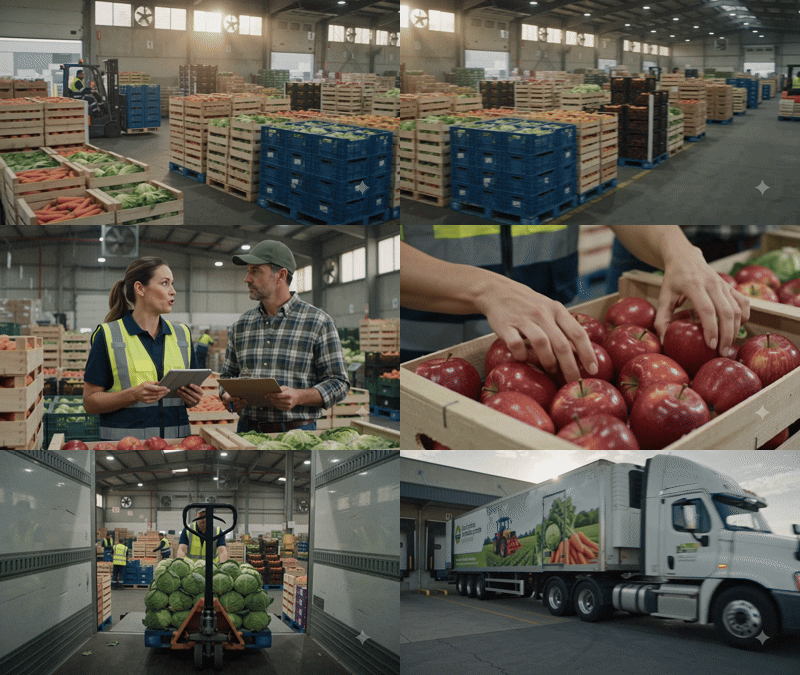
The agricultural wholesale distribution industry serves as the fundamental bridge between primary production and terminal consumption, operating within a multi-trillion-dollar global food system that is currently experiencing a historic convergence of technological disruption, regulatory tightening, and macroeconomic volatility. As the global population is projected to reach approximately 8.8 billion by the year 2034, the structural demands placed upon distributors to ensure food security while maintaining profitability have reached an unprecedented level of complexity.[1, 2] Entering and growing a business in this sector in 2026 requires more than traditional brokerage; it necessitates a sophisticated integration of cold chain mastery, data-driven inventory management, and a nuanced understanding of federal and state legal frameworks such as the Perishable Agricultural Commodities Act (PACA) and the Food Safety Modernization Act (FSMA).[3, 4, 5]
The Macroeconomic Landscape and Industry Outlook for 2026
The economic environment for agricultural distribution is characterized by a “margin squeeze” where rising input costs for producers—including fertilizers, seeds, and equipment—fluctuate alongside volatile commodity prices, directly impacting the supply-side reliability for wholesalers.[6] For the distributor, these pressures are compounded by broader macroeconomic trends such as persistent inflation, fluctuating interest rates, and geopolitical tensions that disrupt established trade routes.[7] In 2025, the industry faces a shift in consumer spending habits where discretionary income is redirected, forcing wholesalers to optimize their portfolios toward high-demand staples or differentiated niche products.[7]
Global Demand Shifts and Consumption Patterns
Long-term projections for the decade ending in 2034 indicate a deceleration in the growth of global agricultural consumption, largely attributed to slowing population growth and saturated demand in advanced economies.[2] However, this trend is counterbalanced by significant opportunities in low- and middle-income countries, where urbanization and rising per capita incomes are driving a transition toward higher consumption of livestock, fish, and horticultural products.[2] For a growing distribution business, this suggests that scaling operations must involve a dual focus on domestic efficiency and the ability to pivot toward international markets where demand remains robust.
| Commodity Category | Projected Consumption Trend (2025-2034) | Principal Growth Drivers |
|---|---|---|
| Livestock and Fish | High Growth in Emerging Markets | Rising incomes; dietary shifts toward animal proteins [2] |
| Fresh Produce (Fruits/Veg) | Moderate Steady Growth | Health-conscious consumer trends; year-round demand [1, 2] |
| Staple Grains | Decelerating Growth | Saturated demand in developed nations; shifts in biofuel policy [2, 6] |
| Biofuel Feedstocks | High Uncertainty | EV adoption rates; Renewable Fuel Standard (RFS) debates [6] |
The ambiguity surrounding biofuel policies, particularly concerning ethanol blending and the long-term impact of electric vehicle (EV) adoption on liquid fuel demand, introduces a unique risk layer for distributors handling corn and soybeans.[6] Wholesalers must remain vigilant regarding the Renewable Fuel Standard (RFS) and federal support programs, as these regulations fundamentally alter the planting decisions of farmers and the subsequent availability of raw commodities.[6]
Foundational Legal Requirements and Regulatory Frameworks
A successful agricultural wholesale operation is built upon a foundation of rigorous compliance. In the United States, the primary regulatory mechanism for the produce trade is the Perishable Agricultural Commodities Act (PACA), which was established to promote fair trade practices and ensure that sellers are paid for the goods they deliver.[8]
Federal Licensing under PACA
The law mandates that any entity buying or selling more than 2,000 pounds of fresh or frozen fruits and vegetables in a single day must obtain a PACA license.[3] This requirement extends beyond traditional wholesalers to include processors, truckers, and grocery wholesalers.[3] For commission merchants and brokers, the licensing requirement applies from the very first transaction.[3] The license acts as a “driver’s license” for the industry, signaling to the marketplace that the firm is a legitimate entity capable of honoring contract terms and maintaining trust assets.[3]
| Regulatory Element | Detail | Financial/Legal Implication |
|---|---|---|
| License Threshold | >2,000 lbs produce per day | Mandatory for legal operation [3] |
| Base Annual Fee | $995 (as of 2010) | Standard cost of entry; capped at $8,000 aggregate [3] |
| Branch Fee | $600 per additional facility | Scalability cost for multi-site operations [3] |
| Non-compliance Penalty | Up to $1,200 per violation | Daily fines of $350 can accrue indefinitely [3] |
Beyond the federal PACA requirements, distributors must navigate the Food Safety Modernization Act (FSMA), which mandates preventive controls for human food.[4, 5] This includes rigorous training for employees, sanitation of facilities, and the maintenance of a comprehensive food safety plan.[5, 9] FSMA compliance is increasingly a prerequisite for securing contracts with major retail and foodservice buyers, who often require third-party audits to verify that the distributor is managing risks related to microbial contamination and intentional adulteration.[9, 10]
State-Level Compliance and Food Handling Licenses
The regulatory environment varies significantly by state, necessitating a localized approach to licensing and inspections. States like Pennsylvania, Minnesota, and Massachusetts provide representative models of the complexity involved in starting a wholesale food business.
In Minnesota, any wholesale food manufacturer or warehouse operator must obtain a Food Handler License from the Minnesota Department of Agriculture (MDA).[11] The process involves a pre-licensing applicant form and a technical review of business plans, followed by a final licensing inspection that verifies compliance with building, fire, plumbing, and electrical codes.[11] Pennsylvania requires food registration under Act 106 of 2010, which incorporates all federal regulations including Good Manufacturing Practices (GMPs) specified in 21 CFR Part 117.[4] These GMPs address everything from personnel health and practices to equipment maintenance and sanitation controls.[4]
Massachusetts requires wholesale food businesses to comply with 105 CMR 500.000, governing Good Manufacturing Practices for Food.[12] The state emphasizes that all packaged foods must be labeled in accordance with both state and federal regulations, specifically 105 CMR 500.006.[12] For new entrants, these state requirements often necessitate a 60-day lead time for plan reviews and inspections prior to the commencement of operations.[4]
Capital Planning and Initial Financial Architecture
Launching an agricultural distribution enterprise requires substantial upfront capital, primarily driven by the need for specialized logistics and infrastructure. Initial startup costs typically range from $300,000 to $400,000 for a modest operation, with a significant portion allocated to refrigerated assets and warehouse setup.[13]
One-Time Capital Expenditure (CAPEX) Analysis
The largest single expenditure for a new distributor is often the acquisition of a refrigerated delivery fleet. A brand-new, made-to-order refrigerated truck can cost between $75,000 and $150,000.[14, 15] While used trucks can be acquired for $30,000 to $80,000, they often carry higher maintenance risks and potential repair costs that can delay a launch.[15]
| CAPEX Category | Estimated Investment | Strategic Criticality |
|---|---|---|
| Refrigerated Fleet | $85,000 – $150,000 | Essential for maintaining cold chain integrity [13, 15] |
| Warehouse Infrastructure | $35,000 – $60,000 | Includes racking, security deposits, and pallets [13, 16] |
| Initial Inventory Stock | $20,000 – $50,000 | “Lifeblood” for initial revenue generation [13] |
| IT and Logistics Software | $10,000 – $25,000 | Crucial for inventory tracking and scheduling [13, 16] |
| Permits and Licensing | $1,000 – $28,000 | Varies by location and complexity of operation [14, 15] |
Under-investing in initial infrastructure can lead to systemic failures as the business scales. For example, if initial server and software capacity cannot handle peak loads as order volumes exceed 100 per day, the entire delivery scheduling system can fail.[13] Furthermore, the timing of a warehouse lease is critical; fixed rent costs often begin the moment a lease is signed, regardless of whether the fleet has arrived or the first order has shipped.[13]
Revenue Management and Profitability Frameworks
Profitability in wholesale distribution is predicated on volume and the meticulous management of margins. The industry standard for distributor margins is typically between 20% and 30%, which must cover all operational overheads including energy, labor, and transport fuel.[17]
Distributors must utilize sophisticated pricing models to ensure sustainability. Absorption pricing is a common method:
Wholesale Price=Production Cost+(Number of Units ProducedTotal Overheads+Admin Expenses)+Desired Profit Margin
Alternatively, many wholesalers set their price by dividing the average cost of goods manufactured (ACGM) by the remainder of the profit margin percentage:
Wholesale Price=1−Profit Margin %ACGM
In this model, if a product costs $50 to acquire and the desired margin is 40%, the wholesale price would be set at $83.33.[18] This ensure that the price covers acquisition, customer acquisition costs (CAC), and overhead while delivering the target return.
Infrastructure and the Mastery of Cold Chain Logistics
In the agricultural sector, freshness is the primary measure of value. The cold chain—a series of temperature-controlled storage and transport stages—is the most critical component of the distribution infrastructure.[19, 20, 21] Any breach in this chain can result in quality degradation, nutrient loss, and the proliferation of foodborne pathogens.[19, 21]
Cold Storage Facility Construction and Operation
Constructing a temperature-controlled warehouse in 2025 is a high-cost endeavor, with construction costs per square foot ranging from $130 to $350—nearly three times the cost of a standard dry warehouse.[22] These costs are driven by advanced refrigeration systems, specialized insulation (such as polyurethane foam and vapor barriers), and the engineering complexity of maintaining multiple temperature zones.[22]
Energy consumption is the dominant operating cost for these facilities, often accounting for 60% to 70% of total facility expenses.[23] For a 100,000-square-foot facility, annual energy costs can exceed $400,000.[23] Efficiency improvements, such as utilizing floating head pressure control or upgrading to high-efficiency evaporator fan motors, can lead to significant annual savings.[24]
| Storage Type | Temperature Range | Ideal Commodities |
|---|---|---|
| Chilled Storage | 0°C to 10°C | Vegetables, dairy, certain fruits [25] |
| Frozen Storage | Below 0°C (often -18°C) | Meats, seafood, frozen produce [25, 26] |
| Deep Frozen | -29°C | Long-term preservation of specific proteins [26] |
| Controlled Atmosphere | Combined Temp/Gas | Apples, pears (extends life by months) [25] |
Advanced Refrigeration Systems and Long-Term TCO
When selecting refrigeration technology, a “low-bid” approach often leads to disastrous long-term financial outcomes. The initial capital cost of a system typically represents only 15% to 20% of its total lifetime expenditure (TCO), with the remaining 80% to 85% tied to energy, maintenance, and refrigerant management.[23]
Industrial ammonia systems, while more expensive upfront than HFC (hydrofluorocarbon) systems, offer a projected 25-year cost that can be millions of dollars lower due to higher energy efficiency and the stability of ammonia prices.[23] Furthermore, the EPA’s phase-down of HFC production under the AIM Act is driving HFC prices up significantly, turning routine maintenance of older systems into a major financial liability.[23]
| Cost Category (25-year TCO) | Standard HFC System | Industrial Ammonia System | Delta |
|---|---|---|---|
| Initial Investment | $3.8 Million | $4.4 Million | +$600,000 |
| Energy Consumption | $14.5 Million | $11.2 Million | -$3.3 Million |
| Maintenance Costs | $3.2 Million | $2.1 Million | -$1.1 Million |
| Refrigerant Costs | $2.8 Million | $0.45 Million | -$2.35 Million |
| Total 25-Year Cost | $26.2 Million | $19.25 Million | -$6.95 Million |
Sourcing and Supply Chain Management Strategies
Growing a distribution business requires building a resilient and transparent supply chain. This involves shifting from transactional buying to strategic partnerships with farmers, cooperatives, and food brokers.[27, 28]
Vetting and Audit Processes for Supplier Integrity
To access high-value markets, distributors must often require their suppliers to undergo third-party food safety audits.[10, 29] The USDA Good Agricultural Practices (GAP) and Good Handling Practices (GHP) audits are standard benchmarks.[10, 30] These audits verify that produce is grown, harvested, and packed in a manner that minimizes microbial risks.[10]
A comprehensive supplier audit checklist should include:
- Documentation Review: Verification of food safety manuals, traceability programs, and mock recall results.[10, 31]
- On-Site Observations: Inspection of worker hygiene, toilet and handwashing facilities, and the quality of irrigation water.[30]
- Soil and Manure Management: Ensuring that soil amendments are handled in a way that prevents contamination of the edible portions of crops.[30]
- Packing and Storage: Assessing the sanitation of packing facilities and the adequacy of on-farm cold storage.[4, 30]
Distributors should prioritize farmers who demonstrate “good communication” and a willingness to replace product in the event of a quality issue.[28] Previous commercial production experience is also a critical factor, as it indicates a grower’s understanding of packaging and grading standards required in a warehouse environment.[28]
Leveraging Agricultural Cooperatives
Agricultural cooperatives offer a mechanism for wholesalers to source large volumes while supporting local farming communities.[27] Cooperatives allow individual growers to pool resources for processing, packaging, and marketing, providing a more consistent and graded supply for the wholesaler.[27, 32] In sourcing from cooperatives, wholesalers should seek “risk-based due diligence,” where the cooperative demonstrates how it manages social and environmental risks in its operations.[32]
Technological Integration and the Digital Supply Chain
The transition to digital operations is no longer optional in 2026. Modern agricultural distribution is increasingly managed via cloud-based Enterprise Resource Planning (ERP) systems that offer real-time visibility from the field to the final delivery.[33, 34]
ERP Selection and Implementation
An effective agricultural ERP system should integrate accounting, agronomy, inventory tracking, and logistics.[34] For large-scale operations with complex logistics, SAP S/4HANA provides end-to-end visibility for supply chains and production.[34] For food processors and agri-exporters, Oracle NetSuite offers a robust platform to centralize financials and traceability across multiple regions.[33, 34]
| Software Platform | Best For | Standout Feature |
|---|---|---|
| SAP Intelligent Ag | Global Scalability | AI-powered supply chain optimization [35] |
| FarmERP | Diverse Crop Management | Detailed farm-to-market traceability [35] |
| AgriWebb | Livestock and Crops | Dual inventory and IoT sensor support [36] |
| Priority ERP | Supply Chain Tracking | High visibility into the movement of goods [35] |
| Agvance | Agribusiness Retailers | Connects accounting with agronomy and energy [34] |
The Role of AI and IoT in Quality Assurance
Innovative technologies such as IoT-enabled sensors and satellite monitoring are revolutionizing inventory management. IoT devices can automatically update input/output quantities as they occur, minimizing manual data entry errors.[36] Satellite-based monitoring, pioneered by firms like Farmonaut, provides real-time imagery to track crop health and resource deployment, allowing wholesalers to align their inventory planning with actual field conditions.[36]
AI is increasingly used in “predictive logistics” to reduce spoilage. By analyzing ordering patterns across an entire customer base, AI can alert a distributor sales representative (DSR) if a customer’s order quantities drop significantly, signaling a potential retention issue.[37] In the warehouse, predictive analysis can reduce energy bills by up to 30% by optimizing refrigeration cycles based on load and ambient conditions.[38]
Sales, Marketing, and Customer Acquisition Strategies
Growing a distribution business requires a sophisticated B2B sales approach that moves beyond price to focus on logic and value propositions.[37, 39]
The DSR as a Trusted Advisor
Successful distributor sales representatives (DSRs) prioritize understanding the specific crop planning and timing requirements of their clients.[40] This consultative approach positions the rep as a trusted advisor who helps the client improve their own profitability through better ingredient selection and supply reliability.[40]
Key sales strategies include:
- Demonstrating Measurable Value: Utilizing field demonstration programs or sample drop-offs to prove the quality and resilience of a product.[40, 41]
- Proactive Solution Provision: Contacting clients with “money-saving opportunities” or “business-growing insights” rather than just taking orders.[37]
- Pricing in Context: Giving pricing that reflects market shifts. If a distributor’s price gets too far out of line with market trends, they risk losing the customer’s trust.[37]
Digital Marketing and Brand Positioning
In the B2B space, content marketing is a powerful tool for establishing thought leadership. White papers on industry trends, recipe guides featuring specific ingredients, or webinars on new processing technologies can attract forward-thinking buyers.[39] A strong presence on LinkedIn and a well-designed website that highlights the farm story and production philosophy can differentiate a wholesaler from traditional, faceless commodity brokers.[39, 41, 42]
Expansion through Value-Added Services and Exporting
To overcome the thin margins of bulk commodity distribution, many wholesalers are expanding into value-added services and international markets.
The Economics of Value-Added Processing
Value-added agriculture involves changing a raw product into something new through processing, packaging, or cooling.[43] Examples include processing raw peppers into hot sauces, bagging salad mixes, or opening a retail butcher shop to sell specific cuts of meat.[43, 44] The benefit is the potential to capture a greater portion of the consumer’s dollar—for example, strawberries sold as jelly often yield higher returns than strawberries sold to a generic processor.[45]
However, these ventures are only profitable if the premium price received exceeds the significant costs of packaging, transportation, and additional labor.[44] Case studies have shown that on-farm value-adding enterprises often struggle to achieve a sufficient economy of scale, sometimes resulting in operational costs exceeding the added income for several years.[46]
Entering International Export Markets
Exporting is a common growth strategy for agricultural businesses looking to manage domestic surpluses or tap into high-growth regions.[47] The USDA Foreign Agricultural Service (FAS) provides critical resources for this expansion, including the Market Access Program (MAP), which shares the costs of overseas marketing and promotional activities.[48, 49]
Navigating international trade requires a deep understanding of Food and Agricultural Import Regulations and Standards (FAIRS) for target countries.[49, 50] Wholesalers must be prepared to manage:
- Phytosanitary Certification: Attesting that products are free from pests and diseases, often verified by USDA APHIS.[50]
- Maximum Residue Limits (MRLs): Complying with pesticide and veterinary drug standards that vary widely by country.[50]
- Logistical Complexity: Managing extended transit times and customs procedures that can shorten the effective shelf life of fresh produce.[51, 52]
Conclusion: Orchestrating a Resilient Distribution Ecosystem
Starting and growing a business in wholesale agricultural distribution in 2025 is an exercise in complex orchestration. Success is not found in a single breakthrough but in the meticulous alignment of regulatory compliance, financial architecture, cold chain integrity, and technological sophistication. The modern wholesaler must be as proficient in interpreting PACA trust assets as they are in managing ammonia refrigeration TCO or utilizing satellite imagery for inventory forecasting.
The industry’s future belongs to those who can transition from being passive links in a supply chain to being active orchestrators of a resilient, transparent food system. By focusing on deep relationships with producers, investing in “safety-first” high-efficiency infrastructure, and embracing AI-driven operational insights, a distribution business can transcend the traditional “commodity trap” and build a sustainable, high-growth enterprise that meets the demands of a growing global population.
——————————————————————————–
- 2025 Trends: Innovations and Challenges in Agriculture and Food Systems – DLL, https://www.dllgroup.com/en/blogs/blogsoverview/2025-trends-innovations-and-challenges-in-agriculture-and-food-systems
- Agricultural and food markets: Trends and prospects: OECD-FAO Agricultural Outlook 2025-2034 | OECD, https://www.oecd.org/en/publications/oecd-fao-agricultural-outlook-2025-2034_601276cd-en/full-report/agricultural-and-food-markets-trends-and-prospects_d3812d71.html
- PACA Licensing | Agricultural Marketing Service, https://www.ams.usda.gov/rules-regulations/paca/licensing
- Commercial Food Establishments | Commonwealth of Pennsylvania, https://www.pa.gov/agencies/pda/food/food-safety/food-manufacturing-packing-holding-and-distribution/commercial-food-establishments
- Fresh Produce Movement: 3 Major Challenges – Clarifruit, https://clarifresh.com/blog/3-challenges-with-the-movement-of-fresh-produce/
- Agriculture Trends 2025: US Farmers’ Challenges & Outlook – Farmonaut, https://farmonaut.com/usa/navigating-uncertainty-us-agriculture-industry-challenges-and-outlook-for-2025
- 2025 Challenges Distributors and Wholesalers Need To Consider – LaceUp Solutions, https://www.laceupsolutions.com/2025-challenges-distributors-or-wholesalers-in-the-us-need-to-consider/
- Perishable Agricultural Commodities Act (PACA), https://www.ams.usda.gov/rules-regulations/paca
- Supplier and Foreign Supplier Audits – BD Food Safety Consultants …, https://bdfoodsafety.com/consulting/supplier-audits/
- Good Agricultural Practices and Good Handling Practices Audit Verification Program, https://sustainableagriculture.net/publications/grassrootsguide/food-safety/good-agricultural-practices-and-good-handling-practices-audit-verification-program/
- Starting a New Wholesale Food Business | Minnesota Department of Agriculture, https://www.mda.state.mn.us/food-feed/starting-new-wholesale-food-business
- Starting a wholesale food business | Mass.gov, https://www.mass.gov/guides/starting-a-wholesale-food-business
- Food Distribution Startup Costs: $318K CAPEX, 25-Month Breakeven;, https://financialmodelslab.com/blogs/startup-costs/food-distribution
- How Much Does A Food Truck Cost in 2025? A Complete Guide – Square, https://squareup.com/us/en/the-bottom-line/operating-your-business/food-truck-cost
- How to Start a Food Truck Business in 11 Practical Steps? – korona pos, https://koronapos.com/blog/how-to-start-a-food-truck-business/
- Developing a Wholesale Food Business Plan – PlainsCapital Bank, https://plainscapital.com/blog/developing-a-wholesale-food-business-plan/
- Chapter 4: Calculating Costs & Setting a Price | Mass.gov, https://www.mass.gov/info-details/chapter-4-calculating-costs-setting-a-price
- How to Calculate Wholesale Price Like a Pro: Strategies and Formulas Explained, https://getwholesalex.com/how-to-calculate-wholesale-price/
- Agriculture & Farming Logistics Best Practices: How to Get It Right – Transport Works, https://www.transportworks.com/post/agriculture-farming-logistics-best-practices
- Agricultural Supply Chain Efficiency – Schwarz Logistics Corp, https://schwarzlogistics.com/blog/agricultural-supply-chain-efficiency
- Overcoming the Challenges of Transporting Fresh Produce: A Guide to Keeping Goods Fresh | Central Coast Cooling, https://centralcoastcooling.com/overcoming-the-challenges-of-transporting-fresh-produce-a-guide-to-keeping-goods-fresh/
- Understanding Cold Storage Construction Costs in 2025, https://www.clarionconst.com/understanding-cold-storage-construction-costs-in-2025
- The True Cost of Cold Storage: Beyond the Bid Price – Industrial …, https://irpros.com/the-true-cost-of-cold-storage-beyond-the-bid-price/
- Save energy and money at your refrigerated warehouse, https://www.midamericanenergy.com/refrigerated-warehouse
- AGFs and Cold Storage: Principles, Applications, and Innovations – RGRobotix, https://www.rgrobotix.com/post/agfs-and-cold-storage-principles-applications-and-innovations
- Cold Chain Logistics – CAREC Program, https://www.carecprogram.org/uploads/Cold-Chain-Logistics.pdf
- From Farm to Table: Understanding the Wholesale Food Supply Chain – DairyCentral, https://dairycentral.ca/from-farm-to-table-understanding-the-wholesale-food-supply-chain/
- Buying Local: A Guide for Retail and Wholesale Buyers | NC State Extension Publications, https://content.ces.ncsu.edu/buying-local-a-guide-for-retail-and-wholesale-buyers
- GAP audits – do I need one for my farm, and how do I get one? – Fruit and Vegetable News, https://blog-fruit-vegetable-ipm.extension.umn.edu/2024/03/gap-audits-do-i-need-one-for-my-farm.html
- Navigating the USDA GAP audit process | UMN Extension, https://extension.umn.edu/growing-safe-food/navigating-usda-gap-audit-process
- GFSI Audits: A Complete Guide to Achieving Certification (+ Free Checklists) – GoAudits, https://goaudits.com/blog/gfsi-audits-and-certification/
- Agricultural cooperatives, responsible sourcing and risk-based due diligence – FAO Knowledge Repository, https://openknowledge.fao.org/server/api/core/bitstreams/a33b508d-9429-4f01-b6a2-eba1be940f79/content
- 20 Best Distribution Management Software for Agriculture | SaaS Adviser USA, https://www.saasadviser.co/software/distribution-management-software/agriculture
- Top 20 ERP Software for the Agro Industry – AKIJ iBOS, https://ibos.io/top-20-erp-software-for-the-agro-industry/
- 15 Best Agriculture ERP Reviewed in 2025 – The CFO Club, https://thecfoclub.com/tools/best-agriculture-erp/
- Best Agriculture Inventory Management Software 2025 – Farmonaut, https://farmonaut.com/blogs/best-agriculture-inventory-management-software-2025
- Distributor Sales: 6 Strategies For Higher Performing Reps – Pepper, https://www.usepepper.com/post/distributor-sales-6-strategies-for-higher-performing-reps
- Cold Storage WMS Cost: Pricing, Features & Beyond – WareGo, https://warego.co/blog/cold-storage-wms-cost/
- 7 B2B Food Marketing Strategies Explained – Tastewise, https://tastewise.io/blog/b2b-food-marketing
- Agriculture Sales Strategies: How Field Teams Can Boost Reach and Revenue – Leadbeam, https://www.leadbeam.ai/blog/agriculture-sales-strategies
- Expanding Wholesale Opportunities with Farmer-Focused Buyers – GrowNYC, https://www.grownyc.org/files/gmkt/farmroots/FVI_2019_Expanding%20Wholesale%20Opportunities_Final.pdf
- Selling Strategies for Local Food Producers | MU Extension – University of Missouri, https://extension.missouri.edu/publications/g6222
- Exploring Value-Added Agriculture – Small Farms Program – Oregon State University, https://smallfarms.oregonstate.edu/smallfarms/exploring-value-added-agriculture
- PB1642-Considerations for a Value-Added Agribusiness – TRACE …, https://trace.tennessee.edu/cgi/viewcontent.cgi?referer=&httpsredir=1&article=1010&context=utk_agexmkt
- Value-Added Agriculture: Enhancing Farm Opportunities, https://extension.psu.edu/value-added-agriculture-enhancing-farm-opportunities
- Financial Viability of an On-Farm Processing and Retail Enterprise: A Case Study of Value-Added Agriculture in Rural Kentucky (USA) – MDPI, https://www.mdpi.com/2071-1050/12/2/708
- Cooperatives in International Trade – USDA Rural Development, https://www.rd.usda.gov/files/cir1-27.pdf
- Market Access Program (MAP) – USDA Foreign Agricultural Service, https://www.fas.usda.gov/programs/market-access-program-map
- Getting Started | USDA Foreign Agricultural Service, https://www.fas.usda.gov/topics/getting-started
- Regulations & Requirements | USDA Foreign Agricultural Service, https://www.fas.usda.gov/topics/regulations-and-requirements
- Transporting Fresh Produce: Challenges and Best Practices – Couriers and Freight, https://www.couriersandfreight.com.au/blog/transporting-fresh-produce
- Fresh Produce Logistics: Ensuring Efficient Transport – Dark Blue shipping LLC, https://www.darkblueshipping.com/fresh-produce-logistics/


Leave a comment