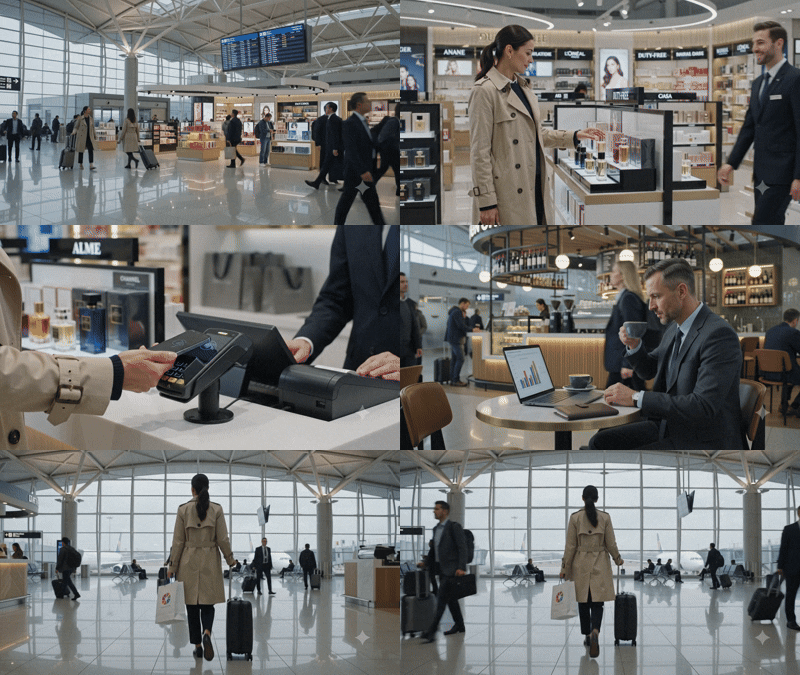
The ecosystem of airport commerce has evolved from a secondary service provided to travelers into a primary engine of non-aeronautical revenue that sustains the global aviation infrastructure. For modern airport authorities, commercial activities—encompassing retail, food and beverage, specialty services, and advertising—often represent nearly half of total operating income.[1] This shift has necessitated the development of sophisticated business models, stringent regulatory frameworks, and complex partnership structures. Entering and growing a business within this specialized environment requires a nuanced understanding of federal mandates, multi-year procurement cycles, and the unique logistical constraints of the sterile area. The financial intensity of the sector is marked by sales per square foot that frequently exceed three times the average of high-end regional malls, yet these rewards are counterbalanced by capital expenditure requirements and labor costs that significantly outpace street-side equivalents.[1, 2]
The Regulatory and Legal Foundation of Airport Concessions
The gateway to airport commerce in the United States is primarily defined by the Airport Concessions Disadvantaged Business Enterprise (ACDBE) program. Mandated by 49 CFR Parts 23 and 26 and administered by the Department of Transportation (DOT), the program is a critical requirement for any airport receiving federal development grants.[3, 4] The program’s objective is to ensure that small businesses owned and controlled by socially and economically disadvantaged individuals have a fair opportunity to participate in the lucrative but high-barrier airport market.[5] For a business to qualify, it must be a for-profit entity at least 51% owned by individuals who meet the criteria for social and economic disadvantage, with management and daily operations firmly under their control.[3, 6]
Economic disadvantage is quantified through a Personal Net Worth (PNW) cap, which currently stands at $1.32 million, excluding equity in a primary residence and the applicant business.[6] Furthermore, the business must meet size standards based on average annual gross receipts over a three- to five-year period. These standards are indexed by industry to reflect the differing capital requirements of various sectors.
ACDBE Size Standards and Industry Thresholds
| Industry Category | Size Standard (Average Annual Gross Receipts) |
|---|---|
| General Concessions (Non-Car Rental) | $56.42 million |
| Passenger Car Rental Companies | $75.23 million |
| Banks and Financial Institutions | $1 billion in assets |
| Pay Telephone Companies | 1,500 employees |
| New Car Dealers | 350 employees |
| [4] |
The regulatory environment is currently in a state of transition due to an Interim Final Rule (IFR) that has removed previous race- and sex-based presumptions of social disadvantage.[7] This shift requires all applicants to submit an individualized narrative and evidence of social disadvantage, increasing the administrative burden for firms seeking certification.[7] While this may deter some small businesses with limited administrative capacity, it is intended to create a more resilient legal framework that aligns with contemporary constitutional interpretations.[7] For existing ACDBEs, the re-evaluation process represents a significant milestone, as failure to provide a compelling case-specific justification could lead to decertification and the loss of existing contracts.[7]
Partnership Architectures and Joint Venture Mechanics
Because the capital requirements and operational complexities of airport commerce are so high, many small businesses enter the market through Joint Ventures (JVs) with established “prime” operators. A JV is defined as an association of an ACDBE firm and one or more other firms to carry out a single, for-profit business enterprise.[8] This model allows the airport to meet its federally mandated participation goals while ensuring the operational expertise and financial backing of a global leader such as HMSHost, SSP America, or Paradies Lagardère.[9]
The Joint Venture Agreement Checklist
The Federal Aviation Administration (FAA) provides rigorous guidance on the structure of these partnerships to ensure they represent legitimate business arrangements rather than “front” companies. A valid JV agreement must be a signed, written document that clearly defines the contributions of capital, property, efforts, skills, and knowledge from each party.[10]
| Component | Regulatory Requirement |
|---|---|
| Capital Contribution | Each party must contribute cash or financing equal to its ownership percentage. [10] |
| Management and Control | The ACDBE must share in day-to-day management and have a vote on major decisions. [10] |
| Profit and Loss Sharing | Profits and risks must be distributed in strict proportion to ownership interest. [8] |
| Commercially Useful Function | The ACDBE must perform a distinct, clearly defined portion of the work with its own forces. [5] |
| Reporting Relationship | The ACDBE must have the power to hire and fire staff within its scope of work. [8] |
One of the most scrutinized areas in JV compliance is the concept of “performing with its own forces.” This means the ACDBE partner must be responsible for a distinct element of the contract and must actually perform, manage, and supervise that work.[5] In a food and beverage joint venture, this might mean the ACDBE partner manages specific units or a specific functional area like human resources or local procurement. If the ACDBE is found to be a passive recipient of profits without operational involvement, the airport risks a finding of non-compliance, which can lead to the loss of federal funding.[11] Consequently, airports have increased the frequency and depth of JV reviews, making it essential for partners to maintain meticulous records of management committee meetings, voting minutes, and capital calls.[10, 11]
Management and Control Dynamics
A “Management Committee” structure is a common mechanism for governance in airport JVs. Under this structure, each participant is represented and votes according to its ownership interest.[10] However, to substantiate a level of control for the ACDBE, major decisions—such as borrowing money, expanding operations, or entering into large contracts—often require a unanimous vote.[10] The FAA also prohibits “inter-firm transactions” that siphon off profits before they can be distributed to the ACDBE partner.[8] For example, if the prime partner provides supplies or accounting services to the JV, those services must be billed at actual cost plus reasonable overhead, rather than at market rates that could artificially inflate the prime’s take at the expense of the ACDBE.[8]
Competitive Procurement and the RFP Lifecycle
Securing a business location in an airport is a multi-year endeavor that follows a public, transparent, and highly competitive procurement process. Unlike street-side retail, where a lease is negotiated directly with a landlord, airport space is awarded via a Request for Proposals (RFP).[12, 13] This lifecycle, from the airport identifying an available space to the “grand opening,” typically takes between 1.5 and 3 years.[12, 14]
The Three Stages of Procurement
- Preparation and Solicitation: The airport authority identifies locations and issues an RFP. This phase often includes a “Request for Information” (RFI) or “Request for Qualifications” (RFQ) to narrow the field of potential bidders based on their experience and financial capability.[15]
- Response and Selection: Proposers prepare exhaustive documents detailing their brand concept, design plans, operations strategy, and financial proforma. A Selection Committee then scores these proposals based on weighted criteria.[12, 14]
- Finalization and Construction: The selected concessionaire negotiates the final lease, which must often be approved by a City Council or Airport Board. Only after this approval can the tenant submit 100% architectural drawings and apply for building permits.[12, 16]
Strategic Elements of a Winning Proposal
A winning proposal is not merely a sales pitch; it is a technical document that demonstrates a deep understanding of the airport’s specific passenger demographics and operational challenges. Proposers are expected to attend pre-proposal meetings and terminal tours to gain firsthand knowledge of the site’s constraints.[14]
| Proposal Section | Key Evaluative Criteria |
|---|---|
| Brand Identity | Is the concept a national, local, or regional brand that aligns with the “Sense of Place”? [12] |
| Operational Plan | Does the proposer show an ability to operate 365 days a year from 5 AM to 11 PM? [17] |
| Design & Aesthetics | Do the materials and layout comply with the airport’s Tenant Design Manual? [17] |
| Financial Commitment | What is the proposed Percentage Rent and Minimum Annual Guarantee (MAG)? [12] |
| ACDBE Participation | Does the plan meet or exceed the airport’s specific participation goal (e.g., 30%)? [12] |
In the evaluation process, revenue is a primary but not exclusive factor. Larger, government-operated airports tend to prioritize revenue generation and socioeconomic attachments, while independent authorities may place higher weight on “command and control” measures such as operational experience and brand reputation.[18] The use of the Analytic Hierarchy Process (AHP) is becoming more common among airport managers to objectively evaluate tangible factors like pricing and intangible factors like brand equity and technological integration.[19]
Financial Engineering: Rent, CapEx, and Labor
The financial model of airport commerce is uniquely demanding, characterized by high fixed costs and a risk structure that heavily favors the airport authority. The primary rent mechanism is the “greater of the Minimum Annual Guarantee (MAG) or Percentage Rent”.[12, 20]
The Economics of Rent and MAG
The MAG serves as a baseline payment that the tenant must provide regardless of sales volume. It is typically calculated as 25% of the projected first-year revenue or a flat per-square-foot rate.[12, 20]
Rent=max(MAG,∑(Gross Receipts×% Category))
For instance, if a lease requires a MAG of $100,000 or 15% of sales, and the unit generates $800,000 in revenue, the rent is $120,000. However, if sales drop to $500,000, the rent remains $100,000, effectively increasing the rent-to-sales ratio from 15% to 20%.[12] This lack of flexibility was a focal point of industry distress during the pandemic, leading organizations like the Airport Restaurant and Retail Association (ARRA) to advocate for a “Variable MAG” model that adjusts based on terminal enplanements.[2] ARRA suggests that MAG payments should be suspended if enplanements in a specific zone decline by 20% for two consecutive months.[2]
Capital Expenditure and Build-out Intensity
The cost to build a retail or dining unit in an airport is exponentially higher than a street-side equivalent. This is due to the “airport premium” on labor and materials, the need for overnight construction shifts to minimize passenger disruption, and the stringent security screening required for all construction personnel and materials.[14]
| Development Type | Airport Cost (per Sq Ft) | Street Cost (per Sq Ft) |
|---|---|---|
| Food & Beverage (Average) | $1,000 – $1,400 | $100 – $400 |
| Retail / News (Average) | $400 – $800 | $100 – $300 |
| O’Hare (ORD) Premium | Up to $1,700 | — |
| [2, 14] |
These high costs necessitate longer lease terms—often 10 to 15 years—to allow operators to achieve a fair Return on Investment (ROI).[2, 13] Furthermore, concessionaires are typically required to perform a mid-term refurbishment to keep the concept fresh, adding another layer of capital requirement 5-7 years into the lease.[2]
Labor and Operating Surcharges
Labor represents the most significant ongoing operational expense, often consuming $0.35 to $0.45 of every dollar earned.[2] This is vastly higher than street-side benchmarks of 15% for retail and 25-30% for food service.[2] High labor costs are driven by the need for “badged” employees who must commute to the airport, pass background checks, and endure security screening every day.[14] To offset these pressures, many airports now allow a 3-5% surcharge on checks to cover escalating wage and benefit costs.[2]
Operational Rigor in the Sterile Environment
Operating a business in the sterile area (post-security) requires a level of security compliance that is unparalleled in other retail sectors. Every employee, every pallet of merchandise, and every kitchen utensil must be accounted for and screened.[14, 21]
The SIDA Badging Process
Access to the terminal’s restricted areas is controlled by the Security Identification Display Area (SIDA) badge. Obtaining this badge is a multi-step process that can take up to 30 days.[22, 23]
- Authorization: An “Authorized Signatory” from the company must vouch for the employee’s need for access.[22, 24]
- Vetting: The applicant must undergo an FBI fingerprint-based Criminal History Records Check (CHRC) and a TSA Security Threat Assessment (STA).[25, 26]
- Wants and Warrants: A local check is conducted for any outstanding legal issues.[22, 25]
- Training: The employee must complete interactive computerized training on security rules, “Insider Threats,” and emergency procedures.[24, 25]
The consequences of non-compliance are severe. If an employee fails to display their badge above the waist on their outermost garment, or if they allow “piggybacking” through a secure door, the company can face massive fines and the employee can be permanently barred from the airport.[24, 26]
Logistics and the Central Distribution Model
Modern airports are increasingly adopting a Central Receiving and Distribution Center (CRDC) model to manage the flow of goods into the terminal. In this model, vendors deliver to a landside warehouse where goods are unboxed and screened by TSA or private security.[2] From there, the airport’s logistics provider delivers the “clean” goods to the terminal units.[2] While this increases security and reduces traffic on the airfield, it also introduces a “Central Distribution Fee”—typically 1-3% of sales—and requires tenants to manage their inventory with extreme precision.[12]
Operating Challenges and Security Disruptions
Retailers must be prepared for a range of security challenges that can disrupt operations. Perimeter breaches, cybersecurity attacks on point-of-sale systems, and crowd management issues at security checkpoints can all lead to sudden drops in foot traffic or forced closures.[21] Airport Collaborative Decision Making (ACDM) is an emerging framework where retailers, airlines, and security officials share real-time data to optimize flow and mitigate these disruptions.[27]
Scaling the Business: Data, Demographics, and Digital
Growing a business in airport commerce is less about physical expansion and more about increasing “capture rates” and “sales per enplanement”.[2] Successful operators move beyond basic concessions to embrace data-driven commercial strategies.
Leveraging Passenger Demographics
The airline passenger is a highly desirable retail demographic, with an average annual income of $80,130.[1] However, spending patterns vary significantly by trip type. Long-haul and international passengers have a much higher propensity to spend on high-end retail and full-service dining, whereas short-haul domestic travelers often prioritize grab-and-go options and news/convenience items.[1]
| Passenger Metric | Impact on Sales |
|---|---|
| Dwell Time | Average 103 minutes; 80% of sales occur after clearing security. [1] |
| Capture Rate | The percentage of travelers who enter a unit; food (54-68%) vs. retail (11-37%). [1] |
| Sales per Enplanement | The critical KPI for evaluating terminal performance. [2] |
| Trip Distance | Longer flights correlate with higher F&B and total retail spend. [1] |
The Omnichannel Shift
By 2025, omnichannel shopping—the ability to seamlessly transition between digital platforms and physical stores—will be the industry standard.[28] High-performing airport retailers are aiming for at least 20% of total sales to be generated through digital channels.[28] This includes mobile pre-ordering of meals, gate delivery services, and digital loyalty programs that recognize travelers as they move between hubs.[28, 29] Programmatic advertising is another growth engine, allowing brands to display ads based on real-time flight information or weather conditions (e.g., pushing umbrellas or cold-weather gear to passengers departing for rainy destinations).[30]
“Sense of Place” and Regional Branding
There is a growing trend among airport developers, such as Fraport USA, to prioritize local and regional brands that offer a “Sense of Place”.[9, 17] This strategy involves scaling a local concept—perhaps a famous city bakery or a craft brewery—into the airport terminal to serve as a “front door” for the region.[1] This not only satisfies the traveler’s desire for authentic local experiences but also allows the airport to differentiate itself from other global hubs.[1, 17] For the business owner, this means that growth often comes from the ability to maintain the brand’s “street” standards while adapting to the rigorous operational requirements of the airport.[17]
Future Outlook: Resilience and Sustainability
The future of airport commerce is being shaped by two major forces: the recovery from the pandemic and the increasing focus on sustainability. The volatility of passenger traffic has led to a re-evaluation of the traditional “MAG + Percentage” contract. New agreements are likely to include “Variable MAG” structures and benchmarking by zone to trigger MAG waivers.[2]
Sustainability is also moving from a “nice-to-have” to a mandatory component of RFP responses. Airports now frequently require concessionaires to provide environmentally friendly packaging, eliminate single-use plastics, and demonstrate a commitment to social equity beyond the ACDBE requirements.[12, 17, 31] For a business to scale, it must integrate these values into its core operations, as travelers—particularly those under 40—are increasingly seeking out brands that align with their ethical preferences.[31]
Ultimately, starting and growing a business in airport commerce is a marathon of preparation and a masterclass in operational discipline. The barriers to entry—from ACDBE certification and the SIDA badging process to the high CapEx of secure construction—are formidable. However, for the operator who can navigate these hurdles, the airport remains one of the highest-performing retail environments in the world. Success requires a dual-track strategy: maintaining absolute compliance with federal and security mandates while leveraging the latest in digital and demographic data to capture the attention of the modern traveler. As the industry moves toward more collaborative and resilient partnership models, those who view the airport authority not just as a landlord, but as a strategic partner, will be best positioned for long-term growth.
——————————————————————————–
- The appropriate scale of US airport retail activities | Aerotropolis …, http://aerotropolisbusinessconcepts.aero/wp-content/uploads/2020/03/The-appropriate-scale-of-US-airport-retail-activities-1.pdf
- Airport Restaurant & Retail Association tackles MAGs and …, https://moodiedavittreport.com/airport-restaurant-retail-association-tackles-mags-and-concessionaire-costs-in-latest-white-paper/
- Understanding DBE / ACDBE | Wayne County Airport Authority – Detroit Metro Airport (DTW), https://metroairport.com/business/doing-business-wcaa/disadvantaged-business-programs/understanding-dbe-acdbe
- 49 CFR Part 23 — Participation of Disadvantaged Business Enterprise in Airport Concessions – eCFR, https://www.ecfr.gov/current/title-49/subtitle-A/part-23
- Airport Concession Disadvantaged Business Enterprise (ACDBE) Program, https://dot.alaska.gov/cvlrts/acdbe.shtml
- DBE and ACDBE Programs – Orlando International Airport, https://flymco.com/airport-business/small-business/dbe-and-acdbe-programs/
- Disadvantaged Business Enterprise Program and Disadvantaged Business Enterprise in Airport Concessions Program Implementation Modifications – Federal Register, https://www.federalregister.gov/documents/2025/10/03/2025-19460/disadvantaged-business-enterprise-program-and-disadvantaged-business-enterprise-in-airport
- 2024 Airport Concessions Disadvantaged Business Enterprise Joint …, https://www.faa.gov/about/office_org/headquarters_offices/acr/bus_ent_program/joint-venture-guidance
- Industry Partners – AMAC, https://www.amac-org.com/our-partners/
- p3_401233.docx – DFW Airport Concessions, https://sites.dfwairport.com/cs/groups/webcontent/documents/webasset/p3_401233.docx
- ACDBE Joint Venture Guidance for Airport Concessions Leases – Michelle DelMar, Esq., https://www.contactmylawyer.com/blog/acdbe-joint-venture-guidance
- concessions 101: – doing business at o’hare airport – Flychicago, https://www.flychicago.com/ordsymposium/2023/assets/documents/Concessions%20101%20for%20Symposium.01%20–%202023.pdf
- REQUEST FOR PROPOSALS FOR FOOD AND RETAIL CONCESSION OPERATOR – Great Falls International Airport, https://flygtf.com/resources/FoodBeverageandRetailConcessionOperationRFP.pdf
- What Makes a Great Proposal | Flychicago, https://www.flychicago.com/concessionsresources/assets/documents/Concessions–OACS2–What-Makes-a-Great-Proposal.pdf
- The Winning RFP Response: Process, Strategy, and Tools, https://www.utleystrategies.com/blog/rfp-response
- airport concession program handbook – Flychicago, https://www.flychicago.com/rfp2020/assets/documents/ord/2020%20Concessions%20Program%20Handbook-Exhibit%206%20REVISED%207-23-19.pdf
- APPENDIX E CONCESSION SERVICES This section of the RFP contains the following information for the concession services required b – SRQ Airport, https://flysrq.com/sites/default/files/2023-06/RFP%20Appendix%20E%2C%20F.pdf
- A Qualitative Study Comparing Proposals Used to Evaluate Airport Concessionaires, https://search.proquest.com/openview/7f3e1434475848a634678ea6f67034a2/1?pq-origsite=gscholar&cbl=18750
- Airport Retail Market Power: A Performance Assessment Framework on Business Success and Regional Retail Market Characteristics – MDPI, https://www.mdpi.com/2673-8392/5/2/66
- Dallas Fort Worth International Airport Concessions Lease ARTICLE …, https://sites.dfwairport.com/cs/groups/webcontent/documents/webasset/p3_106718.pdf
- 7 Common Airport Security Challenges | Delta Scientific, https://deltascientific.com/2025/03/25/7-airport-security-challenges/
- Airport Employees (Airlines/Vendors/Tenants) | Access ID & Badging Office, https://slcairport.com/badging/get-a-badge/all-airport-employees/
- Badging – Houston Airport System, https://www.fly2houston.com/airport-business/resources/badging/
- AIRPORT IDENTIFICATION BADGE APPLICATION, https://concordairportnc.com/Portals/0/Concord%20Airport/Documents/JQF%20ASP%20-%20APPENDIX%2012%20-%20AIRPORT%20IDENTIFICATION%20BADGE%20APPLICATION%202021-05.pdf
- DTW Airport ID Badges | Wayne County Airport Authority, https://www.metroairport.com/about-dtw/dtw-airport-id-badges
- Security Identification Display Area (SIDA) Study Guide – Port Authority, https://www.panynj.gov/content/dam/airports/employees/SIDA-Study-Guide.pdf
- Chapter 2: Operations – National Academies of Sciences, Engineering, and Medicine, https://www.nationalacademies.org/read/27969/chapter/4
- Airport Retail: Brace for Disruption | Bain & Company, https://www.bain.com/insights/airport-retail-brace-for-disruption/
- Airport Retail Market Size, Share & Trends | Global Report [2032], https://www.fortunebusinessinsights.com/airport-retail-market-110581
- Maximizing Travel Ad Spend: Leveraging Aviation Data for Strategic Allocation – OAG, https://www.oag.com/blog/maximizing-travel-ad-spend-leveraging-aviation-data-for-strategic-allocation
- Millennial impact: CTM Global Survey reveals a shift in business travel preferences, https://us.travelctm.com/blog/ctm-survey-business-travel-preferences/


Leave a comment