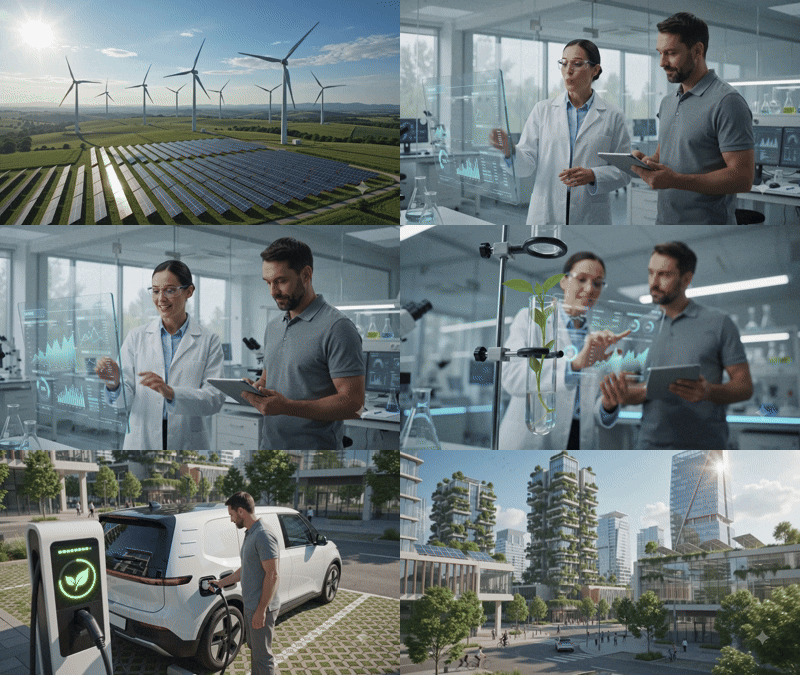
The transition toward sustainable business models has transcended the era of voluntary corporate social responsibility, evolving into a fundamental structural shift in the global economy. As of 2026, sustainable transformation is characterized by the systemic integration of environmental, social, and governance (ESG) principles into the core operational and financial architecture of the enterprise. This evolution is driven by a convergence of maturing regulatory mandates, sophisticated investor scrutiny, and a radical realignment of consumer preferences that prioritizes long-term resilience over short-term extraction. Organizations that successfully navigate this shift are not merely mitigating risks but are actively capturing new growth opportunities, with data indicating that companies prioritizing digital and sustainable initiatives are 2.5 times more likely to achieve significant revenue growth than their less adaptable peers.[1, 2]
The 2026 Growth Landscape: Defining the Sustainable Transformation Sector
The sustainable transformation sector in 2026 is no longer a niche market but an expansive economic frontier. Management consulting firms such as McKinsey, BCG, and Deloitte increasingly define growth through the lens of adaptability, technology integration, and data-driven decision-making.[1] The reliance on advanced analytics has reached a critical threshold, with organizations utilizing big data to inform sustainability strategies being five times more likely to make accelerated, high-quality decisions than those relying on traditional intuitive models.[1]
Growth areas within this sector are increasingly specialized. While the primary focus remains on decarbonization and energy efficiency, new frontiers have emerged in circular supply chain management, nature-based solutions, and social equity metrics. Business leaders now view sustainability as a top-three strategic priority, placing it alongside artificial intelligence and digital transformation on the C-suite agenda.[2] This prioritization is reflected in the business benefits reported: over 66% of organizations indicate that their sustainability actions have a direct positive impact on revenue generation.[2]
| Sector Growth Areas 2025 | Strategic Focus & Growth Drivers | Economic Impact Potential |
|---|---|---|
| Energy & Resources | Renewables integration, grid modernization, and carbon capture.[2] | 80% of new capacity now from renewables.[3] |
| Life Sciences & Healthcare | Digitalization of clinical trials, ethical sourcing of API, and health equity.[4] | 11% value increase relative to revenue via AI.[4] |
| Consumer Goods & Retail | Circular fashion, compostable packaging, and radical supply chain transparency.[5] | $64B used-fashion market value by 2028.[5] |
| Financial Services | ESG-aligned risk modeling, green bonds, and impact investment platforms.[2] | $130 trillion in assets aligned with net zero.[6] |
| Technology & Media | Green data centers, hardware circularity, and ethical AI governance.[2] | 20% increase in customer satisfaction via CX.[1] |
The cost of inaction has become a material financial liability. Regulatory noncompliance, once a matter of minor fines, now triggers significant litigation risks and long-term brand erosion.[3] Physical climate risks, such as water scarcity and supply chain disruptions due to extreme weather, are already impacting operations for 70% of global businesses.[2] Consequently, the business case for sustainability is anchored in three primary actions: looking ahead to capture growth, looking inside to reconfigure operations, and looking around to leverage the broader business ecosystem.[5]
Foundational Steps: Legal Structures and Hybrid Entities
Starting a business in sustainable transformation requires a deliberate choice regarding legal identity. The traditional corporate form, which often prioritizes shareholder wealth maximization, can create friction for founders pursuing social or environmental missions. In response, several hybrid legal structures have emerged to protect mission-driven objectives.
Public Benefit Corporations and Hybrid Models
The Public Benefit Corporation (PBC) has become a preferred vehicle for social entrepreneurs. A PBC is a legally recognized corporate form that commits the entity to higher standards of purpose, accountability, and transparency.[7, 8] Unlike traditional C-Corps, PBCs are legally mandated to consider the impact of their decisions on all stakeholders, including workers, the community, and the environment.[8] This legal “tweak” differentiates them from traditional entities by enshrining the commitment to public good in the company’s articles of incorporation.[9]
Other hybrid models include the Low-Profit Limited Liability Company (L3C) and the Community Interest Company (CIC). The L3C is a specifically designed version of an LLC that focuses on social goals while allowing for profit-oriented objectives. It is particularly effective for organizations seeking “Program Related Investments” (PRIs) from private foundations.[10, 11] These structures allow for the blending of philanthropic capital and commercial investment, providing a unique financial bridge for early-stage sustainable ventures.
| Legal Form vs. Certification | Governing Authority | Purpose & Mandate |
|---|---|---|
| Public Benefit Corp (PBC) | State or National Law.[7] | Legal duty to balance profit and public benefit.[8] |
| Certified B Corporation | B Lab (Third-party).[12] | High performance score (80+) on B Impact Assessment.[12] |
| L3C (Low-Profit LLC) | IRS/State Regulations.[10] | Facilitates Program Related Investments (PRIs).[11] |
| Traditional C-Corp | Shareholder Fiduciary Duty.[8] | Primarily focused on shareholder value maximization.[10] |
The Path to B Corp Certification
While PBC status is a legal designation, B Corp Certification is a performance-based accreditation. To achieve this, a company must undergo a rigorous assessment of its entire operations, covering governance, workers, community, environment, and customers.[12, 13] As of 2025, B Lab has introduced new standards that require businesses to demonstrate continuous improvement across seven impact topics, including Climate Action, Fair Work, and Human Rights.[14, 15]
The certification process involves a foundational assessment, a detailed gap analysis, and the strategic implementation of policies to address identified deficiencies.[14] For example, a company might need to formalize its supplier code of conduct or implement greenhouse gas (GHG) accounting systems to meet the required thresholds.[14] Once certified, the organization must update its assessment every three years and maintain transparency by making its performance data public.[12]
The 2026 Regulatory Super-Cycle
The regulatory landscape in 2026 is defined by the “expanding complexity” of mandatory sustainability reporting and due diligence. The primary driver of this shift is the European Union’s commitment to the Green Deal, which has introduced a suite of regulations with significant extraterritorial effects.[16, 17]
The Corporate Sustainability Reporting Directive (CSRD)
The CSRD has entered a critical implementation phase. As of early 2025, “Wave 1” companies—large, listed entities previously governed by the Non-Financial Reporting Directive (NFRD)—are required to issue their first comprehensive sustainability reports for the 2024 fiscal year.[18] A central requirement of the CSRD is the Double Materiality Assessment (DMA). This process mandates that companies report on both “Impact Materiality” (the company’s impact on people and the environment) and “Financial Materiality” (the financial risks and opportunities created by sustainability issues).[17, 18]
In late 2025, the EU reached a compromise known as the “Sustainability Omnibus Package” to simplify reporting for smaller entities. This package raised the employee threshold for CSRD coverage to 1,000 employees and the annual turnover threshold to $522 million (€450 million), effectively removing approximately 90% of smaller companies from the direct mandate while maintaining rigorous standards for the largest market participants.[17]
The Corporate Sustainability Due Diligence Directive (CS3D/CSDDD)
The CS3D represents a further escalation in regulatory oversight, requiring companies to identify, prevent, and mitigate adverse impacts on human rights and environmental obligations across their entire global value chains.[16, 17] Under the 2025 Omnibus compromise, the CS3D applies to EU businesses with at least 5,000 employees and over $1.74 billion (€1.5 billion) in turnover.[17] This directive also mandates the adoption of “climate transition plans,” requiring companies to explain how their business models align with the 2-degree Celsius target established in international climate agreements.[17]
US and Transatlantic Regulatory Dynamics
In the United States, the regulatory environment is characterized by a significant divide between federal and state mandates. While the SEC’s climate disclosure rule remains in a state of “legal limbo” due to litigation and shifts in political administration, California has moved forward with its own landmark disclosure laws.[17] California’s SB 253 and SB 261 require companies with revenue exceeding $1 billion that do business in the state to disclose Scope 1, 2, and 3 emissions, effectively creating a national standard for many major US firms.[17]
The Carbon Border Adjustment Mechanism (CBAM) also introduces a new dimension to international trade. By imposing a carbon price on imports of carbon-intensive goods like steel, cement, and electricity, the EU aims to prevent “carbon leakage” and encourage cleaner industrial production globally.[16] This mechanism has a phased rollout, with full implementation and phased tariff introductions reaching capacity by 2034.[16]
Sustainable Business Model Archetypes
Growing a sustainable business requires the adoption of innovative archetypes that move beyond linear “take-make-waste” models. These archetypes help organizations innovate their value propositions across environmental, social, and economic dimensions.[19]
Circular Economy Business Models (CEBMs)
Circular models are restorative and regenerative by design. They aim to keep products, components, and materials at their highest utility and value at all times.[19, 20] Common patterns include:
- Product-as-a-Service (PaaS): Maintaining product ownership and delivering functionality rather than physical ownership. This incentivizes durability and responsible use throughout the full value chain.[19]
- Product Life Extension: Extending the lifecycle of products through repair, maintenance, resale, and remanufacturing. Fnac Darty’s “Darty Max” service, which offers unlimited repairs, is a prime example of this archetype in action.[21]
- Resource Recovery: Digitizing waste flows to transform waste into resources. Startups like Replenysh and KWOTA are pioneering digital marketplaces for traceable, recycled materials.[22]
Stewardship and Sufficiency Models
The “Stewardship Role” involves proactive engagement with stakeholders to ensure their long-term health and well-being. This includes radical transparency regarding social impacts and upstream stewardship, where suppliers are required to meet strict social and environmental standards.[19] “Sufficiency Models” actively seek to reduce overall consumption and production by focusing on product durability, consumer education, and demand management.[19] Patagonia’s “Worn Wear” program demonstrates how a brand can successfully integrate sufficiency by promoting the resale and repair of its own products.[21, 23]
Operational Challenges and Supply Chain Volatility
Scaling a business in sustainable transformation is hindered by significant operational complexities, particularly in the realm of reverse supply chains and global volatility.
The Complexity of Reverse Logistics
Scaling circular initiatives requires retrieving products from consumers, a process that is often more complex and less predictable than forward distribution.[24] Primary hurdles include low consumer participation, the unpredictable quality of returned goods, and the lack of robust infrastructure for refurbishment and remanufacturing.[24] Collaborative ventures, such as the partnership between Renault and Suez (The Future is Neutral), are essential for building the necessary infrastructure to recover and recycle materials from end-of-life products at scale.[24]
Navigating Global Volatility in 2026
Supply chains in 2026 are facing “pervasive uncertainty” due to geopolitical unrest, climate-induced resource shortages, and rapid shifts in regulatory environments.[25] Geopolitical tensions can spark sudden shocks, such as sanctions or tariffs, that slow down distribution and raise costs for raw materials.[26, 27] In this environment, the traditional reliance on “lean, single-source global networks” has become a systemic vulnerability.[25]
| Supply Chain Risk Factor | Operational Manifestation | Strategic Response |
|---|---|---|
| Geopolitical Unrest | Abrupt stockouts, export bans on food/tech, and rising freight prices.[26, 27] | Regionalization and dual-sourcing strategies to build redundancy.[25] |
| Climate-Induced Shocks | Regional resource shortages (water, crops) and infrastructure loss.[25, 26] | Advanced data analytics and “digital twin” simulations of risk.[28] |
| Economic Volatility | Rapid inflation in energy/labor costs and currency devaluation.[25, 28] | Hedging via financial instruments to lock in raw material prices.[25] |
| Cyber/Digital Threats | Ransomware attacks on tracking platforms and data breaches.[26] | Strengthening digital transparency and investing in cloud-based visibility tools.[28] |
Integrated Risk Management (IRM) has emerged as the necessary framework for 2026. Unlike traditional, siloed approaches, IRM views risks as interdependent and dynamic, embedding risk awareness across the entire supply network.[29]
Financing Sustainable Growth
The funding landscape for sustainable transformation is undergoing a transition from broad ESG investing to specialized climate technology verticals. By 2026, global climate tech investment continues to trend upward despite a challenging macroeconomic climate, with Europe increasingly becoming a focal point for innovation.[6]
Venture Capital Trends
Smart money in 2026 is flowing into specialised verticals that blend innovation with measurable impact. The five subsectors likely to attract the majority of capital include:
- Bioplastic and Packaging Innovation: Driven by the surge in demand for alternatives to single-use plastics.[6]
- Carbon Removal and Sequestration: Technologies focusing on active atmospheric carbon reduction.[6]
- Clean Energy and Electrification: Including grid-scale storage and next-generation renewables.[6]
- Climate Data and Analytics: Tools that provide the transparency needed for regulatory compliance.[6]
- Circular Economy Tech: Software and hardware enabling the tracking and recovery of materials.[6, 22]
Public and Blended Finance
Public funding remains a critical catalyst, especially for early-stage ventures. In the US, the $20 billion Greenhouse Gas Reduction Fund (GGRF) provides low-interest loans to advance green projects in underserved communities.[30] Localized grant programs, such as Cincinnati’s “Seeds of Change,” offer funding for community-initiated projects that align with local climate action plans.[31]
The shift from the Biden-era Inflation Reduction Act (IRA) to the Trump administration’s “One Big Beautiful Bill Act” (OBBBA) in mid-2026 has introduced significant changes to the clean energy tax credit landscape.[32] Key residential credits are set to terminate at the end of 2025, while commercial credits for wind and solar are facing accelerated phaseouts.[32] However, credits for existing nuclear facilities and clean hydrogen have been partially retained, albeit with new restrictions on “Foreign Entities of Concern” (FEOC).[32]
Impact Measurement: The ESG Framework Ecosystem
As sustainability disclosure becomes mandatory, organizations must master the primary reporting frameworks to communicate their performance effectively to diverse stakeholders.[33]
Standardized Reporting Frameworks
The reporting ecosystem is currently defined by three major standards:
- GRI (Global Reporting Initiative): Focuses on “impact materiality,” detailing a company’s impact on the environment and society. It is the most widely used framework globally and is preferred by stakeholders such as NGOs and government bodies.[33, 34]
- SASB (Sustainability Accounting Standards Board): Focuses on “financial materiality” by industry. It is designed specifically for investors and CFOs, providing metrics on ESG issues that directly impact a company’s balance sheet.[33, 34]
- ISSB (International Sustainability Standards Board): A newer, ambitious unifier that combines elements of SASB and TCFD to create a comprehensive global baseline for sustainability disclosure.[33, 35]
| Framework / Standard | Primary Audience | Materiality Focus | Core Utility |
|---|---|---|---|
| GRI | Multi-stakeholder (NGOs, Public) | Impact Materiality.[33] | Accountability and social license.[35] |
| SASB | Capital Markets (Investors, CFOs) | Financial Materiality.[33] | Sector-specific risk assessment.[34] |
| CSRD / ESRS | Regulators and EU Stakeholders | Double Materiality.[34] | Mandatory legal compliance in EU.[36] |
| GHG Protocol | All Organizations | Carbon Footprint | The standard for GHG accounting.[37] |
Practical Guidance for SMEs
For Small and Medium-sized Enterprises (SMEs), carbon accounting is the essential first step toward sustainable transformation. The standard process involves defining organizational boundaries and categorizing emissions into three “scopes” as defined by the GHG Protocol.[38, 39]
- Scope 1: Direct emissions from owned or controlled sources, such as company vehicles and onsite fuel combustion.[37, 40]
- Scope 2: Indirect emissions from the generation of purchased energy (electricity, heating, cooling).[37, 40]
- Scope 3: All other indirect emissions in the value chain, including purchased goods, business travel, and waste disposal. Scope 3 often accounts for over 80% of a company’s total footprint and is the most challenging to measure.[38, 40, 41]
SMEs are encouraged to use free calculators provided by platforms like the SME Climate Hub or Hedgehog to begin their measurement journey.[37, 38] Setting “Science-Based Targets” (SBTs) provides a rigorous pathway for reduction, and while the process for large corporations involves five steps, SMEs follow a simplified pathway that skips the initial commitment and move directly to target submission.[38]
Marketing Sustainability: Authenticity and the Greenwashing Challenge
In 2026, marketing sustainability has moved beyond “green” labels to a model of radical transparency. Consumers are increasingly savvy and skeptical; honesty in communication is now a prerequisite for building brand trust.[42, 43]
The 4 Ps of Green Marketing
Authentic sustainability must be woven into the entire marketing mix:
- Product: Designing for recyclability, using responsibly sourced materials, and minimizing packaging.[42, 44]
- Price: Pricing that supports fair wages and carbon offsets, reflecting the true cost of production.[44]
- Place: Delivering products through low-impact channels, such as local fulfillment and electric delivery fleets.[44]
- Promotion: Communicating efforts with specific, data-backed evidence rather than vague slogans.[43, 44]
Strategies to Avoid Greenwashing
Greenwashing—misleading or exaggerated environmental claims—carries significant legal and reputational risks. To avoid these traps, organizations should adhere to several expert strategies:
- Back Claims with Data: Vague terms like “eco-friendly” should be replaced with specific metrics (e.g., “100% recycled materials”).[43]
- Use Third-Party Verification: Independent audits and certifications (e.g., B Corp, ISO 14001) provide necessary credibility.[42, 45]
- Disclose Limitations: Transparency about what the company is not yet doing is as important as reporting achievements.[42, 45]
- Embed Sustainability in Culture: Messaging will fail if it is not rooted in the company’s actual operations and leadership commitment.[42, 43]
Industrial Case Study: The Circular Transformation of IKEA
IKEA’s journey provides a comprehensive template for large-scale sustainable transformation. Historically scrutinized for wood sourcing, the company made a strategic decision to center its business model on renewable energy, low-impact materials, and circular logic.[23]
Financial and Operational Performance in 2025
For the 2025 financial year, IKEA reported total revenues of EUR 26.3 billion, demonstrating resilience despite global supply chain turmoil and the volatility of commodity markets following the announcement of new US tariffs.[46, 47] While revenue remained fairly unchanged, sales volumes grew by 6%, fueled by price reductions that supported the company’s affordability ambitions.[47]
Key circular milestones for IKEA in 2026 include:
- Recycled Wood Integration: The company acquired 8,000 hectares of forestland in Latvia to secure responsible supply and is building sorting facilities to reach its goal of 80% recycled wood in particle boards by 2030.[47]
- The Buyback and Resell Program: Over 211,600 participants utilized the program in 2023, keeping usable items out of landfills and creating new, sustainable revenue streams.[23]
- Circular Product Design: By 2024, 61% of the IKEA product range was circular by design, focusing on modularity and reparability.[48]
- Social Entrepreneurship: The IKEA Social Entrepreneurship program continues to integrate social businesses into the value chain, such as Duitin in Indonesia, which manages waste for IKEA stores.[49]
Economic Outcomes and Decoupling
IKEA has successfully demonstrated the possibility of decoupling economic growth from environmental impact. Since 2016, the company’s revenue has risen by over 30%, while its climate footprint has decreased by 24.3% in the same period.[23] This “decoupling” is achieved through large-scale investments in green power, logistics optimization, and product life cycle upgrades that cut energy use and supply chain inefficiencies.[23]
Industrial Case Study: Patagonia’s Radical Transparency
Patagonia represents the “Sufficiency Model” of sustainable transformation. Its circular business initiative, “Worn Wear,” allows customers to trade in used gear for credit and purchase pre-owned apparel.[21] By integrating “Shop Used” directly into its primary digital navigation, Patagonia has made circularity a core part of the customer experience rather than a peripheral pilot program.[21] This strategy builds trust with a loyal customer base and positions the brand as a thought leader in conscious consumption.[50]
Industrial Case Study: Fnac Darty’s Repair-First Strategy
Fnac Darty, a European leader in electronics, has pivoted its business model toward reparability. Its “Darty Max” subscription service provides unlimited repairs for appliances, addressing the fact that over 40% of breakdowns are caused by misuse or lack of maintenance.[21] By May 2022, the service had over 500,000 subscribers and has since expanded its video-based preventive maintenance features to Fnac stores.[21] This shift from “repairing broken products” to “preventing breakdowns” exemplifies the “Product-as-a-Service” and “Life Extension” archetypes, creating a steady subscription-based revenue stream while reducing electronic waste.[21]
Conclusion: Synthesis and Strategic Recommendations
The transition to a sustainable enterprise in 2025 is a multifaceted challenge that requires the alignment of legal, financial, and operational strategies. The research indicates that the most successful organizations are those that move beyond compliance to view sustainability as a driver of long-term value and operational resilience.
To start and grow a business in this sector, leaders should adopt the following strategic pillars:
- Mission Protection: Utilize legal structures like Public Benefit Corporations to ensure that social and environmental purposes are enshrined in the company’s DNA, protecting the mission during growth and potential liquidity events.[8, 51]
- Technological Integration: Leverage AI and cloud-based analytics to manage supply chain volatility and provide the radical transparency required by regulators and consumers.[1, 28]
- Collaborative Ecosystems: Engage in strategic partnerships and joint ventures to build the necessary infrastructure for circularity, particularly in the difficult area of reverse logistics.[1, 24]
- Authentic Communication: Shift marketing efforts toward data-backed, third-party verified transparency to build credible brand equity and avoid the severe risks of greenwashing.[42, 43]
- Rigorous Impact Measurement: Adopt standardized frameworks like GRI and SASB early in the business lifecycle to attract institutional capital and ensure readiness for the expanding global regulatory super-cycle.[33, 36]
As we move toward 2027, the organizations that will lead the global economy are those that treat sustainability not as a separate department, but as the fundamental logic of their entire business and product strategy. The transformation is complex, but the data from leaders like IKEA and Fnac Darty demonstrates that ecology and profits are no longer in collision; rather, they have become the dual engines of modern business success.
——————————————————————————–
- Business Growth Consulting in 2025 – Kamyar Shah, https://kamyarshah.com/wp-content/uploads/2024/12/Business-Growth-Consulting-in-2025.pdf
- 2025 C-suite Sustainability Report | Deloitte Global, https://www.deloitte.com/global/en/issues/climate/c-suite-sustainability-report.html
- The Business Case for Sustainability | Deloitte US, https://www.deloitte.com/us/en/services/consulting/articles/the-business-case-for-sustainability.html
- 2025 life sciences outlook | Deloitte Insights, https://www.deloitte.com/us/en/insights/industry/health-care/life-sciences-and-health-care-industry-outlooks/2025-life-sciences-executive-outlook.html
- Sustainability transformation | Deloitte Insights, https://www.deloitte.com/us/en/insights/topics/business-strategy-growth/sustainable-transformation-in-business.html
- Venture Capital Trends — OnePlanetCapital, https://www.oneplanet.capital/insights/the-future-is-green-venture-capital-trends-to-watch-in-2025
- B Corps vs Public Benefit Corporations: What’s the Difference? – Sunrise Banks, https://sunrisebanks.com/stories/public-benefit-corporations-vs-b-corps-whats-the-difference/
- Benefit Corporations – B Lab U.S. & Canada, https://usca.bcorporation.net/benefit-corporation/
- What is B Corp certification? – BDC, https://www.bdc.ca/en/articles-tools/sustainability/environment/3-steps-to-becoming-certified-b-corp
- L3C vs. B Corp: A Comparison of Social Enterprise Structures – Legal GPS, https://www.legalgps.com/business-entity-comparison/l3c-vs-b-corp
- The Difference Between B-Corp, Benefit Corp, L3C, And PBC – Ethix Merch, https://ethixmerch.com/blog/b-corp-benefit-corp/
- 3 Steps to Become a B Corp – B Lab Europe, https://bcorporation.eu/blog_post/3-steps-to-become-a-b-corp/
- ISO 14001 & B Corp: A Perfect Partnership For Sustainable Business – Compliant Ltd, https://compliantltd.com/insights/iso-14001-b-corp-a-perfect-partnership-for-sustainable-business/
- B Corp Update: Your Guide to the 2025 Certification Standards – Arbor.eco, https://www.arbor.eco/blog/b-corp
- FAQs: Key Changes to B Lab’s New Standards – Support :, https://kb.bimpactassessment.net/en/support/solutions/articles/43000651678-faqs-key-changes-to-b-lab-s-new-standards
- All 2025 ESG and non-financial reporting regulations in the EU – PlanA.Earth, https://plana.earth/academy/eu-esg-regulations
- Corporate Climate Disclosures in the US and EU: An Expanding …, https://blogs.law.columbia.edu/climatechange/2025/10/20/corporate-climate-disclosures-in-the-us-and-eu-an-expanding-regulatory-landscape-amidst-resistance/
- What shifting sustainability regulations mean for business | EY – Global, https://www.ey.com/en_pt/insights/climate-change-sustainability-services/what-do-shifting-sustainability-regulations-mean-for-business
- Archetypes for Sustainable Business Models – NTNU, https://www.ntnu.edu/iif/archetypes-for-sustainable-business-models
- A typology of sustainable circular business models with applications in the bioeconomy – Lirias, https://lirias.kuleuven.be/retrieve/699095
- Scaling Circularity into Profitable Business Models | BCG, https://www.bcg.com/publications/2025/scaling-circularity-into-profitable-business
- Sustainability start-ups solving circular economy challenges – The World Economic Forum, https://www.weforum.org/stories/2024/09/startups-shaping-the-circular-economy/
- IKEA Sustainability: A Case Study & Eco Guide (2025) – Play It Green, https://playitgreen.com/the-sustainability-success-of-ikea-a-case-study/
- WEF: How Companies Can Scale Circular Supply Chains | Procurement Magazine, https://procurementmag.com/news/wef-companies-scale-circular-supply-chains
- Global Supply Chain Volatility → Area → Sustainability, https://esg.sustainability-directory.com/area/global-supply-chain-volatility/
- Supply Chain Disruptions: How They Happen, Industries Affected, and How to Manage, https://www.inboundlogistics.com/articles/supply_chain_disruptions_how_they_happen_industries_affected_and_how_to_manage/
- Top Supply Chain Challenges in 2025 – Fractory, https://fractory.com/supply-chain-challenges/
- 10 Supply Chain Risks, and Ways to Mitigate Them – SAP, https://www.sap.com/resources/supply-chain-risks
- Toward a Resilient and Sustainable Supply Chain: Operational Responses to Global Disruptions in the Post-COVID-19 Era – MDPI, https://www.mdpi.com/2071-1050/17/13/6167
- The Brief: Searching for sustainable climate momentum in 2026 – Impact Alpha, https://impactalpha.com/the-brief-searching-for-sustainable-climate-momentum-in-2026/
- Seeds of Change Grant Program – Environment & Sustainability – cincinnati-oh.gov, https://www.cincinnati-oh.gov/oes/green-cincinnati-plan/seeds-of-change-grant-program/
- From IRA to OBBBA: A New Era for Clean Energy Tax Credits | Advisories | Arnold & Porter, https://www.arnoldporter.com/en/perspectives/advisories/2025/07/from-ira-to-obbba-a-new-era-for-clean-energy-tax-credits
- ESG Frameworks Explained: GRI vs SASB vs ISSB – iicsr, https://www.iicsr.com/post/esg-frameworks-explained-gri-vs-sasb-vs-issb
- Mastering ESG reporting: frameworks, standards, and best practices – The Corporate Governance Institute, https://www.thecorporategovernanceinstitute.com/insights/guides/mastering-esg-reporting-frameworks-standards-and-best-practices/
- SASB Standards and other ESG frameworks, https://sasb.ifrs.org/about/sasb-and-other-esg-frameworks/
- Choosing the Right ESG Framework: A 2025 Guide to CSRD, GRI, SASB, TCFD & More, https://ecoactivetech.com/choosing-esg-framework-2025-guide/
- Guide for Measuring Your Emissions | SME Climate Hub, https://smeclimatehub.org/wp-content/uploads/2025/01/Guide-for-Measuring-Your-Emissions.pdf
- Carbon Footprint Accounting for SMEs: A Complete Guide – Hedgehog, https://www.hhc.earth/knowledge-base/guides/carbon-footprint
- Greenhouse Gas Protocol Essentials for SMEs – EcoHedge, https://www.ecohedge.com/blog/greenhouse-gas-protocol-essentials-for-smes/
- Carbon Accounting for SMEs: A Beginner’s Guide – Seedling, https://www.seedling.earth/post/carbon-accounting-for-smes
- Begin Tackling Your Scope 3 Emissions: A Practical Guide for SMEs – ENSO Impact, https://www.ensoimpact.com/insights/begin-tackling-your-scope-3-emissions-a-practical-guide-for-smes
- Marketing Sustainability: Strategies for Authentic Consumer …, https://esgthereport.com/marketing-sustainability-strategies-for-authentic-impact/
- 12 Expert Strategies To Master Green Marketing (And Avoid Greenwashing) – Forbes, https://www.forbes.com/councils/forbescommunicationscouncil/2025/04/29/12-expert-strategies-to-master-green-marketing-and-avoid-greenwashing/
- Green Marketing in 2025: Strategy, Benefits, and Best Practices – G2 Learning Hub, https://learn.g2.com/green-marketing
- Anti-Greenwashing Strategies for 2025: How can Companies Maintain Trust with Authentic ESG Claims? – SG Analytics, https://www.sganalytics.com/blog/anti-greenwashing-strategies/
- Inter IKEA Holding B.V. Annual Report FY25, https://www.inter.ikea.com/-/media/interikea/igi/financial-reports/fy25-financial-reports/inter-ikea-holding-bv-annual-report-fy25-final.pdf?rev=10c81cc96c064789932e13ebf6229492&sc_lang=en
- Inter IKEA Group reports resilient FY25 results amid global challenges, https://www.inter.ikea.com/en/newsroom/inter-ikea-group-reports-resilient-fy25-results-amid-global-challenges
- IKEA’s Financial Goals & Strategy [2025] – DigitalDefynd, https://digitaldefynd.com/IQ/ikea-financial-goals-strategy/
- Annual Review FY25 – IKEA Social Entrepreneurship, https://www.ikeasocialentrepreneurship.org/-/media/ikeasocialentrepreneurship/publications/ikea-social-entrepreneurship-annual-review-fy25.pdf?rev=8285b60a27b14988ba65a8ab108cc4e0&sc_lang=en&hash=F1CE324224B99387F24107DB6C817B8E
- Sustainable marketing examples: 8 tips for 2025 – Click A Tree – ClickATree, https://clickatree.com/en/sustainable-marketing-examples/
- Public Benefit Corporations vs. B Corp Certification: The Key Differences Explained, https://www.ecolytics.io/blog/public-benefit-corporations-vs-b-corp-certification-the-key-differences-explained
 Journal for Policy & Market Research
Leave a comment