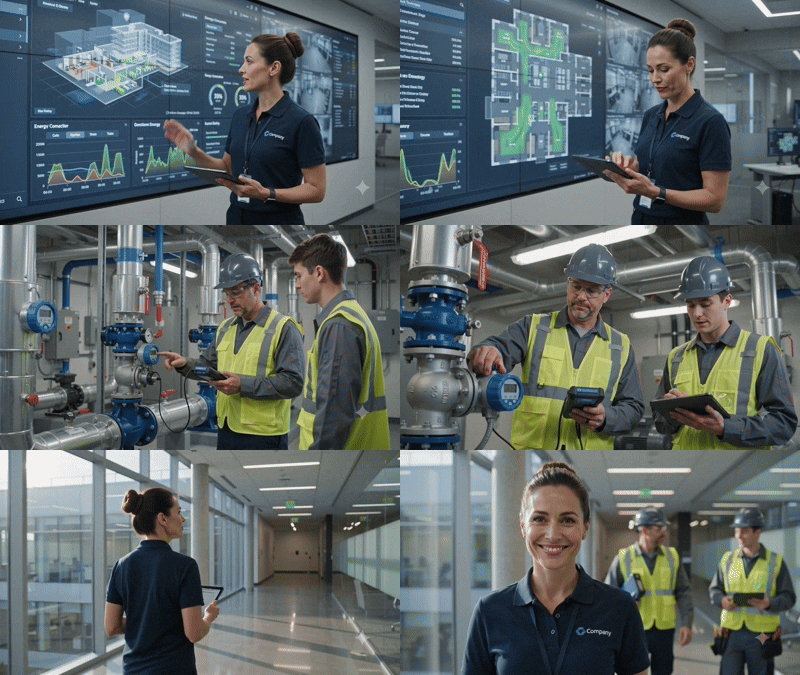
The facilities management industry has transcended its historical perception as a series of disparate maintenance tasks, evolving into a sophisticated discipline that integrates people, place, and process within the built environment to improve the quality of life and core business productivity.[1] As of 2024, the global market valuation stands at approximately $1,286 billion, with projections indicating a robust expansion to $2,996 billion by 2035, representing a compound annual growth rate of 8%.[2] This trajectory is underpinned by a systemic shift toward outsourcing non-core functions, which currently drives over 72% of market growth as organizations prioritize operational efficiency and cost reduction.[3] For the entrepreneur or corporate strategist, starting and growing a facilities management business in 2026 requires navigating a complex landscape of technological integration, stringent statutory compliance, and shifting workplace paradigms such as hybrid models and Environmental, Social, and Governance mandates.[4, 5, 6]
Structural Framework for Business Initiation
The inception of a facilities management enterprise necessitates a structured nine-step approach that transitions from conceptual validation to operational launch. The foundational phase begins with identifying a specific niche, as generalized service models often struggle to compete with the specialized expertise required in high-stakes environments like healthcare or industrial manufacturing.[7]
Market Research and Niche Selection
Initial efforts must focus on a comprehensive analysis of target market size, demographics, and competitor reputation. In 2026, market research is increasingly augmented by AI-powered tools that analyze data clusters to identify underserved geographic areas or specific service gaps.[7] Successful niche identification often targets segments with high barriers to entry, such as healthcare facilities, which account for 21% of service contracts in the United States, supported by over 6,100 hospitals requiring 24/7 technical operations.[3, 5]
| Market Vertical | Dominant Service Demand | Key Growth Driver |
|---|---|---|
| Commercial Real Estate | Integrated Facilities Management (IFM) | Optimization of total cost of ownership [2, 8] |
| Healthcare | Hard FM / Statutory Compliance | 24/7 critical asset uptime and sterilization [3, 5] |
| Government | Compliance-led Maintenance | Strict adherence to safety and building codes [3, 5] |
| Education | Asset lifecycle and Space Planning | Managing diverse property portfolios and student safety [2, 4] |
| Manufacturing | Hard FM / Predictive Maintenance | Minimizing production downtime and equipment failure [2, 9] |
Beyond traditional verticals, emerging trends suggest that residential assisted living and flexible coworking spaces are becoming high-growth segments. For instance, the US facility management market is dominated by the commercial sector, which accounts for 87% of the total market share, yet the shift to hybrid work models is forcing a reconfiguration of space utilization, creating opportunities for firms that specialize in flexible layout management and indoor air quality monitoring.[4, 5]
The Business Planning and Financial Infrastructure
A robust business plan for an FM startup must detail the service line, marketing strategy, and financial projections, including a clear funding request if external capital is required.[7] Startup costs vary dramatically based on the business model. Online or home-based consulting services might launch for under $10,000, while a comprehensive service business requiring a vehicle fleet and specialized equipment typically requires between $25,000 and $500,000.[10, 11]
| Startup Cost Component | Estimated Initial Outlay (USD) | Ongoing Monthly Expense (USD) |
|---|---|---|
| Equipment and Machinery | $5,000 – $100,000 | $500 – $2,000 (Maintenance) [10, 12] |
| Technology and Software | $25,000 – $40,000 (MVP) | $300 – $1,000 (SaaS fees) [9, 11] |
| Legal and Incorporation | $150 – $3,000 | $100 – $500 (Compliance) [10, 13] |
| Insurance Premiums | $3,000 – $10,000 | $145 – $215 [10, 14] |
| Marketing and Branding | $500 – $5,000 | 7-10% of revenue [7, 10] |
Labor is consistently the most significant operational expense, often accounting for 25% to 35% of total revenue. A specialized technician earning $15 per hour may actually cost the business between $18 and $21 per hour after factoring in payroll taxes, workers’ compensation, and benefits.[10] Consequently, financial modeling must account for a 6-to-12-month runway of operating expenses to ensure stability during the initial phase of client acquisition and contract stabilization.[10, 11]
Legal Entities and Insurance Requirements
Establishing a legal framework involves choosing between structures like an LLC, S-Corp, or C-Corp in the United States, which determines liability protection and tax obligations.[13] Registration must include obtaining an Employer Identification Number (EIN) and securing various state and local licenses. While FM licensing is not standardized nationwide in the U.S., specific services such as electrical, plumbing, or HVAC maintenance often require trade-specific certifications for both the company and its technicians.[7, 13]
Risk mitigation is achieved through a comprehensive insurance portfolio. General liability insurance protects against third-party injury or property damage, while professional liability (Errors and Omissions) is critical for protecting against claims of negligence in service delivery.[13] In the United Kingdom, Employers’ Liability insurance with a minimum of £5 million cover is a legal requirement if any staff are employed, with non-compliance resulting in daily fines of up to £2,500.[15, 16]
The Evolution of Service Delivery Models
As a facilities management business matures, the transition from single-service provision to an Integrated Facility Management (IFM) model becomes a strategic necessity for high-volume growth. Traditional FM often operates in silos, where cleaning, security, and maintenance are handled by different vendors, leading to miscommunication and overlapping tasks.[8, 17]
Integrated Facility Management (IFM)
The IFM model consolidates all facility efforts under one united team, managed through a single contract and service-level agreement.[8, 18] This approach shifts management from focusing purely on resources to outcome-based performance. By self-performing most services, an IFM provider gains economies of scope and provides the client with a “bird’s-eye view” of all management tasks, which can reduce total facility costs by up to 15%.[8, 18]
| Model Type | Management Structure | Key Advantage |
|---|---|---|
| Single Service | Individual vendors for each task | High proficiency in niche areas [8, 19] |
| Bundled Services | Groups of services under one vendor | Reduced contract management complexity [8, 18] |
| REAM (Aggregator) | Management company subcontracts all | High flexibility but lower oversight [8, 18] |
| IFM (Integrated) | Single partner, self-performed tasks | Strategic alignment and cost predictability [8, 18] |
The adoption of IFM is particularly prevalent among multi-site organizations and large corporations that desire a holistic approach to asset management. In North America, integrated FM contracts now account for approximately 20% of the outsourced market, reflecting a growing preference for “one-stop-shop” solutions.[20] This trend is driven by the need to monitor performance across multiple assets and advance sustainability targets through a unified data stream.[18]
Hard FM vs. Soft FM Services
The distinction between hard and soft services defines the operational scope of an FM business. Hard services pertain directly to the building’s physical structure and critical systems, which are often capital-intensive and subject to strict regulatory codes.[2, 18]
- Hard FM: Includes Mechanical, Electrical, and Plumbing (MEP), HVAC maintenance, fire safety systems, energy management, and structural repairs. Hard services dominate the market with a 58% to 60% share due to the vital role they play in building safety and compliance.[3, 5]
- Soft FM: Encompasses services that improve occupant experience and well-being, such as janitorial work, security, catering, groundskeeping, and waste management. While once seen as peripheral, soft services are seeing increased demand post-pandemic, focusing on workplace hygiene and flexible support for hybrid work models.[5]
Digital Infrastructure and Software Architecture
The modern facilities management firm is essentially a technology company that manages physical assets. The adoption of a centralized digital platform is no longer optional; it is the primary engine for operational efficiency and scaling.[7, 21]
CMMS, CAFM, IWMS, and EAM Comparison
Selecting the right software depends on the organization’s size, complexity, and primary pain points. Many teams initially manage operations through “point solutions” that work independently, but long-term scalability requires integrated systems.[22]
| Software Type | Core Focus | Ideal For |
|---|---|---|
| CMMS | Maintenance execution and work orders | Teams prioritizing asset reliability [21, 22] |
| CAFM | Physical space management and floor plans | Organizations focused on space optimization [22, 23] |
| IWMS | Portfolio strategy and sustainability | Large enterprises managing diverse sites [24, 25] |
| EAM | Asset lifecycle and financial planning | Asset-heavy industries like utilities/manufacturing [22, 24] |
A Computerized Maintenance Management System (CMMS) is often the entry point for FM startups, as it allows for the tracking of maintenance history and the automation of preventive maintenance schedules.[21, 22] In contrast, an Integrated Workplace Management System (IWMS) is the most comprehensive platform, unifying real estate management, operations, and sustainability tracking into a single “knowledge graph” that supports C-suite decision-making.[23, 26]
IoT, AI, and Predictive Maintenance
The integration of the Internet of Things (IoT) and Artificial Intelligence (AI) is transforming FM from a reactive to a proactive discipline. IoT sensors act as a building’s “nervous system,” collecting real-time data on temperature, vibration, humidity, and occupancy.[27, 28, 29]
Predictive maintenance, enabled by IoT, allows facility managers to identify potential equipment failures before they occur. For example, ultrasonic sensors can detect irregularities in HVAC sounds with 99% accuracy, allowing for repairs that prevent catastrophic failure and spoiled inventory.[30] Research indicates that moving toward predictive energy management can reduce energy consumption by up to 30% and operating expenses by 20%.[31]
AI systems process these massive data streams to optimize HVAC settings, predict the need for spare parts, and automate technician dispatch based on priority and skill levels.[26, 30] This technological edge is particularly crucial in addressing the current labor shortage, as it automates mundane tasks and allows limited staff to focus on strategic interventions.[26, 32]
Statutory Compliance and Risk Management
Compliance is the non-negotiable bedrock of facilities management. In 2025, firms must navigate a dense thicket of health, safety, and environmental regulations that vary by region.[33]
UK Regulatory Framework
In the United Kingdom, statutory compliance involves ensuring that buildings meet legal requirements under acts such as the Health and Safety at Work etc. Act 1974 (HSWA) and the Management of Health and Safety at Work Regulations 1999.[33] The Building Safety Act 2022 has introduced the “Golden Thread” of digital safety information, particularly for higher-risk residential buildings, requiring FM firms to maintain rigorous digital safety case files.[33]
| Regulation | Scope of Application | Mandatory Evidence |
|---|---|---|
| Fire Safety Order 2005 | All non-domestic premises | Fire Risk Assessment (FRA), maintenance logs [33] |
| Martyn’s Law (2025) | Public venues over capacity limits | Terrorism risk assessment, drills, staff training [33] |
| LOLER & PUWER 1998 | Lifting and work equipment | Statutory inspection certificates [33] |
| Asbestos Regs 2012 | Premises with ACMs | Asbestos register, re-inspection every 12 months [33] |
| Legionella (L8) | Water systems | Temperature and flushing logs [33] |
The Terrorism (Protection of Premises) Act 2025 (Martyn’s Law) is a significant new addition to the FM compliance calendar, requiring firms to implement protective security measures and terrorism risk assessments for public-facing venues.[33] To manage this complexity, many UK firms use SFG20 as their “operational backbone,” which maps legislative requirements directly into specific maintenance tasks and schedules.[33]
US Regulatory Framework
In the United States, compliance is governed by federal agencies such as OSHA for workplace safety and the EPA for environmental standards.[13] Regulatory mapping must include federal, state, and local licensing. For instance, the EPA’s Clean Air in Buildings Challenge serves as a roadmap for improving indoor air quality, which has become a key metric for tenant satisfaction and health.[34] Failure to maintain accurate maintenance logs and safety records can result in massive financial penalties and the collapse of a firm’s legal defense during an audit or lawsuit.[16, 33]
Sustainability and ESG Integration
Environmental, Social, and Governance (ESG) considerations are no longer philanthropic gestures but central components of profitability and contract retention. Clients and stakeholders increasingly select service providers based on their commitment to sustainability and social responsibility.[34, 35]
Environmental Stewardship
Facility managers are at the center of corporate environmental strategies, as buildings account for a massive portion of carbon emissions and energy use.[34, 36] Integrating sustainability involves energy optimization through LED retrofits (which can reduce energy use by 75%), the implementation of on-site renewable energy like solar panels, and water stewardship via low-flow fixtures and IoT leak detection.[34, 37]
| ESG Pillar | FM Strategic Initiative | Financial / Reputation Impact |
|---|---|---|
| Environmental | Energy audits and smart HVAC scheduling | Direct reduction in utility costs and carbon footprint [34, 37] |
| Social | Improving IAQ and workplace accessibility | Enhanced occupant productivity and talent retention [34, 36] |
| Governance | Ethical procurement and data transparency | Verified proof of compliance for investors/auditors [34] |
Balancing Profitability and Sustainability
The perceived barrier of high upfront investment in green technologies is often mitigated by long-term savings. Organizations that prioritize sustainable FM can realize substantial cost reductions while improving the value of their assets.[29, 36] Small, low-cost initiatives—such as switching to microfiber cleaning cloths or reprogramming thermostats for off-hour hibernation—can create a culture of sustainability while yielding immediate ROI.[37, 38] Achieving certifications such as LEED, WELL, or BOMA BEST® provides a standardized framework for these efforts and serves as a powerful marketing tool to win high-value contracts.[18, 37]
Human Capital and Professional Development
The facilities management sector faces an unprecedented labor shortage, with 41% of firms struggling to find skilled technicians.[3] This crisis is driven by an aging workforce, the rapid evolution of building technology, and a gap in traditional training programs.[32, 39]
Recruitment and Retention Strategies
To attract “digital natives” to the field, FM firms must emphasize the high-tech nature of the role, utilizing mobile-first platforms and cloud-based systems that align with modern workforce expectations.[26] Solutions to the labor shortage include sponsoring hands-on skilled trades programs in schools, offering paid apprenticeships, and providing scholarships for trade education.[40]
| Solution Category | Specific Implementation | Expected Outcome |
|---|---|---|
| Technology | Digitizing OT assets with IoT/AI | Attracting tech-savvy “digital natives” [26] |
| Training | Internal upskilling and retraining programs | Closing the technician skill gap [6, 32] |
| Partnerships | Collaborating with trade institutions | Creating a consistent talent pipeline [6, 40] |
| Outsourcing | Accessing niche skills via contractors | Flexibility without the cost of full-time hires [32] |
Industry Certifications
Professional credentials are vital for establishing credibility and career progression. Two major organizations, the International Facility Management Association (IFMA) and BOMI International, offer the most recognized designations.[41, 42]
- IFMA CFM (Certified Facility Manager): A globally recognized credential focused on leadership and strategic management. CFMs typically earn an average of $6,000 more per year than their non-certified peers.[41, 43]
- IFMA FMP (Facility Management Professional): Designed for entry-level or transitioning professionals to build a foundational maintenance skillset.[43]
- BOMI FMA (Facilities Management Administrator): Primarily geared toward technical operations and commercial property management roles.[41, 42]
- BOMI RPA (Real Property Administrator): Focused on those who lease space to others, emphasizing property management over internal facility occupancy.[42]
Business Development and Strategic Scaling
Scaling a facilities management business involves transitioning from local, ad-hoc work to securing multi-site contracts and navigating government procurement systems.
Government Procurement Portals
Public sector contracts offer stability and high volume. In the United Kingdom, firms must monitor the “Find a Tender” service for high-value contracts (usually over £139,688) and “Contracts Finder” for smaller opportunities.[44, 45] These portals allow for the tracking of upcoming opportunities and the research of previous award data.[46]
In the United States, SAM.gov is the centralized source for federal contract opportunities. To be competitive, firms should aim to get on the GSA Multiple Award Schedule (MAS), which opens doors to over $39 billion in annual federal spending.[47, 48] Eligibility for GSA Schedules typically requires two years of financial statements and measurable past performance, though the “Startup Springboard” program can waive these requirements for eligible small businesses.[48]
Relationship Building with Developers
For private sector growth, building trust with property owners and developers is essential. FM firms must showcase a track record of effective management through case studies and testimonials.[49] Proactive maintenance planning and transparent communication channels—where owners are kept informed of asset performance and potential risks—are the most effective ways to foster long-term loyalty and secure referrals.[49, 50]
Global Standards and Quality Assurance
As a firm scales internationally, implementing ISO 41001:2018 (the standard for Facility Management Systems) provides a clear framework for improving operations and linking them to business goals.[51] This standard helps in selecting providers who can demonstrate consistency and efficiency across different jurisdictions. It follows the Plan-Do-Check-Act (PDCA) framework, ensuring a culture of continual improvement that is essential for competing in the global marketplace.[52, 53, 54]
Operational Excellence and Best Practices for 2026
Achieving long-term success requires a “phased approach” to operational changes, ensuring minimal disruption and maximum stakeholder buy-in.[55]
- Establish a Baseline: Measure current space utilization using IoT sensors and Wi-Fi analytics to create a benchmark for success.[55]
- Iterate and Refine: Space optimization and maintenance strategies are not one-time projects; they require continuous monitoring of data to remain aligned with user needs.[55, 56]
- Involve the Team: Transparent communication with employees regarding data collection (such as occupancy sensors) is critical for privacy compliance and buy-in.[55]
- Prioritize Fundamentals: Before implementing high-end amenities, ensure foundational needs—air quality, thermal comfort, and lighting—are met, as these have the greatest impact on occupant productivity.[34, 55]
- Maintain Backup Vendors: Identify and vet backup providers for critical services (e.g., emergency electrical repairs) to ensure operational continuity during disruptions.[55, 56]
By integrating these technological, regulatory, and human-centric strategies, a facilities management business can transition from a nascent startup to a resilient, strategic partner capable of driving value in the complex real estate landscape of 2026. The shift from reactive maintenance to data-driven, sustainable, and integrated management models represents the definitive frontier for the industry’s next decade of growth.[5, 6, 18]
——————————————————————————–
- ISO 41001: Standard for Facility Management – ANAB Blog, https://blog.ansi.org/anab/iso-41001-facility-management-systems-standard/
- Facility Management Market Size, Share, Trends & Insights Report, 2035 – Roots Analysis, https://www.rootsanalysis.com/facility-management-market
- Facilities Management market Size & Trends Research [2034], https://www.marketreportsworld.com/market-reports/facilities-management-market-14722708
- North America Facilities Management Market Size and Forecast 2032 – Credence Research, https://www.credenceresearch.com/report/north-america-facilities-management-market
- Facility Management Services Market | Industry Report, 2033 – Grand View Research, https://www.grandviewresearch.com/industry-analysis/facility-management-services-market-report
- Facilities Management in 2025: Challenges and Trends – Nextbitt, https://nextbitt.com/blog/facilities-management-in-2025-challenges-and-trends
- How to Start a Maintenance Business [2025 Guide: 9 Steps + Free …, https://www.serif.ai/start-a-business/how-to-start-a-maintenance-business-2025-guide-9-steps-free-business-plan
- Integrated Facility Management vs. Facility Management – What’s The Difference? – Dexterra Group, https://dexterra.com/us/blog/integrated-facility-management-vs-facility-management-whats-the-difference/
- Facility Management Software Development Cost in 2025 – APPWRK, https://appwrk.com/insights/facility-management-software-development-cost
- How Much Does It Cost to Start a Business in 2025? – Homebase, https://www.joinhomebase.com/blog/how-much-does-it-cost-to-start-a-business
- Cost of Starting a Business with Real Examples + Free Template – FluentCart, https://fluentcart.com/blog/cost-of-starting-a-business/
- Facility Management Business Setup Cost 2025: Industry Trends – IMARC Group, https://www.imarcgroup.com/facility-management-business-plan-project-report
- How to start Facility Management business in USA – Aviaan Accounting, https://aviaanaccounting.com/how-to-start-facility-management-business-in-usa/
- The REAL Cost of Starting a Residential Assisted Living in 2025, https://www.assistedlivinginvesting.net/blog/the-real-cost-of-starting-a-residential-assisted-living-in-2025
- Property & Facilities Management Insurance – Darwin Clayton, https://www.darwinclayton.co.uk/products/property-and-facilities-management-insurance/
- Insurance for facilities managers explained – PolicyBee, https://www.policybee.co.uk/blog/insurance-facilities-managers
- Understanding FM Services: Comprehensive Look at IFM vs Traditional FM, https://www.enternest.com/blog/ifm-vs.-traditional-fm
- Integrated Facility Management – 2025 Ultimate Guide | Dexterra, https://dexterra.com/us/blog/integrated-facility-management-2025-ultimate-guide/
- Integrated Facility Management or Single FM: A comparison – Coor.com, https://www.coor.com/news/press-releases/2020/integrated-facility-management-or-single-fm-a-comparison/
- How the Facility Management Services Industry Works | Umbrex, https://umbrex.com/resources/how-industries-work/professional-business-services/how-the-facility-management-services-industry-works/
- Building Facility Management System Guide for 2025, https://trilliumfacility.com/building-facility-management-system/
- Differences Between EAM CMMS IWMS and CAFM and Deciding Which is Right for You, https://eptura.com/discover-more/blog/differences-between-eam-cmms-iwms-and-cafm/
- What you need to know about the difference between IWMS and CAFM, https://www.goassetworks.com/blog/what-you-need-to-know-about-the-difference-between-iwms-and-cafm
- Comparing Common Facility Management Tools – OfficeSpace, https://www.officespacesoftware.com/blog/asset-and-facility-management-tools/
- CAFM vs IWMS: Which Is Right For Me? Your Ultimate Guide – SFG20, https://www.sfg20.co.uk/blog/cafm-vs-iwms
- Addressing the FM Labor Shortage – FMJ Magazine – IFMA, https://fmj.ifma.org/addressing-the-fm-labor-shortage
- IoT Facility Management: How It’s Transforming the Industry, https://blog.ifma.org/iot-facility-management
- Guide to Smart Building Technology in 2025 – Understanding the Future – Coram AI, https://www.coram.ai/post/smart-building-technology
- Facilities Management Recruitment Trends 2025: Sustainability and the Leaders Driving Change | CSG Talent, https://www.csgtalent.com/insights/blog/facilities-management-recruitment-trends-2025–sustainability–smart-buildings–and-the-leaders-driving-change/
- Facilities Management Technology Trends to Embrace in 2025, https://www.cityfm.us/blog/facilities-management-technology/
- How smart sensors are transforming building energy management | illuminem, https://illuminem.com/illuminemvoices/from-passive-to-predictive-how-smart-sensors-are-transforming-building-energy-management
- 10 Facilities Management trends and challenges in 2025 – Infraspeak Blog, https://blog.infraspeak.com/facilities-management-challenges/
- 10 Essential UK Facilities Management Compliances (2025) – Facilio, https://facilio.com/blog/statutory-compliance-for-facilities-management/
- How ESG Goals Are Reshaping Facilities Management Strategies, https://facilitiesmanagementadvisor.com/maintenance-and-operations/how-esg-goals-are-reshaping-facilities-management-strategies/
- ESG and Facility Management – IFMA, https://pages.ifma.org/esgfm
- Understanding the Importance of Sustainability in Facility Management – FlowPath CMMS, https://www.getflowpath.com/blog/importance-of-sustainability-in-facility-management
- Sustainability in Facilities Management: Strategies for Greener Buildings – ISSA, https://www.issa.com/articles/sustainability-in-facilities-management/
- Balancing Sustainability with Profitability – Executive Search – 3P Partners, https://3ppartners.com/balancing-sustainability-with-profitability/
- Workforce shortages accelerate global demand for integrated facility management, https://theinvestor.vn/workforce-shortages-accelerate-global-demand-for-integrated-facility-management-d17936.html
- Staffing Challenges, High-Level Solutions – Facilities Management Insights – Facilitiesnet, https://www.facilitiesnet.com/facilitiesmanagement/article/Staffing-Challenges-High-Level-Solutions–20668
- BOMI vs IFMA Which Certification Grows Your Career & Salary Faster – YouTube, https://www.youtube.com/watch?v=4__Px-tzCkU
- Which Facility Management Association and Designation is right for you?, http://facilityleadership.com/blog/career/which-facility-management-association-and-designation-is-right-for-you
- The Best Facility Maintenance Certification for You – Limble, https://limble.com/learn/maintenance-training/facility-certification/
- Procurement at Home Office – GOV.UK, https://www.gov.uk/government/organisations/home-office/about/procurement
- Contracts Finder – GOV.UK, https://www.gov.uk/contracts-finder
- Procurement Portals: Navigating UK Systems for Business Growth – Thornton & Lowe, https://thorntonandlowe.com/procurement-portals-navigating-uk-systems-for-business-growth/
- Contracting | SAM.gov, https://sam.gov/contracting
- How to access contract opportunities | GSA, https://www.gsa.gov/sell-to-government/step-1-learn-about-government-contracting/how-to-access-contract-opportunities
- How to Build Strong Relationships with Property Owners, https://propertymeld.com/blog/how-to-build-strong-relationships-with-property-owners/
- Why Relationships Matter in the Facilities Management Industry – Fexa, https://fexa.io/blog/why-relationships-matter-in-the-facilities-management-industry/
- ISO 41001 Certification Guide | Facility Management Excellence, https://ossmideast.com/iso-41001-certification-guide-facility-management-excellence/
- The 2025 facility managers’ reading list – World FM Day, https://worldfmdayinfo.ifma.org/hubfs/World%20FM%20Day/World%20FM%20Day%202025/World%20FM%20Day%20Content%202025/2025WorldFMDay-FacilityManagersReadingList.pdf?hsLang=en
- ISO 41001 Facility Management Systems Implementation & Training, https://www.iso41001guide.com/
- ISO 41001 for Facility Management: All you need to know – Spacewell, https://spacewell.com/resources/blog/iso-41001-facility-management/
- 8 Facility Management Best Practices for 2025 – Vendmoore Enterprises, https://www.vendmoore.com/post/8-facility-management-best-practices-for-2025
- Tenant Engagement Strategies for Commercial Properties – Singu, https://singu.com/tenant-engagement-strategies-for-commercial-properties/


Leave a comment