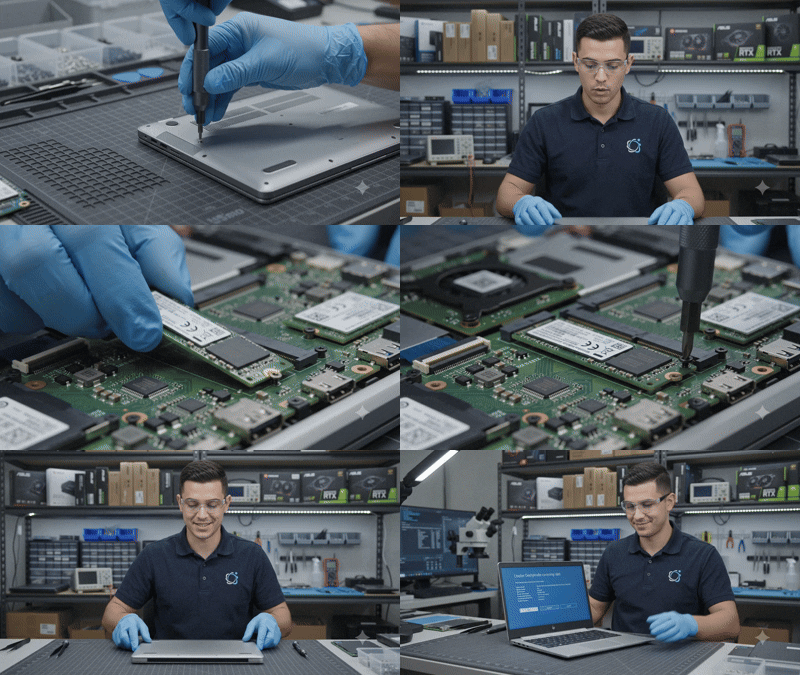
The landscape of the hardware services industry is undergoing a systemic transition, moving away from reactive, incident-based repairs toward proactive, integrated lifecycle management. As of 2026, the proliferation of sophisticated electronic components across every economic sector—from decentralized finance and healthcare to automated manufacturing and smart infrastructure—has elevated hardware services from a secondary support function to a primary driver of industrial continuity.[1, 2] The successful establishment of a hardware service venture now demands a multi-disciplinary approach that synthesizes technical expertise with advanced financial modeling, rigorous regulatory compliance, and a digitized operational infrastructure.[3, 4]
1. Macro-Economic Drivers and Emerging Market Opportunities
The valuation of the hardware services market is increasingly tethered to the explosive growth of specialized technology sectors. Artificial Intelligence (AI) and the Internet of Things (IoT) have emerged as the dominant catalysts for hardware demand. For instance, the AI market is projected to expand at an annual rate of 37.1% through 2030, necessitating a massive physical infrastructure of GPU clusters, edge computing nodes, and specialized cooling systems that require constant maintenance.[5] Simultaneously, global IoT revenue is expected to reach approximately $419.8 billion by 2025, creating a vast ecosystem of billions of connected devices that require physical installation, network integration, and sensor calibration.[2]
Foundational Growth Projections for 2026 Hardware Service Segments
| Market Vertical | Projected Annual Growth | Key Hardware Drivers | Infrastructure Requirements |
|---|---|---|---|
| Artificial Intelligence | 37.1% | GPU/TPU Arrays, Edge Nodes | High-density cooling, specialized power |
| Internet of Things (IoT) | 10.6% | Sensors, Gateways, Actuators | Low-latency networks, remote power |
| Cybersecurity | 13.8% | Hardware Firewalls, HSMs | Physical security audits, biometric tech |
| Smart Home Technology | 10.6% | Security cameras, HVAC controls | Consumer-grade wireless integration |
| Fintech Infrastructure | 25% – 40% (FinTech) | ASIC Miners, POS Terminals | Secure physical data reconciliation |
[1, 2, 5]
This economic expansion is further fueled by the increasing cost of technical downtime. With data breaches now costing an average of $4.45 million per incident, businesses are aggressively shifting their hardware budgets toward preventive maintenance and hardware-level security.[5] This creates a high-margin opportunity for service providers who can offer proactive monitoring and rapid-response physical support.[3, 4]
2. Entrepreneurial Strategy: Launching and Structuring the Venture
Starting a hardware service business in 2026 requires a phased approach that begins with exhaustive market research and a clear definition of the business model. Entrepreneurs must decide between the autonomy of an independent operation and the established systems of a franchise model.[6] Franchises like Ace Hardware or True Value offer immediate name recognition and robust supplier networks, which can significantly reduce the initial barrier to entry, though they require adherence to standardized corporate protocols and the payment of ongoing royalties.[6]
The 12-Step Framework for Hardware Venture Initiation
Establishing a viable entity involves a complex sequence of legal, financial, and operational milestones. The following table outlines the critical path for the first year of operation.
| Phase | Milestone | Primary Objective | Estimated Capital Requirement |
|---|---|---|---|
| I: Planning | Market Niche Definition | Identifying unmet local/industry demand | $1,000 – $5,000 |
| II: Legal | Entity Registration (LLC/S-Corp) | Personal asset protection & tax optimization | $500 – $2,500 |
| III: Financial | Capital Sourcing (SBA/Private) | Securing $100k – $500k in startup funds | N/A |
| IV: Facility | Site Selection & Zoning | Choosing high-visibility/high-access spots | $5,000 – $50,000 (Deposit) |
| V: Compliance | Licenses & Insurance | FCC, CE, Liability, and Workers’ Comp | $2,000 – $10,000 |
| VI: Supply | Supplier Relationship Setup | Direct OEM vs. Wholesaler accounts | $50,000 – $200,000 (Initial Stock) |
| VII: Tech | FSM & POS Integration | Implementing Salesforce, Joblogic, or ERP | $2,000 – $10,000 |
| VIII: Workforce | Hiring & Vetting | Recruiting certified technicians (CompTIA A+) | Variable |
| IX: Training | Skill Certification | Specialized training (Medical, Industrial) | $500 – $2,000 per staff |
| X: Operations | Workspace Optimization | Bench setup, diagnostic suite assembly | $10,000 – $30,000 |
| XI: Marketing | Digital & Local SEO | Google Business Profile, LinkedIn outreach | $2,000 – $5,000/mo |
| XII: Launch | Grand Opening & Referral Launch | Creating initial customer momentum | $5,000 – $10,000 |
[4, 6, 7, 8, 9]
The choice of legal structure is particularly vital. While a sole proprietorship is simple to establish, the analysis indicates that for most hardware service businesses, a Limited Liability Company (LLC) offers the optimal balance of liability protection and tax flexibility.[4, 7] For firms planning rapid scaling or public investment, an S-Corporation structure may provide superior long-term tax advantages for owners.[4]
3. Financial Modeling: Transitions from Break-Fix to MaaS
The most significant strategic shift in the industry is the migration from the traditional “break-fix” model to “Managed Hardware as a Service” (MaaS). The break-fix model is inherently reactive; providers generate revenue only when a customer’s equipment fails.[3, 10] This creates a fundamental misalignment of incentives, as the provider profits from dysfunction. In contrast, the MaaS model uses a fixed-fee subscription approach, where the provider is incentivized to maintain system stability, as every failure reduces the provider’s profit margin.[3, 10, 11]
Comparative Economics of Hardware Service Models
| Operational Metric | Break-Fix Model (Reactive) | Managed Services (MaaS/Proactive) |
|---|---|---|
| Revenue Stream | Transactional & Unpredictable | Recurring & Predictable (Monthly) |
| Client Relationship | Ad-hoc / Distance | Strategic Partnership |
| Financial Incentive | Revenue increases with failure | Revenue increases with stability |
| Cost to Client | High per-incident spikes | Lower long-term predictable OPEX |
| Provider Risk | High (Revenue volatility) | Low (Sustained cash flow) |
| Response Time | Best effort / On-call | SLA-guaranteed (e.g., 4-hour fix) |
[3, 12, 13]
Evidence suggests that managed services can lead to a 25% to 40% reduction in IT costs for the end-user through the avoidance of major outages and emergency repair rates.[11, 13] For the service provider, the MaaS model ensures a steady cash flow that facilitates better personnel planning and inventory management.[10]
2025 Pricing Benchmarks for Managed Hardware Services
To maintain competitiveness while ensuring profitability, firms must align their pricing with regional and industry benchmarks.
| Service Tier | Per-User Pricing (Monthly) | Per-Device Pricing (Monthly) | Industry Premium |
|---|---|---|---|
| Standard Support | $100 – $250 | Variable | Baseline |
| Healthcare/HIPAA | $125 – $275 | Computer: 60−150 | +18% to 30% |
| Legal/Compliance | $110 – $260 | Server: 200−400 | +10% to 20% |
| Manufacturing/Industrial | $105 – $255 | Network: 30−100 | +5% to 15% |
| SLA 1-Hour Response | +15% to 25% | Mobile: 15−40 | N/A |
[14, 15]
The implementation of Hardware as a Service (HaaS) adds another layer of complexity, where the provider retains ownership of the hardware and leases it to the client as part of a service bundle. This shift from CAPEX to OPEX for the client often necessitates that the service provider secures debt financing or equipment lines of credit to fund the initial purchase of the hardware assets.[16]
4. Specialized Niche Segments and Technical Requirements
Specialization is the most effective strategy for differentiating a new hardware service firm from commoditized competitors. High-growth niches in 2026 require not only technical proficiency but also specific regulatory knowledge and specialized equipment.
Medical Equipment Services and Clinical Calibration
The medical hardware sector is one of the most resilient and high-margin niches available. Technicians in this space are responsible for the installation, calibration, and repair of life-critical devices, including MRI machines, patient monitors, and surgical robotics.[17, 18] The complexity of these systems requires an intimate understanding of both mechanical engineering and electronic logic.[18, 19]
Critical success factors in this niche include:
- Regulatory Knowledge: Adherence to FDA and local health department standards.[18]
- Specialized Certification: Mandatory requirements often include the Certified Biomedical Equipment Technician (CBET) credential.[17, 19]
- Emergency Response: The ability to provide 24/7 support, as equipment failure in a clinical setting can directly impact patient safety.[17, 18]
Industrial and Manufacturing Maintenance
Industrial maintenance firms focus on the “Equipment Triangle” of equipment owners, suppliers, and service professionals.[20] Technicians must be capable of servicing CNC machines, programmable logic controllers (PLCs), and variable frequency drives (VFDs).[21, 22] This niche is increasingly moving toward “predictive maintenance,” where IoT sensors provide real-time data on vibration, heat, and power draw to predict hardware failure before it halts production lines.[5, 22]
Summary of Specialized Technical Skills by Vertical
| Vertical | Core Technical Skills | Essential Tools | Key Certifications |
|---|---|---|---|
| Medical | Biomedical logic, Calibration | Hi-Pot testers, simulators | CBET, CLES |
| Industrial | PLCs, VFDs, Hydraulics | Multimeters, ladder logic soft | CEM, CESP, Mechatronics |
| Cybersecurity | HSMs, Firewalls, Biometrics | Penetration testing rigs | CISSP, CompTIA Security+ |
| PC/Computing | Advanced troubleshooting | Diagnostic suites, soldering | CompTIA A+, ACMT |
| Industrial HVAC | Pneumatics, Steam systems | Pressure gauges, HVAC/R kits | Section 608 (EPA) |
[4, 17, 20, 21, 22, 23]
5. Regulatory Compliance and Global Quality Standards
Compliance is a non-negotiable pillar of the hardware services industry. For a new venture, failure to meet regulatory requirements can result in legal penalties, the voiding of insurance policies, and the loss of critical B2B contracts.[6, 24]
Electromagnetic and Safety Certifications
In the United States, the Federal Communications Commission (FCC) regulates all electronic devices that oscillate at 9 kHz or higher to prevent interference with communication networks.[24] For hardware service firms, it is essential to ensure that any components used in repairs or any refurbished units sold meet these standards.
- FCC Class A: Intended for industrial applications; testing is slightly less rigorous.[24]
- FCC Class B: Stricter testing for consumer products, reflecting the higher density of devices in residential environments.[24]
- Intentional vs. Non-intentional Radiators: Products with wireless capabilities (Wi-Fi, Bluetooth) are “intentional radiators” and require more complex certification.[24]
In international markets, the CE mark is required for all hardware sold in the European Union, signaling compliance with health, safety, and environmental standards.[24] While Underwriters Laboratories (UL) and the Canadian Standards Association (CSA) are technically voluntary, most insurance providers and major retailers mandate these certifications to mitigate fire and electrical shock risks.[24]
Environmental Stewardship and Data Security
The modern hardware service firm acts as a critical link in the circular economy. Responsible recycling (R2v3) and RIOS certifications are essential for businesses handling end-of-life electronics.[25, 26, 27] These standards ensure that hazardous materials such as lead, mercury, and cadmium are recovered safely and that data-bearing devices are sanitized before reuse or destruction.[25]
The R2v3 standard establishes six core process requirements that define operational excellence in hardware services:
- Downstream Recycling Chain: Ensuring that materials are tracked to their final disposition.[26]
- Data Sanitization: Utilizing physical shredding or logical wiping that meets NIST 800-88 standards.[24, 26]
- Test and Repair: Prioritizing reuse and refurbishment over recycling to extend equipment life.[25, 26]
- Specialty Electronics: Managing high-value or highly-regulated hardware like medical or telecom gear.[26, 28]
- Material Recovery: Maximizing the reclamation of precious metals from non-repairable boards.[26, 27]
- Brokering: Managing the secure transfer of assets between different market entities.[26]
6. Operational Optimization: The Technological Stack
The efficiency of a hardware service organization in 2026 is largely a function of its software integration. The transition from paper-based tracking to Field Service Management (FSM) software allows firms to optimize technician routing, manage complex parts inventory, and provide customers with real-time transparency.[29, 30, 31]
Critical Features of FSM and ERP Platforms
A robust FSM platform must provide more than simple scheduling. For hardware-centric businesses, asset management and inventory logistics are paramount.[31]
| Software Platform | Best Use Case | Primary Differentiator | Hardware-Specific Features |
|---|---|---|---|
| ServiceMax | Asset-Heavy Industrial | Complex lifecycle management | Cradle-to-grave asset tracking |
| Salesforce FSM | CRM-Integrated B2B | Einstein AI-powered scheduling | Unified customer/service view |
| Joblogic | Scaling Service SME | Advanced reporting & compliance | Asset register, mobile job history |
| Monday.com | Small / Agile Teams | High visual customization | Drag-and-drop project boards |
| Workever | Small Field Trades | Ease of use for small teams | Mobile quoting & invoicing |
| NetSuite | Enterprise ERP | Integrated financials & inventory | Multi-location stock visibility |
[29, 30, 31, 32]
Advanced platforms like ServiceMax specialize in equipment-centered industries, tracking high-value assets through installation, preventive maintenance cycles, and eventual decommissioning.[31] For businesses scaling through the MaaS model, integration with Remote Monitoring and Management (RMM) tools is essential to detect hardware failures remotely and trigger automated work orders.[5, 12]
7. Workforce Management: Hiring, Vetting, and Skills Development
Technical talent remains the most constrained resource in the hardware services sector. To build a resilient service organization, firms must implement rigorous vetting protocols and ongoing training programs.[18, 33]
Technical Competency and Certification Roadmap
Technicians must be evaluated on a combination of mechanical aptitude, electronic logic, and soft skills. The ability to explain complex technical failures to a non-technical business owner is as important as the ability to solder a surface-mount component.[18, 33]
Foundational and Advanced Certifications:
- CompTIA A+: The industry standard for foundational hardware support.[23, 33]
- CompTIA Network+: Essential for technicians working on IoT and networked industrial equipment.[4, 33]
- Certified Electronics Technician (CET): Validates expertise in analog and digital circuitry.[23]
- Certified Interconnect Designer (CID): Specialized for firms involved in PCB repair and redesign.[23]
- Cisco CCNA: Vital for high-end network hardware configuration and maintenance.[23]
Hiring for specialized roles, such as medical device technicians, often requires partnering with niche staffing agencies like Medix, which utilize candidate assessments to evaluate performance potential and long-term cultural fit.[18, 34]
8. Supply Chain Resilience and Component Sourcing Strategies
The profitability of a hardware service business is highly sensitive to the cost and availability of replacement parts. Service providers must navigate the trade-offs between OEM, aftermarket, and refurbished components.[35, 36]
The Component Sourcing Matrix
| Feature | OEM (Original Equipment) | Aftermarket (Third-Party) | Refurbished / Remanufactured |
|---|---|---|---|
| Quality | Consistent, Brand-standard | Highly variable | Tested to original spec |
| Cost | Highest upfront cost | Lowest upfront cost | Moderate (Fraction of new) |
| Compatibility | Guaranteed fit | Potential for misalignment | High (Original part) |
| Warranty | Backed by manufacturer | Limited or non-existent | Backed by refurbisher |
| Impact on Asset | Preserves resale value | Potential for premature wear | Extends equipment lifespan |
| Sustainability | Low | Low | High (Circular economy) |
[35, 36, 37, 38]
Strategic sourcing involves using OEM parts for safety-critical systems and aftermarket parts for non-critical cosmetic or peripheral repairs where cost is the primary factor.[35, 36] Refurbished parts are particularly valuable for extending the life of decommissioned or “end-of-life” systems that are no longer supported by the manufacturer.[38]
9. Logistics and Reverse Logistics Orchestration
Logistics in hardware services involves a complex flow of “forward” delivery (sending technicians or parts to a site) and “reverse” logistics (bringing failed hardware back for repair or recycling).[39, 40] Efficient logistics reduce the amount of capital tied up in slow-moving inventory and improve customer satisfaction through faster turnaround times.[40, 41]
Optimization Strategies for Hardware Logistics
- Route Optimization: AI-powered route planning reduces fuel costs and transit times, which is critical for same-day repair commitments.[39, 41, 42]
- Strategic Warehousing: Utilizing micro-fulfillment centers or strategic depots near high-density customer zones allows for more rapid response to emergency service calls.[42]
- Reverse Logistics Planning: A structured five-step process (Process, Identify, Keep in Motion, Repair, Recycle) ensures that returned hardware is handled efficiently and either returned to the “available” stock or responsibly recycled.[40]
- Last-Mile Visibility: Providing customers with real-time GPS tracking of their service technician or their parcel’s location builds trust and reduces missed service windows.[39, 42, 43]
For high-value industrial equipment, logistics must also account for specialized handling requirements. This includes using climate-controlled transport and taking photographic evidence of the load at every transfer point to protect against damage claims.[43]
10. Growth and Networking: The B2B Referral Ecosystem
Successful scaling in hardware services is rarely achieved through traditional advertising alone. Instead, growth is driven by trust-based referral partnerships and strategic B2B networking.[44, 45, 46]
Strategic Alliances and Partnership Models
- Referral Partnerships: Building relationships with non-competing businesses that serve the same clientele, such as an IT repair firm partnering with a cybersecurity insurance provider.[44, 47]
- Reseller Models: Purchasing hardware at wholesale rates and bundling it with managed service contracts to provide an all-in-one solution.[44]
- Integrated Marketing: Collaborating with hardware manufacturers (OEMs) to become an “Authorized Service Provider,” which provides a steady stream of warranty-based leads.[47, 48]
In the 2026 era, networking is “digital-first.” Successful entrepreneurs prioritize a relationship-first approach, using AI-enhanced outreach to deliver personalized value to potential partners rather than generic sales pitches.[49] This involves active participation in industry forums, hosting educational webinars, and maintaining a robust presence on LinkedIn, which remains the primary engine for B2B social leads.[49, 50, 51]
11. Strategic Conclusions and Path Forward
The establishment of a hardware service enterprise in the current technological climate demands a departure from the artisanal repair shops of the past. The analysis confirms that profitability and scalability are now linked to the adoption of proactive, fixed-fee managed services and Hardware as a Service models.
To succeed, new ventures must prioritize:
- Niche Specialization: Focusing on high-complexity, high-regulation verticals like medical, industrial, or secure fintech hardware.
- Technological Integration: Utilizing FSM and ERP platforms to automate workflows and provide deep asset visibility.
- Regulatory Rigor: Achieving R2v3, ISO, and electromagnetic certifications to build B2B credibility and environmental accountability.
- Strategic Supply Chains: Developing diverse sourcing strategies that balance OEM reliability with the cost-efficiency of refurbished parts.
- Human Capital: Building a team of multi-disciplinary technicians supported by ongoing professional development and industry-recognized certifications.
As hardware becomes more deeply embedded in the logic of global industry, the firms that position themselves as the “guardians of the physical layer” will be the ones that capture the most significant value in the 2026 technology ecosystem. The convergence of AI-driven diagnostics and circular economy recycling standards represents the next frontier for the industry, offering a sustainable and highly profitable pathway for the next generation of hardware service entrepreneurs.
——————————————————————————–
- Top 10 IT Startup Ideas for 2025: Proven Niches for Real Growth – Ptolemay, https://www.ptolemay.com/post/top-10-it-startup-ideas-for-nowadays
- 25 Profitable Tech Business Ideas for 2026 Beginners – Shopify, https://www.shopify.com/blog/tech-business-ideas
- Break/Fix vs. Managed Services IT Models Explained – NinjaOne, https://www.ninjaone.com/blog/does-break-fix-still-have-a-place-in-the-it-channel/
- How to Start a PC Repair Business [2025 Guide: 9 Steps + Free …, https://www.serif.ai/start-a-business/how-to-start-a-pc-repair-business-2025-guide-9-steps-free-business-plan
- 15 Breakthrough Tech Business Ideas for Startups in 2025 – Nextsky, https://nextsky.co/blogs/e-commerce/tech-business-ideas
- How to Start a Hardware Store? A 12-Step Guide for 2025 – korona pos, https://koronapos.com/blog/how-to-start-a-hardware-store/
- How to Start Hardware Store in 5 Steps: Comprehensive Guide – Lightspeed, https://www.lightspeedhq.com/blog/how-to-start-a-hardware-store-in-5-steps/
- How To Open a Hardware Store in 7 Steps – Comcash, https://www.comcash.com/blog/how-to-open-a-hardware-store
- Everything You Need to Start & Open a Hardware Store – National Retail Solutions, https://nrsplus.com/blog/how-start-a-hardware-store/
- Break-Fix vs. Managed Services Explained – Smart CT, https://www.smartct.com/insights/break-fix-vs-managed-services-explained/
- What Is the Difference Between Break/Fix and Managed IT Services?, https://kelleycreate.com/break-fix-and-managed-it/
- Break-Fix vs Managed Services Comparison – OXEN Technology, https://oxen.tech/blog/managed-service-vs-break-fix/
- Break-fix vs. managed services: Which Model Wins Today? – OneNet Global, https://www.onenetglobal.com/managed-service-vs-break-fix/
- Managed IT Services Pricing in 2025: How Much Should You Pay?, https://www.sterling-technology.com/blog/managed-it-services-pricing
- Average Cost of Managed IT Services: 2025 SMB Pricing Guide – Xperts Unlimited, https://xpertsunlimited.com/average-cost-of-managed-it-services/
- HaaS 100 (early July 2025) – Hardfin blog, https://blog.hardfin.com/haas-100/hardware-as-a-service-companies-volume-30
- 16−48/hr Medical Equipment Repair Jobs in California – ZipRecruiter, https://www.ziprecruiter.com/Jobs/Medical-Equipment-Repair/–in-California
- Medical Equipment Technician Hiring Guide, https://www.ziprecruiter.com/hiring/how-to-hire/medical-equipment-technician
- Medical Equipment Repairers – Occupation Profile | NC Careers.org, https://nccareers.org/occupation-profile/499062/1284
- Certifications – Association of Equipment Management Professionals (AEMP), https://aemp.org/page/certifications
- Industrial Maintenance Certificate | Grand Rapids Community College, https://www.grcc.edu/programs/industrial-maintenance-certificate
- Industrial Equipment Technology (Certificate) – Jamestown Community College, https://www.sunyjcc.edu/programs/industrial-equipment-technology-certificate
- Best Certifications for Hardware Engineers in 2025 (Ranked) – Teal, https://www.tealhq.com/certifications/hardware-engineer
- Certifications for Electronics Hardware: When, Why and How to …, https://www.acdi.com/certifications-electronics-hardware-obtain/
- The Ultimate Guide to R2v3 (Responsible Recycling) Certification …, https://www.4thbin.com/blogs/r2v3-responsible-recycling-certification
- R2v3 and RIOS Certifications – Georgia Computer Inc., https://gcitad.com/about/certifications
- Electronic Waste (e-Waste) Recycling Certification – NSF, https://www.nsf.org/sustainability/circularity-waste-materials-management/e-waste-recycling-certification
- R2 – SERI, https://sustainableelectronics.org/r2/
- Best Online Field Service Management Software Companies for 2025 – Research.com, https://research.com/software/online-field-service-management-software-companies
- 6 Best Field Service Management Software 2025 | Salesforce, https://www.salesforce.com/service/field-service-management/software/
- 8 Best Field Service Management Software Solutions in 2025, https://threadgoldconsulting.com/insights/best-field-service-management-software-solutions
- Best Field Service Management Software [2025] | Workever, https://workever.com/blog/best-field-service-management-software/
- How to become a hardware technician – CareerExplorer, https://www.careerexplorer.com/careers/hardware-technician/how-to-become/
- Medical Device Staffing | Medix Staffing Solutions, https://www.medixteam.com/solutions/life-sciences/medical-device-staffing/
- Comparing OEM vs. Aftermarket Equipment Parts – Thompson Tractor, https://thompsontractor.com/blog/oem-vs-aftermarket-parts/
- OEM vs. Aftermarket Parts: What OEMs Need to Know – Partful, https://partful.io/blog/oem-vs.-aftermarket-parts-what-oems-need-to-know
- Genuine Parts vs. Aftermarket Parts: How After-Sales Leaders in Industrial Equipment Manufacturing Can Win Back Customers and Drive Revenue – CDS Visual, https://cdsvisual.com/blog/genuine-parts-vs-aftermarket-parts-how-after-sales-leaders-in-industrial-equipment-manufacturing-can-win-back-customers-and-drive-revenue/
- Why Refurbished Spare Parts Matter in Equipment Maintenance – Agrius IT, https://agriusit.com/refurbished-spare-parts/
- Parcel Logistics: Strategies, Challenges, and Innovations for Efficient Deliveries – PackageX, https://packagex.io/blog/parcel-logistics
- A Guide to Reverse Logistics: How It Works, Types and Strategies | NetSuite, https://www.netsuite.com/portal/resource/articles/inventory-management/reverse-logistics.shtml
- 6 TIPS TO STREAMLINE THE OPERATIONS OF YOUR COURIER COMPANY, https://www.keysoftwaresystems.com/newsroom/6-tips-to-streamline-the-operations-of-your-courier-company/
- How Hardware Stores Ensure Same-Day Delivery – Solbox, https://www.solbox.it/how-hardware-stores-ensure-same-day-delivery/
- Best Practices for Delivery Service – The Hardware Connection, https://thehardwareconnection.com/best-practices-for-delivery-service/
- How to Build a Successful Referral Partner Program, https://referral-factory.com/learn/referral-partner
- The Art of Effective B2B Networking: Strategies and Tips | Marketfit.co, https://www.marketfit.co/the-art-of-effective-b2b-networking-strategies-and-tips/
- B2B Networking: Strategies, Trends & How it Works | by Dreamcast – Medium, https://dreamcast.medium.com/b2b-networking-strategies-trends-how-it-works-d3c8f66b72a3
- Guide to Building a Partner Network – sales – Reddit, https://www.reddit.com/r/sales/comments/48bbjh/guide_to_building_a_partner_network/
- 4 Elements of a Valuable ISV-Hardware Integration Partnership – – RSPA, https://www.gorspa.org/commiq-4-elements-of-a-valuable-isv-hardware-integration-partnership/
- B2B Networking 2025: Trends, Strategies, and Expert Insights – Martal Group, https://martal.ca/b2b-networking-lb/
- Top B2B Networking Tips for Business Growth and Success – CMIT Solutions Franchise, https://cmitfranchise.com/blog/b2b-networking-tips/
- 3 B2B Networking Strategies That Won’t Break the Bank | Gripped, https://gripped.io/digital-marketing-strategy/b2b-networking-strategies/


Leave a comment