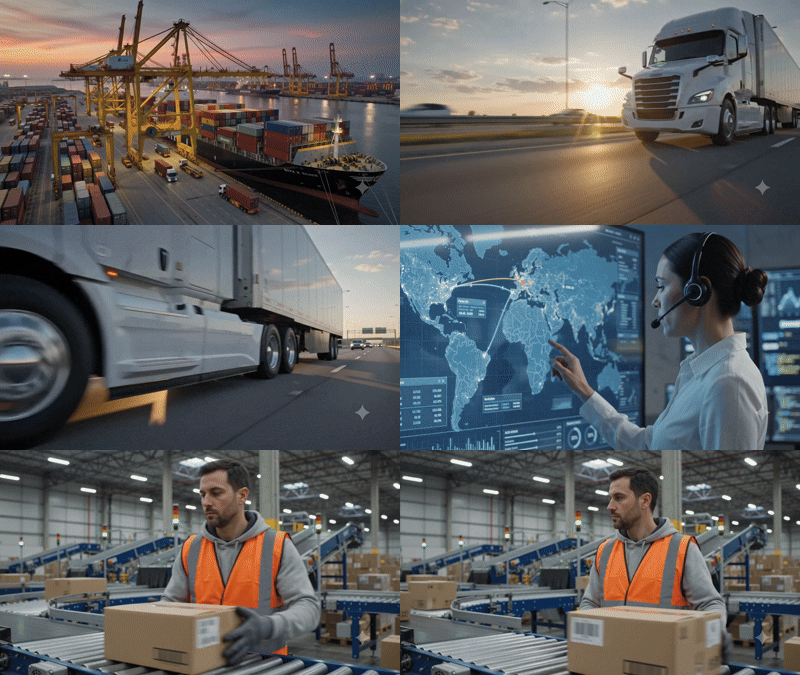
The global logistics and transportation landscape in 2026 stands at the precipice of a radical transformation, driven by the convergence of advanced digital architectures, evolving regulatory mandates, and a structural shift in the labor market. Developing a resilient enterprise within this sector requires a sophisticated synthesis of capital management, technological integration, and a nuanced understanding of the multimodal supply chain.[1, 2] As traditional barriers to entry are complicated by high initial capital expenditures and increasingly complex compliance requirements, the distinction between a successful firm and an operational failure is increasingly defined by the ability to leverage data as a primary asset.[3, 4]
Strategic Niche Identification and Market Positioning
The foundational step in establishing a logistics enterprise is the rigorous selection of a specific niche. The breadth of the industry—ranging from freight brokerage to specialized hazardous materials (HAZMAT) transport—precludes a generalized approach for new entrants.[1, 5] Specialization allows a firm to cultivate the specific technical expertise and regulatory compliance necessary to command higher margins in a competitive market.[1]
Taxonomy of Logistics Business Models
The industry is categorized into several distinct layers of involvement, often referred to as Logistics Models (PL). A 1PL model involves an enterprise managing its own logistics internally, whereas 2PL involves outsourcing only the physical transport to a carrier.[6] The 3PL (Third-Party Logistics) model represents a comprehensive integration where a provider handles storage, fulfillment, and distribution, becoming a strategic extension of the client’s brand.[6, 7] In contrast, the 4PL model acts as a lead logistics provider, coordinating multiple 3PLs across an entire supply chain.[6]
| Model | Primary Focus | Service Scope | Typical Client Base |
|---|---|---|---|
| Freight Brokerage | Intermediation | Connecting shippers with carriers; non-asset based | Mid-market manufacturers; seasonal retailers [1, 8] |
| 3PL Provider | Integration | Warehousing, picking, packing, and technology tools | E-commerce brands; wholesale distributors [7, 9] |
| Freight Forwarder | Cross-Border | International shipping coordination; customs clearance | Import/Export firms; global manufacturers [7, 10] |
| Trucking (Asset-Based) | Physical Transport | Regional, interstate, or specialized hauling | Direct shippers; freight brokers [11, 12] |
| Last-Mile Delivery | Final Fulfillment | Urban courier services; e-commerce delivery | Local retailers; B2C e-commerce [1, 2] |
The decision to be asset-heavy (owning trucks and warehouses) versus asset-light (brokerage and forwarding) fundamentally dictates the firm’s financial risk and scalability.[2] Asset-light models, such as freight brokerage, offer lower entry costs but require exceptional sales and negotiation skills, whereas asset-heavy models offer greater control over service quality but entail significant debt service and maintenance burdens.[11, 13]
Financial Architecture and Capital Requirements
Starting a logistics business in 2026 demands a rigorous financial blueprint. The initial capital requirement is highly sensitive to the chosen niche and the level of asset ownership.[1] For instance, a lean freight brokerage can launch for as little as $3,000 to $15,000, while a full-scale 3PL operation with owned facilities and fleets can require upwards of $1.2 million.[2, 8]
Comparative Startup Cost Analysis
A detailed breakdown of initial expenditures reveals the high cost of compliance and technology integration, which often rivals the cost of physical assets.
| Expense Category | Trucking (Used Unit) | Freight Brokerage | Digital 3PL Platform |
|---|---|---|---|
| Vehicles / Equipment | $20,000 – $50,000 | N/A | N/A [3, 12] |
| Insurance Down Payment | $2,000 – $4,800 | $2,000 – $5,000 | $5,000+ [8, 11] |
| Technology / Software | $100 – $1,000 | $500 – $5,000 | $150,000+ [14, 15] |
| Licenses & Permits | $1,000 – $3,000 | $300 | $5,000 [12, 14] |
| Marketing & Branding | $500 – $2,000 | $1,000 – $3,000 | $25,000 [14, 15] |
| Surety Bond (Form BMC-84) | N/A | $1,000 – $10,000 | N/A [8] |
| Working Capital Reserve | $5,000 – $10,000 | $5,000 – $15,000 | $311,000 [12, 14] |
For digital-first freight forwarding platforms, the ” payroll load” for the first year of operation for a small team can hit $650,000, making it the single largest operating drain.[14] Break-even points for these high-tech ventures typically range from 18 to 24 months, necessitating a significant cash buffer to bridge the gap between startup expenditures and positive cash flow.[2, 14]
Cash Flow Management and Factoring
In the trucking industry, the delta between operational costs (fuel, labor) and revenue collection (often 30-90 days) can be fatal for startups.[12, 13] Freight factoring—the process of selling outstanding invoices to a third party for an immediate advance of 80-90%—has become a standard liquidity tool.[12] While factoring incurs a small fee, it allows carriers to avoid traditional debt while maintaining the liquidity needed to accept new loads and fund expansion.[12]
Regulatory Compliance and Federal Mandates
Navigating the United States regulatory environment is a critical prerequisite for legal operation. The Federal Motor Carrier Safety Administration (FMCSA) is the primary governing body for motor carriers and brokers.[16]
Federal Identifiers and Operating Authority
A new enterprise must obtain several unique identifiers before beginning operations. The USDOT Number serves as a universal identifier for safety monitoring and compliance reviews.[17] For carriers moving regulated property or passengers for compensation across state lines, Interstate Operating Authority (an MC Number) is mandatory.[11, 18]
Starting in late 2025, the FMCSA has mandated several modernizations:
- Paperless Transactions: Effective September 30, 2025, the FMCSA will no longer accept paper-based registrations.[16]
- Identity Verification: New registrants must pass an identity proofing and verification check through the Unified Registration System (URS) using government-issued IDs and biometric capture.[16]
- Multi-Factor Authentication: All online registration updates now require MFA to enhance security.[16]
| Requirement | Purpose | Regulation Reference |
|---|---|---|
| BOC-3 Filing | Designation of process agents in every state | 49 CFR Part 366 [8, 18] |
| UCR | Unified Carrier Registration (Annual Fee) | 49 U.S.C. 14504a [19] |
| IRP | International Registration Plan (License Plates) | State-level registration [12, 15] |
| IFTA | International Fuel Tax Agreement | 49 CFR Part 390 [15] |
| Drug & Alcohol Clearinghouse | Driver testing history queries | 49 CFR Part 382 [20, 21] |
Insurance and Risk Mitigation
Insurance is the single largest recurring cost outside of fuel and labor. Primary Liability insurance is required at a minimum, with annual premiums for new authorities ranging from $12,000 to $25,000 per truck.[11, 12] Brokers must maintain a $75,000 surety bond, the annual premium for which depends on the applicant’s credit score and financial stability, typically costing between $1,000 and $10,000.[8]
The Digital Backbone: TMS, WMS, and AI Integration
In 2026, a logistics company is effectively a technology company that moves physical objects. The integration of a Warehouse Management System (WMS) and a Transportation Management System (TMS) is essential for operational survival.[22, 23]
Functional Synergy of Integrated Systems
A modern WMS serves as the facility command center, orchestrating inventory movement, labor allocation, and quality control.[24] Simultaneously, a TMS plans, executes, and optimizes the external movement of goods, evaluating thousands of routing and carrier combinations.[24]
The integration of these systems yields quantifiable performance gains:
- Productivity: 25% average increase when using integrated order processing.[25]
- Space Usage: 20% gain in warehouse floor efficiency.[25]
- Stock Efficiency: 30% improvement in stock-turn accuracy.[25]
- Empty Miles: AI-powered dispatch can reduce “empty miles” (unproductive distance) by 18%.[26]
Artificial Intelligence and Predictive Analytics
AI in 2026 has moved beyond buzzwords into practical applications. Machine learning models analyze historical traffic patterns, driver behavior, and weather conditions to provide “ETA forecasting” that is significantly more accurate than traditional GPS-based systems.[3, 4] Furthermore, AI-driven “Dynamic Dispatch Optimization” considers driver Hours of Service (HOS) and scheduled maintenance to assign loads with surgical precision.[26]
Predictive maintenance—using IoT sensors to monitor vehicle health in real-time—allows carriers to address mechanical issues before they lead to roadside breakdowns.[3, 27] This shift from reactive to proactive maintenance can lower overall repair costs and improve asset longevity.[26, 27]
Workforce Management and Driver Retention
The logistics industry faces a structural labor crisis. Global projections suggest 3.4 million drivers will retire by 2029, while the aging workforce (average age 46) is not being replaced by younger entrants at a sufficient rate.[28]
The Driver Qualification File (DQF) Infrastructure
Maintaining a compliant Driver Qualification File is the most critical element of risk management.[20] Failure to maintain these files is a leading cause of FMCSA violations.[21]
| Mandatory Document | Regulation | Retention Period |
|---|---|---|
| Employment Application | § 391.21 | Life of Employment + 3 Years [20, 29] |
| Initial 3-Year MVR | § 391.23 | Life of Employment + 3 Years [20, 30] |
| Annual MVR Review | § 391.25 | 3 Years [20, 29] |
| Medical Certificate (MEC) | § 391.43 | 3 Years [20, 30] |
| Road Test Certificate | § 391.31 | Life of Employment + 3 Years [20, 29] |
| Clearinghouse Full Query | § 382.701 | 3 Years [20, 21] |
Effective June 23, 2025, paper medical cards will no longer be issued to CDL holders; medical examiners will transmit results directly to state licensing agencies, though carriers must still track expiration dates manually.[21]
Cultural Factors in Retention
Retention strategies in 2026 focus on “Pay Predictability” over “Pay Amount.” While median wages for heavy truck drivers have moved toward $50,000–$75,000, 62.8% of job-seekers cite income volatility as their primary concern.[28] Successful fleets are implementing:
- Guaranteed Minimums: Replacing pay-per-mile with predictable weekly salary structures.[28]
- Safety Gamification: Using AI-powered dashcams (e.g., Driver•i) to track positive behaviors and reward high-scoring drivers with cash bonuses or prizes.[31]
- Flexible Scheduling: Moving away from long-haul-only models to offer regional routes that allow for more “home time”.[32, 33]
- Driver Advisory Boards: Giving drivers a formal voice in company policy to foster a culture of respect and inclusion.[34]
Business Development and Client Acquisition
Acquiring a stable client base is the primary hurdle for new logistics providers. The industry is highly fragmented, necessitating a multi-channel sales approach.[35]
Load Boards vs. Dedicated Contracts
Load boards (DAT, Truckstop, 123Loadboard) provide immediate access to freight but often result in low-margin “spot market” work.[11, 36] Long-term stability requires securing direct shipper contracts through the Request for Proposal (RFP) process.[37, 38]
The 8-Step Logistics RFP Process for Shippers:
- Recognizing Need: Identifying a supply chain bottleneck.
- Defining Requirements: Outlining volumes and service scopes.
- Building Evaluation Criteria: Setting KPIs (e.g., 98% on-time delivery).
- Creating RFP Document: Providing a standardized bid template.
- Identifying Vendors: Shortlisting carriers based on safety and tech.
- Evaluating Submissions: Using a structured scoring system.
- Finalizing Awards: Negotiating rates and transit times.
- Signing Contracts: Establishing formal service-level agreements (SLAs).[37, 39]
For new entrants, “Direct Prospecting” and “Cold Calling” remain essential for reaching decision-makers at mid-sized manufacturers who may value the personal service of a smaller carrier.[11, 35]
Strategic Networking and Trade Shows
Industry events are the primary hubs for securing 3PL partnerships and enterprise contracts.
| Event Name | Date / Location | Strategic Value |
|---|---|---|
| SMC³ Jumpstart | Jan 26-28, 2026 | Atlanta |
| RILA LINK | Feb 1-4, 2026 | Orlando |
| Manifest Vegas | Feb 9-11, 2026 | Las Vegas |
| TPM26 | Mar 1-4, 2026 | Long Beach |
| MODEX 2026 | Apr 13-17, 2026 | Atlanta |
Future Outlook: Autonomous Long-Haul Trucking (2025–2034)
The transition to autonomous trucking represents the most significant shift in freight history. The market is projected to expand from $3.5 billion in 2025 to $42.6 billion by 2034.[44]
The Hub-to-Hub Operational Model
Commercialization is currently focusing on a “hub-to-hub” model. Autonomous trucks handle the long-haul highway segments (interstate corridors), while human drivers manage the complex “first-mile” and “last-mile” urban operations.[44]
- Aurora Innovation: Currently completing daily hauls in Texas; plans mass production of its autonomous platform by 2027.[44]
- Kodiak Robotics: Expanding its fleet to over 200 trucks and scaling production through a partnership with Roush.[44]
- Economic Impact: Autonomous trucking is expected to lower operating costs by 30–40% and improve fuel efficiency by 15% through highway platooning (traveling in close formation).[26, 44]
Green Logistics and Sustainability Mandates
Sustainability has transitioned from a marketing slogan to a core operational requirement. Shippers now demand:
- Carbon Transparency: Real-time CO2 emission tracking per shipment.[4, 26]
- Alternative Fuels: Rapid adoption of electric, hydrogen, and natural gas trucks to meet strict emissions regulations (especially in California and Europe).[27, 44]
- Route Optimization: Using AI to minimize fuel consumption and reduce direct environmental impact.[4, 5]
New logistics enterprises that fail to implement sustainability reporting risk losing major enterprise contracts, as ESG (Environmental, Social, and Governance) becomes a non-negotiable component of most RFPs.[4, 26]
Strategic Conclusions and Recommendations
Starting and building a logistics business in 2026 requires a fundamental shift in perspective. Success is no longer merely about moving freight; it is about managing the data, technology, and relationships that surround the freight. The following strategic imperatives are essential for any new entrant:
The necessity of high-quality technology integration—specifically the WMS and TMS synergy—cannot be overstated. This provides the “Visibility” that 2025 customers expect: proactive alerts, live tracking, and data-backed guarantees.[26, 27] Businesses must budget for significant initial technology investment, potentially reaching $50,000 even for small startups.[1]
Risk management must be viewed through the lens of FMCSA compliance. Meticulous DQ files and a proactive safety culture are the only defenses against business-threatening audits and skyrocketing insurance premiums.[11, 20] The move toward a paperless registration system requires a tech-savvy administrative team capable of managing digital identities and real-time filings.[16]
Finally, the long-term viability of the enterprise depends on adapting to the autonomous and green revolution. By 2030, the “human driver” will transition into a “vehicle manager” role, and the most profitable companies will be those that have integrated hub-to-hub autonomous strategies and zero-emission goals into their 10-year growth plans.[26, 44] The industry in 2026 is a high-stakes environment where innovation is the only hedge against margin compression and labor shortages.
——————————————————————————–
- How to Start a Logistics Business [2025 Guide: 9 Steps + Free …, https://www.serif.ai/start-a-business/how-to-start-a-logistics-business-2025-guide-9-steps-free-business-plan
- How to Start a Logistics Company in 2025 – PrometAI, https://prometai.app/blog/how-to-start-a-logistics-company
- What to Know Before Starting a Logistics Business in 2025 – Lember, https://lember.io/what-is-logistics-for-modern-business-how-to-open-a-logistics-company-in-2025/
- Which logistics trends should WMS and TMS systems support? – Centric Insights, https://insights.centric.eu/en/themes/cloud/which-logistics-trends-should-wms-and-tms-systems-support/
- How to Start a Logistics Business in 2025 – Complete Guide, https://tameta.tech/blogs/topics/how-to-start-a-logistics-business-in-2025-complete-guide
- Comparison of Logistics Models: Differences Between 1PL, 2PL, 3PL, and 4PL, https://hopilogistics.eu/hu-en/blog/comparison-of-logistics-models
- 3PL Logistics and Freight Forwarding: A Beginner’s Guide, https://www.reloadlogistics.com/news/3pl-logistics-and-freight-forwarding-a-beginners-guide
- Freight Broker Costs: Licensing and Start-Up Expenses – SPI Logistics, https://spi3pl.com/freight-broker-costs-licensing-and-start-up-expenses/
- 3PL vs freight forwarder | Maximize supply chain coverage with flexible logistics | Improve shipping efficiency with expert comparisons | Lumenalta, https://lumenalta.com/insights/3pl-vs-freight-forwarder
- 3PL vs. Freight Forwarder: What is the Difference? – Sheer Logistics, https://sheerlogistics.com/blog/3pl-vs-freight-forwarder-what-is-the-difference/
- How to Start a Trucking Company in 2025: An 11-Step Guide, https://www.logisticalforwardingsolutions.com/post/how-to-start-a-trucking-company-in-2025-an-11-step-guide
- How Much Does It Cost To Start A Trucking Company? | altLINE, https://altline.sobanco.com/how-much-does-it-cost-to-start-a-trucking-company/
- Things to Consider When Starting a Freight Business – LivePlan, https://www.liveplan.com/blog/starting/start-freight-business
- Freight Forwarding Startup Costs: $273K CAPEX, 15 Month Break-Even;, https://financialmodelslab.com/blogs/startup-costs/freight-forwarder
- Trucking Startup Costs: A Complete Guide for Aspiring Freight Business Owners, https://otrsolutions.com/blog/trucking-startup-costs-a-complete-guide-for-aspiring-freight-business-owners
- FMCSA Registration – Department of Transportation, https://www.fmcsa.dot.gov/registration
- Registration Forms | FMCSA – Department of Transportation, https://www.fmcsa.dot.gov/registration/registration-forms
- AskFMCSA | FMCSA – Department of Transportation, https://www.fmcsa.dot.gov/registration/ask-fmcsa
- FMCSA Compliance Made Easy: Your Go-To Checklist – Logbook Solution LLC, https://www.logbooksolutionllc.com/blog/fmcsa-compliance-checklist
- Driver Qualification Files In 2025: The Ultimate Guide To FMCSA Compliance, https://dotdriverfiles.com/driver-qualification-files-in-2025-the-ultimate-guide-to-fmcsa-compliance/
- DOT Driver Qualification File Requirements & Checklists – US Compliance Services, https://uscomplianceservices.org/driver-qualification-file-requirements/
- The Essential Guide to WMS TMS Integration – Cadre Technologies, https://www.cadretech.com/wms-tms-integration/
- How TMS–WMS Integration Improves Supply Chain Efficiency – Manhattan Associates, https://www.manh.com/our-insights/resources/articles/how-tms-integration-wms-drives-supply-chain-efficiency
- WMS and TMS Selection Guide 2025: Strategic Decision Framework …, https://www.als-int.com/insights/posts/wms-tms-selection-guide-strategic-framework-2025/
- Understanding Modern Warehouse Management Systems (WMS) – Deposco, https://deposco.com/blog/understanding-modern-warehouse-management-systems-wms/
- 7 Technologies Revolutionizing Trucking 2025 – Crown Xpress Transport, https://crownxt.com/7-technologies-that-are-revolutionizing-the-trucking-industry-in-2025/
- How Technology Will Transform Trucking Companies in 2025 | TransPlus, https://www.transplus.io/blog/how-technology-will-benefit-trucking-companies-in-2025
- Driver Shortage Solutions: Proven Retention Strategies 2025 – CargoRx Blog, https://www.cargorx.com/blog/how-to-solve-driver-shortages-proven-retention-strategies
- Driver Qualification File Checklist – CSA, https://csa.fmcsa.dot.gov/safetyplanner/GetFile.aspx?d=44
- 6.1.2 Driver Qualification File – CSA – Department of Transportation, https://csa.fmcsa.dot.gov/safetyplanner/MyFiles/SubSections.aspx?ch=23&sec=66&sub=152
- How to Boost Driver Retention in 2025 – Netradyne, https://www.netradyne.com/blog/how-to-increase-driver-retention-reduce-driver-turnover
- Navigating the Future: Top Trends in Truck Driver Staffing for Trucking Companies in 2025, https://ptstaff.com/top-trends-in-truck-driver-staffing-for-trucking-companies/
- Truck Driver Recruiting Trends to Watch in 2025 – Conversion Interactive Agency, https://conversionia.com/blog/truck-driver-recruiting-trends-to-watch-in-2025
- How to Improve Truck Driver Retention in 2025 – Centerline Drivers, https://www.centerlinedrivers.com/resources/how-to-improve-truck-driver-retention-in-2025-strategies-for-success/
- How Logistics Companies Get Clients: Proven Strategies for Growth – North Penn Now, https://northpennnow.com/news/2025/oct/24/how-logistics-companies-get-clients-proven-strategies-for-growth/
- Getting Contracts Lanes and Negotiating With Shippers In The Truck Business – Reddit, https://www.reddit.com/r/TruckingStartups/comments/1o71cua/getting_contracts_lanes_and_negotiating_with/
- The Complete Logistics RFP Playbook [w/ Free RFP Template], https://legacyscs.com/3pl-logistics-rfp-template/
- The Ultimate Trucking RFP Checklist for Shippers in Need of a New …, https://heyprimo.com/the-ultimate-trucking-rfp-checklist-for-shippers-in-need-of-a-new-broker/
- What Is a Freight and Logistics RFP?, https://www.flockfreight.com/blog/what-is-a-freight-and-logistics-rfp
- Upcoming Logistics Events | Georgia.org, https://georgia.org/center-of-innovation/logistics-1/upcoming-logistics-events
- Top Supply Chain Conferences 2026 – Mastery Logistics Systems, https://www.mastery.net/top-supply-chain-conferences-2026/
- Top supply chain conferences to keep on your radar in 2026, https://www.supplychaindive.com/news/top-supply-chain-conferences-2026/761302/
- Top 10 logistics events in 2026. List of 150+ events downloadable – Adexin, https://adexin.com/blog/logistics-conferences-and-events/
- Autonomous Long-Haul Trucking Market Size, 2025-2034 Report, https://www.gminsights.com/industry-analysis/autonomous-long-haul-trucking-market
 Journal for Policy & Market Research
Leave a comment