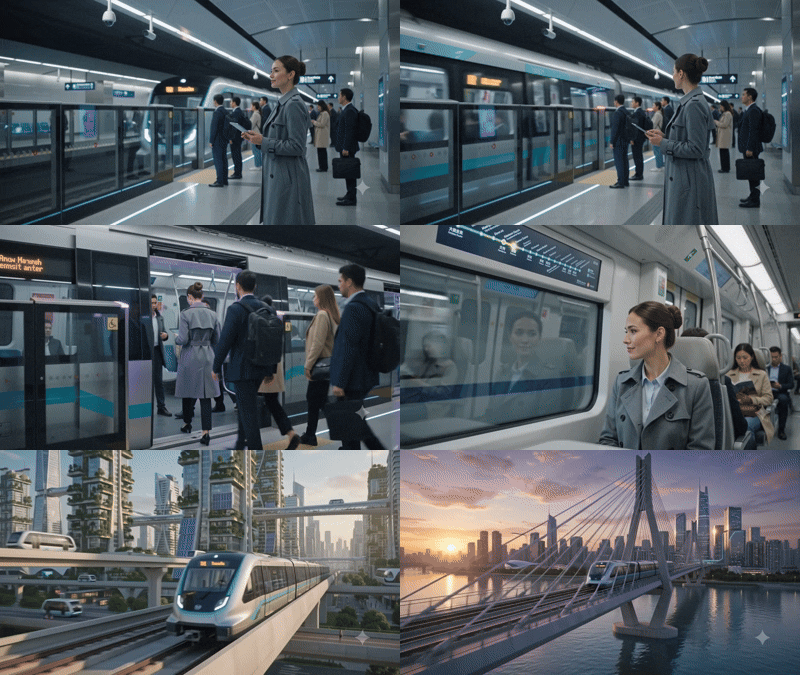
Metropolitan transit systems have undergone a fundamental transformation from utilitarian corridors of mobility into complex, multi-layered commercial environments. This evolution is driven by the necessity for transit authorities to diversify revenue streams beyond the farebox and by the shifting expectations of modern urban commuters who demand seamless integration of work, travel, and leisure. The commercialization of transit space represents a specialized intersection of urban planning, civil engineering, and high-density retail management. For the entrepreneur or corporate entity, starting and building a business in this domain requires navigating a formidable landscape of regulatory hurdles, stringent safety protocols, and the logistical constraints inherent in subterranean and elevated infrastructures. However, the unique advantage of transit environments—the concentrated, captive audience—provides a level of predictable foot traffic and brand exposure that is increasingly difficult to find in traditional “high street” or shopping mall settings.[1, 2, 3]
Foundational Entry: Navigating the Administrative and Legal Framework of Transit Procurement
Starting a business within a transit network is rarely as simple as signing a commercial lease. It is a process governed by the rigorous standards of public procurement and governmental transparency. Most major transit authorities, including the Metropolitan Transportation Authority (MTA) in New York, Transport for London (TfL), and SMRT in Singapore, have centralized their entry points through sophisticated electronic portals and vendor management systems.[4, 5, 6]
The Registration and Qualification Lifecycle
The first step for any prospective vendor is formal registration. In the New York MTA system, this involves the “My MTA Portal,” a one-stop-shop where firms register to be placed on “Bidders Lists” for specific categories of goods and services.[4, 7] Similarly, TfL requires registration on the SAP Ariba Business Network to connect with the TfL domain for contract opportunities and streamlined invoicing.[5] These portals serve as the gatekeepers of the transit ecosystem, ensuring that every business entity meets the basic legal and financial criteria required to interact with a public utility.
Registration often entails the submission of foundational documents, including a W9 form and a Certificate of Insurance (COI) that meets the agency’s specific liability thresholds.[8] For safety-critical or specialized infrastructure services, the barrier is even higher. In the United Kingdom, TfL utilizes the Railway Industry Supplier Qualification Scheme (RISQS) as a pre-qualification mechanism, which involves audited status for suppliers of safety-critical goods and services.[5] In Singapore, SMRT often mandates a minimum of “bizSAFE Level 3” certification, ensuring that the vendor has implemented a comprehensive risk management system.[6]
| Transit Authority | Primary Procurement Portal | Key Pre-qualification/Standard |
|---|---|---|
| New York MTA | My MTA Portal | NYS Contract Reporter Subscription |
| Transport for London (TfL) | SAP Ariba / RISQS | RISQS Audited Status (for Rail) |
| SMRT Singapore | SAP Ariba (SMRT e-procurement) | bizSAFE Level 3 Certificate |
| Houston METRO | Bonfire Open Solicitations | SBE/DBE Certification |
| San Diego MTS | MTS Business Center | Right of Entry Permits |
| [4, 5, 6, 9, 10] |
Competitive Bidding Modalities
Once registered, businesses must compete for contracts through several distinct procurement methods. The choice of method usually depends on the dollar value and the complexity of the requirement.
The Invitation for Bid (IFB) is the standard for well-defined goods and trade services, such as construction materials or station painting. In an IFB, the contract is typically awarded to the lowest responsive and responsible bidder, making price the primary determinant.[7, 9] Conversely, the Request for Proposal (RFP) is used for professional services, system designs, or major equipment purchases like rolling stock.[7] RFPs are evaluated by selection committees based on a combination of technical merit, experience, and price, often leading to a period of negotiation before the contract is finalized.[7, 11]
For smaller requirements, usually under $10,000, agencies may use “Informal Solicitations,” where they contact vendors directly from the Bidders Lists via email or telephone.[7] This provides a critical entry point for small businesses to build a performance history with the agency before competing for multi-million dollar contracts.
Sector-Specific Analysis: Retail and Concessions in the Transit Environment
The “Transit Lifestyle” model has replaced the traditional kiosk-based approach to station retail. This paradigm, most visible in systems like Singapore’s SMRT and Hong Kong’s MTR, treats the station as a community hub rather than just a transfer point.[3, 12] Building a retail business in this context requires an acute understanding of commuter psychology—specifically the “grab-and-go” mentality versus the emerging “third space” demand.
The Rise of Transit Coworking: The Staytion Model
One of the most innovative developments in transit retail is the integration of coworking spaces. SMRT has pioneered this through the “Staytion” brand, which offers flexible workspaces directly within MRT stations.[12] This model addresses the needs of a mobile workforce that requires professional environments between meetings or during a commute. Staytion provides hot desks, private studios, and meeting rooms, effectively turning transit time into productive time.[12]
| Staytion Location (Singapore) | Rating (Stars) | Hourly Rate (SGD) | Daily Rate (SGD) |
|---|---|---|---|
| Staytion @ Paya Lebar MRT | 4.8 | 7.50 | 53.40 |
| Staytion Lifestyle @ Dhoby Ghaut MRT | 4.7 | 7.50 | 53.40 |
| Staytion @ Marsiling MRT | 4.8 | 6.40 | 42.50 |
| Cosy Corner @ Jalan Besar | 4.5 | 4.20 | 29.00 |
| N9 Offices @ Woodlands | 5.0 | 4.00 | 33.00 |
| [12] |
Merchandising and Retail Planning Strategies
For retail to thrive in a transit environment, the Eno Center for Transportation suggests that agencies and businesses must think about merchandising long before a space is even created.[13] This involves a “Retail Plan” that identifies categories—such as fast-casual food, coffee shops, or dog grooming—that complement the surrounding neighborhood and the specific demographics of the ridership.[13]
Successful transit retail often follows a “high-low” mix, serving both the daily subway rider looking for a quick breakfast sandwich and the higher-income commuter seeking artisanal coffee or high-end retail options.[13] In Hong Kong, the MTR leverages its “MTR Mobile” app and “MTR Points Loyalty Scheme” to drive foot traffic to its shopping malls, which maintain high occupancy rates even in challenging economic climates by offering integrated rewards for travel and shopping.[3, 12]
Sector-Specific Analysis: Transit Advertising and Media Infrastructure
Advertising within metropolitan transit systems offers a reach and frequency that traditional billboards or digital ads cannot match. The environment provides a captive audience that is exposed to media during long dwell times on platforms and extended periods inside vehicles.[1, 2]
High-Impact Media and Station Domination
Agencies like the New York MTA and Metro Transit in the Twin Cities offer high-impact opportunities such as “station dominations,” where a single brand takes over all available advertising surfaces in a station—from mezzanines to stair risers.[1, 2] Advertisements are not limited to static posters; full vehicle wraps on trains and buses turn the transit fleet into mobile billboards that circulate through the city’s most high-traffic corridors.[1]
The Digital Shift and Targeted Messaging
The MTR in Hong Kong reports a significant shift away from traditional media toward targeted, results-driven digital strategies.[3] This involves the deployment of digital portrait and landscape networks that allow for personalized and dynamic ad content.[3] By integrating with transit apps, advertisers can deliver context-specific messages based on the rider’s current location or destination, creating a more engaging and effective marketing funnel.
| Advertising Metric / Opportunity | Description | Impact |
|---|---|---|
| Station Domination | Full takeover of station media surfaces. | Maximum brand immersion and social media “moments.” |
| Vehicle Wraps | External branding on trains and buses. | High-frequency visibility across the metro area. |
| Digital Portrait Networks | Dynamic, real-time digital displays. | Targeted, time-specific messaging. |
| Integrated App Ads | Ads delivered via transit planning apps. | High conversion due to contextual relevance. |
| [1, 2, 3] |
Sector-Specific Analysis: Infrastructure, Telecommunications, and Maintenance Services
Beyond retail and media, the technical maintenance of the transit system itself represents a multi-billion dollar opportunity for private enterprise. Transit agencies are increasingly relying on public-private partnerships to deliver and maintain critical infrastructure.[14]
Telecommunications and 5G Connectivity
The demand for ubiquitous connectivity has made telecommunications one of the fastest-growing sectors in transit commerce. Authorities like the MTA and MTR issue RFPs for the design, construction, and maintenance of public-facing wireless communication systems and broadband networks.[11] MTR, for instance, has successfully rolled out 5G services across all its stations and is actively exploring data center business opportunities to leverage its secure, underground real estate.[3]
The Maintenance and State of Good Repair (SGR) Market
Infrastructure maintenance is a persistent requirement. King County Metro’s “Fixed Assets State of Good Repair” program, for example, envisions $160 million in improvements, ranging from underground storage tanks and building systems to bus lifts and paving.[15] These projects are often bundled into “General Infrastructure Improvements” packages, providing long-term contract stability for engineering and construction firms.[15]
Houston METRO’s procurement pipeline demonstrates the variety of technical services required:
- Asphalt/Concrete Roadway Improvements: Estimated value of $40-45 million.[9]
- Underground Storage Tank Replacements: Projects ranging from $6-12 million per facility.[9]
- Bus Operating Facility IT Rehab: Direct procurement for cybersecurity and network upgrades.[9]
The Subterranean Barrier: Engineering and Fire Safety Constraints
One of the most significant challenges to building a business in a metro system is the high cost and complexity of the physical environment, particularly in underground stations. The infrastructure for modern retail—such as water, sewer lines, and fire suppression—is often absent in older stations designed only for small newsstands.[13]
Infrastructure Deficiencies and the “4x” Cost Multiplier
In many cases, the startup expenses for a business creating retail space below ground can be four times more than for an above-ground location.[13] This is driven by the need for specialized electrical upgrades to handle the power demands of modern kitchens and the invasive work required to install water and sewer connections through reinforced concrete foundations.[13] Furthermore, waste management in a subterranean environment requires specialized logistics to transport refuse to the surface without interfering with passenger flow.[13, 16]
Fire Protection and Life Safety: The NFPA 130 Standard
The National Fire Protection Association (NFPA) 130 standard is the international benchmark for fire safety in fixed guideway transit and passenger rail systems.[17, 18] Compliance with NFPA 130 is non-negotiable for any business operating within a station. The standard mandates that all materials used in station finishes must be non-combustible or limited-combustible to prevent fire ignition and smoke release.[17, 19]
Critical requirements under NFPA 130 include:
- Sprinkler Systems: Automatic sprinklers must be installed in all storage areas, trash rooms, and concession areas with combustible loading.[19, 20]
- Emergency Egress: Stations must be designed to allow passengers to exit a platform within four minutes and reach a “place of safety” within six minutes.[18] Retail units cannot obstruct these egress paths.[19]
- Emergency Ventilation: Mechanical systems are required to manage smoke in the event of a fire, ensuring that tunnels and stations remain tenable for at least one hour to allow for evacuation.[18, 20]
| Fire Safety Component | NFPA 130 / Local Code Requirement | Operational Impact |
|---|---|---|
| Interior Wall/Ceiling Finishes | Must meet strict flame spread and smoke emission limits. | Increases cost of shopfitting materials. |
| Automatic Sprinklers | Mandatory for retail units (concessions). | High initial plumbing and fire-suppression costs. |
| Emergency Lighting | Must use photoluminescent or battery-backed systems. | Requires specialized egress signage (e.g., Glo Brite). |
| Path of Egress | No obstructions allowed; minimum width requirements. | Limits the footprint of kiosks and storefronts. |
| [17, 18, 19, 20] |
Financial Engineering and Business Resilience Models
The economic relationship between the transit landlord and the private business is increasingly defined by shared risk and collaborative financial support. This is particularly crucial for small and medium-sized enterprises (SMEs) that may struggle with the high upfront costs of transit environments.
The MTR “Rail plus Property” (R+P) Model
Hong Kong’s MTR Corporation utilizes a “Rail plus Property” business model that is widely considered the most successful in the world.[3, 21] Under this model, the MTR receives land development rights from the government as a subsidy for rail construction. The MTR then partners with private developers to build integrated residential and commercial complexes above its stations.[22, 23] This creates a sustainable revenue stream where property profits subsidize the operation and maintenance of the rail network, while the rail network provides a steady stream of customers for the property’s retail components.[21, 22]
SME Support and Cash Flow Management: The SMRT/UOB Partnership
In Singapore, SMRT and UOB have signed a memorandum of understanding to help retail tenants improve their cash flow.[24] A key feature of this partnership is the replacement of traditional cash security deposits with banker’s guarantees, potentially freeing up to three months of rent for the business to reinvest in its operations.[24] Additionally, tenants gain access to “UOB BizSmart,” a suite of digital tools for accounting, payroll, and point-of-sale systems, which helps streamline operations and reduce administrative overhead.[24]
Turnover Rent and Variable Lease Structures
The shift toward “turnover rent” (also known as percentage rent) has become a key tool for aligning the interests of landlords and tenants. In this model, the rent is calculated as a percentage of the tenant’s business turnover at the premises.[25, 26]
There are three primary variations of this model:
- Pure Turnover Rent: The entire rent is a percentage of sales. This is high-risk for the landlord but provides maximum flexibility for the tenant during downturns.[27]
- Base Plus Turnover (Top-up): The tenant pays a fixed base rent plus a percentage of sales above an agreed-upon threshold. This is the most common model, providing the landlord with a guaranteed minimum while allowing them to share in the tenant’s success.[26, 27]
- “Whichever is Higher”: The system automatically charges the higher of the base rent or the turnover rent for any given period, ensuring the landlord never receives less than a minimum while capturing the upside of peak periods.[26]
| Lease Factor | Fixed Rent Model | Turnover Rent Model |
|---|---|---|
| Payment Basis | Pre-determined monthly/annual sum. | Percentage of gross sales/turnover. |
| Risk Distribution | Borne primarily by the tenant. | Shared between landlord and tenant. |
| Market Responsiveness | Low; requires formal rent reviews. | High; adjusts automatically with sales. |
| Administrative Load | Low. | High; requires audits and sales verification. |
| [25, 26, 27, 28] |
Technological Catalysts: Smart Vending and Data-Driven Operations
The “Smart Metro” is not just about moving trains; it is about using data to optimize every interaction within the station environment. For businesses, this means moving beyond passive storefronts to active, data-driven service delivery.
AI Video Analytics for Audience and Flow Management
AI-powered video analytics have become essential for both security and commercial optimization. Systems can now detect incidents, monitor crowd density, and perform automated passenger counting with superior accuracy.[29] For a business, this data provides “heatmap analysis” of passenger movement, allowing them to understand precisely where the most valuable “dwell zones” are located within a station.[29, 30]
Furthermore, AI can analyze queue patterns at ticket counters or retail kiosks, allowing operators to dynamically adjust staffing levels or resource allocation in real-time.[29] In Hangzhou, China, researchers extracted three weeks of data from the Automatic Fare Collection (AFC) system to predict passenger flow with a 22% reduction in error compared to traditional models, enabling more precise demand forecasting for station retailers.[31, 32]
The Evolution of Smart Vending and Automated Ticketing
Passenger Ticket Vending Machines (TVMs) are evolving into “smart transit centers” that incorporate AI-based predictive maintenance, biometric login, and voice command integration.[33, 34] The global market for these machines is poised to grow significantly, driven by the push for “Smart City” infrastructure and the demand for 24/7 self-service options.[33, 34]
| Market Insight: TVMs | Value / Projection | Key Driver |
|---|---|---|
| Global Market Size (2023) | USD 4.2 Billion | Public transport modernization. |
| Expected Market Size (2032) | USD 7.66 Billion | Smart city infrastructure integration. |
| Compound Annual Growth Rate | 6.9% (2025-2032) | Shift toward contactless/AI systems. |
| Cashless Payment Share | 66.4% (2024) | Digitalization and NFC adoption. |
| [33, 34] |
Human Capital: Workforce Development and Operational Staffing
Starting and building a business in a transit system also requires managing a specialized workforce. Transit authorities themselves employ thousands of professionals across diverse areas, from GIS analysts and demographers to revenue collection foremen and customer resolution specialists.[35]
Workforce Certification and Compliance
Private vendors must ensure their employees are trained in the specific safety and operational protocols of the transit environment. This includes fire evacuation training, where employees must learn the location of alternative exits and how to operate fire extinguishers in confined spaces.[36] Compliance with the Public Employee Safety and Health (PESH) Bureau in New York, for example, requires reporting any work-related hospitalization within 24 hours and any fatality within eight hours, necessitating a robust administrative structure for safety management.[37]
Small Business and DBE Outreach Programs
Most major transit agencies have a dedicated Office of Economic Business Opportunity to oversee small business functions, certification, and outreach.[35] These programs are designed to lower the barriers to entry for historically underutilized businesses, offering management oversight and control of acquisitions to ensure equitable participation in the transit economy.[14, 35]
Future Outlook: The Hybrid Work Era and Shifting Commuter Behavior
The long-term success of a transit-based business is intrinsically linked to the health of the transit system itself. The post-pandemic shift toward hybrid work has fundamentally altered the ridership patterns upon which transit retail was originally built.[38, 39]
Ridership Recovery and the “New Normal”
As of June 2025, ridership across major systems like the SCAG region in California continues to recover, but the patterns have shifted. While overall vehicle miles traveled (VMT) have returned to 97% of pre-pandemic levels, transit ridership varies by mode. Bus ridership has led the recovery at 76%, while commuter rail remains the slowest to return at 63%.[40]
The “New Normal” is defined by:
- Persistent Telework: Approximately 34% of workdays were performed from home over the last year, reducing peak-hour demand.[40]
- Delivery Substitution: People are replacing 16-36% of their in-person shopping trips with delivery, which impacts the demand for traditional station retail.[41]
- The “Midweek Peak”: Ridership is increasingly concentrated on Tuesdays, Wednesdays, and Thursdays, forcing retailers to adjust their staffing and inventory levels for a shorter, more intense peak week.[42]
| SCAG Region Recovery (June 2025) | Recovery % of Pre-Pandemic Level |
|---|---|
| Bus Ridership | 76% |
| Light and Heavy Rail | 74% |
| Commuter Rail | 63% |
| Overall Vehicle Travel (VMT) | 97% |
| [40] |
Adapting Through Mobility-as-a-Service (MaaS)
To combat the decline in traditional commuting, agencies are turning to MaaS to encourage multimodal journeys.[43, 44] By integrating dynamic trip-planning and ticketing, transit systems can become the “backbone” of an ecosystem that includes bike-sharing, ride-hailing, and on-demand minibuses.[43, 45, 46] For a business, this means the “captive audience” is no longer just the subway rider; it is anyone using the station as a hub for their “first- and last-mile” connection.[43, 47]
Strategic Synthesis and Nuanced Conclusions
Starting and building a business in a metropolitan transit system is an enterprise of significant scale and complexity. The transition from a transit-only node to a “lifestyle hub” has opened up diverse opportunities in retail, advertising, and infrastructure maintenance. However, these opportunities are gated by a rigorous procurement process that demands financial stability, legal compliance, and a commitment to safety standards like NFPA 130.
The successful transit-based business of the future will be characterized by:
- Agile Financial Models: Embracing turnover rent and digital financing tools to manage the high overhead and ridership volatility of the hybrid work era.
- Technological Integration: Leveraging AI video analytics and AFC data to optimize store placement, inventory, and marketing efforts based on real-time passenger flow.
- Transit-Native Merchandising: Moving beyond traditional retail to provide high-value, “grab-and-go” services that address the specific needs of the time-compressed urban commuter.
- Regulatory Proficiency: Navigating the labyrinth of subterranean logistics and fire safety codes as a core competency rather than a bureaucratic hurdle.
While the post-pandemic landscape presents undeniable challenges to ridership, the fundamental value of the transit hub as a high-density destination remains intact. By aligning with the strategic goals of transit authorities—revenue diversification, passenger comfort, and smart-city integration—private enterprises can build resilient and highly profitable businesses that are integral to the fabric of the modern city. The convergence of mobility, technology, and commerce in these spaces ensures that metropolitan transit systems will remain one of the most dynamic and rewarding frontiers for urban entrepreneurship in the decades to come.
——————————————————————————–
- Advertise with Metro Transit, https://www.metrotransit.org/advertise-with-metro-transit
- MTA advertising and activations, https://www.mta.info/doing-business-with-us/advertising
- THE FIRST HALF IN REVIEW – MTR, https://www.mtr.com.hk/archive/corporate/en/investor/interim2025/E07.pdf
- MTA Procurement, https://www.mta.info/doing-business-with-us/procurement
- Become a TfL supplier – Transport for London, https://tfl.gov.uk/info-for/suppliers-and-contractors/become-a-tfl-supplier
- TENDER NOTICES – Singapore – SMRT, https://www.smrt.com.sg/tender-notices/
- Guide for Contractors and Suppliers – MTA, https://www.mta.info/doing-business-with-us/procurement/guide-for-contractors-and-suppliers
- Purchasing | MTA FlintMTA Flint, https://www.mtaflint.org/purchasing/
- Procurement Opportunities | Vendor Solicitation | METRO | Houston, TX, https://www.ridemetro.org/about/business-to-business/procurement-opportunities
- Business Center | San Diego Metropolitan Transit System, https://www.sdmts.com/business-center
- MTA Real Estate RFPs, https://rfponline.nymta.info/
- Transit Lifestyle | SMRT – SMRT Corporation, https://www.smrt.com.sg/public-transport/transit-lifestyle/
- Seven Effective Strategies to Improve Retail at Transit Stations (Part …, https://enotrans.org/article/seven-effective-strategies-to-improve-retail-at-transit-stations-part-1/
- Doing Business with Metro, https://www.metro.net/about/doing-business-with-metro/
- June 2025 update: Metro’s Fixed Assets State of Good Repair Program, https://kingcountymetro.blog/2025/06/02/december-2024-update-metros-fixed-assets-state-of-good-repair-program/
- Retail Logistics Management: Challenges and Best Practices – Pragma, https://www.bepragma.ai/blogs/retail-logistics-management
- NFPA 130, Standard for Fixed Guideway Transit and Passenger Rail Systems (2026), https://www.nfpa.org/product/nfpa-130-standard/p0130code
- Details You Need to Know About NFPA 130 – Jessup Manufacturing, https://www.jessupmfg.com/blog/details-you-need-to-know-about-nfpa-130.html
- Fire protection for underground passenger rail systems – NFPA, https://www.nfpa.org/news-blogs-and-articles/nfpa-journal/2021/02/08/nfpa-13-february
- 1 REGULATORY IMPACT STATEMENT (19 NYCRR Part 1228) 1. STATUTORY AUTHORITY Article 18 of the Executive Law (§370-383) establish – New York State Department of State, http://dos.ny.gov/uniform-code-provisions-rail-stations-regulatory-impact-statement
- MTR Corporation – Wikipedia, https://en.wikipedia.org/wiki/MTR_Corporation
- MTR Corporation Company Overview, https://www.mtr.com.hk/archive/corporate/en/investor/pre_blackout_202407.pdf
- MTR Corporation Company Overview, https://www.mtr.com.hk/archive/corporate/en/investor/im/pre_blackout_202501.pdf
- SMRT, UOB team up to help retailers improve cash flow, gain …, https://www.straitstimes.com/business/smrt-uob-team-up-to-help-retailers-improve-cash-flow-gain-access-to-digital-and-financial-solutions
- What is turnover rent and how does it work? – Goughs Solicitors, https://www.goughs.co.uk/news/what-is-turnover-rent-and-how-does-it-work/
- Understanding Turnover Rent: A Flexible Leasing Model for Property Management, https://gaiapm.com.hk/understanding-turnover-rent-a-flexible-leasing-model-for-property-management/
- Turning to turnover? The ‘return’ of the turnover rent model – Lewis Silkin LLP, https://www.lewissilkin.com/our-thinking/the-collective/insights/2022/01/02/turning-to-turnover-the-return-of-the-turnover-rent-model
- Understanding Variable Rent in Commercial Real Estate – ReboLease, https://www.rebolease.com/commercial-real-estate-lease-administration-glossary/understanding-variable-rent
- How AI Video Analytics is Transforming Modern Metro Systems: Top …, https://www.katomaran.com/blogs/ai-video-analytics-use-cases-modern-metro-systems
- An Example of a Digital Twin for a Metro with Crowd Management Technology – AnyLogic, https://www.anylogic.com/resources/case-studies/an-example-of-a-digital-twin-for-a-metro-with-crowd-management-technology/
- Passenger Flow Forecasting in Metro Transfer Station Based on the Combination of Singular Spectrum Analysis and AdaBoost-Weighted Extreme Learning Machine – MDPI, https://www.mdpi.com/1424-8220/20/12/3555
- Passenger Flow Prediction Based on Land Use around Metro Stations: A Case Study – MDPI, https://www.mdpi.com/2071-1050/12/17/6844
- Passenger Ticket Vending Machine Market Size, Share and Analysis | Trends – 2032, https://www.skyquestt.com/report/passenger-ticket-vending-machine-market
- Passenger Ticket Vending Machine Market Size | CAGR 5.6%, https://market.us/report/passenger-ticket-vending-machine-market/
- Careers at METRO | Public transit and transportation jobs | Houston, TX, https://www.ridemetro.org/about/careers
- Fire safety for small business – EPS Security, https://www.epssecurity.com/news/business-security/fire-safety-small-business/
- Public Employee Safety & Health | Department of Labor – NY.gov, https://dol.ny.gov/public-employee-safety-health
- Public Transportation Ridership: Implications of Recent Trends for Federal Policy, https://www.congress.gov/crs-product/R47302
- Remote Work Trends Settle Across US Metro Areas – CRE Daily, https://www.credaily.com/briefs/remote-work-trends-settle-across-us-metro-areas/
- Transportation Trends Report: June 2025 | SCAG – CA.gov, https://scag.ca.gov/sites/default/files/2025-08/26-417-MMI-0343-Transportation-Trends-Report-June-2025.pdf
- Executive Summary | Oregon Metro, https://www.oregonmetro.gov/sites/default/files/2025-12/metro-emerging-trends-summary-final.pdf
- State of Hybrid Work 2025 | US Report – Owl Labs, https://owllabs.com/state-of-hybrid-work/2025
- Connected Urban Growth: Public-Private Collaborations for Transforming Urban Mobility – McKinsey, https://www.mckinsey.com/~/media/mckinsey/business%20functions/sustainability/our%20insights/public%20private%20collaborations%20for%20transforming%20urban%20mobility/connected-urban-growth.pdf
- “Mobility as a Service” Platforms: A Critical Path towards Increasing the Sustainability of Transportation Systems – MDPI, https://www.mdpi.com/2071-1050/12/16/6368
- What is Mobility-as-a-Service and why MaaS matters for your mobility business?, https://www.atommobility.com/blog/mobility-as-a-service-maas
- Being Mobility-as-a-Service (MaaS) Ready – American Public Transportation Association, https://www.apta.com/wp-content/uploads/MaaS_European_Study_Mission-Final-Report_10-2019.pdf
- Mobility as a service resources – Urbanism Next, https://www.urbanismnext.org/resource-technologies/mobility-as-a-service
 Journal for Policy & Market Research
Leave a comment