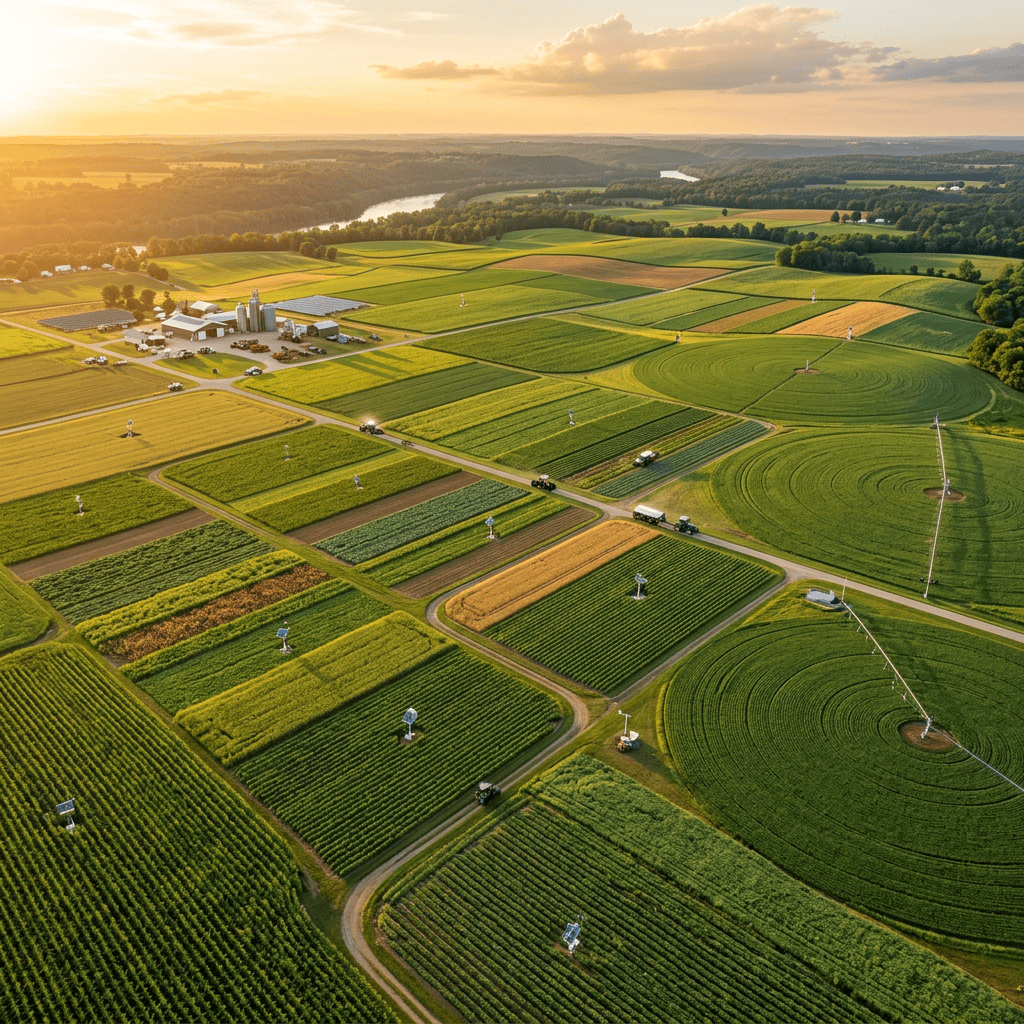
The global agricultural landscape is undergoing a structural paradigm shift driven by the imperative to feed a population projected to reach 9.3 billion by 2050.[1, 2] To meet this demand, food production must increase by approximately $60\%$ while simultaneously mitigating the environmental impacts of intensive farming and navigating a chronic farm labor shortage.[1, 3, 4] Precision agriculture, frequently categorized as Smart Farming or Agriculture 4.0, has emerged as the primary technological solution to this systemic crisis. The market is currently characterized by a robust growth trajectory, with the global precision farming sector expected to reach $USD$ 24.09 billion by 2030, sustained by a compound annual growth rate (CAGR) of $13.1\%$ from 2025 to 2030.[5] For entrepreneurs and investors, the inception and scaling of a precision agriculture business require a sophisticated synthesis of advanced hardware engineering, data science, specialized legal frameworks, and a deep understanding of the unique socio-economic barriers inherent in rural markets.[6, 7, 8]
The Technological Architecture of Precision Agriculture
The foundational premise of precision agriculture is the transition from uniform field management to site-specific management. This evolution is facilitated by an integrated stack of technologies that allow for the observation, measurement, and response to inter- and intra-field variability in crops.[9, 10, 11]
Core Sensing and Data Acquisition Systems
A precision agriculture enterprise begins with data acquisition. Modern systems rely on a combination of terrestrial and aerial sensors to create a high-fidelity digital twin of the farm environment. In-ground sensors represent a critical component of this stack, providing near-real-time data on soil moisture, temperature, and nutrient concentrations.[8, 9] These sensors enable the implementation of Variable Rate Technology (VRT), allowing for the automated adjustment of input applications such as seeds, fertilizers, and pesticides based on the specific needs of distinct zones within a field.[3, 4, 9]
| Technology Category | Mechanism and Implementation | Primary Economic Benefit | Adoption Trend (2026) |
|---|---|---|---|
| In-Ground Sensors | Real-time monitoring of $N-P-K$ levels, pH, and moisture. | $20-30\%$ reduction in water and fertilizer waste. | High preference in $52\%$ of robotic deployments.[12, 13] |
| Multispectral Drones | High-resolution aerial mapping via NDVI and thermal bands. | Early pest detection and $20\%$ yield improvement. | $24\%$ projected impact on overall productivity.[4, 6] |
| Satellite Imagery | Remote sensing for temporal vegetation monitoring. | Scalable crop health monitoring and yield forecasting. | Integrated with cloud analytics for B2B advisory.[6, 7] |
| AI Soil Sensors | Granular soil health tracking and real-time alerts. | Tailored recommendations for soil amendment. | $19\%$ of the precision sensor market share.[4] |
Aerial sensing, particularly through unmanned aerial vehicles (UAVs) or drones, provides a level of resolution and temporal frequency that traditional satellite imagery cannot match. In 2026, drones are equipped with advanced multispectral and thermal sensors that identify crop stress, irrigation leaks, and nutrient deficiencies long before they are visible to the human eye.[6, 14] Furthermore, the evolution of drone technology has moved beyond simple inspection to active intervention. Spraying drones utilize the “vortex effect”—a phenomenon where the downward airflow from rotors increases agrochemical penetration and distribution through dense vegetation—significantly improving the efficiency of plant protection.[14]
Robotics and Autonomous Machinery
The labor shortage in the agricultural sector, estimated at an annual gap of 2.4 million farm jobs, has necessitated the acceleration of robotics and autonomous systems.[3, 4] Autonomous tractors and robotic harvesters are no longer futuristic concepts; they are operational realities for large-scale producers. These machines utilize Global Positioning Systems (GPS) and Real-Time Kinematic (RTK) navigation to achieve centimeter-level accuracy, ensuring consistent performance while minimizing soil compaction and fuel consumption.[3, 9, 15]
Specialized robotics, such as autonomous weeders, have carved out a significant niche. The global automatic weeding robot market reached $USD$ 2.6 billion in 2025 and is projected to grow to $USD$ 3.09 billion in 2026, reaching $USD$ 14.44 billion by 2035 at a CAGR of $18.7\%$.[13] These robots utilize computer vision and deep learning models to distinguish between crops and weeds, often terminating the latter with high-powered lasers or precision micro-sprays, thereby reducing herbicide dependency by up to $46\%$.[16, 17]
| Robotic Segment | Projected CAGR (2026-2035) | Key Driving Factor | Market Value 2025 |
|---|---|---|---|
| Automatic Weeding | $18.7\%$ | Herbicide resistance and non-chemical demand. | $USD$ 2.6 Billion [13] |
| Autonomous Tractors | $14\%$ (impact on productivity) | Labor shortages and 24/7 operation capability. | High-value niche in large-scale row crops [4] |
| Crop Spraying Drones | Rapid Adoption | Precision application in hard-to-reach areas. | Part of $USD$ 15.5B autonomous machinery market [18] |
| Smart Irrigation | $17\%$ | Escalating water scarcity and cost. | Integral to specialty crop profitability [4, 10] |
Strategic Intellectual Property Management
For an ag-tech startup, intellectual property (IP) is the primary engine of valuation and a critical barrier to entry. The intangible assets of an ag-tech firm—ranging from proprietary algorithms for plant disease recognition to the mechanical design of a robotic arm—must be protected through a multi-layered strategy.[19, 20, 21]
The Patent Landscape: Functional vs. Expression
Ag-tech innovations typically fall under the category of processes or mechanical improvements. Utility patents are the standard mechanism for protecting functional innovations. In the context of Software as a Service (SaaS), patentable elements may include novel pre-processing techniques for model training data, unique model architectures, or the specific application of a trained model to solve an agronomic problem.[20] To be granted, a patent must demonstrate novelty, non-obviousness, and utility.[20]
Startups often leverage provisional patents in their early stages. A provisional application grants the company “patent pending” status for 12 months, securing a priority filing date while the founders refine the technology or seek investment.[20] This is particularly advantageous in the rapid development cycles of autonomous robotics. Conversely, copyright is utilized to protect the “expression” of the software, including the source code, user interface (UI) design, and marketing content.[19, 20]
Trade Secrets and Open Source Risks
In many instances, the specific weighting of an AI model or a proprietary dataset is protected as a trade secret rather than a patent. Trade secrets provide indefinite protection as long as the information remains confidential.[19] However, maintaining this protection requires rigorous internal protocols, including non-disclosure agreements (NDAs), access restrictions, and employee education.[20, 22]
A significant risk for ag-tech startups is the inadvertent use of open-source software with restrictive licenses. While permissive licenses like MIT or Apache 2.0 allow for commercial use, “copyleft” licenses such as the GNU General Public License (GPL) may require the entire software stack to be released as open-source if integrated into a product.[23] Investors frequently conduct “open-source audits” during due diligence; therefore, establishing a clear open-source policy is vital for future funding rounds.[23]
Organizational and Legal Foundations
The selection of a legal entity structure is a strategic decision that dictates the business’s ability to raise capital, distribute profits, and manage liability.[24, 25]
Entity Selection: LLC vs. C-Corporation vs. B-Corporation
While many small businesses begin as Limited Liability Companies (LLCs) due to their simplicity and pass-through taxation—where profits and losses are reported on the owners’ personal tax returns, avoiding double taxation—they are often suboptimal for high-growth tech startups.[24, 25, 26] Venture capital firms and top-tier accelerators like Y Combinator or Techstars typically require startups to be incorporated as Delaware C-Corporations.[25, 27] This preference is driven by the standardized governance, the ability to issue multiple classes of stock, and the ease of implementing equity incentive plans for employees.[25]
| Feature | Limited Liability Company (LLC) | Delaware C-Corporation | Benefit Corporation (B-Corp) |
|---|---|---|---|
| Taxation | Pass-through (Avoids double tax) | Double Taxation (Corporate + Dividend) | standard Corporate Tax [26] |
| Capital Raising | Difficult for VCs | High preference for investors | Attractive to Impact Investors [25, 28] |
| Management | Flexible; Member or Manager managed | Formal Board and Officers | High transparency requirements [24, 26] |
| Employee Equity | Complex (Profits Interests) | Standardized (Stock Options) | Standardized [25] |
| Liability | Personal asset protection | Personal asset protection | Personal asset protection [24] |
For ag-tech businesses focused on sustainability, the Benefit Corporation (B-Corp) structure is gaining traction. Recognized in a majority of U.S. states, B-Corps are legally authorized to prioritize social and environmental impact alongside shareholder profit.[26, 28] This provides legal protection for directors who may choose a more sustainable, long-term approach over immediate short-term financial returns, which aligns with the values of many modern agricultural producers and impact-focused venture capital firms.[28]
Capitalization and Funding Pathways
Scaling a precision agriculture business requires substantial capital, particularly for hardware-intensive ventures. Entrepreneurs must navigate a path that often starts with non-dilutive government support before moving into the private equity markets.[29, 30]
Federal Research Grants: SBIR and STTR
The Small Business Innovation Research (SBIR) and Small Business Technology Transfer (STTR) programs, often called “America’s Seed Fund,” provide competitively awarded grants to small businesses for high-quality research that has significant commercial potential.[29, 31, 32] The USDA NIFA program is a primary grantor in this space, offering funds across several topic areas relevant to precision agriculture, such as plant production, natural resources management, and rural development.[31, 32]
- Phase I: Focused on establishing the scientific and technical merit of the proposed research. Awards are generally limited to $USD$ 175,000 for an 8 to 12-month period.[32]
- Phase II: Focused on the continuation of R&D efforts initiated in Phase I, with an emphasis on commercialization. Awards are limited to $USD$ 600,000 to $USD$ 650,000 for a 24-month period.[32, 33]
Eligible companies must be for-profit, U.S.-owned, and have fewer than 500 employees.[32, 34] These grants are highly attractive because they do not require the founder to give up equity, allowing the company to reach critical development milestones before seeking private investment.[29]
The Venture Capital Ecosystem
As the technology enters the commercialization phase, venture capital (VC) firms become the primary source of scaling capital. The ag-tech VC landscape is robust, with specialized firms such as AgFunder, S2G Ventures, and Cultivian Sandbox focusing exclusively on the food and agriculture value chain.[35, 36] These investors look for businesses with high monthly recurring revenue (MRR) potential, strong IP, and a clear path to market dominance.[35]
| VC Firm / Platform | Sweet Spot / Stage | Focus / Thesis | Headquarters |
|---|---|---|---|
| AgFunder | Seed to Series B | Impactful tech transforming food/ag systems. | San Francisco, USA [35] |
| S2G Ventures | Series A to Growth | Sustainability across the food system. | Chicago, USA [35] |
| Khosla Ventures | Seed to Late Stage | Bold, experimental ideas in AI and Robotics. | Menlo Park, USA [30] |
| The Yield Lab | Accelerator / Pre-Seed | Providing funding, training, and networking. | St. Louis, USA [35, 37] |
| Omnivore | Seed to Series B | Agri-fintech and innovative farming in India. | Mumbai, India [35] |
Accelerators such as AgLaunch365 and THRIVE play a pivotal role in the “customer discovery” phase. Unlike generic tech accelerators, these programs often include a network of “innovation-ready” farmers who participate in on-farm trials.[38, 39] This provides startups with critical real-world data to refine their models and proves the ROI to potential customers and later-stage investors.[38]
Business Model Innovation in Precision Agriculture
The method of delivering value is as important as the technology itself. Precision agriculture businesses are increasingly adopting recurring revenue models that reduce the financial barrier for farmers.[4, 18, 21]
SaaS and HaaS: Shifting from CAPEX to OPEX
The transition from selling hardware as a one-time purchase to offering it as a service is a defining trend. Hardware as a Service (HaaS) or Robotics as a Service (RaaS) allows farmers to utilize autonomous machinery or sensors for an annual fee or a per-acre usage charge.[18] This effectively shifts the cost from a capital expenditure (CAPEX), which requires high upfront liquidity, to an operational expenditure (OPEX), which can be managed against the season’s revenue.[4, 18]
Software as a Service (SaaS) models are used for farm management information systems (FMIS). These platforms integrate data from sensors, drones, and satellites to provide predictive insights.[6, 7] In 2026, many SaaS platforms are leveraging generative AI to offer “AI Copilots” that help farmers make complex decisions regarding planting windows and nitrogen application rates.[4, 6, 38]
Retrofitting and OEM Partnerships
A critical barrier to precision agriculture adoption is the massive existing investment in traditional machinery. Farmers are often reluctant to replace a functioning $USD$ 500,000 tractor just to gain autonomous capabilities. Consequently, companies like AGCO and Trimble are focusing on retrofit solutions—kits that can be installed on existing equipment, regardless of the brand or age.[40, 41, 42] This “mixed-fleet” approach is essential for market penetration, as the average farm operates equipment from multiple manufacturers.[40, 43]
Strategic partnerships with Original Equipment Manufacturers (OEMs) such as John Deere or CNH Industrial can provide a startup with immediate global scale. However, OEMs are also competitors, often acquiring startups to integrate their technology into their own “walled garden” ecosystems.[44] Startups must balance the benefits of OEM distribution with the need to remain interoperable across different platforms.[45]
Overcoming Barriers to Adoption: Connectivity and Interoperability
While the potential for precision agriculture is vast, widespread adoption is hindered by infrastructure and technical fragmentation. Only $27\%$ of U.S. farms currently utilize precision agriculture practices.[8]
The Rural Connectivity Gap
Reliable broadband is the “enabling technology” for precision agriculture. Next-generation applications, such as real-time autonomous navigation and cloud-based data aggregation, require high-speed, ubiquitous internet access.[8] However, a significant urban-rural divide persists; approximately $17\%$ of rural Americans lacked access to fixed broadband at speeds of $25/3$ Mbps as of 2019, compared to only $1\%$ of urban residents.[8, 46] For a business, this means designing “edge computing” solutions where data is processed locally on the machine or sensor, rather than relying on a constant cloud connection.[8]
Interoperability and the ADAPT Standard
A primary frustration for farmers is the lack of compatibility between different technology platforms. Data collected by one brand’s yield monitor often cannot be easily uploaded to another brand’s management software.[8, 45] This fragmentation has led to the development of industry standards like ADAPT (Agricultural Data Application Programming Toolkit) and ISOBUS.[47, 48]
The ADAPT Standard, released in version 2.0 in 2025, provides a common data schema and set of definitions that allow for the business-to-business transfer of agricultural production data without proprietary software dependencies.[49] It utilizes open formats like JSON, GeoParquet for vector data, and GeoTIFF for raster data.[47, 49] For an ag-tech startup, ensuring compatibility with the ADAPT Standard is critical for integrating into the broader ecosystem and avoiding the “walled garden” trap.[45, 48]
Quantifying the Return on Investment (ROI)
The adoption of precision technology is fundamentally an economic decision. A precision agriculture business must clearly articulate the payback period, which for most producers needs to be within one to two seasons.[15]
Economic Advantages of Precision Management
The ROI of precision agriculture is typically calculated based on input savings, yield increases, and labor efficiency. For a mid-size farm of 1,000 acres, the transition from manual to precision management can yield significant annual savings.[15]
| Metric | Source of Savings / Gain | Estimated Annual Impact (1,000 Acres) |
|---|---|---|
| Input Costs | $VRT$ application of chemicals/fertilizers. | $USD$ 15,000 – 25,000 [15] |
| Fuel Expenses | Reduced passes via auto-guidance/GPS. | $USD$ 3,000 – 5,000 [15] |
| Labor Costs | Automation of weeding and spraying. | $USD$ 2,000 – 4,000 [15] |
| Yield Gains | Optimized seed placement and irrigation. | $15-30\%$ productivity boost [4, 12] |
| Water Usage | $IoT$-enabled precision irrigation. | Up to $30-80\%$ savings [12, 50] |
For specialty crops, the ROI can be even more dramatic. High-density organic farms, which historically relied on manual labor for weeding, have seen revolutionary shifts. For instance, the use of the Carbon Robotics LaserWeeder on organic spinach and spring mix farms reduced overall weeding costs by approximately $40\%$, or over $USD$ 250 per acre.[51, 52] Despite the high upfront cost of $USD$ 1.2 million per unit, the machine’s ability to replace three crews of 25 employees leads to a rapid payback period.[51, 53]
Non-Financial and Long-Term Returns
Beyond immediate financial gains, precision agriculture contributes to long-term farm resilience. Soil sensors and VRT prevent the over-application of chemicals, which reduces runoff into waterways and prevents soil degradation.[6, 8] In drought-prone regions like California or Uzbekistan, precision water management is not just a cost-saving measure but a necessity for survival.[10, 46, 54] Furthermore, the collection of field-level data allows farmers to participate in carbon credit markets, providing a new revenue stream for regenerative practices such as cover cropping and minimal tillage.[3, 55, 56]
Global Scaling and Market Expansion
Scaling an ag-tech business requires navigating diverse regulatory environments and localized agronomic needs.
Geographic Expansion Strategies
The mechanism for scaling often involves “quantitative scaling” or geographic expansion. This can be achieved through business model replication, franchising, or strategic acquisitions.[57] However, what works for a corn farmer in the U.S. Midwest may not work for a rice farmer in Southeast Asia or a wheat producer in Central Anatolia.[57, 58]
Successful scaling requires “tailored” approaches. For example, Indigo Ag expanded its international biological business into Türkiye by partnering with Galeri Ziraat, a local distributor with established trust and logistics networks.[58] This partnership allowed for the rapid distribution of microbial seed coatings that improve water stress protection—a critical need in the region.[58]
Navigating Regulatory Barriers
International expansion introduces complex regulatory challenges, particularly regarding data privacy and chemical usage.
- Data Protection: Businesses expanding into Europe must comply with the General Data Protection Regulation (GDPR), while those in California must adhere to the California Consumer Privacy Act (CCPA).[59] These laws have strict requirements for how agricultural data, which is often tied to a specific individual’s land, is stored and shared.[59]
- Licensing and Permits: Autonomous drones and robots often require special operational permits that vary by country. In the U.S., the FAA regulates drone flights, while in Europe, individual member states may have varying requirements for autonomous ground machinery.[14, 59]
- Climate Standards: As countries implement greenhouse gas (GHG) reduction targets, ag-tech companies must align their products with future regulations regarding carbon footprints and chemical runoff.[3, 6]
| Expansion Barrier | Strategic Response | Target Region / Sector |
|---|---|---|
| Regulatory Compliance | Expert legal counsel for GDPR/CCPA. | Europe / North America [59] |
| Market Fit | Pilot launches and localized branding. | Global [59] |
| Data Sovereignty | Secure, transparent governance models. | Large-scale row crops [7, 8] |
| Skill Gaps | Investment in local dealer training. | Emerging economies [17] |
Case Studies in Inception and Growth
The trajectory of successful precision agriculture firms provides a roadmap for new entrants.
Carbon Robotics: The LaserWeeder Paradigm
Founded in 2018 by technologist Paul Mikesell, Carbon Robotics transitioned from a “backyard experiment” to a global leader in agricultural robotics by 2025.[60] The company’s success was driven by a field-driven engineering culture and a direct-to-grower sales approach that focused on high-value specialty crops.[60] By targeting the organic sector, where chemical herbicides are prohibited and manual labor is increasingly scarce and expensive ($USD$ 900 per acre for hand-weeding), Carbon Robotics addressed a critical pain point.[51, 53]
The company’s second-generation LaserWeeder (G2) introduced a modular design that could be adapted for different farm sizes, from small specialty plots to large organic corn and soybean operations.[53] This modularity allowed the company to scale its total addressable market (TAM) while maintaining high margins on its core technology.[53, 60]
Indigo Ag: The Biological and Digital Intersection
Indigo Ag has scaled by combining physical products—microbial seed coatings—with digital software and carbon credit programs.[58, 61] The company’s “Indigo Carbon” program allows farmers to earn income for sequestration efforts, using proprietary technology to track carbon removals at the field level with scientific integrity.[55, 56]
A key to Indigo’s growth has been its “computational biology platform,” which uses DNA sequencing and AI to predict which microbes will benefit plants under specific climatic conditions.[61] This data-driven approach allowed Indigo to develop products in 1 to 3 years, significantly faster than the 10 to 15 years required for traditional synthetic chemicals, enabling a cycle of “continuous innovation”.[61]
Conclusion: The Strategic Path Forward
The precision agriculture industry in 2026 is defined by the convergence of technological maturity and economic necessity. For entrepreneurs starting a business in this sector, the primary requirement is not merely the development of a novel sensor or robot, but the creation of an integrated solution that delivers a clear, quantifiable ROI to the producer. The most successful businesses will be those that prioritize interoperability through industry standards like ADAPT, offer flexible business models such as HaaS to mitigate high upfront costs, and build deep trust through transparent data governance and robust local support networks.
As climate volatility and labor shortages continue to challenge global food security, the role of precision agriculture will expand from a niche application for early adopters to an indispensable standard for all commercial farming. The companies that successfully navigate the complex intersection of agronomy, engineering, and rural economics will be the architects of a more resilient and sustainable global food system. In this high-stakes environment, the ability to turn vast volumes of farm data into actionable intelligence remains the ultimate competitive advantage.
——————————————————————————–
- Precision Agriculture Market Size, Share & Forecast to 2028 – UnivDatos, https://univdatos.com/reports/precision-agriculture-market-2
- Agritech x Open Innovations: 3 Groundbreaking Case Studies Shaping the Future of Agriculture in 2024-2025 – 2080 Ventures, https://www.2080.ventures/insights/agritech-x-open-innovations-3-groundbreaking-case-studies-shaping-the-future-of-agriculture-in-2024-2025
- Explore the Top 10 Agriculture Trends and Innovations in 2026 – StartUs Insights, https://www.startus-insights.com/innovators-guide/agriculture-trends/
- High Tech Agriculture Equipment: 2026 Tech Revolution – Farmonaut, https://farmonaut.com/precision-farming/high-tech-agriculture-equipment-2026-tech-revolution
- Precision Agriculture Market Report 2026 [Free PDF] | StartUs, https://www.startus-insights.com/innovators-guide/precision-agriculture-market-report/
- Precision Agriculture: Transforming Farming With Drones – Farmonaut, https://farmonaut.com/precision-farming/precision-agriculture-transforming-farming-with-drones
- Agtech: Breaking down the farmer adoption dilemma – McKinsey, https://www.mckinsey.com/industries/agriculture/our-insights/agtech-breaking-down-the-farmer-adoption-dilemma
- GAO-24-105962, Precision Agriculture: Benefits and Challenges for Technology Adoption and Use, https://www.gao.gov/assets/d24105962.pdf
- Precision Agriculture: What is it, Current State & Key Technologies – iGrow News, https://igrownews.com/precision-agriculture-transforming-farming-with-technology/
- Precision Agriculture: It’s the Future that’s Here | Progressive Crop Consultant, https://progressivecrop.com/2025/11/09/precision-agriculture-its-the-future-thats-here/
- CRS Report for Congress – National Agricultural Law Center, https://nationalaglawcenter.org/wp-content/uploads/assets/crs/RL30630.pdf
- Kisan Diwas 2025: Driving farm productivity through digital adoption – ET Edge Insights, https://etedge-insights.com/trending/kisan-diwas-2025-driving-farm-productivity-through-digital-adoption/
- Automatic Weeding Robot Market Size Forecast 2026–2035, https://www.globalgrowthinsights.com/market-reports/automatic-weeding-robot-market-104674
- Drones, AI and IoT in precision agriculture: innovation across the phenological cycle, https://telefonicatech.com/en/blog/drones-ai-and-iot-in-precision-agriculture-innovation-across-the-phenological-cycle
- ROI Calculator: See How An Upgrade from Manual to Precision Ag Can Boost Your Farm, https://blog.koenigequipment.com/roi-calculator-see-how-an-upgrade-from-manual-to-precision-ag-can-boost-your-farm
- Brassicas | Enhance Your Yield – Carbon Robotics, https://carbonrobotics.com/brassicas
- Autonomous Robots Weeder Market Size | Global Forecast To 2034 – Industry Research, https://www.industryresearch.biz/market-reports/autonomous-robots-weeder-market-114212
- Autonomous Agricultural Machinery Market Consumption Trends: Growth Analysis 2025-2033, https://www.marketreportanalytics.com/reports/autonomous-agricultural-machinery-111623
- What Is SaaS Intellectual Property? Key Concepts & Types – PayPro Global, https://payproglobal.com/answers/what-is-saas-intellectual-property/
- Essential Intellectual Property Strategies for SaaS Founders …, https://saaslegalservices.com/essential-intellectual-property-strategies-for-saas-founders/
- Monetize Your Companies IP: Revenue Models That Scale with SaaS and Tech, https://athenalegal.io/blog/monetize-your-companies-ip-revenue-models-that-scale-with-saas-and-tech
- Intellectual Property Considerations for Start-Ups and Emerging Companies | Cole Schotz, https://www.coleschotz.com/intellectual-property-considerations-for-start-ups-and-emerging-companies/
- IP Risk Mitigation for SaaS Startups: Where to Start | PatentPC, https://patentpc.com/blog/ip-risk-mitigation-for-saas-startups-where-to-start
- LLC vs. corporation: Here’s how to decide which to form for your startup – Stripe, https://stripe.com/resources/more/should-you-form-an-llc-or-a-corporation-for-your-startup
- C Corp vs LLC: Key Differences & How to Choose – Startups – Carta, https://carta.com/learn/startups/private-companies/c-corp-vs-llc/
- Choose a business structure | U.S. Small Business Administration, https://www.sba.gov/business-guide/launch-your-business/choose-business-structure
- LLC vs INC: a guide for startups – YouTube, https://www.youtube.com/watch?v=IC-ex3XslcQ
- LLC vs. B Corp: Which Business Structure Is Right for You? – Chore, https://www.hirechore.com/startups/llc-vs-b-corp
- About SBIR and STTR, https://www.sbir.gov/about
- Top 38 Agriculture Venture Capital Firms (2026) – Failory, https://www.failory.com/blog/agriculture-venture-capital-firms
- Small Business Innovation Research and Technology Transfer Programs (SBIR/STTR) – USDA NIFA, https://www.nifa.usda.gov/grants/programs/sbir-sttr
- Program Information | NIFA, https://www.nifa.usda.gov/grants/programs/sbir-sttr/program-information
- USDA-NIFA-SBIR-011120 – Search Results Detail | Grants.gov, https://grants.gov/search-results-detail/360040
- USDA-NIFA-SBIR-010774 – Search Results Detail | Grants.gov, https://grants.gov/search-results-detail/355247
- The Global Guide for Agriculture Startups: Top 15 VCs & Essential Resources – Visible.vc, https://visible.vc/blog/agriculture-startup-vcs/
- List of Agtech Investors & VC Firms for Startups (2025) – OpenVC, https://www.openvc.app/investor-lists/agtech-investors
- Top AgTech Accelerators & VCs (2025) — Open Deadlines | IncubatorList, https://incubatorlist.com/best-agtech-startup-accelerators-incubators-and-vcs
- Applications Now Open for 2026 AgLaunch365 Accelerator! – Ag …, https://aglaunch.com/applications-now-open-for-2026-aglaunch365-accelerator/
- AgLaunch Opens Applications for 2026 AgLaunch365 Accelerator – iGrow News, https://igrownews.com/aglaunch-latest-news/
- Precision Agriculture – AGCO Corporation, https://www.agcocorp.com/ca/en/home/precision-agriculture.html
- UPDATE: AGCO Tech Day 2025 Spotlights AI, Autonomy and Mixed-Fleet Solutions to Enhance Farmer Profitability, https://investors.agcocorp.com/news-releases/news-release-details/c-o-r-r-e-c-t-i-o-n-agco-corporation-0
- AGCO Tech Days 2024 to Showcase Innovation Across the Crop Cycle Serving Farmers with Mixed Fleets Globally, https://investors.agcocorp.com/news-releases/news-release-details/agco-tech-days-2024-showcase-innovation-across-crop-cycle
- PTx Ag, https://www.ptxag.com/en.html
- Precision Planting Research Report 2025-2035: OEMs Such As – GlobeNewswire, https://www.globenewswire.com/news-release/2025/10/16/3167711/28124/en/Precision-Planting-Research-Report-2025-2035-OEMs-Such-As-John-Deere-CNH-Industrial-and-AGCO-are-Investing-Heavily-in-Integrating-Precision-Hardware-and-Software.html
- Interoperability between precision ag platforms – what’s the current state? : r/PrecisionAg – Reddit, https://www.reddit.com/r/PrecisionAg/comments/1pa244f/interoperability_between_precision_ag_platforms/
- 2026 Top Trends In Agriculture – Current Industry Advancements – Hayden Outdoors, https://www.haydenoutdoors.com/top-agriculture-industry-trends-and-technology/
- AgGateway > Get Connected > ADAPT Standard, https://aggateway.org/GetConnected/ADAPTStandard.aspx
- AgGateway Releases ADAPT Standard Version 1.0, https://aggateway.org/News/2024PressReleases/AgGatewayReleasesAdaptStandardVersion10.aspx
- ADAPT Standard | AgGateway ADAPT Standard, https://adaptstandard.org/
- Smart Farming ROI – Meegle, https://www.meegle.com/en_us/topics/smart-agriculture/smart-farming-roi
- CASE STUDY – AWS, https://wga.s3.us-west-1.amazonaws.com/cit/2024/cit_case-study_carbon-robotics.pdf
- Western Growers Case Study – Carbon Robotics LaserWeeder – ACIS, https://acis.cals.arizona.edu/agricultural-ipm/vegetables/vipm-archive/vipm-mechanization-view/western-growers-case-study-carbon-robotics-laserweeder
- Study brings exposure to Carbon Robotics’ weeder – Farm Progress, https://www.farmprogress.com/technology/study-brings-exposure-to-carbon-robotics-weeder
- How CNH’s precision technology is helping farmers tackle water scarcity, https://investors.cnh.com/news/news-details/2025/How-CNHs-precision-technology-is-helping-farmers-tackle-water-scarcity/default.aspx
- How Data and Technology Bring Value to Sustainable Farming Practices – Indigo Ag, https://www.indigoag.com/blog/how-data-and-technology-bring-value-to-sustainable-farming-practices
- Success Stories | Indigo Ag, https://www.indigoag.com/customer-stories
- Scaling strategies and mechanisms in small and medium enterprises in the agri-food sector: a systematic literature review – Frontiers, https://www.frontiersin.org/journals/sustainable-food-systems/articles/10.3389/fsufs.2023.1169948/full
- Indigo Ag Signals Major Expansion of International Biological Business with Galeri Ziraat Partnership, https://www.indigoag.com/pages/news/indigo-ag-signals-major-expansion-of-international-biological-business-with-galeri-ziraat-partnership
- How scaleups can tackle the barriers to international expansion – Stone & Chalk, https://www.stoneandchalk.com.au/articles/how-scaleups-can-tackle-the-barriers-to-international-expansion
- Carbon Robotics: Weeding Out the Competition – Case – Faculty & Research, https://www.hbs.edu/faculty/Pages/item.aspx?num=68182
- Indigo Innovation: A Model of Continuous Improvement, https://www.indigoag.com/blog-2/indigo-innovation-a-model-of-continuous-improvement
 Journal for Policy & Market Research
Leave a comment