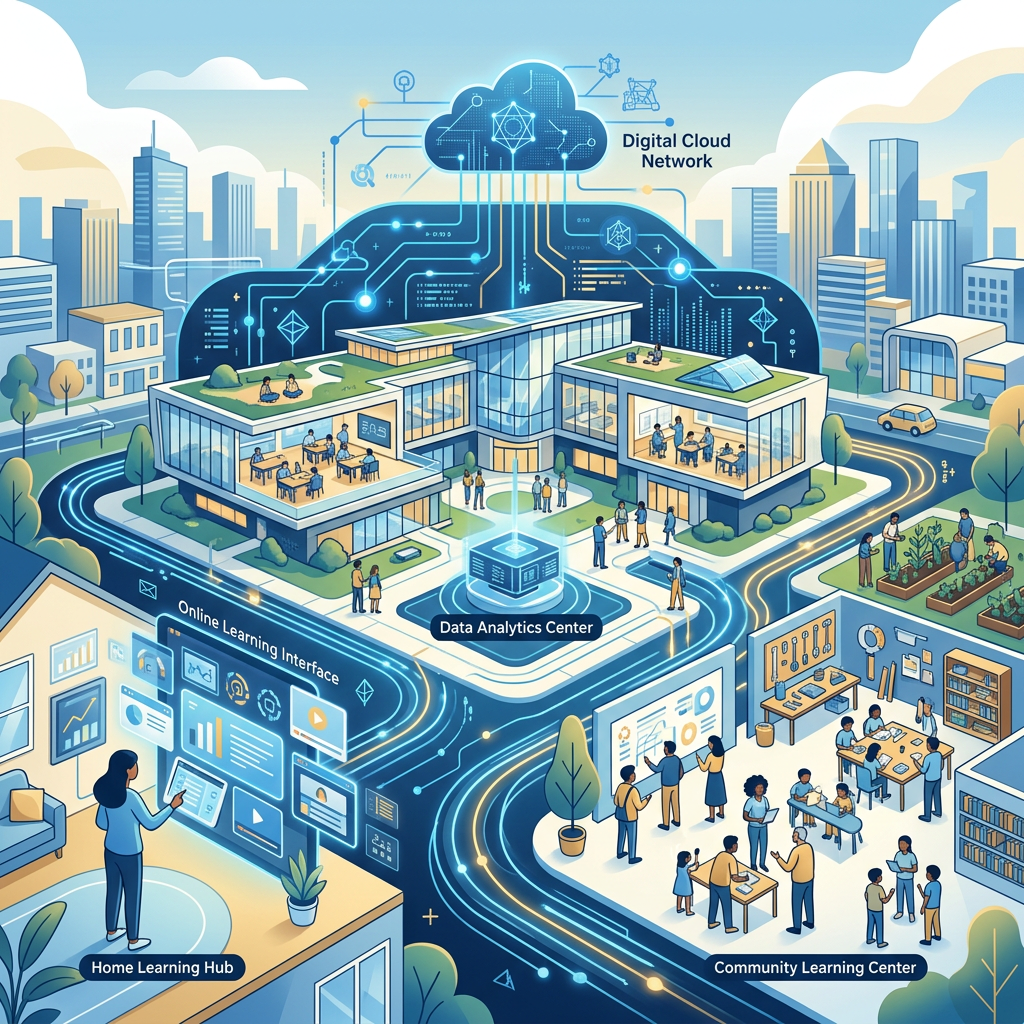
The global market for K-12 education is currently undergoing a structural transformation, shifting from the traditional, centralized public model toward a more fragmented but high-growth ecosystem comprising private institutions, microschools, tutoring centers, and edtech platforms. As of 2025, the global K-12 private education sector has attained a market valuation of approximately $431.46 billion, with projections indicating a steady climb to $609.22 billion by 2029.[1] This expansion is characterized by an annual growth rate of approximately 9%, driven by an increasing parental prioritization of quality, personalized instruction and the rising disposable income of the global middle class.[1] Simultaneously, the broader K-12 education market—encompassing public, private, and online segments—reached $130.6 billion in 2024 and is expected to grow at a compound annual growth rate (CAGR) of 13.1% to reach $242.19 billion by 2029.[2] For education entrepreneurs, this period represents a critical inflection point where the demand for specialized, technology-integrated learning environments is outpacing the supply of traditional educational infrastructure.
The macro-economic environment of 2026 introduces specific operational challenges that must be navigated with surgical precision. Rising trade tensions and the implementation of significant tariffs have inflated the costs of technology, digital hardware, and office infrastructure, impacting the professional services sector and increasing the overhead for educational institutions that rely on global supply chains for their edtech ecosystems.[1] Consequently, service providers are increasingly turning to artificial intelligence (AI) and automated systems to preserve profit margins and maintain competitive pricing models.[1] In this context, starting and growing a business in primary and secondary education requires a multidimensional strategy that balances regulatory compliance, financial capitalization, and innovative pedagogical delivery.
Global Market Architecture and Economic Indicators
The valuation of the K-12 education market is segmented by type, geography, and delivery mode, providing a clear roadmap for where the highest opportunities for return on investment reside. While North America remains the largest regional market due to its established infrastructure and high per-pupil spending, the Asia-Pacific region has emerged as the fastest-growing market.[2, 3] This regional growth is fueled by massive government investments in digital education infrastructure, high smartphone penetration, and a cultural emphasis on academic competitiveness.[4]
| Market Segment | 2024/2025 Value (USD) | 2029/2034 Projected Value (USD) | Growth Rate (CAGR) |
|---|---|---|---|
| K-12 Private Education | $431.46 Billion (2025) | $609.22 Billion (2029) | 9.0% [1] |
| Global K-12 Total Market | $130.6 Billion (2024) | $242.19 Billion (2029) | 13.1% [2] |
| K-12 Online Education | $154.31 Billion (2025) | $331.44 Billion (2034) | 21.1% [5] |
| AI in K-12 Education | $390.8 Million (2024) | $7.95 Billion (2033) | 38.1% [4] |
| Education Consulting | $4.04 Billion (2025) | $5.81 Billion (2034) | 9.5% [6] |
Within these segments, the online education sector is particularly aggressive. The global K-12 online education market is expected to grow from $126.52 billion in 2024 to $154.31 billion in 2025, reflecting a 22% CAGR in the short term as schools increasingly integrate digital platforms to support hybrid learning models.[5] This digitalization is not merely a supplementary trend but is becoming the foundational delivery mechanism for core curricula, advanced placement (AP), and vocational training.[2, 5] The surge in AI adoption is perhaps the most transformative sub-sector, projected to grow at a staggering CAGR of 38.1% through 2033.[4] This suggests that the next generation of educational ventures will be primarily tech-enabled, leveraging AI for personalized learning, automated assessment, and intelligent tutoring systems (ITS).[4]
The underlying trends driving this data suggest that the “one-size-fits-all” model of public education is losing market share to specialized niches. Parents are increasingly seeking “boutique” educational experiences, such as microschools, hybrid homeschools, and private academies that emphasize social-emotional learning (SEL), STEM, or vocational skills.[1, 7] This shift implies that new ventures must lead with a strong value proposition focused on measurable student outcomes and holistic development to compete with established public systems.[7, 8]
Foundational Business Design and Strategic Planning
The lifecycle of an educational venture begins with a rigorous business planning phase. A robust school business plan typically ranges from 15 to 25 pages and serves as the primary document for securing investment from lenders or venture philanthropists.[9, 10] This plan must go beyond a mere mission statement; it must articulate a clear vision for the student experience and a viable path to financial sustainability.
The Executive Summary and Mission Crafting
The executive summary must encapsulate the business’s unique selling proposition (USP), market opportunity, and financial highlights.[11] In the current landscape, a mission statement should reflect a commitment to high expectations and shared values about teaching and learning.[12] For a primary or secondary school, this often involves defining whether the focus is on early childhood, elementary, middle, or high school education, and whether the curriculum will follow a core standard, International Baccalaureate (IB), or specialized vocational pathways.[2, 11]
Market Breakdown and Niche Identification
Education entrepreneurs must conduct comprehensive market research to identify specific gaps in local or regional offerings. In 2025, emerging niches include schools for gifted learners, neurodiverse student populations, nature-based learning environments, and science/innovation hubs.[13] Understanding the target demographic is vital; for instance, high-income families may value interactive content, personalized feedback, and elite college prep, while middle-income families in school-choice states may be more focused on accessibility and the efficient use of school vouchers or education savings accounts (ESAs).[7, 11, 14]
Strategic resource decisions are a paramount trend in 2025, as schools navigate financial pressures and academic recovery challenges.[15] Leadership teams are increasingly using data-driven insights to evaluate the return on investment (ROI) of their programs, ensuring that every dollar spent on curriculum or technology directly contributes to positive student outcomes.[16] This requires a sophisticated management team with expertise in academic services, IT, operations, and procurement.[16]
Operational Logistics and Staffing Requirements
The plan of operations must outline the enrollment process, classroom management strategies, and staffing requirements.[17] For K-12 institutions, identifying the number of teachers needed and their required certifications is a legal and operational necessity.[17] The business plan should also detail auxiliary services such as counseling, special education, transportation, and food services, as these are often critical components of a comprehensive private school offering.[17]
Legal Architecture and Regulatory Compliance
The regulatory landscape for educational businesses is characterized by its lack of federal uniformity, placing the burden of compliance on state and local authorities. Navigating this architecture requires a thorough understanding of incorporation, licensing, and safety protocols.
Incorporation and Business Structure
Entrepreneurs must select a legal structure—such as a Sole Proprietorship, Limited Liability Company (LLC), or Corporation (C-Corp or S-Corp)—that aligns with their scaling goals and tax liability preferences.[18, 19] While a Sole Proprietorship may be suitable for small-scale tutoring, an LLC or Corporation is typically preferred for schools and edtech platforms to provide liability protection and facilitate external investment.[19, 20] For-profit schools are generally subject to local building and zoning regulations and must obtain a Business Tax Certificate or occupational license.[21]
State-Specific Registration Protocols
The requirements for opening a private school vary significantly by state. In Florida, the Division of Corporations processes applications for school organizations, and once established, the school must register its existence with the Department of Education.[21] This involves submitting a signed, notarized annual private school survey to maintain legal standing.[22] In contrast, California requires private schools serving children from kindergarten through grade 12 to file a Private School Affidavit with the state.[23] Michigan defines a private or parochial school as any non-public institution providing instruction to children under 16, and while accreditation is often optional, schools must comply with health and safety standards and submit annual reporting on teacher qualifications and curricula.[24]
Personnel Vetting and Child Safety
Compliance with safety standards is the most critical non-academic requirement. Education businesses must conduct comprehensive background checks on all staff members who have contact with minors. These checks typically include:
- FBI fingerprinting and state criminal history searches.[18, 25]
- Clearance from the National Sex Offender Registry and child abuse registries.[18, 25]
- Verification of educational qualifications and at least two credible references.[18, 20]
- Verification of the right to work (passport and worker’s permit).[18, 20]
In the United Kingdom, the Disclosure and Barring Service (DBS) check is the mandatory standard for validating a tutor’s or teacher’s criminal record, ensuring a secure learning environment.[20]
| Compliance Factor | Requirement Detail | Responsible Entity |
|---|---|---|
| Business Licensing | Local municipality permit/Business Tax Receipt | City/County Clerk [19, 25] |
| Zoning & Occupancy | Facility must meet educational use standards | Local Building Department [22, 26] |
| Background Checks | FBI Fingerprints, Sex Offender Registry clearance | Business Owner/HR [18, 25] |
| Data Privacy | COPPA/FERPA Compliance | EdTech Provider/School [27, 28] |
| Records Maintenance | Accurate attendance, grades, and health records | School Administration [22, 29] |
Environmental and Facility Standards
Schools and physical tutoring centers must adhere to strict fire safety standards, health inspections, and Americans with Disabilities Act (ADA) requirements.[21, 30] In 2026, specific focus has also been placed on indoor air quality and lead-in-water remediation, with states providing grant funding for public schools that can serve as a benchmark for private facility standards.[30] Ensuring a Certificate of Occupancy is obtained before students arrive is a fundamental legal step to verify the building’s safety for educational use.[22, 26]
Capitalization Strategies and Financial Management
Starting an education business requires significant upfront capital, often necessitating a multi-channel funding strategy. This includes government-backed loans, federal and state grants, venture philanthropy, and private investment.
Small Business Administration (SBA) Funding
The SBA offers several loan programs that are highly applicable to K-12 schools and tutoring centers. The SBA 7(a) loan, the agency’s primary financing vehicle, provides up to $5 million for working capital, equipment, real estate, and debt refinancing.[31] For larger fixed-asset projects, such as purchasing or constructing a school building, the SBA 504 program offers long-term, fixed-rate financing of up to $5.5 million through Certified Development Companies (CDCs).[31, 32] To qualify for a 504 loan, the business must have a tangible net worth of less than $20 million and an average net income below $6.5 million.[32]
| Loan Type | Maximum Amount | Primary Use |
|---|---|---|
| SBA 7(a) | $5,000,000 | Multi-purpose: working capital, tech, hiring [31, 33] |
| SBA 504 | $5,500,000 | Fixed assets: real estate, building, heavy machinery [31, 32] |
| SBA Express | $500,000 | Quick-access line of credit or term loan [31] |
| Microloans | $50,000 | Smaller improvements for centers/nonprofit childcare [33, 34] |
The Grant Ecosystem: Federal and State Sources
Most public and charter school funding—totaling nearly $860 billion in 2022—is derived from local, state, and federal sources.[35] Private schools can also access specific federal funds, primarily through the Every Student Succeeds Act (ESSA). Title I funds are the largest federal aid package, designed to help schools with high percentages of low-income students close achievement gaps.[35] These funds can be used for supplemental instruction, technology, and professional development.[35]
Additional grant sources include:
- IDEA Part B Grants: Funding for services, materials, and technology for students with disabilities.[35]
- Title II Funds: Allocated to improve the quality and effectiveness of educators and school leaders.[35]
- Title IV (Part A): Funding to ensure students have access to a well-rounded education and to improve digital literacy and the effective use of technology.[35]
- State-Specific Grants: For example, Washington state provided $202 million in 2025 for Small Rural District Modernization and $15 million for urgent repair projects.[30] California offers “Kitchen Infrastructure” and “Career Technical Education Incentive” grants.[36]
Venture Philanthropy and Private Capital
For innovative models, venture philanthropy organizations like NewSchools build better education systems by connecting entrepreneurs with ideas and resources. In 2025, NewSchools announced over $23 million in investments to over 80 ventures focused on improving student learning.[37] Private education centers may also use term loans for education, which provide lump-sum funds with fixed repayment terms of 3 to 10 years, often used to upgrade CRMs, invest in labs, or hire certified staff during peak enrollment seasons.[38]
Microschools: The Disruptive Frontier of K-12
One of the most significant shifts in the 2026 educational landscape is the rise of the microschool. Often described as a modern reinvention of the one-room schoolhouse, microschools serve small groups of 4 to 15 students in mixed-age settings.[23] Their low overhead and high flexibility make them an attractive entry point for education entrepreneurs.
Operational Models and Niches
Microschools are diverse in their focus, allowing founders to create specialized environments that traditional districts often lack. Popular models include coworking-style spaces where students choose their projects, nature-based schools where the outdoors serves as the classroom, and STEM-focused innovation hubs.[13] Additionally, microschools for gifted or neurodiverse learners provide the one-on-one attention and flexible environments that help these students thrive.[13]
Legal Status and the “Gray Area”
The legal classification of a microschool is a complex issue that varies by state. Microschools typically operate under three main legal pathways:
- Private Schools: In many states, microschools must register as private institutions, complying with attendance reporting, curriculum standards, and teacher background checks.[26, 29]
- Homeschool Co-ops/Pods: In states like Texas, microschools may be largely unregulated if they fall under homeschool laws, where parents file intents-to-homeschool and act as facilitators rather than forming a formal private school.[26]
- Codified Microschool Laws: States like West Virginia and Georgia have passed specific legislation (e.g., the Learning Pod Protection Act) to codify legal definitions for microschools and learning pods, exempting them from many traditional government regulations.[14, 39]
Regardless of the classification, physical microschools must still meet basic local building safety codes and fire inspections.[26] The trend toward public funding of private options—with 32% of microschools in 2024 reporting the receipt of state-provided school choice funds—suggests that accountability measures and performance metrics will likely become more stringent in the future.[14]
Strategies for Growth and Scalability
Scaling an educational business requires a strategic choice between expanding through company-owned locations or adopting a franchising model. Each path presents distinct financial and operational implications.
The Franchising Advantage
Franchising is a “smarter” approach for rapid expansion with reduced financial risk. By partnering with independent operators (franchisees) who invest their own capital to open and run new locations, the franchisor can scale the brand presence quickly without overextending its own reserves.[40, 41] Franchisees bring local market insights and a high level of personal commitment because they have a financial stake in their location’s success.[40, 42] This model generates steady revenue through initial franchise fees and ongoing royalties while shifting day-to-day management to the franchisees.[40, 41]
Company-Owned Expansion and Organic Scaling
Scaling organically or through company-owned branches allows for total control over the brand experience and operations.[41] This model captures all profits directly but requires significant internal capital for real estate, staffing, and inventory.[41] It also places an exponential management burden on the parent company, which can lead to “initiative fatigue” if not handled by a sophisticated leadership team.[42, 43]
Maintaining Quality and Instructional Fidelity
As an education business grows across multiple sites, maintaining the “active ingredients” of the curriculum is vital. Efficacy trials are often used to determine whether an intervention produces the expected result when implemented “as intended by the developers”.[44] To ensure fidelity, scaling organizations should:
- Establish Improvement Teams: Recruit diverse voices to guide planning and implementation.[43, 45]
- Use Driver Diagrams and Fishbone Analysis: Identify root causes of problems and establish clear aims for improvement.[45]
- Implement PDSA Cycles: The “Plan-Do-Study-Act” cycle allows for iterative testing of new practices before full-scale adoption.[45]
- Continuous Evaluation: Adopt a “complex adaptive systems” perspective, viewing school improvement as a long-term process rather than a one-time initiative.[46]
Curricular Innovation and the EdTech Vanguard
In 2026, curriculum development has moved beyond static textbooks toward interactive, AI-driven learning experiences. This evolution has birthed a massive sub-market for educational consulting and training, which stood at $72.93 billion in 2025 and is projected to reach nearly $130 billion by 2030.[3]
The Role of Artificial Intelligence
AI is no longer a peripheral tool but a core component of instructional design. Global AI in K-12 education is expanding at a 38.1% CAGR, driven by the adoption of personalized learning solutions and intelligent tutoring systems (ITS).[4] These technologies allow for:
- Personalized Learning: Dynamic adjustment of content to a student’s interests and learning pace.[4, 47]
- Automated Assessment: Using Natural Language Processing (NLP) for automated grading, essay evaluation, and multilingual support.[4]
- Enhanced Inclusion: Multi-modal learning supports and AI-powered accessibility tools that reduce barriers for students with diverse needs.[48]
Revenue and Licensing Models for Curriculum Providers
For businesses focused on curriculum and edtech, selecting the right revenue model is a critical decision that must align with institutional budgeting cycles.
| Revenue Model | Target Audience | Key Characteristics |
|---|---|---|
| B2B Institutional | Schools/Districts | Bulk seat, concurrent users, long-term contracts [49, 50] |
| B2C Individual | Parents/Students | Subscriptions, pay-per-use, immediate decisions [49, 50, 51] |
| Per-Student Licensing | Large Districts | Standard for institutional edtech sales; scales with enrollment [51] |
| Freemium/Tiered | Broad User Base | Low barrier to entry; basic features free, advanced features paid [51, 52] |
| Usage-Based | Seasonal Programs | Aligns with academic years; can grow 38% faster than pure subscriptions [51] |
Hybrid models—where a company sells both to institutions (B2B) and directly to consumers (B2C)—multiplies reach and revenue but introduces operational complexity, often requiring separate sales teams and distinct product versions.[49, 50] Successful edtech companies focus on demonstrating clear ROI to administrative purchasers by documenting cost savings and improvements in student outcomes.[51]
Marketing, Enrollment, and Brand Advocacy
Attracting and retaining families in a competitive K-12 environment requires a shift from traditional advertising toward “parent-centric” digital strategies.
Articulating the Value Proposition
Schools must move beyond buzzwords like “innovative” and clearly articulate their unique strengths. In 2026, parents’ top priorities include student safety, mental health support, social-emotional learning, and “future-ready” skills like coding or robotics.[7, 8, 53] A compelling value proposition should translate these strengths into specific benefits, such as high university admission rates or unique mentorship opportunities.[8, 53]
Precision Digital Marketing Funnels
The 2026 marketing playbook for schools includes:
- Optimized Websites: As 79% of people will leave a site if they don’t find what they need, a mobile-first, fast-loading, and easy-to-navigate website is the foundation of any strategy.[54]
- Search Engine Optimization (SEO): Targeting specific keywords like “STEM-focused middle school” or “safe learning environment” captures families in the search phase.[7, 53]
- Geofencing and Retargeting: Serving ads to mobile devices in specific geographic zones (e.g., local real estate offices) and maintaining visibility with families who have already visited the website.[7]
- Video and Virtual Experiences: Virtual tours, faculty interviews, and “day-in-the-life” videos serve as a “digital handshake” that builds trust before an in-person visit.[7, 55]
The Power of Authentic Voices
Parent Ambassador Programs are increasingly effective, as parents trust other parents more than traditional marketing messages.[55, 56] By recruiting and training committed volunteers to share their stories, schools can build a culture of appreciation and harness the power of peer-to-peer influence.[55, 57] Strategic storytelling that highlights student success, teacher excellence, and the vibrant school community humanizes the brand and creates an emotional connection with prospective families.[8, 55]
Institutional Quality and the Role of Accreditation
For any educational venture seeking long-term credibility and sustainability, accreditation is a vital milestone. It signifies that the institution meets or exceeds rigorous standards of educational quality and effectiveness.[58]
The Cognia Standard
Cognia is a globally recognized nonprofit that evaluates schools against five broad research-based standards:
- Purpose and Direction: Committing to high expectations and shared values.[12]
- Governance and Leadership: Promoting student performance and institutional effectiveness through strong leadership.[12]
- Teaching and Assessing for Learning: Aligning curriculum, instructional design, and assessment to ensure teacher effectiveness.[12]
- Resources and Support Systems: Providing the services and infrastructure necessary for student success.[12]
- Using Results for Continuous Improvement: Implementing comprehensive assessment systems to guide growth.[12]
The Accreditation Lifecycle
The accreditation process typically spans several months and involves five stages: application, candidacy self-assessment, accreditation self-assessment, a third-party review by outside educators, and final approval by the Global Commission.[58] Schools are reevaluated every six years to maintain their designation.[58, 59] This process forces institutions to ask deep questions about root causes of performance issues and develop “School Improvement Plans” that are verified by the accrediting body.[12, 60]
Data Privacy, Governance, and Security
As schools and tutoring centers adopt more digital tools, the protection of student data has become a critical legal and ethical mandate.
FERPA and COPPA Compliance
The Family Educational Rights and Privacy Act (FERPA) protects “education records” and personally identifiable information (PII), giving parents the right to access records and prohibiting their disclosure without consent.[27, 61, 62] The Children’s Online Privacy Protection Act (COPPA) requires online operators targeting children under 13 to obtain “verifiable parental consent” before collecting any personal information.[28, 61] For edtech startups, compliance with these laws is not optional; it requires clear privacy policies, careful data handling, and the ability to honor data-deletion requests.[28, 61]
Security Protocols and Risk Management
Educational institutions must implement advanced security measures, including:
- Encryption at Rest and in Transit: Protecting data from unauthorized access.[61]
- Multi-Factor Authentication (MFA) and Role-Based Access Controls: Fostering trust with stakeholders.[61]
- Systematic Vendor Tracking: Ensuring that third-party vendors (e.g., LMS or digital math programs) maintain agreed-upon privacy practices.[63]
- Data Protection Impact Assessments (DPIAs): Embedding privacy by design and default in all digital processes.[28]
Human Capital and Teacher Retention Strategies
The growth of an education business is inherently linked to its ability to attract and retain high-quality teachers. In 2025, successful administrators are looking beyond salary to enhance overall working conditions.
Professionalization and Autonomy
Teachers are more likely to stay in the profession when they feel supported by the administration and respected as experts.[64, 65] Retention strategies that prioritize teacher agency include:
- Mentorship Programs: Providing professional and emotional support tailored to the unique challenges of early-career educators.[65, 66]
- Career Ladders: Creating pathways for advancement—such as lead teachers, curriculum developers, or master teacher designations—that allow for growth without moving into administration.[65, 67]
- Autonomy: Trusting teachers to make instructional decisions and allowing them to adapt content to meet their students’ unique needs.[65]
- Shared Leadership: Establishing teacher-advisory councils with genuine influence over policy and curriculum decisions.[65]
Culture and Recognition
Building a school culture of continuous encouragement is perhaps the most important strategy for long-term retention.[64] Administrators can foster this by implementing “Kudos Corners” for public acknowledgment of peer achievements, creating “psychological safety” where teachers feel free to take risks and share opinions, and respecting teachers’ time by minimizing unnecessary meetings.[64, 65, 68]
Conclusion: Synthesis and Strategic Outlook
The transition into the primary and secondary education market in 2026 demands a sophisticated synthesis of pedagogical innovation and corporate discipline. The market data reveals a landscape where traditional boundaries are blurring; the 21.1% CAGR of online education and the 38.1% surge in AI adoption suggest that “educational quality” is increasingly defined by the seamless integration of high-touch human instruction with high-tech personalization.[4, 5] For the entrepreneur, growth is no longer just a matter of adding classrooms but of building a brand that serves as a trusted advisor to parents.
The roadmap to success is multifaceted. It begins with a comprehensive business plan that identifies underserved niches—such as the neurodiverse or gifted populations—and secures capitalization through a mix of SBA 504 loans and federal ESSA grants.[11, 32, 35] It requires navigating a patchwork of state-level regulations, ensuring that every microschool or private academy is legally incorporated and that every staff member is rigorously vetted.[21, 26] As the venture scales, the choice between franchising and organic growth will dictate the financial risk profile, but the maintenance of “instructional fidelity” through PDSA cycles will remain the ultimate determinant of student outcomes.[40, 45]
Finally, the education business of the future must be built on a foundation of trust. This trust is earned through rigorous accreditation from bodies like Cognia, unwavering commitment to data privacy under FERPA and COPPA, and the creation of a workplace culture that values teachers as the institution’s most vital asset.[28, 58, 65] By aligning operational excellence with a parent-centric value proposition, new ventures in primary and secondary education can not only achieve sustainable growth but also drive the transformative progress necessary to prepare students for the 21st-century workforce.
——————————————————————————–
- K-12 Private Education Market Report 2025, https://www.researchandmarkets.com/reports/5989782/k-12-private-education-market-report
- K12 Education Market Report 2025, Size, Share, Research, Forecast, https://www.thebusinessresearchcompany.com/report/k12-education-global-market-report
- Educational Consulting And Training Market Forecasts to 2030 – Mordor Intelligence, https://www.mordorintelligence.com/industry-reports/educational-consulting-and-training-market
- AI In K-12 Education Market Size | Industry Report, 2033 – Grand View Research, https://www.grandviewresearch.com/industry-analysis/ai-k-12-education-market-report
- K-12 Online Education Global Market Report 2025 – The Business Research Company, https://www.thebusinessresearchcompany.com/report/k-12-online-education-global-market-report
- Education Consulting Global Market Report 2025 – The Business Research Company, https://www.thebusinessresearchcompany.com/report/education-consulting-global-market-report
- Private K-12 School Marketing Strategies to Connect with Families, https://www.ravennasolutions.com/blog/private-k-12-school-marketing-strategies-to-connect-with-families/
- Parent-Centric Educational Marketing | TUIO Blog, https://tuiopay.com/blog/parent-centric-educational-marketing-strategies/
- education business plan example | Black Sheep Business Consulting, https://www.bsbcon.com/us/education-business-plan-example/
- How To Write a Business Plan: Seven Elements | Infographic, https://www.uagc.edu/blog/how-write-business-plan-step-by-step
- Education Business Plan – Modeliks, https://www.modeliks.com/industries/education/how-to-write-an-education-business-plan
- Cognia-SACS Accredited Online High School | Sterling Academy, https://www.sterling.academy/accreditation
- Microschools: Your Guide to Joining an Education Movement …, https://www.kaipodlearning.com/starting-a-microschool-guide/
- The Importance of Holding Microschools Accountable – Center for American Progress, https://www.americanprogress.org/article/the-importance-of-holding-microschools-accountable/
- 2025 Trends in K-12 Education – Hanover Research, https://www.hanoverresearch.com/reports-and-briefs/k-12-education/2025-trends-in-k-12-education/
- Strategic Steps for Districts to Drive Student Outcomes – edWeb, https://home.edweb.net/strategic-steps-to-drive-student-outcomes/
- School Business Plan [Free Template – 2025 ] – Upmetrics, https://upmetrics.co/template/school-business-plan
- List of Legal Requirements for Starting a Tutoring Business – Pinlearn, https://pinlearn.com/legal-requirements-for-tutoring-business/
- Legal Requirements for Starting an Online Tutoring Business & FAQs – FATbit Technologies, https://www.fatbit.com/fab/legal-requirements-for-starting-an-online-tutoring-business/
- Legal Requirements for Tutoring Businesses & FAQs – TutorCruncher, https://tutorcruncher.com/blog/legal-requirements-for-tutoring-business
- Opening A Private School – Florida Department of Education, https://www.fldoe.org/schools/school-choice/private-schools/opening-a-private-school.stml
- How to Start a Dual Enrollment Microschool in Florida – Christian Leaders Institute, https://www.christianleadersinstitute.org/dual-enrollment-microschool-in-florida/
- How to Launch a Micro School – Wonderschool, https://www.wonderschool.com/blog/child-care-provider-resources/micro-school
- Michigan State Regulation of Private and Home Schools | U.S. Department of Education, https://www.ed.gov/birth-to-grade-12-education/alternatives-traditional-public-education/private-school-state-regulations/mi
- Do You Need a License to Start a Tutoring Business? Here’s What You Should Know | Wise, https://www.wise.live/blog/do-you-need-a-license-to-start-a-tutoring-business/
- Microschools: Legal Considerations and Requirements You Must Know, https://www.tshanywhere.org/post/are-micro-schools-legal-requirements
- Data Security Checklist – Protecting Student Privacy – U.S. Department of Education, https://studentprivacy.ed.gov/resources/data-security-checklist
- Your Company’s Complete Guide To Student Data Privacy Laws – Usercentrics, https://usercentrics.com/knowledge-hub/student-data-privacy-laws/
- The Legal Requirements For Microschools In Your State – Omella, https://omella.com/blog/the-legal-requirements-for-microschools-in-your-state
- Grants & Funding Resources (non-SCAP) – OSPI, https://ospi.k12.wa.us/policy-funding/school-buildings-facilities/grants-funding-resources-non-scap
- What Is an SBA Loan? – Citizens Bank, https://www.citizensbank.com/learning/sba-loans.aspx
- 504 loans | U.S. Small Business Administration, https://www.sba.gov/funding-programs/loans/504-loans
- Loans | U.S. Small Business Administration, https://www.sba.gov/funding-programs/loans
- Funding Opportunities for Small Businesses and Nonprofits, https://calosba.ca.gov/for-small-businesses-and-non-profits/funding-opportunities-for-small-businesses-and-nonprofits/
- Education Funding for K-12 Schools, https://www.discoveryeducation.com/resources/featured-topics/education-funding/
- Available Funding – Finance & Grants (CA Dept of Education), https://www.cde.ca.gov/fg/fo/af/
- NewSchools Venture Fund, https://www.newschools.org/
- Grants for Private Schools & Fast Funding Options (2025 Guide) – Biz2Credit, https://www.biz2credit.com/loans-for-education-business/private-education-centers-fund-expansion
- Starting a Microschool: A Comprehensive Guide – Georgia Public …, https://www.georgiapolicy.org/wp-content/uploads/2024/07/Starting-a-Microschool_-A-Comprehensive-Guide.pdf
- Franchising vs Expansion: What’s the Best Growth Strategy?, https://www.tmplus.co.nz/podcast/04-03-2025/franchising-vs-expansion-choosing-the-best-growth-path/
- The Benefits of Franchising vs. Company-Owned Expansion – FranEd, https://www.franed.com/blog/benefits-of-franchising-vs-company-owned-expansion
- Franchising vs. Scaling: How to Expand Your Small Business – Shield Advisory Group, https://www.shieldadvisorygroup.com/blog/franchisevsscaling
- School Improvement Strategies: Educational Planning – Fullmind, https://www.fullmindlearning.com/blog/school-improvement-strategies
- Scaling effective practices in schools – Teacher Magazine, https://www.teachermagazine.com/au_en/articles/scaling-effective-practices-in-schools
- Continuous Improvement in Education: A Toolkit for Schools and Districts, https://ies.ed.gov/ies/2025/01/continuous-improvement-education-toolkit-schools-and-districts
- Full article: Sustaining school improvement initiatives: advice from educational leaders, https://www.tandfonline.com/doi/full/10.1080/09243453.2023.2190130
- 50 predictions about what 2025 will bring to edtech, innovation, and everything in between, https://www.eschoolnews.com/innovative-teaching/2025/01/01/2025-trends-draft/
- 9 Essential EdTech Trends Changing Product Innovation in 2025 – Openfield, https://openfieldx.com/edtech-trends-2025/
- Why Flexible B2B and B2C Licensing Models Unlock Maximum Digital Reach – Kitaboo, https://kitaboo.com/b2b-b2c-licensing-models-digital-reach/
- Should Your Education Company Sell To B2B or B2C? – The Renaissance Network, https://ren-network.com/which-direction-should-your-education-company-take-b2b-or-b2c/
- EdTech Pricing Models: Monetizing Education Technology Effectively, https://www.getmonetizely.com/articles/edtech-pricing-models-monetizing-education-technology-effectively
- Edtech Startup Business Model: Top 7 Revenue Streams – MindK.com, https://www.mindk.com/blog/edtech-startup-business-model/
- Optimizing Paid Search for K-12 Education: Best Practices for 2025 – Target River, https://targetriver.com/paid-search-strategies-k12-education-2025/
- 8 Smart Marketing Strategies For Schools | Finalsite Blog, https://www.finalsite.com/blog/p/~board/b/post/smart-school-marketing-strategies
- Marketing Strategies for Schools: 2025 Guide | MarCom Society Blog, https://blog.marcomsociety.org/marketing-strategies-for-schools/
- 6 ways districts can embrace marketing as an enrollment strategy | K-12 Dive, https://www.k12dive.com/news/6-ways-districts-can-embrace-marketing-as-enrollment-strategy/645648/
- School District Marketing: 6 Strategies to Boost Engagement and Showcase Excellence, https://www.solvedconsulting.com/blog/school-district-marketing-6-strategic-ways-to-elevate-your-districts-impact
- Accreditation for Schools – Cognia, https://www.cognia.org/accreditation/
- Schools and Systems of Distinction – Cognia, https://www.cognia.org/schools-of-distinction/
- The Role of Accountability Systems and Regional Accreditation in Improving K–12 Education | Cognia, https://www.cognia.org/wp-content/uploads/2023/01/The-Role-of-Accountability-Systems-and-Regional-Accreditation-in-Improving-K-12-Education-White-Paper.pdf
- EdTech and Privacy: Navigating a Shifting Regulatory Landscape, https://www.mwe.com/insights/edtech-and-privacy-navigating-a-shifting-regulatory-landscape/
- Protecting Student Privacy While Using Online Educational Services: Requirements and Best Practices, https://studentprivacy.ed.gov/sites/default/files/resource_document/file/Student%20Privacy%20and%20Online%20Educational%20Services%20%28February%202014%29_0.pdf
- Vendor privacy agreement tracker for schools GDPR, FERPA & COPPA, https://secureprivacy.ai/blog/vendor-privacy-agreement-tracker-for-schools-gdpr-ferpa-coppa
- How to Increase Teacher Retention: Strategies for K-12 School Administrators | KI, https://www.ki.com/insights/blog/how-to-increase-teacher-retention-strategies-for-k12-school-administrators/
- Want to Retain Teachers? Try These Strategies (Opinion) – Education Week, https://www.edweek.org/leadership/opinion-want-to-retain-teachers-try-these-strategies/2025/02
- Addressing Teacher Shortages: Insights From Four States | Learning Policy Institute, https://learningpolicyinstitute.org/blog/addressing-teacher-shortages-insights-four-states
- Teacher Retention Strategies: 5 Ways PD Can Help You Keep Great Teachers – Edthena, https://www.edthena.com/teacher-retention-strategies-pd-keep-teachers/
- Teacher Retention: 5 Effective Strategies for Retaining High-Quality Staff, https://www.panoramaed.com/blog/teacher-retention-strategies
 Journal for Policy & Market Research
Leave a comment