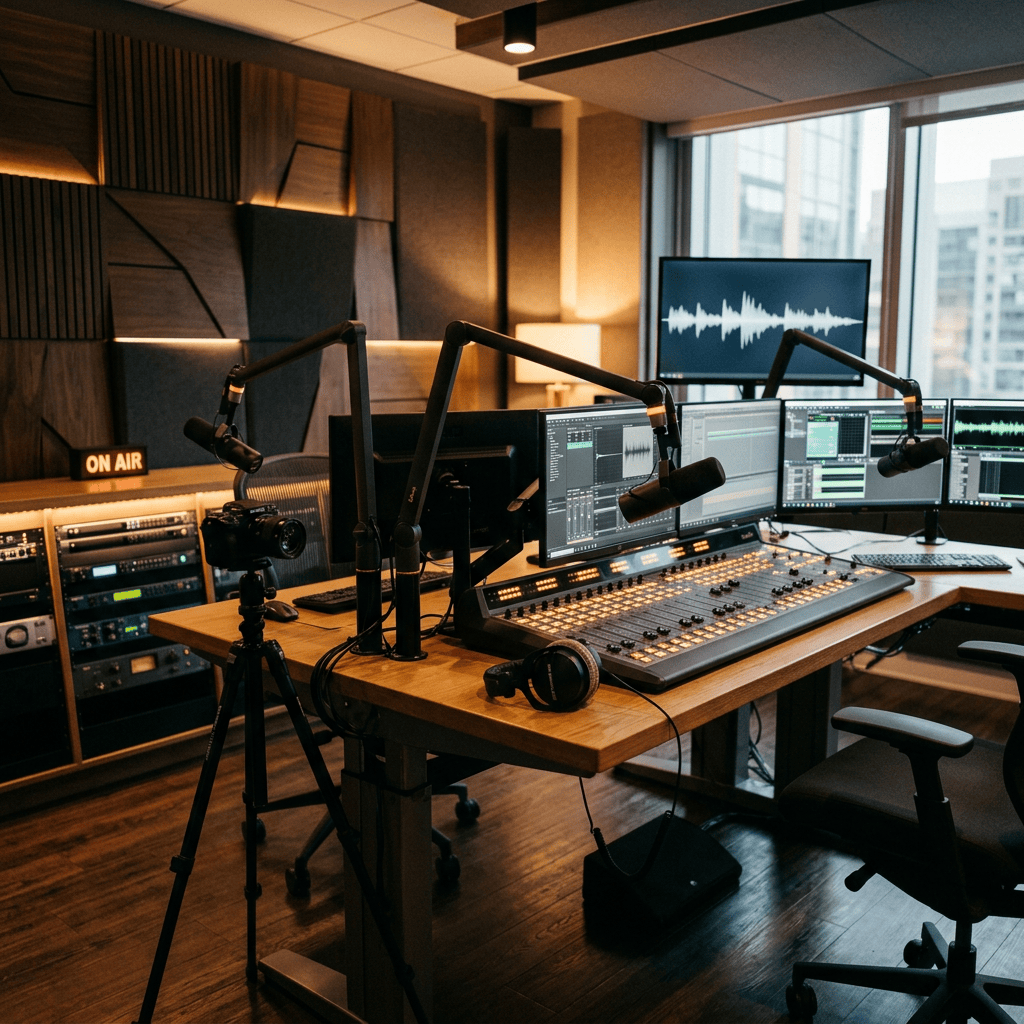
The global audio ecosystem in 2026 has arrived at a transformative juncture where traditional over-the-air broadcasting, high-growth digital streaming, and sophisticated interactive platforms converge into a single, multi-platform industry. For entrepreneurs and investors, starting and growing a radio business now requires a hybrid mindset that values the historic “Theater of the Mind” while simultaneously aggressively adopting cloud-native automation, artificial intelligence, and integrated digital advertising models.[1, 2] The resilience of the medium is evidenced by its ability to reach 84% of adults weekly, a figure that surpasses social networking on smartphones and traditional television.[3] However, the path to financial stability is increasingly dictated by a station’s ability to bridge the gap between terrestrial reach and digital targeting, creating a synergistic promotional environment that caters to modern consumer habits.[4, 5]
Macro-Economic Landscape and Revenue Projections
The economic foundation of the radio industry in 2026 is characterized by a “new normal” following the record-breaking political spending of previous cycles. Local advertising revenue in the United States is projected to reach approximately $171 billion, reflecting a 5.5% to 6.1% increase in core spending when political fluctuations are removed from the baseline.[4, 6] A pivotal shift has occurred: local digital advertising spend is forecast to surpass traditional media for the first time in history.[4]
Advertising Revenue and Market Share
While over-the-air (OTA) spot revenue is expected to undergo a nominal decline of 0.4% to 1.6%, totaling roughly $10 billion, this contraction is being mitigated by the rapid expansion of radio-digital revenue.[4, 7] Digital initiatives within the radio sector are expected to grow by 4.2%, reaching $2.9 billion and representing a critical growth opportunity for stations that have modernized their sales strategies.[7] The following table delineates the projected revenue distribution for the 2025 fiscal year.
| Media Category | 2025 Projected Revenue | Growth Rate | Strategic Outlook |
|---|---|---|---|
| Total Local Advertising | $171.4 Billion | -0.5% | Resilience despite economic shifts [6] |
| Core Local Ad Spending | $170.9 Billion | +5.5% | Driven by digital media expansion [4] |
| Traditional Radio OTA | $10.0 Billion | -0.4% | Remains top mass-reach medium [4] |
| Radio Digital Revenue | $2.9 Billion | +4.2% | The “true opportunity” for 2025 [4] |
| Local CTV/OTT Spend | $2.8 Billion | +9.1% | Fastest-growing category [4] |
The migration of advertising dollars is a fundamental trend, with approximately $9.56 billion expected to shift from traditional to digital channels between 2025 and 2026.[3, 4] For the entrepreneur, this necessitates a sales force that can recommend digital tactics alongside airtime as a single, cohesive package.[5]
Industry Vertical Dynamics
The “Three R’s”—Retail, Restaurants, and Real Estate—are poised to be the primary drivers of growth in the coming year.[7] The retail vertical is experiencing a paradigm shift toward continuous 12-month engagement, moving away from traditional seasonal peaks as consumer buying habits evolve through platforms like Amazon.[7] Restaurants, facing high churn and consumer price sensitivity, are projected to increase their local ad spend by 9.2%, utilizing geofencing and radio spots to drive both recruitment and foot traffic.[4, 6]
| Vertical Segment | Growth Projection | Key Tactics for Success |
|---|---|---|
| Real Estate | 9.3% | Virtual tours on CTV/OTT; localized FM [6, 7] |
| Restaurants | 9.2% | Geofencing to lure diners; hiring ads [4] |
| Retail | 6.8% | 12-month campaigns; differentiators [4, 6] |
| Education/Auto | 5.0% | Multi-tactic digital + traditional [5, 6] |
The finance and insurance sectors are also expected to see digital growth of 2.2%, even as OTA spend contracts slightly.[4] This highlights a second-order insight: older demographics (Baby Boomers and Gen X) are approaching retirement, leading to a surge in demand for estate planning and financial advisory services, which radio stations can capture by emphasizing the “trust halo” inherent in the medium.[4, 5]
Foundational Business Planning and Organizational Structure
Starting a radio business begins with a robust business plan that serves as a roadmap for financial stability and a tool for attracting investment.[8] Entrepreneurs must decide whether they are launching a lean online-only station, a non-profit community project, or a high-capital terrestrial operation.[8, 9]
Business Planning Components
A comprehensive business plan for a 2026 radio startup should include a detailed market analysis, defined target audience, and clear monetization strategies.[8, 9] Key elements include:
- Executive Summary: A high-level overview of the station’s mission and format.[9]
- Market Analysis: Identification of local competitors and gaps in the existing audio landscape.[8, 9]
- Financial Projections: Clear break-even timelines, startup cost analysis, and ongoing operational expenditure (OPEX) estimates.[10]
- Operational Plan: Details on staffing, studio location, and technology infrastructure.[10, 11]
Securing funding often involves a mix of personal savings, small business loans, crowdfunding, or media-focused venture capital.[10] Additionally, the Small Business Administration (SBA) can assist in finding qualifying grants to provide an injection of cash for early operations.[8]
Legal Registration and Organizational Framework
Before broadcasting can commence, the business must be registered as a legal entity, such as an LLC, S-Corp, or non-profit.[8] This process includes obtaining an Employer Identification Number (EIN) from the IRS and securing necessary insurance, including general liability and workers’ compensation.[8]
| Operational Step | Requirement | Purpose |
|---|---|---|
| Legal Structure | LLC, C-Corp, or Non-Profit | Liability protection and tax efficiency [8] |
| IRS Registration | EIN | Tax filing and bank account opening [8] |
| Financial Accounts | Business Bank Account | Separation of personal and business funds [8] |
| Insurance | General Liability; Workers’ Comp | Risk management for assets and staff [8] |
Choosing a business name is a strategic decision; it must be easily recognizable for voice search optimization (VSEO), as hard-to-spell or pronounce names can lead to a significant loss of audience in the smart speaker era.[9, 12, 13]
Regulatory Compliance and Licensing
The regulatory environment for radio is divided between the highly controlled terrestrial airwaves and the decentralized online space. In the United States, the Federal Communications Commission (FCC) manages the electromagnetic spectrum, while online stations navigate complex international copyright laws.[14, 15, 16]
Terrestrial Licensing (FCC)
Securing a terrestrial license is an intensive process, as frequencies are finite and highly sought after. The FCC only accepts applications during specific “filing window” periods.[16] Because of the high demand and engineering complexity, most applicants retain legal counsel and broadcast engineering consultants to conduct frequency searches and prepare the technical portions of their applications.[16]
| FCC Application Form | Purpose | Associated Station Type |
|---|---|---|
| Form 301 | Construction Permit | AM and FM Commercial [16] |
| Form 340 | Construction Permit | FM Non-Commercial Educational (NCE) [16] |
| Form 318 | Construction Permit | Low Power FM (LPFM) [16, 17] |
| Form 314 | Assignment of License | Selling/Buying an existing station [16] |
| Form 315 | Transfer of Control | Changing ownership of a licensee [16] |
The FCC strictly prohibits unlicensed operations. Unlicensed broadcasting—even at powers as low as one watt—can lead to fines, criminal prosecution, and seizure of equipment.[16, 17] Permitted unlicensed operations are limited to “Part 15” devices with a coverage radius of approximately 200 feet.[16, 17]
UK Regulatory Comparison (Ofcom)
In the United Kingdom, the Office of Communications (Ofcom) oversees radio licensing with a recently modernized framework. As of late 2024 and 2025, Ofcom has implemented a three-tier amateur licensing system (Foundation, Intermediate, and Full) and continues to reform broadcast regulation to reflect the “wholly digital environment”.[18, 19, 20]
Key differences in the UK include:
- Amateur Licensing: Automated online platforms allow for the selection and periodic changing of call signs (limited to once every five years).[18, 21]
- Revalidation: Licensees are required to revalidate their details every five years to avoid revocation, a process designed to maintain an accurate national database.[19, 21]
- Regulatory Reset: Ofcom is currently examining whether legacy advertising and content standard rules remain proportionate in an era of algorithm-driven viewing and global platform competition.[20]
Content Standards and Public Decency
Terrestrial broadcasters are legally required to operate in the “public interest, convenience, and necessity”.[22] This includes adhering to federal laws prohibiting obscene, indecent, and profane content.[23, 24]
- Obscenity: Not protected by the First Amendment; prohibited at all times. It must meet a three-pronged Supreme Court test, including appealing to prurient interests and lacking serious literary or scientific value.[23, 24, 25]
- Indecency and Profanity: Prohibited between 6:00 a.m. and 10:00 p.m. when children are likely to be listening.[23, 26] This “Safe Harbor” period (10:00 p.m. to 6:00 a.m.) allows for more mature content.[24, 27]
- Enforcement: The FCC relies on public complaints, which must include the date, time, station call sign, and a transcript or recording of the offensive material.[23, 24, 27]
Political advertising also carries strict regulations, including “Reasonable Access” for federal candidates and “Equal Opportunities” for all legally qualified candidates.[22] Stations must provide the “Lowest Unit Charge” during the 45-60 days preceding an election and ensure all political ads have clear sponsorship identification.[22]
Music Licensing and Royalties
Playing copyrighted music requires licenses from Performance Rights Organizations (PROs). In the U.S., this typically involves ASCAP, BMI, and SESAC for the musical composition, and SoundExchange for the digital performance of the sound recording.[10, 15]
Online-only stations face a global licensing challenge, as they are subject to the laws of both their country of origin and the locations of their listeners.[10] Platforms like Live365 provide a streamlined solution by bundling U.S., Canada, and UK music licenses into their monthly subscription, which ranges from $75 to $150 depending on features and ad injection.[10, 28] For independent setups, music licensing remains the single largest operational cost, often amounting to thousands of dollars per month.[28]
Infrastructure and Technical Implementation
The technological choice between terrestrial and online broadcasting dictates the initial capital requirement. An online station can be launched for roughly $10,000, while a traditional FM station can exceed $1 million in startup costs.[8, 10]
Terrestrial Hardware and Engineering
Terrestrial stations require a significant physical footprint, including towers, antennas, and transmitters.[10] The transmitter converts the audio signal into radio frequency (RF) energy, which the antenna radiates into the air.[29] Modern installations, such as those by Rohde & Schwarz, are increasingly utilizing liquid-cooled, high-power transmitters to enhance reliability and lower operating costs.[30]
| Terrestrial Equipment | Estimated Cost | Functionality |
|---|---|---|
| FM Transmitter | $30,000 – $150,000 | Core RF signal generation [10, 11] |
| Antenna Array | $20,000 – $500,000 | Signal radiation and coverage [10, 11, 29] |
| Emergency Alert System | $3,000 – $3,500 | Mandatory public safety link [8, 31] |
| Audio Processors | $5,000 – $20,000 | Sonic tweaking and loudness control [29] |
| STL Link | $5,000 – $15,000 | Studio-to-Transmitter Link [31] |
A critical emerging technology is the Virtualized Radio Access Network (vRAN), which replaces proprietary hardware with software running on commercial off-the-shelf (COTS) servers.[32, 33, 34] This approach offers a total cost of ownership (TCO) savings of up to 44% and allows for more elastic scaling of network resources.[32]
The Digital Studio and RoIP
The modern radio studio is increasingly IP-based, leveraging Radio over IP (RoIP) to transmit voice and data over standard internet protocols.[35, 36] RoIP converts analog signals into digital packets, providing global connectivity without the need for expensive satellite links or leased lines.[35, 36]
Essential studio components for any station in 2025 include:
- Computers: High-performance desktops or laptops for running automation software.[37, 38]
- Microphones: Dynamic microphones (e.g., Shure SM58 or SM7B) are ideal for reducing background noise, while condenser mics (e.g., Audio-Technica AT2020) provide superior voice clarity in treated studios.[37, 38]
- Mixers/Consoles: Managing multiple audio inputs and ensuring smooth transitions.[29, 37]
- Automation Software: Platforms like SAM Broadcaster, Radio.co, or Radio Cult handle scheduling, playout, and media management.[9, 37, 38]
Cloud-based automation has matured into a browser-based production environment, allowing station managers to handle workflows from anywhere with internet access.[39] This eliminates the need for extensive on-premise hardware and specialized technical space, significantly reducing capital expenditure (CAPEX).[39]
Content Strategy and Programming Evolution
The success of a radio enterprise depends on its ability to create compelling content that resonance with a target audience.[40] While streaming services excel at music discovery through algorithms, radio provides a “human-curated” experience that fosters community spirit.[1, 40]
Identifying Hyper-Niche Demographics
Modern market research utilizes tools like Nielsen Audio, Statista, and social media analytics to segment the audience by age, lifestyle, and consumption habits.[11, 41] The 2025 landscape identifies 10 unique audience segments that offer growth opportunities:
- Independent Podcast Hosts: Seeking a personalized platform to reach niche audiences.[42]
- Hyperlocal Community Managers: Residents looking for neighborhood-specific news and events.[42]
- Niche Music Curators: Dedicated fans of specialized genres (e.g., electronic, jazz, or classical).[42]
- Non-Profit Cultural Broadcasters: Promoting local arts, languages, and social issues.[42]
- Fitness & Wellness Creators: Sharing motivational content and health tips.[42]
The interactivity of modern radio allows these niche groups to participate in live polls, active chats, and reward systems, instilling an “in-the-moment” consumption ethos.[43]
Format Selection and Syndication
Choosing the right format (Talk, Music, or a Hybrid) is a foundational decision.[9] For smaller stations, syndication provides access to world-class talent and production at a fraction of the cost of hiring local staff.[44, 45]
| Syndication Partner | Reach | Specialty |
|---|---|---|
| Premiere Networks | 245M monthly | #1 syndicator; top personalities [46] |
| Syndication Networks Corp | 5,000+ stations | Turn-key packages; marketing/ad sales [44, 47] |
| Radio Express | Global | Branded entertainment and holiday specials [45] |
| Syndicast | 2,400+ stations | Global digital delivery for music/electronic [48] |
Syndication companies offer “Station-in-a-Box” solutions, providing ongoing consultation, affiliate relations, and national sales support to help small stations succeed.[31, 44]
Artificial Intelligence in Programming
Generative AI is fundamentally changing the broadcast day by automating repetitive tasks and expanding reach.[49] In 2025, AI is used to:
- Automate Off-Peak Programming: Powering overnight or weekend blocks with AI personas to ensure the station never goes silent.[49]
- Multilingual Briefs: Instantly rendering English scripts into other languages (e.g., Spanish or Hindi) to serve diverse local communities without hiring a full translation team.[49]
- Ad Production: Generating voice-overs for commercial spots, which provides a quick ROI without affecting live programming.[49]
Ethical integration remains a priority; 71% of job seekers and many listeners still equate human interaction with authenticity and fairness.[50] Successful stations frame AI as a “co-pilot” that empowers human hosts to focus on creative segment development and community interaction.[49]
Monetization and Financial Growth
Sustainable growth requires a diversified revenue strategy that moves beyond traditional advertising spots.[51, 52]
Revenue Streams for 2025
| Monetization Strategy | Mechanism | Revenue Potential |
|---|---|---|
| Programmatic Audio | Automated ad placement via networks | High efficiency for large bases [52, 53] |
| Memberships/Subscriptions | Exclusive content; ad-free tiers | Predictable monthly income [51, 52] |
| Listener Donations | PayPal, Stripe, or Ko-fi links | Low barrier to entry; loyal support [52, 53] |
| Branded Merchandise | T-shirts, mugs via print-on-demand | Passive advertising and brand loyalty [52, 53] |
| Live & Virtual Events | Paid concerts, workshops, or Q&As | High engagement; ticket sales [53] |
| V-Commerce | Voice-activated purchases from ads | Explosive growth; $81.8B market [54, 55] |
Voice Commerce (V-Commerce) Implementation
A significant second-order insight is the rise of voice-activated shopping. Global voice commerce sales are projected to reach $81.8 billion by 2025.[54, 55] Radio stations are uniquely positioned to benefit from this by integrating with AI assistants like Alexa or Google Assistant.[56, 57] Listeners can now say, “Alexa, order the olive oil from the ad,” creating a frictionless path from broadcast to purchase.[55, 58] Brands like Domino’s and Walmart are early adopters, allowing customers to place orders via smart speakers simply by speaking.[55, 58]
The Experience Economy and Gamification
Radio is borrowing engagement strategies from the gaming industry to deepen listener loyalty.[51] By creating participatory models where listeners influence playlists, unlock digital badges, or compete in trivia, broadcasters transform passive listening into emotional investment.[51] This loyalty is a “measurable asset” that translates into resilient advertising revenue and more successful direct-to-consumer offerings.[51]
Growth Strategies and Audience Acquisition
Growing a radio business in the digital age requires “Audio Everywhere”—a plan to ensure the station brand is visible and accessible across all devices.[12]
Smart Speaker and VSEO Optimization
Approximately 101 million Americans (35% of those aged 12+) own at least one smart speaker.[59] For radio stations, this technology enables hands-free listening that fits seamlessly into daily routines like cooking or exercising.[2, 13]
| Smart Speaker Brand | Market Share | Agent/Station Strategy |
|---|---|---|
| Amazon Echo | 65% (US) | Matter-compatible; central home hub [59, 60, 61] |
| Apple HomePod | 15% | Spatial audio/360-degree sound [59, 60] |
| Google Nest | 8% | Personalized user profiles; sleek design [59, 60, 61] |
Optimization for these platforms requires:
- Voice Search Optimization (VSEO): Using natural language and conversational keyword phrases in metadata.[13, 62]
- Schema Markup: Implementing FAQ, Local Business, and HowTo schema to help AI models parse station content for featured snippets.[63, 64, 65]
- Metadata Clarity: Ensuring station names and show titles are easy to say and search by voice.[12, 13]
Multi-Platform Promotion
Effective promotion involves a mix of social media, email marketing, and traditional out-of-home (OOH) advertising.[66]
- Social Media: Platforms like TikTok and Instagram are used for behind-the-scenes content and interactive polls to turn passive followers into active fans.[66]
- Podcast Integration: Repurposing on-air content into on-demand podcasts expands reach and provides “TV-level scale” for younger generations.[12, 67, 68]
- OOH Advertising: Strategic placement of billboards and bus wraps with QR codes can significantly boost brand visibility and drive immediate traffic to the station’s mobile app.[66]
Competitive Analysis: Radio vs. Streaming
The competition between linear radio and streaming platforms like Spotify and Apple Music is a defining feature of the 2026 landscape. While Spotify takes an “aggressive stance of cannibalization,” aiming to replace radio with algorithmic playlists and podcasts, Apple Music has rebranded its stations to facilitate a more artist-driven, live radio experience.[69]
Curation vs. Algorithm
Radio remains the most common way for Americans to discover new music, leading both streaming and social media.[70] While streaming platforms have “infinitely deep catalogues,” a large chunk of passive listeners still prefers the curated experience provided by radio DJs.[70] The conclude of current research suggests that radio build reach faster than TV and remains the dominant in-car medium, capturing 56% to 90% of all ad-supported audio time behind the wheel.[3]
The Shelf Life of Hits
A stark divide exists in song performance: rap songs gain traction on Spotify long before they earn radio airplay but are also supplanted much faster.[70] Radio hits take longer to reach the Top 10 but remain on the charts for an average of 26 weeks, compared to roughly 13 weeks on Spotify.[70] This “staying power” provides radio stations with consistent listener interest and a more stable environment for advertisers.[70]
Future Outlook and Strategic Conclusion
The radio industry of 2026 is not a medium in decline but one in the midst of a sophisticated reinvention. The core value proposition of radio—its immediacy, intimacy, and accessibility—remains intact, even as the delivery mechanisms undergo a digital revolution.[1, 2] For the modern radio entrepreneur, success is contingent on a strategy that integrates terrestrial reach with digital precision, leveraging the “trust halo” of the airwaves to legitimize expansive digital streams.[4, 12]
To grow a sustainable business, operators must:
- Embrace Cloud-Native Infrastructure: Reducing hardware costs and enabling remote production through RoIP and cloud automation.[32, 36, 39]
- Diversify Monetization: Moving beyond the 30-second spot to include V-commerce, tiered memberships, and integrated CTV/OTT offerings.[5, 7, 51, 55]
- Optimize for Voice and AI: Ensuring the station is the single spoken answer for voice assistants and utilizing AI to expand multilingual reach.[49, 62, 64, 71]
- Invest in Localism: Fostering community spirit through live interactions and localized content that algorithms cannot replicate.[1, 4, 72]
By treating radio as a vibrant, multi-platform ecosystem rather than a legacy technology, broadcasters can unlock new opportunities and expand their audiences in an increasingly crowded media space.[2, 72] The future of radio lies in its ability to blend time-honored storytelling with the interactive and measurable power of the digital age.
——————————————————————————–
- The power of radio | McGuinness Media & Marketing, https://mcguinnessmedia.com/the-power-of-radio-in-2025
- Is Radio Dying? The Future of Radio in a Streaming World – Live365, https://live365.com/broadcaster/the-future-of-radio
- Radio Statistics – Compass Media Networks, https://www.compassmedianetworks.com/index.php/loveradio/
- The 2025 Radio Revenue Outlook and Review | Marketron, https://www.marketron.com/2025outlook/
- 5 Ways to Update Your Local Media Sales Strategy for 2025 – Aspire by Marketron, https://aspire.marketron.com/5-ways-to-update-your-local-media-sales-strategy-for-2025/
- BIA Estimates Local Ad Revenue to Reach $171B in 2025, Core Spending Up 6.1%, https://bia.com/press-releases/bia-estimates-local-ad-revenue-to-reach-171b-in-2025-core-spending-up-6-1/
- BIA Reveals Its Top Revenue Strategies For Radio In 2025, https://radioink.com/2024/09/26/bia-reveals-its-top-revenue-strategies-for-radio-in-2025/
- How to Start a Radio Station | ZenBusiness, https://www.zenbusiness.com/start-radio-station/
- How To Start a Radio Station – 9 Easy Steps, https://producer.musicradiocreative.com/start-radio-station/
- How to Start a Radio Station: Step-by-Step Guide – Live365, https://live365.com/broadcaster/how-to-start-a-radio-station-guide/
- How to Start a Radio Station: Step-by-Step Guide – Live365, https://live365.com/broadcaster/how-to-start-a-radio-station-guide
- Digital Audio Trends 2025: Audio Everywhere – Chris Kubacki, https://chriskubacki.com/audio-everywhere-digital-audio-trends-2025/
- How Smart Speakers Continue To Reshape Local Radio – Leighton Media Blog, https://blog.leighton.media/smart-speakers-local-radio
- Licensing – Federal Communications Commission, https://www.fcc.gov/licensing
- Broadcast License Basics: What Every Station Needs to Know – Live365, https://live365.com/broadcaster/broadcast-license-basics
- How to Apply for a Radio or Television Broadcast Station | Federal …, https://www.fcc.gov/media/radio/how-to-apply
- Low Power Radio – General Information | Federal Communications Commission, https://www.fcc.gov/media/radio/low-power-radio-general-information
- Updating the Amateur Radio licensing framework: overview of key changes | Ofcom, https://www.ofcom.org.uk/siteassets/resources/documents/consultations/category-2-6-weeks/263174-amateur-radio-licensing-framework/associated-documents/updating-the-amateur-radio-licensing-framework-overview-of-key-changes?v=330562
- UK Amateur Licensing – Radio Society of Great Britain – Main Site, https://rsgb.org/main/operating/licensing-novs-visitors/uk-licensing/
- Ofcom and European Commission review broadcast regulation – Lewis Silkin LLP, https://www.lewissilkin.com/insights/2025/11/24/ofcom-and-european-commission-review-broadcast-regulation-102lvqa
- Licensing updates – Ofcom, https://www.ofcom.org.uk/spectrum/radio-equipment/licensing-updates
- The Public and Broadcasting | Federal Communications Commission, https://www.fcc.gov/media/radio/public-and-broadcasting
- Obscene, Indecent and Profane Broadcasts – Federal Communications Commission, https://www.fcc.gov/sites/default/files/obscene_indecent_and_profane_broadcasts.pdf
- Obscene, Indecent and Profane Broadcasts – Federal Communications Commission, https://www.fcc.gov/consumers/guides/obscene-indecent-and-profane-broadcasts
- Broadcast of Obscenity, Indecency, and Profanity – Federal Communications Commission, https://www.fcc.gov/enforcement/areas/broadcast-obscenity-indecency-profanity
- Regulation of Broadcast Indecency: Background and Legal Analysis – EveryCRSReport.com, https://www.everycrsreport.com/reports/RL32222.html
- FCC defines the indefinable | The Reporters Committee for Freedom of the Press, https://www.rcfp.org/journals/the-news-media-and-the-law-spring-2001/fcc-defines-indefinable/
- About how much would it cost to operate a streaming-only radio station? Website, fcc fees, fees for playing the songs. Ang information will be greatly appreciated! – Reddit, https://www.reddit.com/r/radio/comments/1f4ecgx/about_how_much_would_it_cost_to_operate_a/
- Professional Radio Broadcasting Equipment – Broadcast Supply Worldwide, https://bswusa.com/blog/professional-radio-broadcasting-equipment/
- Radio Station Equipment Market Size & Share, Growth Report 2035, https://www.researchnester.com/reports/radio-station-equipment-market/7850
- Radio Station Equipment – OpenBroadcaster, https://www.openbroadcaster.com/products/radio-station-equipment-list/
- What is vRAN? – Red Hat, https://www.redhat.com/en/topics/virtualization/what-is-vran
- Virtualized RAN (vRAN) Market Size | CAGR of 35.5%, https://market.us/report/virtualized-ran-vran-market/
- VRAN vs. ORAN: Comparison Between Two Radio Access Networks – Nybsys, https://nybsys.com/vran-vs-oran/
- What is RoIP? Benefits of Radio over IP in Modern Communications – Parraid, https://www.parraid.com/what-is-roip-and-benefits-of-radio-over-ip-in-modern-communications/
- Radio over IP (RoIP) Benefits – Mobile Systems, https://mobilesystems.nz/blogs/technology/radio-over-ip-roip-benefits
- How to Start an Online Radio Station in 2025, https://www.radiocult.fm/radio-bootcamp/how-to-start-an-online-radio-station
- Internet radio station equipment list | Radio Cult, https://www.radiocult.fm/radio-bootcamp/internet-radio-station-equipment-list
- What are the benefits of cloud-based radio automation software in 2025? – Jutel, https://jutel.fi/what-are-the-benefits-of-cloud-based-radio-automation-software-in-2025/
- Starting Your Own Radio Station: A Comprehensive Guide | The Startup Magazine, https://thestartupmag.com/starting-your-own-radio-station-a-comprehensive-guide/
- How To Target The Right Radio Ad Audience – Hybrid Media Services – Direct Response Radio Advertising Agency, https://hybridmediaservices.com/how-to-target-the-right-radio-ad-audience/
- Target Audience for Radio station in 2025 [Example] – FounderPal, https://founderpal.ai/target-audience-examples/radio-station
- How Digital Audio Is Transforming Listener Behavior in 2025: The Shift From Radio to Interactive Entertainment – RadioInsight, https://radioinsight.com/extra/329098/how-digital-audio-is-transforming-listener-behavior-in-2025-the-shift-from-radio-to-interactive-entertainment/
- Syndication Networks.net : Services, https://www.syndication.net/services/
- Radio Express: Best syndicated radio shows, https://radioexpress.com/
- Premiere Networks, https://www.premierenetworks.com/
- Syndication Networks.net : Radio Syndication | Syndication.net, https://www.syndication.net/
- The Best Radio Promotion Companies: Who to Trust in 2025 – Syndicast, https://syndicast.co.uk/blog/the-best-radio-promotion-companies-who-to-trust-in-2025/
- AI Voices in Radio Broadcasting: The Ultimate 2025 Guide – TrueFan AI, https://www.truefan.ai/blogs/ai-voices-radio-broadcasting-guide
- How AI Is Redefining Talent Acquisition in 2025: Data, Ethics, and Human Impact, https://www.hrfuture.net/strategy-operations/leadership-talent-management/how-ai-is-redefining-talent-acquisition-in-2025-data-ethics-and-human-impact/
- How listener loyalty is driving new revenue models for radio in 2025, https://radiotoday.co.uk/2025/09/how-listener-loyalty-is-driving-new-revenue-models-for-radio-in-2025/
- How to Monetize Your Online Radio Station, Updated for 2025 – Shoutcheap, https://www.shoutcheap.com/monetize-online-radio-station/
- How Do Radio Stations Make Money? – RadioKing Blog, https://www.radioking.com/blog/how-do-radio-stations-make-money/
- Voice Search & Voice Commerce in 2025: Strategies for AI-Enhanced Marketing – Averi AI, https://www.averi.ai/blog/voice-search-voice-commerce-in-2025-strategies-for-ai-enhanced-marketing
- Voice Commerce and IoT Payments: Is Your Business Ready for Voice-Activated Shopping?, https://www.hostmerchantservices.com/2025/07/voice-commerce/
- Voice Commerce: Use Cases and Benefits in 2025 – Rep AI, https://www.hellorep.ai/glossary/what-is-voice-commerce
- Voice Commerce: What It Is, How It Works & Benefits (2026) | Twilio, https://www.twilio.com/en-us/blog/insights/best-practices/what-is-voice-commerce
- Voice Commerce In Retail: How It Works & Challenges In 2025 – Dev Technosys, https://devtechnosys.com/insights/voice-commerce-in-retail/
- Smart Speaker Statistics, By Usage, Market Size & Facts 2025 – ElectroIQ, https://electroiq.com/stats/smart-speaker-statistics/
- Help Clients Upgrade Their Home Sound: Top Smart Speakers of 2025, https://www.nar.realtor/magazine/real-estate-news/technology/help-clients-upgrade-their-home-sound-top-smart-speakers-of-2025
- Best Smart Speakers for 2025: Audio and Assistants Thoroughly Tested – CNET, https://www.cnet.com/home/smart-home/best-smart-speaker/
- Voice SEO: The Ultimate Guide to Optimize for 2025 – Improvado, https://improvado.io/blog/voice-search-seo
- Voice Search Optimization 2025 for Local Biz | GreenBananaSEO, https://greenbananaseo.com/voice-search-optimization-in-2025/
- Voice Search SEO 2025: Master Conversational Optimization – Concept Beans, https://www.conceptbeans.com/voice-search-seo-2025/
- Voice Search Optimization in 2025 | Best Practices for UX & SEO – Design In DC, https://designindc.com/blog/how-to-optimize-your-website-for-voice-search-in-2025/
- 23 Radio Station Promotion Ideas | Radio Cult, https://www.radiocult.fm/radio-bootcamp/online-radio-station-promotion
- Must-Know Podcast Statistics in 2025 – Loopex Digital, https://www.loopexdigital.com/blog/podcast-statistics
- Podcast Trends 2025: Key Innovations Transforming the Audio World, https://www.bostonbrandmedia.com/news/podcast-trends-2025-key-innovations-transforming-the-audio-world
- Spotify and Apple Music disagree on the future of radio. Who’s right?, https://www.waterandmusic.com/spotify-and-apple-music-disagree-on-the-future-of-radio-whos-right/
- Measuring Radio’s Lag Behind Streaming Services | The DataFace, https://archive.thedataface.com/2019/01/culture/streaming-vs-radio
- Master Voice Search SEO in 2025: The Complete Guide – The Go-To Guy!, https://www.thegotoguy.co/blog/master-voice-search-seo-2025-the-complete-guide/
- Playbook for growth: Treat radio like a vibrant platform and your audience will flourish, https://current.org/2025/10/playbook-for-growth-treat-radio-like-a-vibrant-platform-and-your-audience-will-flourish/


Leave a comment