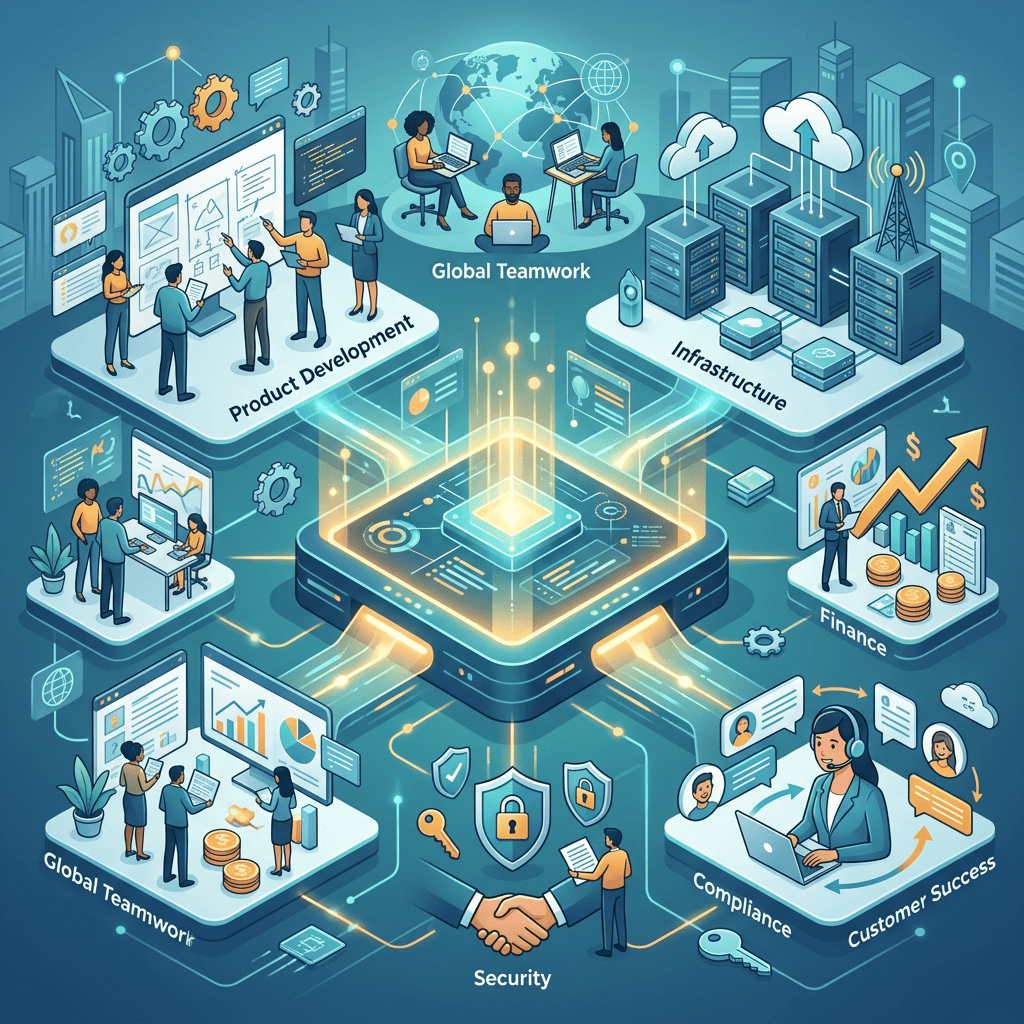
The software industry in 2026 exists in a state of hyper-competition and rapid technological displacement. For founders and executive teams, the transition from a nascent concept to a globally scalable enterprise requires a sophisticated understanding of legal scaffolding, product validation, revenue architecture, and operational maturity. The landscape is no longer dominated by “growth at all costs” but has shifted toward a paradigm of “sustainable, profitable growth,” where unit economics and long-term viability are prioritized over speculative scaling.[1] Building a strong, defensible foundation involves tapping into external expertise, peer networks, and non-dilutive capital to de-risk ventures before significant equity is surrendered to investors.[2] This report provides an exhaustive analysis of the mechanisms required to navigate the complexities of starting and growing a software business in the current era.
The Legal and Administrative Bedrock: Establishing the Corporate Entity
The genesis of a software business is inherently tied to its legal and administrative configuration. Business formation in 2026 is influenced by traditional practices and emerging trends toward corporate accountability and transparency.[3] Selecting the appropriate business structure is one of the most critical decisions a founder makes, as it dictates tax obligations, legal responsibilities, and how the government perceives the venture.[3]
Entity Selection and Strategic Implications
A proper business entity formation must account for state-specific compliance requirements and long-term growth objectives.[4, 5] While simple structures may appear cost-effective initially, they often lack the robustness required for venture capital or complex partnership models.[5]
| Entity Type | Primary Strategic Advantage | Governance Requirements | Revenue/Tax Outlook |
|---|---|---|---|
| Limited Liability Company (LLC) | Asset protection; tax flexibility | Minimal; state-dependent | Pass-through; S-Corp potential |
| C-Corporation | Standard for venture capital | High; formal board/bylaws | Double taxation; equity focus |
| S-Corporation Election | Tax optimization for founders | Moderate | Avoids double taxation on dividends |
| PLLC/PC | Specialized for regulated tech | Varies by professional license | Targeted at licensed professionals |
Source: [3, 4, 5]
Establishing limited liability protection is the primary driver for entity formation, as it separates personal assets from business liabilities.[4] In the software sector, founders often opt for C-Corporations when planning to issue multiple classes of stock or seek institutional funding.[5] The standardization of the company charter is essential from the outset, covering provisions on capital contribution, share transfer, voting rights, and intellectual property ownership.[5] Neglecting to draft comprehensive governing documents that detail ownership stakes and conflict resolution strategies is a common error that can lead to internal disputes and the erosion of investor confidence.[3, 5]
Procedural Mechanics of Launching
The administrative journey begins with the submission of the enterprise registration dossier to the relevant business registration authority, typically under the Department of Finance or Planning and Investment.[5] This process requires obtaining an Employer Identification Number (EIN) from the IRS and registering with state-specific bodies.[3, 4] In 2025, modern administrative requirements include registering for digital signature certificates to enable online tax declarations and maintaining internal records of company seals.[5]
A “Success Factors Assessment” for new founders involves evaluating personal financial readiness. It is recommended that founders maintain six to twelve months of personal living expenses and be prepared for irregular income during the first year of operation.[4] Initial startup costs for a lean, virtual software firm typically range from $5,500 to $12,000, which includes registration, insurance, hardware, and website development.[4]
The Financial Command Center
Setting up robust financial systems from day one is a prerequisite for operational stability. Founders must separate operating accounts for business expenses from savings accounts reserved for tax liabilities, which typically account for 25% to 30% of net income.[4] Accounting software like QuickBooks Online remains the industry standard for small-to-mid-sized software firms, offering automated bank feeds and real-time financial reporting.[4, 6]
A critical inflection point in the first year is the move toward stable profitability, which typically occurs within 12 to 18 months of focused execution.[4] Six-figure revenue is generally achievable within 18 to 24 months if the business successfully identifies an underserved niche and a unique value proposition.[4]
Product Strategy and the Minimum Viable Product (MVP) Paradigm
In 2026, 42% of startups fail because they misread market demand, building products for which there is no real need.[2, 7, 8] The Minimum Viable Product (MVP) is the strategic response to this risk, serving as an initial draft designed to validate fundamental business hypotheses with minimal resource expenditure.[9, 10] An MVP must balance three essential elements: it must be the simplest version (Minimum), functional and usable (Viable), and a tangible solution that allows for data collection (Product).[11]
Ideation, Problem Definition, and Market Research
The foundation of an MVP is a clear understanding of the problem the product aims to solve.[11] Founders often identify problems through domain expertise or a critical analysis of existing market gaps.[12] For instance, a domain expert in real estate might observe that landlords struggle to sell properties because of poor photographic presentation, identifying a specific niche for a software solution.[12]
Thorough market research involves analyzing competitors’ features, pricing, and gaps to ensure the proposed solution is differentiated.[12] It also requires calculating the market size to ensure there are enough potential customers willing to pay for the solution, as running out of money is the second leading cause of startup failure.[12, 13] Qualitative research methods, such as one-on-one interviews and ethnographic studies, help founders understand the “why” behind user behavior, while quantitative methods like surveys and behavioral analytics provide data on market potential.[13]
UX Design and Cognitive Load Management
For a software MVP to be truly viable, it must deliver a seamless user experience despite its limited feature set.[11] Managing “cognitive load”—the mental effort required to complete a task—is a core principle in 2025 UX design.[11] Designers focus on three types of load: intrinsic load (the inherent complexity of information), extrinsic load (how information is presented), and germane load (the effort used to process information into long-term memory).[11]
| UX Strategy | Objective | Implementation Metric |
|---|---|---|
| Progressive Disclosure | Prevent user overwhelm | Click-through rate on “view more” |
| Visual Hierarchy | Direct user attention | Heatmap focus on primary CTAs |
| Asynchronous Update | Improve app responsiveness | Latency reduction in UI elements |
| Mega Menus | Simplify navigation | Reductions in navigation click-paths |
Source: [11, 14, 15]
Best practices for MVPs include utilizing visual hierarchies through font size and color to draw attention to critical information, and maintaining consistency in layouts to follow “Usability Heuristics”.[11] For complex platforms, “Mega Menus” can reduce the mental effort required to scan options, while contextual Call to Action (CTA) buttons adapt based on the user’s state (e.g., showing “Sign up” to guests but “Start Discussion” to logged-in users).[11]
The Build-Measure-Learn Loop and Agile Development
Agile development cycles enable startups to maintain flexibility and iterate quickly based on real-world data.[11, 16] The process involves selecting a scalable but simple technology stack that allows the product to evolve smoothly after validation.[11] Typical timelines for MVP development range from 4-6 weeks for simple concepts to 10-12 weeks for more complex products featuring AI-driven functionality.[11]
Prioritization frameworks like MoSCoW or RICE are used to rank features based on their impact and feasibility.[11] “Must-have” features are non-negotiable for solving the core problem, while “Should-have” or “Could-have” features are deferred to future releases to prevent “feature creep”.[11] This lean approach ensures the initial version remains resource-efficient and focused on delivering its main value proposition.[11]
Low-Fidelity and High-Fidelity Validation Techniques
Validation should ideally occur before significant development resources are committed. “Wizard of Oz” or “manual-first” MVPs provide a front-end interface that appears automated while the back-end processes are performed manually by the founder.[11, 17] This inexpensive approach allows for the validation of service concepts before building the technology.[11] Similarly, “Concierge” MVPs involve being transparent about manual processes to test if users are willing to pay for a solution.[17]
Landing page MVPs and crowdfunding campaigns are high-fidelity validation techniques that gauge market interest through sign-ups, clicks, or pre-orders.[11, 17] These methods provide a “vote of confidence” from the market and can be used to attract initial users or even investors before a full product exists.[10, 17]
Revenue Engineering: Business Models for the Software Economy
The transition from a validated product to a sustainable business model requires a strategic approach to monetization. Software-as-a-Service (SaaS) business models have evolved significantly, moving from perpetual one-time purchases to diverse cloud-based recurring and usage-based structures.[18, 19] In 2026, the ability to align pricing with the value delivered is the primary driver of revenue growth.[19, 20]
SaaS Monetization Architectures
The subscription model remains the dominant SaaS structure, providing predictable recurring revenue through monthly or annual fees.[19] However, more sophisticated models are emerging to capture value more precisely.
| Monetization Model | Primary Advantage | Typical Revenue Cycle | Customer Persona |
|---|---|---|---|
| Tiered Subscription | Predictable growth | Monthly/Annual recurring | SMBs to Mid-Market |
| Usage-Based (Metered) | High value alignment | Consumption-based cycles | Data-intensive firms |
| Freemium | Rapid user acquisition | Free core; 2-5% conversion | Viral/Mass-market |
| Open Core | Community innovation | Support/Premium service fees | Developers/IT Ops |
| Per-User Pricing | Linear expansion | Seat-based growth | Enterprise teams |
Source: [19, 20]
Usage-based pricing (also known as consumption-based or metered billing) charges customers based on quantifiable metrics like data storage, transactions, or compute time.[19, 21] This model is particularly appealing to customers seeking cost-value alignment, as they only pay for what they consume.[20, 21] For the vendor, usage-based models offer higher revenue potential from “power users” but can lead to income fluctuations that make financial forecasting more challenging.[19]
The Freemium Strategy and Product-Led Growth (PLG)
The Freemium model utilizes a free, limited version of the software to attract a large user base and generate brand recognition.[19, 20] It acts as a powerful marketing tool, lowering the barrier to entry and creating a natural upsell pathway as users hit the limits of the free tier.[19] However, supporting free users consumes resources without direct revenue, and low conversion rates (typically 2-5%) mean a startup needs a massive free user base to be profitable.[19]
Product-Led Growth (PLG) takes this a step further by making the product the primary tool for acquisition, conversion, and retention.[22, 23] In a PLG model, users experience the product’s value directly through self-service trials and onboarding.[22] Successful PLG companies in 2025 grow at an average rate of 50% year-over-year, significantly outperforming the 21% growth rate of traditional sales-led SaaS companies.[23] The PLG “flywheel” puts the customer at the center, focusing on adoption and retention rather than just acquisition.[24]
Open Source and Open Core Revenue Strategies
Open-source software (OSS) has transitioned from a developer productivity tool to a component of global mission-critical infrastructure.[25] The “Open Core” model allows businesses to monetize community social capital by offering a free, open-source core while keeping premium, enterprise-grade features (like advanced security or uptime guarantees) proprietary.[19, 26]
Organizations increasingly treat OSS as business-critical, with 71% now expecting support response times of less than 12 hours.[25] For software startups, the open-source model accelerates market penetration and builds developer goodwill, but it requires careful management to balance “Open” vs “Paid” features and avoid the risk of community “forks” if premium tiers become too restrictive.[19, 25] The open-source services sector is expected to reach $50 billion by 2026, as enterprises increasingly seek managed versions and expert support for their OSS dependencies.[27]
Go-to-Market (GTM) and Strategic Growth in 2026
Marketing and sales strategies for software businesses have fundamentally changed due to evolving buyer behavior and the rise of AI. B2B decision-makers now expect faster onboarding, deep personalization, and proof of outcomes before committing to a purchase.[28] In 2025, mass cold email outreach has become largely irrelevant due to buyer fatigue and stricter inbox filters, forcing a shift toward more sophisticated, relationship-driven tactics.[28]
Full-Funnel Content and SEO Evolution
A full-funnel content strategy is essential for engaging discerning B2B buyers who complete 70% of their journey before contacting sales.[22] Top-of-funnel (TOF) content focuses on brand awareness through SEO-optimized blog posts and guides that address customer pain points.[22] In 2025, generic, keyword-stuffed SEO blogs are no longer effective; instead, businesses are investing in authoritative content created by subject matter experts and evergreen knowledge hubs.[28]
Founder-led content has emerged as a major trend, allowing startups to build authority and trust through authentic storytelling.[28] Video content, including short product walkthroughs (2-3 minutes) and customer case study interviews, is highly valued for providing a transparent view of the product in action.[28]
Account-Based Marketing (ABM) and “Smarketing” Alignment
For high-value enterprise accounts, Account-Based Marketing (ABM) is no longer optional.[24] ABM involves targeting specific accounts with personalized content and campaigns tailored to their exact pain points.[24, 28] This requires a high degree of “Smarketing”—the alignment of sales and marketing teams—where both departments share real-time data on lead behavior to determine the optimal moment for sales engagement.[22, 24]
Effective ABM strategies include:
- Identifying high-value target accounts through predictive lead scoring.[10, 24]
- Mapping stakeholders and decision-makers within those accounts.[24]
- Delivering personalized content across multiple channels, including LinkedIn ads and custom landing pages.[22, 24, 28]
AI-Driven Personalization and Adaptive Monetization
Artificial Intelligence has moved from a buzzword to a core component of the product experience in 2025.[28] AI is used to infer user intent based on deep behavioral context—such as action sequences and subtle pauses—allowing products to provide “contextual intelligence” and real-time guidance.[29, 30]
Adaptive monetization is another AI-enabled trend, where paywalls and pricing flex depending on the growth stage or team size of the user.[29] For instance, certain AI tools may allow longer free usage for early-stage startups while incentivizing transitions for enterprise teams demonstrating high-value engagement.[29] This makes monetization itself a part of the product experience rather than just a billing requirement.[29]
Operational Scaling and Human Capital Strategy
Scaling a software business is a delicate act of balancing growth with operational efficiency. As organizations grow, inefficiencies that were manageable at a small scale begin to compound, leading to “revenue leakage” and resource waste.[31, 32]
The Remote Technical Workforce
The software industry has fully embraced distributed workforces in 2026, with remote and hybrid roles attracting 60% of all applications despite making up only 20% of job postings.[33] Startups are increasingly opting for dedicated remote developers over traditional in-house teams to reduce costs and access global talent hubs in Eastern Europe, India, and Southeast Asia.[14, 15]
| Hiring Model | Cost Efficiency | Talent Access | Legal/Compliance |
|---|---|---|---|
| Local In-House | Low (High salary/overhead) | Geographically limited | Simple/Traditional |
| Remote (Global) | High (50-70% savings) | Worldwide pool | Complex (Requires EoR) |
| Hybrid | Moderate | Mixed access | Moderate complexity |
Source: [14, 15, 34]
Managing global remote teams requires overcoming challenges like timezone alignment and international employment laws.[15, 33] Startups often partner with Employer of Record (EoR) services to handle legal compliance in countries where they do not have a local entity.[15, 34] Effective remote management in 2026 relies on “asynchronous collaboration,” where documentation replaces informal “hallway conversations” and projects are broken into 1-2 week sprints with fixed deliverables.[14, 34]
Operational Maturity and Frameworks
Operational maturity is a critical inflection point, typically occurring between $80 million and $100 million in revenue.[32] At this stage, leadership teams must focus on defining business rules, policies, and operational frameworks to capture risk and manage deal approvals.[32] Investing in sales operations and “renewal operations” functions is essential for providing strategic value rather than just administrative support.[32]
Automation is a key driver of maturity, particularly in the “quote-to-cash” process. Using technology to automatically handle amendments, extensions, and renewals can significantly reduce errors and delays.[32] Integrating disparate software solutions—such as connecting NetSuite with Salesforce—boosts the reach of automated capabilities and ensures a 360-degree view of the customer.[32]
The Role of Professional Services Outsourcing
For many software firms, particularly those in the SaaS space, building and maintaining in-house professional services (PS) teams is a significant financial burden. These teams often operate at a loss, with negative gross margins of 10-20% due to the high costs of recruitment and training.[35] Consequently, tech companies are increasingly outsourcing complex client projects—such as data migrations and industry-specific customizations—to external PS providers.[35] This model allows for rapid and flexible workforce scaling during periods of peak demand, such as a major customer rollout, without the risk of long-term fixed costs or idle staff during slower periods.[35]
Technical Architecture for High-Growth Environments
The right software architecture grows with the business, while poor architectural choices create “technical debt” that can stall future progress.[16, 36, 37] High-growth startups must select foundational patterns that allow systems to scale to meet increasing demand while maintaining performance and reliability.[37]
Architectural Patterns and Evolution
Startup architecture naturally evolves through several distinct phases: from proving the concept with minimal infrastructure to stabilizing the codebase and eventually decomposing the monolith as scale demands it.[37]
| Architecture Pattern | Best Use Case | Primary Benefit | Operational Challenge |
|---|---|---|---|
| Modular Monolith | Early-stage/Validation | Simplicity; easy deployment | Shared resource bottlenecks |
| Microservices | High-performance/Scaling | Independent service scaling | High operational overhead |
| Event-Driven | Logistics/Fintech/High-task | Loose coupling; async | Debugging/Event ordering |
| Serverless | Erratic workloads | Cost efficiency; auto-scaling | Vendor lock-in; cold starts |
| CQRS | High-read systems | Optimized reads vs writes | Design complexity |
Source: [37, 38, 39]
Microservices architecture split a system into independent, self-contained services (e.g., UserService, OrderService), allowing for fine-grained scalability and fault isolation.[38, 39] However, it comes with increased operational overhead for monitoring and deployment.[38] For many, the “Modular Monolith” is a preferred starting point, providing clear domain separation without the complexity of microservices, while remaining ready for a future migration if scale requires it.[37, 38]
Cloud Infrastructure and Cost Optimization
Cloud-native solutions are the backbone of modern software architecture, with AWS, Google Cloud (GCP), and Azure offering specialized programs for startups.[36, 40] These programs often provide up to $100,000 to $200,000 in credits, technical training, and architecture reviews.[40]
Cost-effective strategies for 2025 include:
- Going Serverless: Using AWS Lambda or GCP Cloud Functions ensures the business only pays for what is used, making it perfect for erratic early-stage workloads.[40]
- Auto-Scaling and Spot Instances: Configuring resources to scale automatically based on demand and using “spot instances” for non-essential workloads can save up to 90% in costs.[40]
- Infrastructure as Code (IaC): Tools like Terraform or CloudFormation ensure consistent environments and reduce deployment issues.[37]
- Right-Sizing: Regular audits of compute and storage sizes prevent over-provisioning and ensure resources are aligned with actual needs.[40]
Customer Success: Retention as the Primary Growth Engine
In 2026, customer retention is no longer just a metric; it is a primary driver of company value. Research shows that a 5% increase in customer retention can increase company revenue by at least 25%.[41] Customer Success (CS) has moved from a reactive “support” approach to a proactive, relationship-driven strategy focused on long-term value and adoption.[42]
Outcome-Oriented Partnerships and Value Realization
The 2026 customer success landscape is defined by a shift from simple product adoption to “Value Realization”.[1] CSMs are increasingly guiding customers toward specific, measurable business goals rather than just tracking feature usage.[1] This has led to the emergence of “Success Architect” roles that map customer goals directly to technical solutions.[1]
Standardized methodologies are being adopted to drive “predictable expansion” and growth.[1] These frameworks empower teams to uncover upsell opportunities and articulate ROI to stakeholders in ways that resonate with executive leadership.[1] In high-growth SaaS, best-in-class companies maintain a Net Revenue Retention (NRR) above 120%, demonstrating their ability to grow revenue within the existing customer base even after accounting for churn.[43]
Key Performance Indicators (KPIs) for Customer Success
Successful software firms track a blend of behavioral and financial metrics to monitor customer health and predict churn.[24, 43]
| KPI | Meaning and Calculation | 2026 Strategy |
|---|---|---|
| Customer Health Score | Usage + CSAT + Financial data | AI-driven sentiment analysis |
| NRR | Retention – Churn + Expansion | Benchmark of Best-in-class >120% |
| TTV (Time to Value) | Speed to first meaningful outcome | Minimize to prevent early churn |
| CLV/CAC Ratio | Lifetime value vs. Acquisition cost | Target ratio of 3:1 or higher |
| CES (Effort Score) | Ease of accomplishing goals | Correlates strongly with loyalty |
Source: [6, 24, 43]
Modern health scoring incorporates AI-driven insights and behavioral patterns to predict risk before it results in a cancellation.[43] Reducing Time to Value (TTV) is critical; if a user does not achieve their first win quickly, they are significantly more likely to ghost the onboarding process and churn.[6, 43]
The Role of AI and Digital CS
AI and automation are reshaping CS operations by streamlining tasks and enhancing engagement.[1] “Agentic AI” is emerging as a driver for complex automations that previously required manual effort.[1] AI-powered chatbots can handle routine inquiries 24/7, while proactive provisioning uses anticipation of need to offer services before a customer even asks.[1] However, the most successful leaders balance these digital motions with “intentional human connections” for high-value customers, recognizing that AI cannot deliver deep trust or empathy.[1]
Governance, Risk, and Global Compliance
As software businesses scale, they must navigate an increasingly complex landscape of mandatory regulations and voluntary security standards. Compliance is no longer just a legal hurdle; it is a prerequisite for entering enterprise markets and securing institutional funding.[44, 45]
Navigating the GDPR and SOC 2 Roadmap
For SaaS companies, the dual scrutiny of GDPR (General Data Protection Regulation) and SOC 2 (System and Organization Controls) is becoming standard.[45] While GDPR is a mandatory EU regulation with legal penalties for non-compliance, SOC 2 is a voluntary US audit standard that provides an “attestation” of system integrity.[45]
| Compliance Framework | Requirement Nature | Scope and Focus | Impact of Failure |
|---|---|---|---|
| GDPR | Mandatory Law | EU Personal Data/Privacy | Fines (up to 4% revenue) |
| SOC 2 | Voluntary Audit | B2B Cloud Systems/Security | Commercial/Deal Loss |
| CCPA | Mandatory Law | California Residents/Data | Legal Penalties/Trust Loss |
| ISO 27001 | Voluntary Cert | Information Security Mgmt | Competitive Disadvantage |
Source: [45, 46]
The most efficient way to scale is to adopt a “Common Control Framework” (CCF), which maps shared controls across multiple frameworks.[45] Both GDPR and SOC 2 emphasize “Security by Design,” requiring baseline technical safeguards such as encryption (AES-256 for storage, TLS 1.3 for transmission), multi-factor authentication, and regular access reviews.[45, 47, 48]
Privacy Infrastructure and Data Mapping
Effective compliance requires complete visibility into data flows through “data mapping”.[46] This reveals where personal information is collected, stored, and shared, which is essential for responding accurately to consumer requests for data access or deletion (Data Subject Access Requests).[46] Automated Consumer Rights Management software streamlines these workflows, ensuring timely responses without creating operational bottlenecks.[46]
Building privacy into the initial design of a product—privacy by design—is far more efficient than retrofitting compliance later.[47] This includes implementing data expiration rules, granular user controls over their information, and automated redaction for personally identifiable information (PII) in transit.[47]
Analysis of Startup Failure and Long-Term Sustainability
Despite the accessibility of the startup ecosystem, the failure rate remains high, with approximately 90% of ventures closing their doors in the long run.[7, 8] For software founders, understanding the patterns behind these failures is crucial for developing a sustainable business.
The Anatomy of Failure: Year 1 to Year 10
Failure rates are relatively consistent across industries, but the timing varies. Approximately 20% of startups fail in their first year.[8, 49] However, the highest risk period is between years two and five, with 70% of failures occurring in this window as initial funding runs out and businesses struggle to prove their sustainable revenue models.[7, 8]
| Failure Timeline | Percentage | Primary Pitfall |
|---|---|---|
| Year 1 | ~20% | No market demand; poor team |
| Years 2-5 | ~70% | Ran out of cash; scaling too fast |
| Years 5-10 | ~50% (of survivors) | Competition; inability to innovate |
| Long-term (10yr) | 90% total | Strategic obsolescence |
Source: [7, 8, 49]
Technology businesses face a 63% failure rate within the first five years.[8, 49] Only a small fraction—approximately 1%—ever reach the “unicorn” status of a $1 billion valuation, and only 28% of software companies survive long enough to reach $100 million in revenue.[8, 49]
Determinants of Failure: Financial and Operational Pitfalls
Financial mismanagement is the leading cause of collapse, with 38% of startups failing due to running out of cash or an inability to raise new capital.[50] In 2024-2025, rising interest rates and shifting investor sentiment toward “profitability over growth” have tightened the availability of external capital, making startups with high “burn rates” particularly vulnerable.[50] Misaligned pricing strategies and unsustainable revenue models that fail to generate consistent income further undermine long-term viability.[50]
Operational issues, specifically those related to the team, account for 23% of failures.[7, 8] This includes founder conflicts, a lack of complementary skills, and poor hiring decisions that dilute company culture.[7, 31] Furthermore, 21% of startups fail due to poor market timing—either launching before a market is ready or after competitors have already captured the dominant share.[49, 50]
Factors for Success and Serial Entrepreneurship
Success is often tied to the experience of the founding team. First-time entrepreneurs have a success rate of only 18%, while those who have previously failed fare slightly better at 20%.[7, 8] Entrepreneurs who have already built a successful business enjoy the highest success rate at 30%.[7, 8]
The key elements that set the successful 10% apart include:
- Precise Problem Identification: Building a solution that solves a real, validated customer pain point rather than a “nice-to-have” feature.[7]
- Strategic Scaling: Resisting the urge to scale team and technology until after product-market fit has been definitively proven.[16]
- Robust Financial Planning: Maintaining a detailed financial forecast and building a financial cushion to adapt to market changes.[31, 50]
- The Power of Co-Founders: Startups with two or more co-founders increase their chances of success by 30% due to higher investment rates and a more balanced skillset.[8]
Synthesis and Strategic Recommendations for 2026
The software industry in 2026 rewards discipline over disruption and sustainability over speed. Founders must navigate a lifecycle that begins with meticulous legal and financial scaffolding, followed by a relentless focus on product validation through lean MVP cycles. In an environment where capital is more selective, the ability to engineer efficient revenue models—be it through usage-based billing or product-led growth—is the primary differentiator of long-term survival.
To grow and scale successfully, organizations must embrace the globalized talent market while maintaining a standard of operational maturity that includes automated workflows and rigorous data governance. The most resilient businesses will be those that integrate compliance as a core feature of their product design and view customer success not as a support function, but as the primary engine for net revenue retention. Ultimately, the software companies that thrive in 2025 and beyond will be those that balance innovation with the discipline to test, learn, and adapt constantly to the ever-shifting needs of the market.
——————————————————————————–
- The top 2025 customer success trends predicted by SaaS experts …, https://churnzero.com/blog/2025-customer-success-trends/
- The 2025 Startup Success Blueprint: Funding, Tools, and Resources for Founders, https://www.baytechconsulting.com/blog/the-2025-startup-success-blueprint-funding-tools-and-resources-for-founders
- Starting Fresh: Legal Steps To Launch A Business In 2025 – Hatcher Legal, PLLC, https://hatcherlegal.com/starting-fresh-legal-steps-to-launch-a-business-in-2025/
- How to Start a Law Firm 2025: Complete Guide – LeanLaw – Legal Billing Made Easy, https://www.leanlaw.co/blog/the-ultimate-guide-to-opening-a-new-law-firm-legal-financial-and-tech-checklists/
- Startup Legal Framework: A Complete Guide in 2025, https://lexconsult.com.vn/en/startup-legal-framework-a-complete-guide/
- 8 Proven Strategies for Scaling a SaaS Business – Wise, https://wise.com/us/blog/scaling-a-saas-business
- The Ultimate Startup Guide With Statistics (2024–2025) | Founders …, https://ff.co/startup-statistics-guide/
- Latest Startup Failure Rate Statistics for 2025 – DemandSage, https://www.demandsage.com/startup-failure-rate/
- Building a Minimum Viable Product (MVP) to Test Product Market fit (PMF) – Amoeboids, https://amoeboids.com/blog/minimum-viable-product-mvp/
- The 2025 Startup Success Blueprint: Funding, Tools, and Resources …, https://www.baytechconsulting.com/blog/the-2025-startup-success-blueprint-funding-tools-and-resources-for-founders/
- MVP Development Guide: From Idea Validation to Scalable Product …, https://riseuplabs.com/mvp-development-guide/
- How to Build an MVP: Step-by-Step Guide for Startups and SMBs – Uptech Team, https://www.uptech.team/blog/build-an-mvp
- How To Do Market Research for MVP Development: Step-by-Step Guide – F22 Labs, https://www.f22labs.com/blogs/how-to-do-market-research-for-mvp-development/
- Benefits of Remote Development Teams for Startups in 2025 – Acquaint Softtech, https://acquaintsoft.com/blog/benefits-of-remote-development-teams-for-startups
- Remote Hiring vs. Local Hiring: What Works Best for European Startups in 2025, https://www.remotelytalents.com/blog/remote-hiring-vs-local-hiring-what-works-best-for-european-startups-in-2025
- Software Development for Startups: A Guide to Building Your Tech Backbone – Medium, https://medium.com/algoscale/software-development-for-startups-1c0cffd3c9bd
- 15 Proven Ways to Test an MVP & Build Great Products – Net Solutions, https://www.netsolutions.com/hub/minimum-viable-product/testing/
- A Brief Guide to SaaS Licensing Models – Revenera, https://www.revenera.com/blog/software-monetization/saas-licensing-models-guide/
- 10 Business Models SaaS: Top Trends for 2025 – Acquire.com Blog, https://blog.acquire.com/business-models-saas/
- Software Pricing Models: Enterprise SaaS Pricing Models & Strategies – Thales CPL, https://cpl.thalesgroup.com/software-monetization/saas-pricing-models
- 6 SaaS Licensing Models: Pros, Cons & Use Cases, https://www.cloudeagle.ai/blogs/saas-licensing-models
- 2025 B2B SaaS Marketing Strategies: Trends, Channels & ABM, https://martal.ca/b2b-saas-marketing-strategies-lb/
- What is product-led growth, and how to apply it to your SaaS company – Textmagic, https://www.textmagic.com/blog/product-led-growth/
- 8 SaaS Marketing Trends for 2025: The Latest Tools to Spur Growth – Taboola.com, https://www.taboola.com/marketing-hub/saas-marketing-trends/
- The State of Open Source Software in 2025 – Linux Foundation, https://www.linuxfoundation.org/blog/the-state-of-open-source-software-in-2025
- Business models for open-source software – Wikipedia, https://en.wikipedia.org/wiki/Business_models_for_open-source_software
- Open Source Software in 2025: Trends, Benefits, and What to Expect Next – – BIX Tech, https://bix-tech.com/open-source-software-2025-trends-benefits-future/
- B2B SaaS Marketing in 2025: What’s Working, What’s Dead – Ad Labz, https://www.adlabz.co/b2b-saas-marketing-in-2025-whats-working-whats-dead
- What Is Product-Led Growth in 2025? SaaS Trends, Metrics, and AI Strategies – Salespanel, https://salespanel.io/blog/marketing/what-is-product-led-growth/
- Case Studies in AI-Driven Revenue Growth: Real-World Examples and Lessons Learned in 2025 – SuperAGI, https://superagi.com/case-studies-in-ai-driven-revenue-growth-real-world-examples-and-lessons-learned-in-2025/
- 11 Key Challenges of Scaling a Business & the Solutions – Champion PSI, https://www.championpsi.com/blog/challenges-of-scaling-a-business/
- 3 key focus areas for tech companies scaling for operational maturity – RSM US, https://rsmus.com/insights/industries/technology-companies/3-key-focus-areas-for-tech-companiesscaling-for-operational-matu.html
- Remote Hiring Trends 2025: Complete Guide – Deliberate Directions, https://deliberatedirections.com/remote-hiring-trends/
- Remote Developer Jobs & Hiring Trends in 2025: Global Market Insights – Index.dev, https://www.index.dev/blog/remote-developer-hiring-trends
- How to Solve Tech Company Scaling Issues With Partner Solutions, https://www.socialedgeconsulting.com/post/scaling-your-tech-company-with-professional-services
- Scaling for Success: Adapting Solutions for Business Expansion – Evolved Office, https://evolvedoffice.com/blog/scaling-for-success-adapting-solutions-for-business-expansion/
- Scalable Architecture Patterns for High-Growth Startups That Every Business Owner Should Know Today – Full Scale, https://fullscale.io/blog/scalable-architecture-patterns/
- How to Build Scalable Software Architecture for Startups: A Practical Guide for Entrepreneurs – Decipher Zone, https://www.decipherzone.com/blog-detail/scalable-software-architecture-for-startups
- 14 Software Architecture Patterns in 2025 – MindInventory, https://www.mindinventory.com/blog/software-architecture-patterns/
- Scalable Cloud Solutions for Startups with AWS Cost Optimization in 2025, https://www.seaflux.tech/blogs/cloud-computing-cost-reduction-startups-2025/
- Customer Success Enablement Guide 2025: Framework, KPIs & Tools – GTM Buddy, https://gtmbuddy.ai/guides/customer-success-enablement
- SaaS Customer Success: Complete Guide for 2025 – Hiver, https://hiverhq.com/blog/customer-success-saas
- Top 15 SaaS Customer Success KPIs to Track in 2025 | by Upshot.ai | Medium, https://upshot-ai.medium.com/top-15-saas-customer-success-kpis-to-track-in-2025-1f1660f2b266
- SOC 2 Compliance: A Guide to Building Trust & Security, https://www.upwind.io/glossary/soc-2-and-security-your-guide-to-building-trust-through-compliance
- SOC 2 vs GDPR Explained (2025): Map Once, Comply Twice, https://sprinto.com/blog/soc-2-vs-gdpr/
- Top Tips for CCPA Compliance Software in 2026 – Ketch, https://www.ketch.com/blog/posts/ccpa-compliance-software
- Data privacy compliance: Principles, regulations, & best practices – RudderStack, https://www.rudderstack.com/blog/data-privacy-compliance/
- SOC 2 Compliance in 2026: Requirements, Controls & Best Practices – Venn, https://www.venn.com/learn/soc2-compliance/
- Startup Failure Statistics 2025: 46 Critical Data Points & Success Factors – Growth List, https://growthlist.co/startup-failure-statistics/
- Breaking Down the Financial Challenges of Startups: A Comprehensive Study of Failures, https://www.preprints.org/manuscript/202505.1576/v1


Leave a comment