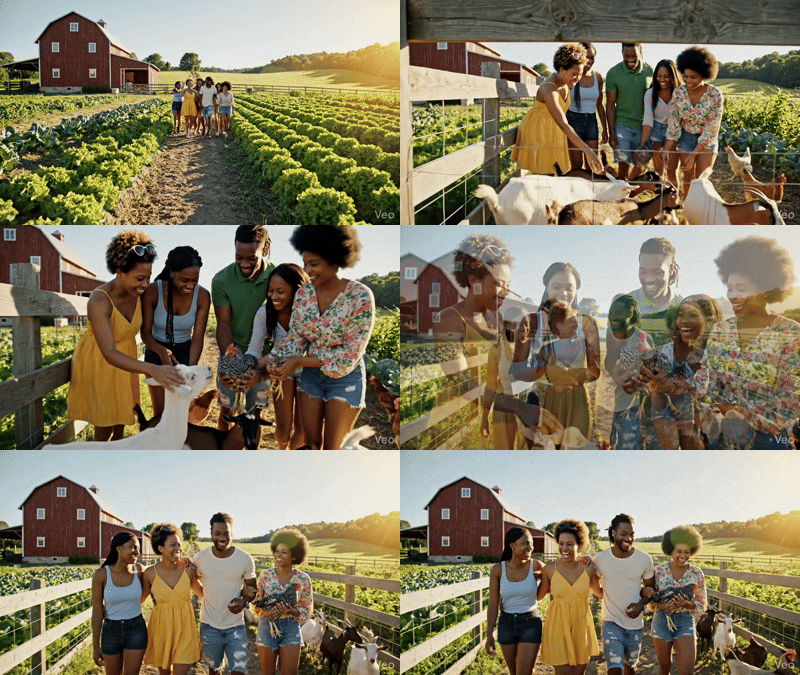
Agricultural tourism, or agritourism, represents a critical intersection of the primary agricultural sector and the tertiary tourism industry. It is evolving rapidly from a niche activity into a formalized global economic driver for rural areas. This report provides an exhaustive analysis of agritourism, examining its foundational definitions, current global market dynamics, operational complexities, nuanced sustainability challenges, and the strategic outlook for future development and technological integration.
I. The Definitional and Historical Foundation of Agritourism
To effectively analyze and strategize within this sector, a precise understanding of its nature and evolution is required, distinguishing it from related forms of rural visitation.
1.1 Conceptualizing Agritourism: A Commercial Enterprise Defined
Agritourism is fundamentally structured as a commercial enterprise that explicitly links agricultural production, processing, or both, with tourism activities.[1] Its core objective is two-fold: to entertain or educate visitors while simultaneously generating a supplementary stream of income for the farm, ranch, or business owner.[1]
This commercial activity encompasses a broad array of operational models, drawing visitors to farms and privately owned agricultural areas through specific activities, events, special occasions, and markets selling grocery or handmade products.[2] The success of agritourism hinges on its capacity to leverage existing farm resources—such as land, livestock, and infrastructure—to create experiences that connect consumers directly with the origins of their food, a movement that aligns with a growing consumer preference for localized food sources.[2]
1.2 Historical Context and Formalization
The notion of visiting rural areas for leisure is not a recent phenomenon. Proto-agritourism activities were well-established in the United States as far back as the nineteenth century, when urban residents would retreat to country farms to escape the severe summer heat.[2] Similar patterns of migration are documented globally. For instance, in South Tyrol, Italy, the practice of villeggiatura or Sommerfrische (summer retreat) saw aristocrats stay at mountain farms during the latter half of the 19th century.[3]
However, the modern, formalized concept of agritourism developed only over the past 35 years, driven by the need to diversify farm income and preserve rural heritage.[3] This formalization process necessitated legislative recognition. Italy was a pioneer in this regard, passing the first national law recognizing and defining agriturismo in 1985. This legislation was specifically designed to support the restoration of farm buildings and provide critical income diversification for working farms in rural regions.[3]
The substantial temporal lag between the organic emergence of rural retreats in the 19th century and the formal legislative definition in the late 20th century highlights a significant regulatory challenge. This delay meant that governments were subsequently tasked with standardizing and regulating an experience—genuine rural immersion—that inherently resists homogenization. Policy frameworks must therefore navigate this conflict, ensuring that profitable diversification efforts are reconciled with the consumer’s deep-seated demand for authentic, non-commoditized experiences.[3, 4]
1.3 Agritourism vs. Related Rural Tourism Segments
The breadth of agritourism necessitates clear differentiation from parallel concepts like ecotourism and rural tourism. Agritourism, ecotourism, and other forms of regenerative travel aim to leave a lasting positive impact.[5] However, their primary focus areas diverge significantly.
Ecotourism is centered on restoring and preserving natural ecosystems and protecting biodiversity.[5, 6] Agritourism, in contrast, emphasizes strengthening local farming communities and promoting sustainable agricultural practices.[5] This difference manifests directly in the visitor experience:
Table I: Comparison of Agritourism and Ecotourism Focus
| Aspect | Agritourism | Ecotourism |
|---|---|---|
| Focus Area | Agriculture, farming communities | Natural ecosystems, conservation |
| Primary Goal | Support sustainable farming and rural development | Protect biodiversity and ecosystems |
| Key Activities | Farm stays, agricultural workshops, local food experiences | Wildlife observation, eco-lodges, guided nature tours |
| Tourist Experience | Hands-on, educational, and food-related | Adventure-based, nature-focused |
| Source | [6] | [6] |
Complicating the delineation is the global variation in the definition of agritourism, which significantly influences regulatory, tax, and policy environments.[3] Operational definitions have, in many places, expanded to embrace a wide variety of rural tourism forms that only vaguely resemble the original concept’s close link to working farms. If regulatory definitions become overly loose, there is a serious risk of eroding the overall tourism product quality. Conversely, definitions that are too restrictive may result in the agritourism sector being viewed as elitist, limiting its reach and socioeconomic benefits.[3]
The historical foundation of agritourism as an escape from urban heat and stress [2] frames its modern expansion as more than just a novelty industry. Its resurgence is fundamentally a response to societal trends related to industrialized food systems and urban isolation. This underlying consumer preference for localized food sources and a deeper connection to agricultural heritage confirms that the sector’s long-term growth trajectory is securely tethered to profound social trends related to environmental awareness, health, and a nostalgic longing for rural life.
II. Economic Dynamics and Market Trajectories
The agritourism sector is characterized by strong growth projections, reflecting its viability as a tool for rural economic revitalization and farm resilience. Understanding the financial drivers requires analyzing market valuations, the role of diversification, and the critical operational factors that influence profitability.
2.1 Global Market Valuation and Growth Forecasts
Agritourism is universally recognized by economists as a rapidly growing industry.[2] Market forecasts overwhelmingly project substantial expansion. For instance, the global market size was estimated at $8.10 billion in 2024 and is projected to reach $15.78 billion by 2030, reflecting a robust Compound Annual Growth Rate (CAGR) of 11.9% from 2025 to 2030.[7] Other research groups project similarly high growth, with some predicting the market size could reach $21.25 billion by 2033 or even $205.6 billion by 2033, registering a CAGR exceeding 11%.[8]
North America currently holds the largest revenue share in the sector, capturing 46.26% of the global market in 2024, with the U.S. market specifically expected to grow at an 11.3% CAGR through 2030.[7] However, future growth is expected to be led by the Asia Pacific Market.[8]
A critical consideration for financial analysts is the significant disparity in reported market valuations. The valuation estimates for 2024 range widely, from $8.10 billion to $73.2 billion.[7, 8] This dramatic variance necessitates cautious interpretation of global market data. The disparity indicates that different market research groups are likely employing differing scopes for valuation. The lower figures likely focus narrowly on direct on-farm receipts (e.g., ticket sales, U-Pick revenue), while the higher figures probably incorporate associated tourism expenditures, such as local lodging, restaurant dining, and regional retail sales stimulated by the visiting tourists. For localized strategic planning, stakeholders must segment their data to accurately project direct revenue versus secondary economic stimulus.
2.2 Financial Significance for Farm Resilience
Agritourism serves as a vital component of farm diversification, enhancing the economic resilience of agricultural producers and reducing dependence on traditional commodity markets.[9] It is an increasingly explored strategy, particularly by beginning, small, and mid-size farms, to maintain competitiveness.[10] The motivation for this shift is primarily economic; a substantial majority of farmers (83%) confirm that income generation opportunities are a key driver in their diversification decisions.[9]
The sector demonstrably boosts revenue. Farm agritourism revenue in the U.S. more than tripled between 2002 and 2017.[10] By combining agriculture and tourism, farmers can generate additional income through direct sales of products and services, while simultaneously fostering public understanding of agriculture and preserving agricultural heritage.[10] However, its current role remains supplementary; in 2017, agritourism revenue accounted for 5.6% of total farm-related income.[10]
The mechanism by which agritourism adds value is through the fuller employment of existing farm resources.[11] This means converting nonproductive or underutilized assets, such as antique resources, nonproductive land, or unused equipment, into attraction lines.[12] This conversion allows operators to shift from selling raw commodities to selling high-margin, experiential products, increasing gross margin percentages above what is achievable in traditional wholesale markets.[12]
2.3 Drivers of Agritourism Profitability
Profitability in agritourism is complex, influenced by market proximity, intrinsic farm resources, and management capacity. Research into the determinants of success reveals critical factors, particularly regarding visitor volume and staffing levels.
The number of visitors is clearly paramount, significantly increasing the odds of an operation’s profitability, as enterprises fundamentally rely on recreation and direct sales to generate revenue.[13] However, the analysis reveals that this positive effect is not achieved simply by attracting more people; it is significantly mediated and amplified by management capacity, specifically the number of employees or staff.[13]
The staffing capacity represents a critical operational precondition, acting as a profit multiplier. Adequate staffing capacity is necessary for managing congestion, delivering quality services, and ensuring the smooth operation of a wider variety of attractions. When staff are sufficient, the likelihood of profitability increases independently and positively.[13] The evidence strongly suggests that management capacity, measured by staff numbers, alleviates the bottleneck associated with high visitor traffic, ensuring that increased visitor volume translates effectively into higher revenue and improved customer experience.[13]
Strategic location also plays a pivotal role in revenue generation. While farms in remote rural areas are more likely to adopt agritourism (often driven by the necessity of diversification), the highest revenue generation is concentrated in farms located close to urban areas.[10] Farms and ranches in more populated counties typically earn more, due to easier access to large consumer markets, while those located near natural amenities or other outdoor activities also show a statistically significant positive impact on economic activity.[10] This locational dynamic implies that policy support for remote areas must focus heavily on logistical improvements and marketing reach, while urban-proximate farms must strategically focus on managing high visitor density and operational scaling to maximize their revenue potential.
Table II: Comparative Analysis of Agritourism Profitability Drivers
| Factor | Impact on Profitability/Visitors | Significance |
|---|---|---|
| Number of Visitors | Significantly increases odds of profitability | Primary driver of direct revenue and enterprise activity [13] |
| Number of Employees/Staff | Independently and positively increases profitability; mediates visitor effect | Critical factor for service quality and managing high visitor volume [13] |
| Operating Season | Fall season operation significantly increases visitor numbers | Highlights importance of aligning offerings with seasonal demand [13] |
| Proximity to Urban Areas | Higher revenue generation | Driven by access to large, dense consumer markets [10] |
| Remoteness | Higher likelihood of adoption | Driven by necessity for income diversification in isolated markets [10] |
III. Categorization of Agritourism Activities and Business Models
Agritourism encompasses a wide spectrum of activities that can be categorized into four primary business models, each offering unique opportunities for income generation and visitor engagement.
3.1 Direct Sales and Harvest Experiences
This category represents the most direct connection between the farm and the consumer, often focusing on seasonal harvests. U-Pick operations, where visitors harvest their own crops, are highly popular, as are on-farm farmers’ markets and farm stands.[14, 15, 16] For example, in Manistee County, Michigan, the abundance of U-Pick farms and markets is a major agritourism draw.[15] These activities, which also include staples like pumpkin picking patches and cut-your-own Christmas tree farms, serve to shorten supply chains, reducing transportation costs and emissions, while ensuring food arrives fresher.[14, 17] This model fosters a stronger consumer appreciation for seasonal eating and the effort involved in food production.[17]
3.2 Immersive and Experiential Education
Educational programs form the conceptual backbone of agritourism, enabling visitors to gain a deeper respect for the land and farming practices.[17]
3.2.1 Hands-On Farm Experiences
Farm tours and experiences are central to this model, offering guided insights into core agricultural operations.[18] Guided by local farmers, these tours explain complex subjects like composting and crop rotation. Activities can be profoundly hands-on, allowing guests to harvest crops, see tractors in operation, or even milk animals.[18] Examples include educational farms, demonstration farms, and agricultural workshops.[14, 19] These experiences are critical for addressing limitations in consumer knowledge about farming systems, promoting knowledge exchange, and influencing purchasing behaviors toward local and sustainably produced food.[20]
3.2.2 Formalized Education Pathways
Agritourism also supports formal academic development. University programs, such as those provided by Penn State, offer research and educational support for operators.[19] Certificates in Agritourism provide graduates with the necessary skills to enter careers as enterprise managers, entrepreneurs, non-formal educators developing programs for private farms, or staff for local tourism agencies. This trend has strong partnerships with the hospitality industry, emphasizing farm-to-table education.[21]
3.3 Hospitality and Culinary Tourism
These activities leverage the farm setting and its products to offer high-value, immersive accommodation and dining experiences. Lodging options range from rural bed & breakfasts and farm stays to larger operations such as dude ranches.[14, 18]
Culinary tourism is a significant revenue generator, transforming raw products into premium experiences. This includes Farm-to-Table dining experiences, which increase demand for local ingredients, and specialized tours of agricultural processing sites, such as vineyard tours, wine tasting, and cider tastings.[16, 17, 18] States like California feature world-class wineries and local dairies as integral components of their agritourism offerings, showcasing the economic power of blending food and hospitality.[16]
3.4 Entertainment Farming and Special Events
This model focuses on maximizing visitor engagement and fun, often operating seasonally to manage high visitor throughput. Common examples include corn mazes, hay rides, petting and feeding zoos, and Christmas light exhibits.[14, 18] While these attractions are primarily recreational, they offer opportunities for operators to blend entertainment with educational messaging. However, these operations necessitate stringent risk management protocols, particularly concerning animal interactions and visitor safety.[22]
IV. The Complexities of Sustainability and Socio-Cultural Impact
Agritourism is frequently heralded as a key component of sustainable rural development, yet a critical analysis reveals inherent conflicts and trade-offs that must be strategically managed.
4.1 Positive Contributions to Sustainable Development
Agritourism offers extensive socio-economic and environmental benefits to farmers, visitors, and local communities.[13]
• Economic Revitalization and Resilience: Agritourism introduces an alternative revenue stream, fostering economic resilience and reducing the reliance of rural households on solely traditional agriculture.[9] Well-developed systems can reverse negative economic trends in rural areas by creating new jobs, stimulating local businesses, and boosting local economies through increased sales taxes and employment.[13, 23, 24]
• Social and Cultural Preservation: Beyond financial metrics, agritourism strengthens cultural heritage and reinforces rural identities.[25] It can provide employment opportunities for farm family members and offer a viable plan for farm succession, preserving farmland for future generations.[23] Educational components facilitate crucial partnerships between local organizations, schools, and farmers, fostering deeper community engagement.[25]
• Enhancing Local Food Systems: By bridging the consumer-producer gap, agritourism fosters appreciation for the resources and effort involved in food production.[17] This connection translates into increased demand for localized, sustainably produced food, promoting better land stewardship and encouraging consumers to make more informed food choices.[17, 20] Furthermore, by shortening the supply chain—allowing consumers to purchase directly from the source—it reduces carbon emissions and transportation costs associated with traditional distribution networks.[17]
4.2 Critical Analysis of Long-Term Risks and Trade-offs
The pursuit of profitability through tourism can, paradoxically, undermine the long-term ecological and cultural health of the rural environment, requiring proactive policy and governance.
4.2.1 Land Use Intensification and Ecological Degradation
The economic incentive to maximize revenue can drive land-use decisions that prioritize short-term profitability over long-term ecological sustainability.[26]
• Land Conversion and Fragmentation: Successful operations often face pressure to expand infrastructure, necessitating the conversion of productive agricultural land for tourism-related facilities, such as parking areas and larger accommodation structures.[26] Paving agricultural land reduces its natural ability to absorb water, exacerbating runoff and flooding.[26] This conversion contributes to the fragmentation of agricultural land, disrupting adjacent operations and contributing to the loss of rural character.[26]
• Environmental Strain: Increased visitor traffic can introduce invasive species and disrupt wildlife habitats.[26] Additionally, the aesthetic maintenance of landscapes to meet tourist expectations may involve the use of pesticides and fertilizers, which further contributes to water pollution and soil degradation.[26] Research indicates that some operations may focus more on maximizing revenue than on implementing stringent environmentally friendly practices, potentially leading to biodiversity loss.[26]
4.2.2 The Socio-Cultural Paradox: Commodification and Authenticity Loss
A central scholarly concern revolves around the paradox that agritourism seeks to preserve agricultural landscapes by commodifying the rural experience.[26]
• Loss of Authenticity: As farms adapt to the “tourist gaze,” they may reshape genuine agricultural practices to align with visitor expectations.[26] This results in a homogenization of the rural experience, where operators prioritize entertainment value over genuine agricultural reality, ultimately undermining the educational mission of agritourism.[26] This phenomenon illustrates a core causal relationship: the consumer demand for an authentic experience, when met by operators attempting to scale for profitability, leads to the standardization of that experience, resulting in commodification and a subsequent erosion of authenticity.
• Social Disruption: The influx of tourism places significant strain on local resources, including water and infrastructure.[26] The presence of tourists can fundamentally alter the character of small towns, leading to community resentment over increased noise, traffic, and loss of privacy, despite the economic opportunities.[26] In certain contexts, this rapid shift can lead to the erosion of traditional customs and the introduction of negative societal behaviors.[27]
4.2.3 Shifting Land Values and Barriers to Entry
The enhanced profitability derived from agritourism operations inevitably influences the local real estate market. Increased farm revenue drives up land values in rural areas.[26] While this benefits existing landowners, it creates substantial challenges for those who rent or lease land, making it difficult for new farmers to enter the market.[26] Moreover, rising land costs increase the financial pressure on existing agricultural producers to sell their land for more lucrative residential or commercial development, further threatening the long-term viability of the regional agricultural base.[26]
The inherent conflict between the financial motivation for expansion and the preservation of ecological integrity reveals that market forces alone are insufficient to guarantee sustainable outcomes.[26] For agritourism to be truly sustainable, proactive policy intervention is essential. This includes mitigation strategies such as establishing zoning regulations, conservation easements, and land trusts, which act not merely as protective measures but as foundational requirements to prevent the sector from destroying the very agricultural and natural resources that drive its existence.[26]
V. Operational and Regulatory Risk Management
A working farm presents a multitude of hazards that are not typically encountered in commercial tourism settings. Therefore, comprehensive risk management, encompassing legal liability, health protocols, and capacity planning, is critical for operational stability.
5.1 Legal Liability and Insurance Requirements
Operating an agritourism business significantly increases the operator’s legal exposure. The introduction of visitors to farm hazards necessitates adequate liability insurance coverage, particularly when activities involve animal interaction, which introduces specialized risks.[22]
Agritourism liability limitation statutes are designed to provide some protection, but this protection is not absolute. The provider is typically not protected from liability if they perform an act in a grossly negligent manner, purposefully cause injury, engage in criminal conduct, or recklessly fail to warn or guard against a known dangerous condition.[28] A dangerous condition is defined as one that creates an imminent and substantial risk of injury or damages to a participant.[28]
To manage inherent risks, operators must implement procedures that require participants to receive and present a ticket or written agreement acknowledging the risks and releasing the operator from liability.[28] Guests who decline to accept this release should not be allowed to participate in the activity.[28]
5.2 Health, Safety, and Biosecurity Protocols
The integration of tourism and agriculture introduces distinct public health risks, primarily related to zoonotic disease transmission. Pathogens such as E. coli O157:H7, Salmonella, Cryptosporidia, and Listeria pose serious concerns, especially in areas with animal interaction.[22]
Mitigation requires rigorous biosecurity and hygiene practices:
1. Animal Contact Management: Animal enclosures must be sound, and any “dangerous” animals must be fully inaccessible to visitors.[29]
2. Hygiene Infrastructure: Mandatory, visible handwashing stations must be installed near all animal contact areas to reduce the risk of zoonotic infection.[29]
In addition to biosecurity, constant auditing of the physical environment is necessary to prevent accidents. Operators must secure potential hazards that could attract children or cause injury, including ladders, chemicals, pesticides, equipment, lagoons, wells, and large tractor tires.[29]
Effective visitor communication through signage is equally vital for risk mitigation. Clear, age-appropriate signs (utilizing both text and images) must be used to define areas visitors are permitted to access, post rules and expectations, and warn explicitly of known dangers.[30] Signs should direct visitors for parking, walking paths, eating areas, and entry/exit points, ensuring visible separation of public and operational areas.[30]
5.3 Strategies for Operational Resilience
Agritourism operators face significant operational challenges related to seasonality and managing high visitor density.
The inherent vulnerability of tourism activities to seasonal fluctuations presents a substantial challenge to maintaining the stability of rural livelihoods.[31] Successful farms adopt flexible livelihood strategies that adapt to these predictable changes. During the off-season, strategies include “Seasonal Employment” and “Seasonal Farming,” while peak season strategies often involve “Extending Working Hours,” “Increasing Staffing Input,” and “Increasing Capital Input”.[31] The ability to extend working hours is often a necessary condition for achieving high livelihood outcomes during high-demand periods.[31] This strategic labor planning, often termed the “Peak-Off Blend-Driven Pattern,” ensures that human capital is mobilized effectively to manage fluctuating demand.
Furthermore, popular destinations frequently struggle with density and carrying capacity challenges, especially during peak seasons (such as the fall season, which significantly increases visitor numbers).[13, 32] Inadequate infrastructure and poor visitor management strategies can quickly lead to congestion, resource degradation, and a measurable decline in the quality of the visitor experience.[32] Proactive capacity management, potentially through technological solutions like staggered entry or online booking limits, is essential for preserving both the environment and the customer experience.
Table III: Key Agritourism Risk Areas and Mitigation Requirements
| Risk Area | Key Hazard | Mitigation Strategy (Operational/Legal) |
|---|---|---|
| Legal Liability | Gross Negligence, Failure to Warn | Mandatory liability waivers/tickets; specialized insurance coverage for activities [22, 28] |
| Biosecurity | Zoonotic Diseases (E. coli, Salmonella) | Secure animal enclosures; mandatory, visible handwashing stations near contact points [22, 29] |
| Physical Safety | Unguarded Equipment, Chemicals, Water Sources | Constant facility audits; securing accessible dangers; clear demarcation of ‘off-limit’ areas [29, 30] |
| Operational Stability | Seasonality and Peak Density | Strategic labor planning (flexible staffing); visitor management systems to control congestion [31, 32] |
VI. Future Outlook, Innovation, and Best Practices
The trajectory of agritourism indicates continued high growth, driven by consumer demand for authentic experiences and accelerated by technological innovation, offering sophisticated tools for scaling operations sustainably.
6.1 Integrating Technology for Sustainable Growth
The future success of agritourism enterprises will heavily depend on the successful integration of smart technologies. This technological adoption is necessary not only to meet evolving consumer preferences but also to enhance productivity, optimize resource utilization, and enrich the visitor experience across the entire value chain.[33]
Operators are currently at a critical juncture regarding the smooth integration of Artificial Intelligence (AI) and other cutting-edge agricultural technologies.[34] This includes utilizing sensors, drones, and data analytics software to improve core farming practices.[34]
Furthermore, technology is revolutionizing the customer experience and accessibility. Virtual Reality (VR) and Augmented Reality (AR) are poised to expand the reach of agritourism, providing immersive remote experiences and sophisticated on-site augmentations.[8, 34]
The implementation of VR/AR offers a powerful mechanism to address one of the sector’s most significant environmental and capacity constraints: visitor density.[32] By enabling farms to capture visitor revenue and deliver comprehensive educational content virtually, technology allows operators to decouple the visitor experience from the physical strain of increasing the number of people on the ground or expanding physical infrastructure.[8, 33] This innovation provides a path toward sustainable scaling that respects the ecological carrying capacity of the land.
6.2 Key Steps for Successful Agritourism Development and Best Practices
Developing a successful agritourism venture requires moving beyond opportunistic sales to a strategic, methodical business approach.[35] Four key strategic steps are necessary:
1. Resource Assessment: A comprehensive evaluation of the farm’s unique assets, its location advantages (proximity to urban areas or natural amenities), and the existing skills of the operator is the foundational step.[35]
2. Unique Experience Development: Activities must be authentic and engaging, reflecting the genuine local culture and agricultural heritage.[35] This is crucial for avoiding the commodification trap and maintaining high-value appeal.[26]
3. Sound Business Plan: Defining clear objectives, setting appropriate pricing strategies, identifying the specific target audience, and developing detailed financial projections are vital for ensuring long-term financial viability.[35]
4. Promotion: Effective marketing strategies are necessary to reach the identified potential visitor segments.[35]
Exemplary cases, such as the Uzum Fermer Winery in Uzbekistan, demonstrate this holistic approach. By growing from a small one-hectare farm to a large 21-hectare property over 16 years, the operation successfully diversified not only its tourism offerings but also its sustainable agricultural practices and products, effectively satisfying both international and domestic tourists.[36] This success underscores that diversification must occur across the entire business model—agriculture and tourism—to achieve resilient, long-term growth.
VII. Conclusions and Recommendations
Agritourism presents a financially robust pathway for rural enterprise diversification, substantiated by strong projected growth rates (CAGR ~11.9%) and its capacity to leverage underutilized farm assets into high-margin experiential sales.[7, 12] The primary drivers of profitability are the volume of visitors and, crucially, the adequate staffing capacity necessary to manage density and ensure service quality.[13]
However, the sector operates within a delicate tension between commercial success and environmental/cultural preservation. The drive for income generation often exerts pressure on land use, leading to fragmentation and potential ecological degradation if not managed.[26] Furthermore, the necessity of standardizing operations to meet high visitor demand risks the commodification of rural life, undermining the very authenticity that attracts consumers.[26]
For investors and policymakers focused on sustainable rural economic development, the following recommendations are critical:
1. Mandate Proactive Land Governance: Local governments must implement stringent zoning regulations and promote the use of conservation easements or land trusts.[26] These measures are required to ensure that farm diversification through tourism does not lead to the permanent conversion or fragmentation of productive agricultural land.
2. Invest in Management Capacity Over Pure Infrastructure: Investment strategies should prioritize human capital, recognizing that staff capacity is the primary mediating factor for profitability.[13] Funding should support training and expansion of the workforce to manage high visitor throughput and maintain service quality, especially in urban-proximate areas.
3. Incentivize Tech Integration for De-Stressing Physical Assets: Policymakers should incentivize the adoption of advanced technologies like VR/AR and sensor networks.[33] This strategy allows operators to maintain high revenue capture and educational delivery while mitigating the negative environmental impacts and capacity challenges associated with physical visitor density.[32]
4. Support Remote Market Access: Recognizing that remote farms adopt agritourism out of necessity, but urban farms generate the highest revenue, support systems should focus on solving logistical hurdles and enhancing digital marketing capabilities for isolated operations to effectively reach wider consumer bases.[10]
5. Require Comprehensive Risk Mitigation Protocols: Strict regulatory oversight is needed, particularly regarding liability waivers, biosecurity standards (handwashing stations near animal contact), and explicit hazard signage.[28, 29] These are non-negotiable requirements for protecting public health and safeguarding farm liability in this specialized commercial environment.
——————————————————————————–
2. Agritourism | Research Starters – EBSCO, https://www.ebsco.com/research-starters/business-and-management/agritourism
3. Agritourism around the globe: Definitions, authenticity, and potential controversy, https://www.foodsystemsjournal.org/index.php/fsj/article/download/945/918/1883
4. Defining agritourism – Carla Barbieri, https://barbieri.wordpress.ncsu.edu/files/2019/05/2013_gilarroyo_definition.pdf
6. Ecotourism vs Agritourism in Regenerative Travel – Sejiva, https://sejiva.id/ecotourism-vs-agritourism-in-regenerative-travel/
7. Agritourism Market Size, Share And Growth Report, 2030, https://www.grandviewresearch.com/industry-analysis/agritourism-market
8. Agritourism Industry Statistics and Trends in 2025 – Peek Pro, https://www.peekpro.com/blog/agritourism-industry-statistics
9. Tourism and farmers’ economic transformation: lessons from North Toraja – Frontiers, https://www.frontiersin.org/journals/sustainable-food-systems/articles/10.3389/fsufs.2024.1487452/full
10. Agritourism Allows Farms to Diversify and Has Potential Benefits for Rural Communities – Vermont Agency of Agriculture, https://agriculture.vermont.gov/agritourism-allows-farms-diversify-and-has-potential-benefits-rural-communities
11. Examining the economic benefits of agritourism: The case of New …, https://foodsystemsjournal.org/index.php/fsj/article/download/149/142
12. PB1642-Considerations for a Value-Added Agribusiness – TRACE: Tennessee Research and Creative Exchange, https://trace.tennessee.edu/cgi/viewcontent.cgi?referer=&httpsredir=1&article=1010&context=utk_agexmkt
13. Factors Associated with the Profitability of Agritourism Operations in …, https://wwwcp.umes.edu/extension/wp-content/uploads/sites/139/2024/02/sustainability-16-01025.pdf
14. Agritourism Overview – National Agricultural Law Center, https://nationalaglawcenter.org/overview/agritourism/
15. U-Pick & Farm Markets Self-Guided Tour – Manistee Tourism, https://www.visitmanisteecounty.com/project/u-pick-markets-self-guided-tour
16. From u-pick to farm stands, new website showcases agritourism across the state, https://mendovoice.com/2025/06/new-agritourism-website/
17. How Does Agritourism Impact Local Food Systems? → Question – Lifestyle → Sustainability Directory, https://lifestyle.sustainability-directory.com/question/how-does-agritourism-impact-local-food-systems/
18. 9 Types of Agritourism Activities to Explore – Peek Pro, https://www.peekpro.com/blog/types-of-agritourism-activities
19. Agritourism at Penn State — Extension and Outreach, https://aese.psu.edu/outreach/agritourism
20. Agritourism Experiences Increase Consumers’ Pro-Environmental Behaviors, https://cnr.ncsu.edu/news/2020/07/agritourism-experiences-environment/
21. Agritourism – Sheridan College, https://www.sheridan.edu/academics/agritourism/
22. Agritourism in Pennsylvania – Legal and Regulatory Issues – Penn State Extension, https://extension.psu.edu/agritourism-in-pennsylvania-legal-and-regulatory-issues
23. Unlocking Value Creation Using an Agritourism Business Model – MDPI, https://www.mdpi.com/2071-1050/9/9/1618
24. Agritourism and Rural Economic Development – Indiana Business Research Center, https://www.ibrc.indiana.edu/ibr/2006/fall/article3.html
26. What Are the Long-Term Impacts of Agritourism on Land Use …, https://lifestyle.sustainability-directory.com/question/what-are-the-long-term-impacts-of-agritourism-on-land-use/
27. Environmental Impacts of Agritourism | Download Scientific Diagram – ResearchGate, https://www.researchgate.net/figure/Environmental-Impacts-of-Agritourism_tbl3_360053393
28. Legal and Regulatory Considerations for Agritourism in Pennsylvania, https://extension.psu.edu/legal-and-regulatory-considerations-for-agritourism-in-pennsylvania
29. Agritourism operators: now is the time for liability risk management – Farm Office, https://farmoffice.osu.edu/blog/wed-05082024-1035am/agritourism-operators-now-time-liability-risk-management
30. MANAGING THE SAFETY RISKS OF AGRITOURISM FARMS, https://agritourism.rutgers.edu/pdfs/module%204%20-%20farm%20safety.pdf
31. Rural Tourism Households Adapting to Seasonality: An Exploratory Sequential Mixed-Methods Study – MDPI, https://www.mdpi.com/2071-1050/15/19/14158
32. Agritourism Development: Designing an Effective Model for Sustainable Growth – BIO Web of Conferences, https://www.bio-conferences.org/articles/bioconf/pdf/2023/14/bioconf_icafe2023_04023.pdf
33. Sustainable Agritourism: Integrating Emerging Technologies within Community-Centric Development – ResearchGate, https://www.researchgate.net/publication/387778650_Sustainable_Agritourism_Integrating_Emerging_Technologies_within_Community-Centric_Development
34. The Future of Eco-Friendly Agritourism with AI Enhancements – The Rike, https://therike.com/blogs/sustainable-living/tourism-industry-adapts-to-environmental-awareness
35. Creating a Successful Agritourism Destination: FAO-EBRD Guide with Case Studies from Jordan, Georgia, and Italy, https://www.uvm.edu/d10-files/documents/2025-04/FAO-EBRD_Webinar_Slides.pdf
36. Agritourism as an Emerging Sustainable Tourism Industry in Uzbekistan – MDPI, https://www.mdpi.com/2071-1050/16/17/7519
 Journal for Policy & Market Research
Leave a comment