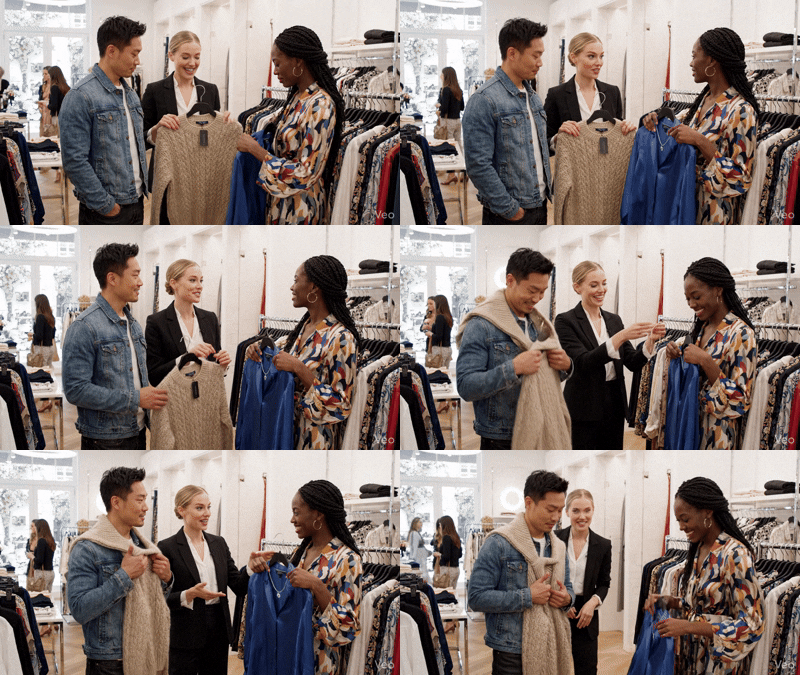
The global retail landscape in 2026 represents a sophisticated convergence of traditional distribution principles and cutting-edge technological orchestration. Retailing services, once defined primarily by the physical exchange of goods, have evolved into a complex service ecosystem characterized by data-driven personalization, real-time supply chain visibility, and a systemic shift toward regenerative economic models. This evolution is necessitated by a consumer base that demands seamless convenience, absolute transparency, and a frictionless transition between digital and physical environments. The efficacy of modern retail is no longer measured solely by transactional volume but by the ability to manage the entire lifecycle of a product and the holistic journey of the consumer.
The Distribution Continuum: Foundational Functions and Intermediary Dynamics
The structural role of retailing within the distribution channel remains the fundamental bridge between mass production and individual consumption. At its core, the retail service function involves the provision of assortment, which allows consumers to choose from a variety of product options within a single category without engaging directly with numerous disparate manufacturers.[1] This curation process provides significant convenience and value, particularly as large retailers leverage their own private labels, such as Walmart’s Great Value, to offer price-competitive alternatives to name brands like Tylenol.[1] By providing multiple purchase options, retailers can effectively target segmented consumer markets within the same physical or digital space.
The second foundational function is the capacity to “break bulk.” Retailers purchase goods in massive quantities from manufacturers or distributors, utilizing their extensive storage and logistical networks to sell these items in smaller, individual units to end-users.[1] This ability to buy in bulk allows for the negotiation of lower procurement prices, which are then passed on to the consumer, creating a cost advantage that would be impossible for an individual purchaser to achieve directly from a manufacturer.[1, 2] This volume-driven model is supported by intensive inventory holding, which ensures that products are available for immediate restock or rapid shipping, a critical differentiator in an era where “out of stock” equates to a lost customer.[1, 3]
Location science has become a critical component of retail service delivery. The placement of retail outlets is determined through rigorous analysis of traffic patterns, demographic data, and proximity to consumer nodes to maximize convenience.[1] This geographical strategic planning is complemented by extended hours of operation, including 24-hour availability in some contexts, to meet the demands of a time-constrained population.[1] Furthermore, the physical retail environment provides the unique service of product evaluation, allowing consumers to try on clothing or experience the tactile qualities of a product—a service that remains a significant hurdle for purely digital platforms.[1]
The Hierarchy of Intermediaries and Strategic Distribution
The retail ecosystem is supported by a network of intermediaries, each playing a distinct role in the movement of goods. While the retailer is the consumer-facing entity, the infrastructure behind them involves wholesalers, distributors, and independent agents.[2, 4]
| Intermediary | Primary Function | Inventory Management | Customer Relationship |
|---|---|---|---|
| Manufacturer | Creation of goods | Bulk production stock | Indirect or DTC [2, 4] |
| Distributor | Logistical network management | High-volume regional stock | Retailers and Wholesalers [4, 5] |
| Wholesaler | Bulk purchasing and resale | High-volume discounted stock | Retailers and Businesses [2, 5] |
| Retailer | Individual unit sales | Curated consumer-ready stock | End Consumers [4, 5] |
| Independent Distributor | Outsourced logistics/negotiation | Variable/Layered | Wholesalers and Retailers [2] |
The strategic choice of distribution model—intensive, selective, or exclusive—determines a brand’s market positioning. Intensive distribution aims for maximum market saturation, placing products in as many outlets as possible, which is essential for low-cost, high-demand items like snacks or household goods.[2] In contrast, exclusive distribution limits availability to a small number of authorized retailers, a strategy favored by luxury brands to reinforce prestige and maintain tight control over the brand experience.[2] Modern brands are increasingly adopting a Direct-to-Consumer (DTC) model, selling through owned e-commerce sites or flagship stores to gain absolute control over pricing, data, and the customer relationship, effectively bypassing traditional intermediaries.[2, 5]
Supply Chain Modernization: Resilience and Visibility in a Volatile Global Market
Retail supply chain management in 2025 has moved beyond mere operational necessity to become a strategic differentiator. The complexity of omnichannel operations, shrinking margins, and rising consumer expectations for rapid delivery have forced retailers to modernize every stage of the supply chain, from procurement to returns.[3, 6] Visibility and agility are the critical metrics of this modernization. A seamless supply chain allows a retailer to synchronize stock availability across multiple nodes—such as a customer ordering online for in-store pickup—without delays or stock discrepancies.[3]
The Shift to Event-Driven Architecture
The technological backbone of this visibility is the shift from traditional batch processing to Event-Driven Architecture (EDA). Traditional systems often update inventory in cycles, leading to data lag and potential overselling.[7] EDA fundamentally changes this by processing inventory changes as “events” that trigger instantaneous updates across all sales channels.[7, 8] This paradigm shift ensures that when an item is sold in a physical store, the e-commerce platform immediately reflects the change, maintaining a single version of the truth for all participants in the ecosystem.[7, 9]
Technical implementation of EDA often involves microservices and advanced patterns such as Event Sourcing and Command Query Responsibility Segregation (CQRS).[7, 10] By separating the core business logic from the presentation layer, retailers can ensure that changes to inventory or pricing automatically propagate to all channels—mobile apps, websites, and physical POS systems.[10] This architecture not only improves data consistency but also enables independent scaling of channel-specific components, allowing a retailer to handle massive traffic spikes during peak seasons without system failure.[10]
Supply Chain Visibility and Control Towers
To manage global disruptions and tariff-related uncertainties, retailers are investing heavily in supply chain visibility software. These tools, provided by leaders like IBM and FourKites, combine real-time tracking of shipments with predictive analytics and machine learning to optimize performance.[11, 12]
| Visibility Tool Category | Primary Feature | Strategic Benefit |
|---|---|---|
| Real-Time Tracking | GPS/ELD integration on vehicles | Precise ETAs and proactive delay alerts [11, 13] |
| Inventory Control Tower | AI-powered unified dashboard | Single view of disparate data sources [12, 14] |
| Blockchain Traceability | Immutable shared ledger | Verified provenance and authenticity [12, 15] |
| Predictive Analytics | Historical pattern detection | Anticipating disruptions and anomalies [12, 13] |
Advanced visibility platforms utilize IoT sensors to monitor critical parameters such as temperature for cold chain integrity, ensuring that pharmaceutical or food products remain compliant throughout their journey.[13] Furthermore, computer vision technology is being deployed in yard management to read license plates and monitor dock door utilization with near-flawless accuracy, eliminating manual data entry errors and reducing vehicle dwell times.[13] These “Control Towers” allow retailers to move from reactive firefighting to proactive decision-making, significantly reducing operational costs and improving on-time delivery rates.[11, 14]
Macroeconomic Determinants and Consumer Behavior Shifts for 2025
The economic outlook for retailing services in 2025 is characterized by a “relatively benign” global environment as inflation decelerates and central banks begin easing monetary policy.[16] In the United States, retail sales are expected to benefit from a GDP growth forecast of 2.4% and a healthy labor market.[17] Total retail sales for 2025 are projected to grow between 2.7% and 3.7%, reaching a total between $5.42 trillion and $5.48 trillion, while holiday sales are expected to surpass $1 trillion for the first time.[18]
Consumer Sentiment and Financial Relief
The easing of Personal Consumption Expenditure (PCE) inflation—from a peak of 7.2% in 2022 to a projected 2.3% in late 2024—is expected to boost consumer purchasing power.[17] Furthermore, as the US Federal Reserve is anticipated to cut interest rates to between 3.75% and 4% by the end of 2025, consumers will likely see relief from high borrowing costs on credit cards and variable-rate loans.[17]
| Economic Indicator | 2024 (Actual/Est) | 2025 (Forecast) |
|---|---|---|
| Real GDP Growth (US) | 2.8% | 2.4% [17] |
| PCE Inflation | 2.3% (Oct) | Decelerating [17] |
| Retail Sales Growth | – | 2.7% – 3.7% [18] |
| Consumer Spending Growth | – | 3.1% [17] |
| Federal Funds Rate | 4.5% – 5.5% | 3.75% – 4.0% [17] |
Despite these positive indicators, retail executives identify climate change-related business costs, price wars, and rising retail theft as primary hurdles to profitability.[17] The introduction of new tariffs also forces a shift in procurement strategies, with some retailers requesting suppliers to absorb increased costs while others explore alternative production locations to mitigate risk.[6]
The Evolution of the Consumer Journey
Consumer behavior in 2025 is marked by a preference for experiences over goods (80% of surveyed executives) and an increasing reliance on generative AI for shopping decisions (71%).[17] The traditional “shopping trip” is being replaced by more frequent, smaller-basket excursions, with 67% of consumers favoring this approach.[17] Furthermore, brand loyalty is under pressure, as 56% of consumers now value lower prices over established brand names, leading to an acceleration in private-label adoption.[17, 19]
A critical emerging segment is Generation Alpha, whose influence is prompting retailers to adopt more agile marketing and product development approaches that move at the “speed of culture”.[16] This requires retailers to foster innovation through incubator programs and partnerships with emerging brands to capture the attention of a demographic that values authenticity and sustainability.[16]
The Operational Core: Advanced Inventory Management and Control Systems
The operational efficiency of a retail store is predicated on the integration of inventory management, visual merchandising, and strategic pricing.[20] Effective inventory management is no longer a manual process of counting stock; it is a data-driven discipline that ensures popular items are always in stock while minimizing the capital tied up in slow-moving goods.[21]
Strategic Inventory Control Protocols
The first step in modern retail inventory management is the creation of a centralized record of all products, including rich data such as stock-keeping units (SKUs), reorder lead times, case quantity amounts, and economic order quantities (EOQ).[22]
The Economic Order Quantity (EOQ) is a fundamental formula used to minimize the total costs of inventory, including ordering and holding costs:
EOQ=HoldingCostperUnit2×AnnualDemand×OrderCost
By utilizing these models, retailers can determine the optimal amount of stock to order to meet demand without incurring unnecessary expenses.[22] The use of RFID tags and barcodes allows for the automated mapping of inventory location across warehouses, distribution centers, and store shelves, preventing misplaced products and lost sales revenue.[22] Retailers must also conduct regular and accurate stock counts, taking into account “shrinkage” (loss due to theft or damage) and returns to ensure the accuracy of their data.[22, 23]
The Integration of Sales and Inventory Data
A key differentiator for high-performing retailers is the integration of sales data with inventory systems. This allows for the tracking of “sales velocity”—the rate at which items are sold—enabling retailers to make informed decisions about reorders, promotions, and markdowns.[22] Automated systems can set reorder triggers with built-in safety buffers to prevent stockouts during seasonal demand spikes.[9, 22] For items that fail to meet expectations due to cooling trends or obsolescence, disciplined markdown strategies are essential to clear space for more profitable products and generate cash flow.[22]
The Cognitive Retail Environment: Visual Merchandising and the Psychology of the Store
Visual merchandising is the strategic practice of organizing and presenting products to create an immersive environment that draws shoppers in and encourages exploration.[24] It goes beyond aesthetics; it is a psychological tool used to influence consumer behavior and drive sales through focal points and sensory triggers.[24]
Core Principles of Visual Presentation
Modern visual merchandising is built on five core principles that ensure an organized and engaging shopping experience:
- Balance, Symmetry, and Focal Points: Creating a visually stable layout that guides the customer’s eye toward key products, such as a mannequin featuring a new collection.[24]
- Color Theory and Psychological Triggers: Leveraging colors to evoke specific emotions—red to encourage impulse purchases and blue to foster trust and calm.[24]
- Storytelling Through Displays: Communicating a brand’s narrative by showing products in a lifestyle context, such as setting up a mountain-themed display for outdoor gear.[24]
- Lighting, Textures, and Props: Using light to emphasize key areas and textures to make the environment more inviting, while props add character and relatability.[24]
- Brand Identity Consistency: Ensuring all visual elements align with the brand’s core message to reinforce recognition and trust.[24]
Strategies for Implementation and Optimization
The creation of a visual merchandising strategy involves a structured four-step process: defining goals (e.g., increasing foot traffic or promoting a new launch), understanding customer demographics, creating mood boards and layout sketches, and finally, testing and optimizing based on engagement data.[24] Techniques such as the “Rule of Three” (grouping items in threes to create visual balance) and the “Pyramid Principle” (placing items at different heights to draw the eye upward) are used to maintain visual interest.[24]
Retailers now utilize advanced tools like planogram software to optimize shelf space and digital signage to provide real-time updates for promotions.[24] Heat mapping and retail analytics help identify high-traffic “hot spots,” allowing retailers to place high-margin or promotional items where they are most likely to be seen and touched.[24]
Strategic Pricing and Markdown Optimization in the Age of AI
Pricing strategy in 2025 is a complex discipline that balances profitability, competitiveness, and consumer perception. The shift from manual, spreadsheet-based pricing to AI-driven optimization has allowed retailers to react to market changes in real-time.[25, 26]
Pricing Strategy Frameworks
Retailers employ various pricing models depending on their brand positioning and market conditions:
| Pricing Model | Description | Primary Advantage |
|---|---|---|
| Cost-Based | Markup added to production/ops costs | Ensures baseline profitability [25] |
| Value-Based | Price set according to perceived value | Higher loyalty and premium positioning [25] |
| Competitor-Based | Alignment with or slightly below market | Protects market share [25] |
| Promotional | Temporary discounts or flash sales | Boosts sales quickly [25] |
| Dynamic | Real-time adjustments based on demand | Maximizes revenue agility [25] |
| Predictive | AI-forecasted demand optimization | Balances long-term goals [25] |
Dynamic pricing is particularly effective in high-velocity sectors like fashion and electronics, where AI can automatically increase prices during high-demand periods to maximize revenue and lower them during slow periods to attract customers.[27] Studies show that businesses using AI-powered dynamic pricing can increase revenue by up to 20% by optimizing their strategies in real-time.[27]
Markdown Optimization and Loss Mitigation
Markdown optimization is critical for maximizing profits at the end of a season. Traditional methods often relied on the “Week Cover” KPI, which frequently failed to account for price elasticity or future demand.[26] AI-powered systems analyze product attributes and estimate price elasticity at the store level, allowing for optimally timed markdowns that vary by region and climate.[26] This prevents deep, unnecessary markdowns that devalue the brand and protects margins while ensuring that inventory is cleared.[26, 28] Case studies, such as those from Levi Strauss and Walmart, demonstrate that AI-driven inventory optimization and pricing significantly increase full-price sell-through rates and reduce overstock waste.[28]
The Artificial Intelligence Frontier: Agentic Systems and Personalization
Artificial intelligence has reached a tipping point in the retail industry, shifting from experimental pilot projects to essential infrastructure for survival. According to recent surveys, 89% of retailers are now actively using or piloting AI projects, marking a fundamental shift in the industry’s technological baseline.[29]
The Year of the AI Agent
2025 is widely recognized as the “Year of the AI Agent”.[18] AI agents differ from traditional chatbots in their ability to combine perception, planning, and execution—effectively automating entire workflows.[19] These agents can monitor inventory levels and autonomously place restock orders, reprice items dynamically across marketplaces, and adjust advertising budgets based on real-time campaign performance.[19, 30] In a customer-facing role, AI shopping assistants personalize recommendations and streamline decision-making, replacing the friction of “endless comparisons” with a seamless, conversational experience.[18, 31]
Computer Vision and Frictionless Transactions
Computer vision technology has evolved from basic security surveillance to sophisticated systems that track product movement and customer behavior in real-time.[29, 32] Autonomous store models, such as Amazon’s “Just Walk Out,” utilize computer vision, sensor fusion, and deep learning to detect when items are taken or returned, automatically billing the customer’s app upon exit.[19, 33]
| Transaction Technology | Mechanism | Key Benefit |
|---|---|---|
| Smart Carts | RFID and computer vision scanning | Bypassing traditional checkout lines [32, 33] |
| Biometric Payments | Facial or palm recognition | Unmatched speed and security [19, 31] |
| Produce Recognition | AI visual identification of bulk items | Smoother self-checkout for unbarcoded goods [32] |
| Smart Shelves | Real-time inventory tracking sensors | Automated restocking alerts [19, 33] |
These technologies address the $112 billion annual challenge of retail shrinkage by ensuring all items are tracked and verified before leaving the store.[33] Furthermore, loss prevention is being revolutionized by AI-powered surveillance that can detect suspicious behavior patterns—such as multiple failed barcode scans—and alert staff in real-time.[32]
Retail Infrastructure: The Convergence of POS, CRM, and Unified Commerce
The infrastructure of modern retail is defined by “unified commerce,” where POS and CRM systems are no longer isolated silos but integrated platforms that provide a single view of the customer across all channels.[34, 35]
The Evolution of the Point of Sale (POS)
A modern retail POS system combines hardware and software to manage sales transactions, inventory, and customer relationships from a single platform.[34] Cloud-based POS systems, such as Lightspeed or retailcloud, allow a customer’s profile and loyalty points to follow them from store to store and channel to channel, ensuring a consistent experience.[34, 36] These systems integrate with e-commerce platforms and wholesale supplier networks, enabling retailers to manage stock levels and place orders with high efficiency.[34]
CRM and Personalized Marketing Analytics
Retail-specific CRM software is purpose-built to centralize customer profiles, purchase history, and preferences, activating this data across marketing and service operations.[35]
| CRM Platform | Target Segment | Key Strength |
|---|---|---|
| Salesforce Retail Cloud | Large Enterprises | AI-powered Einstein analytics and global scalability [35, 37] |
| Microsoft Dynamics 365 | Mid to Large Enterprises | Unification of sales, marketing, and service data [38] |
| HubSpot CRM | Small to Medium Businesses | Robust automation and ease of use [35, 38] |
| Voyado | Fashion and Lifestyle | Purpose-built loyalty and personalization [37] |
Implementing a CRM can lead to significant revenue growth—up to 41% according to some surveys—and improved customer retention by up to 27%.[38] These systems enable sophisticated customer segmentation based on demographics and shopping habits, allowing for targeted marketing campaigns via email, SMS, and mobile apps.[38, 39] Loyalty program management is a core feature, where gamification and personalized rewards increase repeat purchases and customer lifetime value (LTV).[37, 39]
Last-Mile Logistics: Redefining Fulfillment through Automation and Sustainability
The “last mile” is the final leg of the product’s journey and remains the most expensive and complex part of the supply chain, accounting for approximately 53% of total delivery costs.[40, 41] In 2025, the demand for same-day delivery has become a baseline expectation, with 66% of shoppers expecting it and 30% viewing it as a necessity.[40, 42]
Automation and the Autonomous Last Mile
Logistics providers are doubling down on automation to combat labor shortages and rising costs. The market for autonomous delivery robots is projected to grow at a 20.4% annual rate, particularly in urban and campus environments.[40] Walmart and Amazon are successfully deploying drone delivery programs, with Walmart’s partner Wing providing range of 10 km and delivering products within minutes via cable drop.[43]
Highly automated delivery vehicles are also being tested in real-world environments. For example, REWE in Germany is piloting autonomous VW ID. Buzz vehicles that navigate defined routes using AI-powered “Digital Driver” technology.[43] These innovations not only reduce fuel and labor costs but also improve delivery consistency and customer trust.[44]
Sustainability as a Competitive Edge
Sustainability has become a primary driver of brand loyalty, especially among younger demographics. 76% of consumers are willing to pay a 5% premium for sustainable delivery solutions, and 60% of millennials consider sustainability a major factor when shopping online.[40]
| Sustainability Trend | Implementation Mechanism | Business Impact |
|---|---|---|
| Electric Fleets (EVs) | Transitioning from ICE to electric vans | Reduced carbon footprint and fuel costs [41, 44] |
| Micro-Fulfillment Centers | Moving stock closer to urban centers | Shorter travel distances and faster speed [42, 44] |
| Load Pooling | Consolidating shipments across providers | 25% reduction in delivery costs [40] |
| Green Packaging | Recyclable or biodegradable materials | Alignment with eco-conscious values [41, 42] |
Logistics companies are also exploring hydrogen fuel-cell trucks for regional distribution, which offer a 400 km range and quiet operation while significantly reducing CO2 emissions.[43]
Regenerative Retail: The Circular Economy and Reverse Logistics
The circular economy represents a $4.5 trillion economic opportunity, offering a regenerative alternative to the traditional “take, make, dispose” model.[15, 45, 46] As the global circularity rate has fallen to 6.9% in 2025, large businesses are under increasing pressure from regulators and consumers to drive circular transformation at scale.[47]
The Four Pillars of Circular Fashion and Retail
The structural reset toward a circular ecosystem is built on four key strategies:
- Eco-Design: Ensuring that 80% of a product’s environmental impact is addressed at the design stage by using mono-materials and designing for durability and disassembly.[48]
- Repair and Refurbishment: Extending the life of a product through professional services. Extending a garment’s life by 2.2 years can reduce its carbon footprint by 73%.[48]
- Resale and Second-Hand: A segment expected to reach $367 billion by 2029, growing twice as fast as traditional fashion.[48] Brands like Sandro and Soeur have successfully used resale as a growth lever, with 50% of buyers being new or reactivated customers.[48]
- Recycling: Building closed-loop systems for material recovery, such as Unilever’s goal of 100% reusable, recyclable, or compostable packaging by 2025.[45, 47]
Operational Implementation of Circularity
Operationalizing circularity requires robust reverse logistics and take-back programs. Platforms like Faume transform retail stores into buyback centers, equipping them with tools for authentication and register items in exchange for vouchers.[48] Data shows that 90% of these gift cards are redeemed on new products, effectively increasing customer lifetime value by over 60%.[48]
| Company | Circular Practice | Result / Goal |
|---|---|---|
| Patagonia | Worn Wear Program | Returns used items for repair or resale [47] |
| IKEA | Buyback & Re-shop | Evaluates and resells furniture for store credit [46] |
| Philips | Circular Edition | Refurbishes medical imaging systems (28% lower CO2) [46] |
| Caterpillar | Remanufacturing | Diverted 2.1M metric tons of waste since 2020 [15] |
These models are increasingly supported by blockchain technology and digital product passports, which provide immutable tracking of materials throughout their lifecycle, ensuring authenticity and ethical sourcing.[15, 45, 48]
Performance Analytics: A Multidimensional Framework of Retail KPIs
The success of a retail enterprise is measured through a comprehensive set of quantifiable metrics across sales, customer experience, and operations.[23, 49]
Sales and Profitability Metrics
Total sales revenue is categorized into Gross Sales Revenue (GSR) and Net Sales Revenue (NSR), while profitability is often assessed through the Gross Profit Margin (GPM).[23]
GPM=NetSalesNetSales−COGS×100[23]
A critical metric for inventory efficiency is the Gross Margin Return on Investment (GMROI), which tells a retailer how much money they made back for every dollar invested in stock.[49]
Customer and Omnichannel KPIs
The forward-looking value of a customer is captured by Customer Lifetime Value (CLV), while the cost to bring them into the ecosystem is the Customer Acquisition Cost (CAC). A healthy retail business typically aims for a CLV that is at least three times its CAC.[49]
| KPI Category | Metric | Goal / Purpose |
|---|---|---|
| Customer Loyalty | Retention Rate | (Returning Customers / Total Customers) x 100 [23] |
| Omnichannel | BOPIS Conversion | Measures effectiveness of pick-up orders [50] |
| Fulfillment | Split Shipment % | Indicates inventory inefficiency or stock fragmentation [50] |
| Operations | Sales per Square Foot | Evaluates the productivity of physical space [23] |
| Security | Shrinkage Rate | (Inventory Loss / Sales) x 100; tracks theft/damage [23] |
Inventory turnover remains the primary indicator of supply chain health, measuring how often stock is sold and replaced over a given period.[23, 51] For omnichannel retailers, real-time inventory visibility accuracy is the most critical metric for maintaining consumer trust and operational readiness.[50]
Conclusion: Synthesizing the Strategic Path Forward
Retailing services in 2026 are defined by a move toward radical transparency, autonomous orchestration, and regenerative value. The traditional linear model of distribution is being replaced by a circular, omnichannel ecosystem where the consumer is the central node around which all logistical and technological functions revolve.
The integration of agentic AI and computer vision is removing the traditional friction points of shopping—long queues, stockouts, and complex decision-making—while simultaneously protecting margins through real-time pricing and markdown optimization. Last-mile logistics, once purely a cost center, has become a primary driver of brand loyalty, necessitating a dual focus on delivery speed and environmental sustainability.
To achieve sustainable growth, retail leaders must prioritize the unification of their data infrastructure through event-driven architectures and integrated POS/CRM platforms. This ensures that every touchpoint—digital or physical—contributes to a cohesive customer profile that drives higher lifetime value. Furthermore, the transition toward circular economic models is no longer optional; it is a strategic requirement for regulatory compliance and market resilience. Retailers who effectively combine operational excellence with cognitive innovation will lead the next generation of global commerce, delivering services that are not just transactional, but truly transformative.
——————————————————————————–
- 18.1 Retailing and the Role of Retailers in the Distribution Channel …, https://openstax.org/books/principles-marketing/pages/18-1-retailing-and-the-role-of-retailers-in-the-distribution-channel
- What Is Retail Distribution? Strategy & Best Practices, https://www.getnimbl.com/blog/what-is-retail-distribution
- What Is Retail Supply Chain Management? A Complete Guide in 2025 – Locus, https://blog.locus.sh/what-is-retail-supply-chain-management/
- Navigating the Supply Chain: Retailer vs Distributor Roles – Retailbound, https://retailbound.com/navigating-the-supply-chain-retailer-vs-distributor-roles/
- Retailer vs Wholesaler vs Distributor: How Are Consumers Shopping Today? – Flowspace, https://flow.space/blog/retailer-vs-wholesaler-vs-distributor/
- Q2 2025 Retail & Consumer Trends | Deloitte US, https://www.deloitte.com/us/en/Industries/consumer/articles/q2-2025-retail-consumer-trends.html
- Event-Driven Architecture in Retail: Real-Time Inventory Synchronization for Omnichannel Retail – IDEAS/RePEc, https://ideas.repec.org/a/bhx/ojijce/v7y2025i16p13-23id3014.html
- Event-Driven Architecture in Retail: Real-Time Inventory Synchronization for Omnichannel Retail – ResearchGate, https://www.researchgate.net/publication/394001365_Event-Driven_Architecture_in_Retail_Real-Time_Inventory_Synchronization_for_Omnichannel_Retail
- Omnichannel inventory management: Best practices – Cart.com, https://cart.com/blog/omnichannel-inventory-management-best-practices
- Unified E-commerce: Building a Seamless Omnichannel – Unthinkable Solutions, https://www.unthinkable.co/blogs/unified-e-commerce-building-a-seamless-omnichannel/
- Supply Chain Visibility Software – FourKites, https://www.fourkites.com/supply-chain-visibility-software/
- Supply Chain Visibility Software and Solutions – IBM, https://www.ibm.com/solutions/supply-chain-visibility
- Top Supply Chain Visibility Tools for Efficient Logistics – Terminal Industries, https://terminal-industries.com/blog/top-supply-chain-visibility-tools-for-efficient-logistics
- The 7 Best Supply Chain Visibility Tools – Procurement Tactics, https://procurementtactics.com/supply-chain-visibility-tools/
- Circular Economy 2025: 8 Game-Changing Market Intelligence Insights for Business Leaders – Research & Metric, https://www.researchandmetric.com/blog/circular-economy-2025-insights/
- What you need to know about retail trends in 2025 | Deloitte …, https://www.deloitte.com/nl/en/Industries/retail/perspectives/retail-trends.html
- 2025 US Retail Industry Outlook | Deloitte Insights, https://www.deloitte.com/us/en/insights/industry/retail-distribution/retail-distribution-industry-outlook.html
- NRF | 25 predictions for the retail industry in 2025, https://nrf.com/blog/25-predictions-for-the-retail-industry-in-2025
- 8 Mind-Blowing Tech Trends Retailers Must Watch in 2025 – Kanerika, https://kanerika.com/blogs/retail-trends/
- How to improve your retail merchandising strategy with Asana, https://asana.com/resources/retail-merchandising
- A Quick Guide to Retail Operations | SafetyCulture, https://safetyculture.com/topics/retail-management/retail-operations
- Retail Inventory Management: What It Is, Steps, Practices and Tips | NetSuite, https://www.netsuite.com/portal/resource/articles/inventory-management/retail-inventory-management.shtml
- 40 of the most important retail KPIs to track – Solink, https://solink.com/resources/industry-insights/kpis-for-retail-stores/
- Visual Merchandising: Overview, Principles, Strategy, Tools, Types …, https://taqtics.co/retail-operations/visual-merchandising/
- Retail Price Management: Strategies And Benefits – Datawiz, https://datawiz.io/en/blog/retail-price-management
- Markdown optimization for retailers: How AI can make millions – Invent.ai, https://www.invent.ai/blog/markdown-optimization-for-retailers-how-ai-can-make-millions
- Case Studies in AI Price Optimization: Real-World Examples of How Online Stores Boosted Sales and Profitability – SuperAGI, https://superagi.com/case-studies-in-ai-price-optimization-real-world-examples-of-how-online-stores-boosted-sales-and-profitability/
- Agentic AI in Retail [8 Case Studies][2025] – DigitalDefynd, https://digitaldefynd.com/IQ/agentic-ai-in-retail/
- AI in Retail 2025: How Artificial Intelligence Is Reinventing Shopping, Shelves, and Sales Forever – Articsledge, https://www.articsledge.com/post/ai-retail
- Omnichannel Marketing Trends 2025: The Impact of AI on Customer Experience and Retail, https://superagi.com/omnichannel-marketing-trends-2025-the-impact-of-ai-on-customer-experience-and-retail/
- Frictionless Commerce: How AI and Biometric Payments Are Redefining Retail Checkouts, https://al-kindipublishers.org/index.php/jcsts/article/view/10984
- NRF 2025: 3 Ways Computer Vision Cameras Are Improving Retail | BizTech Magazine, https://biztechmagazine.com/article/2025/01/nrf-2025-3-ways-computer-vision-cameras-are-improving-retail
- Are AI Checkout Systems for Retail the Future of In-Store Shopping? – Avahi, https://avahi.ai/blog/future-of-ai-checkout-systems-for-retail/
- Retail POS System | Point of Sale Software – Lightspeed, https://www.lightspeedhq.com/pos/retail/
- Best Retail CRM Software 2025: Top 10+ Tools Compared – Flipsnack Blog, https://blog.flipsnack.com/best-retail-crm-software/
- CRM Marketing Automation Tools | retailcloud, https://retailcloud.com/solution/customer-management-loyalty-marketing/
- 10 Best Loyalty Program Management Software for Omnichannel Retail 2025 – Voyado, https://voyado.com/resources/blog/top-loyalty-program-management-software/
- CRM software for Retail Businesses in 2025, https://erpsoftwareblog.com/2025/09/crm-in-retail/
- Retail CRM Software Development: Cost & Features for 2025 – Octal IT Solution, https://www.octalsoftware.com/blog/retail-crm-software-development
- Last Mile Delivery Statistics: Key Trends & Insights for 2025 – ClickPost, https://www.clickpost.ai/blog/last-mile-delivery-statistics
- Last Mile Delivery 2025 | Speed Meets Sustainability – London Maritime Academy, https://www.lmitac.com/articles/future-of-last-mile-delivery
- Last-Mile Delivery Trends in 2025: How Businesses Can Stay Ahead | Dispatch, https://www.dispatchit.com/blog/the-future-of-last-mile-delivery-trends-shaping-2025-and-beyond
- Logistics trends for 2026: how retail companies are driving the “last mile” forward, https://www.euroshop-tradefair.com/en/media-news/euroshopmag/retail-technology/logistics-trends-for-2026-how-retail-companies-are-driving-the-last-mile-forward
- Top Trends in Last-Mile Delivery in 2025 – Go Logistics, https://gologistics.net/last-mile-delivery-trends/
- Circular Economy Examples: Real Use Cases Across Key Sectors, https://www.reconomy.com/2025/11/03/circular-economy-examples/
- Circular Economy in Business: Case Studies & Strategies – EcoSkills, https://ecoskills.academy/circular-economy-in-business-cases-strategies/
- Circular Economy Initiatives: A Guide for Businesses, https://www.reconomy.com/2025/10/15/circular-economy-initiatives-for-large-businesses/
- Repair, resell, recycle, the new foundation of the fashion … – Faume, https://www.faume.co/en/blog/repair-resell-recycle-what-if-this-became-the-new-fashion-model-baseline
- The Ultimate Guide to Retail KPIs & Metrics for 2025 – Improvado, https://improvado.io/blog/retail-kpi
- 7 Essential KPIs For Omnichannel Retail Success – Ignitiv, https://ignitiv.com/omnichannel-retail-success-kpis/
- Optimizing Omnichannel Inventory Sync with BOPUS … – Sparkco, https://sparkco.ai/blog/optimizing-omnichannel-inventory-sync-with-bopus-metrics
 Journal for Policy & Market Research
Leave a comment