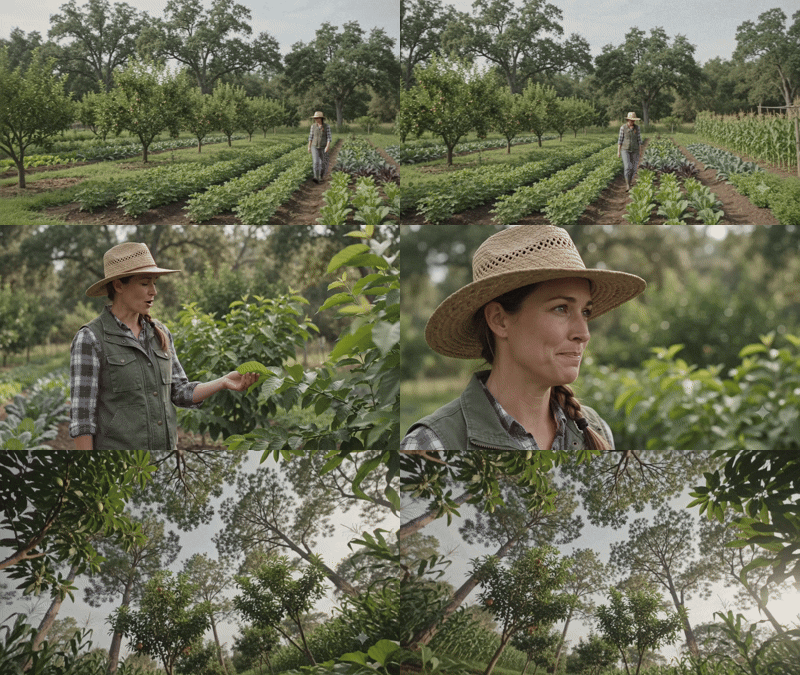
The global landscape of agricultural production is currently undergoing a structural transformation, driven by the dual imperatives of climate resilience and economic diversification. Agroforestry, defined as the intentional integration of trees and shrubs into crop and animal farming systems, has emerged as a primary vehicle for this transition.[1] As of 2025, the global agroforestry market is valued at approximately USD 108.33 billion and is projected to expand to USD 165.05 billion by 2032, reflecting a compound annual growth rate (CAGR) of 6.2%.[2] This growth is underpinned by a paradigm shift in land management that prioritizes “productive conservation,” where environmental stewardship is seamlessly integrated with profitability.[3] Unlike conventional monocultures, agroforestry systems utilize the interactive benefits of biological diversity to create land-use systems that are more integrated, productive, and sustainable.[1] For the entrepreneur or land manager, starting and growing a business in this sector requires a sophisticated understanding of biological interactions, long-term financial modeling, and the navigation of complex regulatory and market environments.
Taxonomy and Operational Mechanics of Agroforestry Systems
To successfully establish an agroforestry enterprise, the operation must satisfy the criteria of being intentional, intensive, integrated, and interactive.[1, 4] These “four i’s” distinguish agroforestry from passive woodlots or accidental tree growth. Intentionality refers to the deliberate design and management of combinations of trees, crops, and livestock to yield multiple benefits.[5] Intensiveness implies that these practices are managed for high productivity and protective functions, often involving cultivation, pruning, and irrigation.[4] Integration describes the structural and functional combination of components into a single management unit.[4] Interactivity refers to the biological and physical interactions between the woody and non-woody components.[1]
Alley Cropping and Agrisilvicultural Dynamics
Alley cropping involves the cultivation of agricultural or horticultural crops in the wide alleys between rows of trees or shrubs.[5, 6] This practice is particularly favored for its ability to provide annual income while longer-term tree crops mature. High-value hardwoods, such as oak, walnut, ash, and pecan, are frequently utilized to provide high-value lumber or veneer logs in the long term.[5, 7] In the interim, the alleys can be utilized for row/cereal crops like corn and soybeans, forage crops such as clover and fescue, or specialty crops like medicinal herbs and floral products.[8]
The strategic advantage of alley cropping lies in its ability to optimize land-use efficiency; research suggests that the combined productivity of trees and crops can be significantly higher than if they were grown in isolation.[9] For instance, intercropping maize with peanuts can yield up to 44% more per unit area than monocultures of either crop.[9] Effective alley cropping requires careful attention to row orientation—often dictated by topography or equipment width—and root management, such as subsoil ripping to minimize competition for moisture.[8, 10]
Silvopasture and Integrated Livestock Management
Silvopasture is the deliberate combination of trees with forage and livestock production on the same land unit.[11] This system offers significant welfare and productivity benefits for livestock. The tree canopy provides shade and shelter, reducing metabolic stress from temperature extremes—protecting animals from the summer sun and winter winds.[1, 12] This thermal regulation leads to improved feeding efficiency, health, and reproductive success.[10, 13]
Economically, silvopasture offers a 6% to 14% 10-year internal rate of return (IRR) compared to traditional grazing systems.[14] In regions like the Pacific Northwest, dominant timber species such as Douglas-fir and ponderosa pine are integrated with perennial ryegrass and orchardgrass to support cattle, sheep, and other livestock.[10] Research indicates that stocking rates for thinned Douglas-fir silvopastoral systems vary by age, with 4 acres per cow/calf unit recommended for 25-year-old stands and 6.5 acres for 55-year-old stands.[10]
Forest Farming and Understory Specialty Crops
Forest farming, or multi-story cropping, involves the cultivation of high-value specialty crops under the protection of a managed forest canopy.[1, 11] This practice is distinct from wildcrafting, as it requires intentional management of shade levels and forest structure to optimize the production of crops like ginseng, shiitake mushrooms, goldenseal, and ramps.[15, 16] Overstory trees can be managed for high-value sawlogs while the understory provides annual or periodic income from medicinal/botanical, decorative, or culinary products.[7] Forest farming allows landowners to generate income from existing woodlots without the need for large-scale timber harvesting, preserving the forest ecosystem while producing high-value specialty niches.[7, 15]
Riparian Forest Buffers and Windbreaks
While often viewed primarily as conservation tools, riparian forest buffers and windbreaks are increasingly managed as productive components of the agroforestry business. Riparian buffers consist of perennial vegetation (trees, shrubs, and grasses) planted adjacent to water bodies to reduce runoff and stabilize streambanks.[5, 13] A common design involves three zones: an undisturbed forest closest to the water, a managed forest in the middle, and a grass filter strip farthest from the stream.[13] The managed forest zone can be planted with fast-growing species that produce harvestable products like timber, nuts, or floral stems.[13]
Windbreaks, or shelterbelts, are linear plantings designed to protect crops, livestock, and soil from wind damage.[13] They can enhance crop yields by improving the microclimate, managing snow distribution, and protecting wind-sensitive vines or tree fruits.[5, 13] Multi-row windbreaks allow for the harvest of marketable timber and non-timber forest products without compromising the protective function of the shelterbelt.[13]
| Practice | Core Interaction | Primary Business Objective | Marketable Outputs |
|---|---|---|---|
| Alley Cropping | Tree rows + Crop alleys | Short-term cash flow + Timber | Grains, Vegetables, Specialty wood |
| Silvopasture | Trees + Forage + Livestock | Welfare + Productivity + Timber | Beef, Lamb, Timber, Nut crops |
| Forest Farming | Canopy + Understory crops | Niche specialty production | Mushrooms, Ginseng, Decorative greens |
| Riparian Buffers | Water interface + Perennials | Water quality + Niche products | Floral products, Nuts, Biomass |
| Windbreaks | Linear rows + Protected fields | Microclimate + Protection | Fiber, Fruit, Seed, Timber |
[1, 5, 11, 13, 15]
Economic Modeling and Financial Performance Indicators
The economic profile of an agroforestry business differs fundamentally from annual agriculture due to the extended “planning horizon.” While a soybean crop may have a planning horizon of six months, an agroforestry system involving timber can span 60 to 80 years.[17, 18] This long-term nature necessitates the use of sophisticated financial analysis techniques to assess viability and attract investment.
Net Present Value and the Discounting of Future Returns
Net Present Value (NPV) is the primary tool for determining the profitability of an agroforestry investment over its entire lifespan. It calculates the current value of all future net income streams, discounted to reflect their present value.[17] This is essential because a dollar received today is worth more than a dollar received forty years from now due to the opportunity cost of capital. The formula for NPV is expressed as:
NPV=Cashflow0+t=1∑n(1+i)tCashflowt
In this equation, i represents the discount rate (the rate of return an investor could earn in their best alternative investment), and n is the number of years in the planning horizon.[17] A positive NPV indicates that the agroforestry practice is more profitable than the alternative uses of capital at that given discount rate. Because trees take years to reach maturity, the choice of the discount rate is critical; a high discount rate (e.g., 20-30%) penalizes long-term timber returns, whereas a lower rate (e.g., <10%) favors investments in long-lived perennial systems.[19]
Internal Rate of Return and Annual Equivalent Value
The Internal Rate of Return (IRR) represents the expected annual growth rate of the investment. It is the discount rate at which the NPV of the project equals zero.[17] For instance, silvopasture systems have demonstrated 10-year IRRs of 6-14%.[14] However, because cash flows in agroforestry are often lumpy—with high initial establishment costs followed by years of low income and eventual large harvests—IRR may not fully capture the risk of negative cash flow in the early years.[17]
To address this, managers use the Annual Equivalent Value (AEV), which converts the fluctuating NPV into a level annual income stream (an annuity). This establishes a level income estimate that can be compared directly to annual crop returns.[17, 18] The AEV is calculated by dividing the NPV by the annuity discount factor for the planning horizon:
t=1∑n(1+i)t1=i1[1−(1+i)n1]
Budgeting for the “Valley of Death”
The primary financial hurdle for agroforestry startups is the period between initial investment and the first commercial harvest. Perennial crops typically require 4 to 6 years to begin producing and 8 to 15 years to reach full maturity.[20] Business planning must include strategies for maintaining liquidity during these non-productive years. Common strategies include:
- Intercropping/Alley Cropping: Growing annual row crops like wheat or soybeans in alleys to provide immediate cash flow until trees reach nut-bearing or timber-harvesting age.[6, 21]
- Livestock Integration: Utilizing silvopasture to generate animal-based income while timber matures, potentially improving returns by 25-68%.[14, 22]
- Incentive Payments: Enrolling in programs like the Conservation Reserve Program (CRP) to receive annual rental payments for the first 10-15 years of a project.[17, 18]
- Carbon Credits: Participating in voluntary carbon markets, where sequestered carbon is sold as Removal Units (CRUs), providing an additional annual income stream.[23, 24]
| Economic Indicator | Definition | Application in Agroforestry Management |
|---|---|---|
| Planning Horizon | Total time to realize all costs and revenues | Essential for long-term timber/nut systems |
| Variable Costs | Establishment and maintenance cash outlays | Managing annual operating budgets |
| Fixed Costs | Ownership costs like taxes and insurance | Determining overhead for the farm business |
| Opportunity Cost | Value of the best alternative land/capital use | Deciding between trees and annual crops |
| Negative Cashflow Duration | Consecutive years of net losses | Assessing startup survival risk |
[17, 18, 19]
Strategic Site Assessment and Bio-Physical Architecture
The technical success of an agroforestry operation is predicated on a thorough site assessment that matches species selection to the existing environmental parameters. This “due diligence” phase prevents the costly failure of long-term perennial investments.
Soil Dynamics and Nutrient Availability
A comprehensive soil analysis is the foundation of site planning. Researchers must evaluate soil texture, depth, organic matter content, and pH.[25, 26] Soil texture (the ratio of sand, silt, and clay) determines the rate at which water and oxygen move through the ground.[25] Optimum texture is essential for root growth and nutrient uptake. For instance, deep, sandy loam soils (deeper than 50 cm) are generally considered ideal for high-value hardwood production.[25]
| Soil Property | Ideal Parameters for Agroforestry | Business Implication |
|---|---|---|
| Texture | Sandy loam | Facilitates root expansion and water movement |
| Depth | > 50 cm | Ensures stability and nutrient access |
| pH | Neutral to slightly acidic | Crucial for species like legumes or walnuts |
| Organic Carbon | High (e.g., > 2%) | Influences soil moisture retention and fertility |
| Drainage | Well-drained | Prevents root rot and allows timely equipment access |
[25, 26, 27]
Soil pH is particularly important, as many leguminous trees used for nitrogen fixation are sensitive to acidity.[25] Simple field tests, such as rubbing soil between fingers or sedimentation tests in jars, can provide preliminary information, but professional laboratory analysis is recommended for accurate nutrient mapping of Nitrogen (N), Phosphorus (P), Potassium (K), and Organic Carbon (C).[25, 27]
Topography and Microclimate Regulation
Topographic data, including elevation, slope, and aspect, play an essential role in regulating microclimatic conditions.[26, 28] North-facing slopes in temperate regions may provide cooler, moister conditions suitable for certain forest farming crops, while south-facing slopes are often preferred for timber species like Douglas-fir.[10, 26] Slope also dictates the feasibility of mechanized harvesting and the risk of water runoff; planting tree rows on the contour can create terraces that reduce soil erosion.[10]
Wind is another critical variable. In planning an operation, the prevalent direction and speed must be measured to determine the optimal placement of windbreaks or the orientation of alley cropping rows to avoid lodging of crops.[13, 29] Average wind speeds of 12-15 mph can significantly impact transpiration rates and livestock comfort.[29]
Geospatial Tools and Suitability Mapping
Modern agroforestry planning increasingly utilizes Geographic Information Systems (GIS) and remote sensing. By integrating thematic data layers—including topography, soil nutrients, rainfall, and proximity to markets—land managers can generate suitability maps that identify the optimal locations for specific practices.[27, 28] For instance, a weighted analysis might prioritize nutrient availability (35% weight) and slope (30% weight) when determining where to establish high-value alley cropping systems.[27] Proximity to roads and settlements is also a key socioeconomic variable in site suitability, as it influences transport costs and market access.[28]
Marketing, Value-Addition, and Enterprise Growth
Starting an agroforestry business often requires the producer to move beyond commodity markets and enter the “black box” of specialty products.[3] This necessitates proactive market research and the development of unique value propositions.
Case Studies in Market Creation and Business Resilience
Case studies of established agroforestry businesses highlight the diversity of successful marketing strategies. These strategies often combine direct-to-consumer sales with niche wholesale partnerships.[21, 30]
- Shepherd Farms (Pecans and Alley Cropping): This 4,000-acre operation in Missouri includes 300 acres of pecan orchards. Initially, they grew soybeans and wheat in the alleys, transitioning to hay as trees grew. Their marketing focus is on direct-to-consumer sales through an on-farm store, emphasizing the “customer experience” and eliminating the middle person to maintain higher prices.[21]
- Delaware Valley Ramps (Wild Edibles and Forest Farming): Steven Schwartz targeted the New York City restaurant scene, creating a market for ramps, fiddlehead ferns, and stinging nettles. He built his business through word-of-mouth and seasonal email updates, using creative collaborations like annual restaurant dinners to engage high-value customers.[21]
- Passamaquoddy Maple (Maple Syrup): The Passamaquoddy Tribe transitioned from timber to forest products to provide more community benefits. They focus on unique packaging and digital tools to reach a national market, maintaining organic certification to differentiate their product in a crowded field.[21]
- Integration Acres (Pawpaws): Chris Chmiel created a market for the pawpaw, a native fruit. His strategy involved heavy use of events, including an annual pawpaw festival, and diversifying his business with agritourism and multiple value-added products.[21]
| Business Lesson | Mechanism | Practical Outcome |
|---|---|---|
| Market Creation | Education and sampling | Building demand for unfamiliar crops (e.g., elderberry) |
| Customer Connection | On-farm stores and festivals | Higher brand loyalty and retail price capture |
| Value-Addition | Processing raw crops (e.g., jam, syrup) | Increased margins and storable inventory |
| Diversification | Multiple products from the same land | Buffer against single-crop failure or market volatility |
| Strategic Alliances | Collaborations with restaurants/chefs | Rapid entry into high-end culinary markets |
[21, 31]
Business Models: CSA, Subscription, and Agritourism
Community Supported Agriculture (CSA) and subscription models provide a way for agroforestry producers to improve cash flow and share production risks with consumers.[32, 33] In a CSA, shareholders pay for their portions before the growing season begins, providing the capital needed for early expenditures.[33] While traditionally used for vegetables, the diversified nature of agroforestry—producing nuts, fruits, honey, mushrooms, and meats—makes it highly suitable for multi-product CSA boxes.[32, 33]
Agritourism, including “pick-your-own” (U-pick) operations, can reduce labor costs associated with harvesting and packaging while providing consumers with an educational experience.[32, 33] On-farm sales rely heavily on location and atmosphere; providing useful information and a friendly greeting can encourage repeat business.[33]
Legal, Regulatory, and Tax Frameworks
Agroforestry businesses operate at the intersection of agricultural and forestry law, which can lead to regulatory friction. Navigating these complexities is essential for protecting land rights and minimizing tax liabilities.
Property Tax Classifications and Reclassification Hurdles
In many jurisdictions, land is classified as either “agricultural” or “forest” for property tax purposes. Because agroforestry combines both, it may fall into a “gray area” where it fails to meet the strict criteria for either.[34] For instance, minimum trees-per-acre requirements for forestry programs may disqualify windbreaks, while maximum tree cover limits for agricultural programs might exclude silvopasture.[34]
Some states have addressed this through “agricultural forest” classifications. In Wisconsin, forest land contiguous to a wholly agricultural parcel owned by the same person can qualify for reduced assessments (valued at 50% of fair market value).[35, 36] Landowners must be aware that converting land between categories can trigger “compensating taxes” if the land is removed from a designated forest status; these taxes can represent the difference in tax rates for up to 10 years.[37]
Federal Tax Incentives for Perennial Systems
Specific sections of the Internal Revenue Code (IRC) provide incentives for agroforestry:
- Section 194 (Reforestation Deduction): Allows taxpayers to deduct up to $10,000 per year of reforestation expenditures and amortize the remaining costs over 84 months.[38] This is applicable to agroforestry practices if the primary purpose is commercial timber production.
- Section 179 (Expensing Election): Provides a deduction for the cost of certain qualifying personal property (e.g., machinery, specialized equipment) used more than 50% in an active farming or forestry business.[38]
- Long-term Capital Gains: Income from timber sales is often taxed at more favorable capital gains rates rather than ordinary income rates, provided the asset has been held for the required period.[38]
Regulatory Compliance and Environmental Standards
Agroforestry operations must comply with state and local laws governing timber harvesting and land use. For example, the Maine Forest Service administers the Forest Practices Act, which includes rules on forest regeneration, clearcutting standards, and harvesting in shoreland areas.[39, 40] Operations disturbing more than one acre may require stormwater permits.[41]
Organic certification introduces additional requirements. To sell products as organic, land must have had no prohibited substances applied for three years prior to harvest.[42] Producers must establish distinct buffer zones to prevent contamination from adjacent conventional farms, which can range from pesticides to GMO pollen.[42] Agroforestry practices like windbreaks or riparian buffers are ideal for meeting these buffer requirements while remaining productive.[21, 42]
Risk Management: Climate, Pests, and Resilience
Managing an agroforestry business requires a proactive approach to biotic and abiotic risks. The diversity of the system is its primary defense, but it also increases management complexity.
Climate Resilience and Yield Stability
Agroforestry is increasingly recognized as a climate-smart solution that mitigates the effects of extreme weather.[2] Trees act as a buffer, reducing crop damage from heavy rainfall, drought, and temperature fluctuations.[43, 44] Studies indicate that integrating trees can increase the resilience of agronomic crops, potentially boosting yields by 5% to 15% during adverse weather years compared to monocultures.[43] This “natural insurance” reduces the vulnerability of the business to single-crop failure.[22, 45]
Integrated Pest Management (IPM) in Multi-Species Systems
The transition from monocultures to complex agroforestry systems requires a transition to Integrated Pest Management (IPM). IPM is an ecological approach that uses a combination of methods to maintain pest populations below economically damaging levels.[46]
- Prevention/Cultural Control: Selecting pest-resistant varieties, using crop rotation, and maintaining farm hygiene to disrupt pest life cycles.[46, 47]
- Biological Control: Supporting natural predators, parasitoids, and microbial agents.[47, 48] Diverse agroforestry habitats provide “refuges” for these beneficial organisms.[49, 50]
- Monitoring: Regular scouting to identify pests and determine if thresholds for action have been met.[47, 51] Technologies like AI-driven sensors and drone monitoring are increasingly used to track pest outbreaks.[48]
- Targeted Intervention: Using mechanical (e.g., handpicking) or chemical controls only when necessary, choosing products that minimize harm to non-target species.[47, 51]
Climate change is altering pest distributions and life cycles, often expanding the range of pests like the fall armyworm.[48, 52] IPM provides the flexibility to adapt to these shifting threats through long-term record-keeping and adaptive management.[49]
| IPM Strategy | Mechanism | Business Value |
|---|---|---|
| Cultural | Sanitation, rotation, timing | Low-cost prevention of outbreaks |
| Biological | Natural enemy conservation | Reduced reliance on synthetic inputs |
| Physical/Mechanical | Fencing, traps, handpicking | Safe for organic certification |
| Chemical | Targeted, threshold-based spraying | Cost efficiency and resistance management |
| Technological | AI sensors and remote sensing | Real-time decision support |
[46, 47, 48, 51]
Financing and Strategic Partnerships
The capital-intensive nature of planting perennials and the long payback period mean that many agroforestry businesses rely on a mix of public and private funding.
USDA and Federal Support Programs
A wide range of USDA programs supports the adoption and scaling of agroforestry:
- EQIP (Environmental Quality Incentives Program): Provides cost-share payments for establishing practices like alley cropping, silvopasture, and windbreaks.[16, 53, 54]
- CIG (Conservation Innovation Grants): A competitive program that supports the development of new tools and approaches to conservation, investing millions annually in on-farm trials.[55]
- Value-Added Producer Grants (VAPG): Helps producers enter into value-added activities related to the processing and marketing of new products.[16, 31]
- FSA (Farm Service Agency) Loans: Offers direct and guaranteed farm ownership and operating loans to farmers who cannot obtain commercial credit, including targeted funds for beginning farmers and ranchers.[54, 56]
Private Capital and Blended Finance
The economic case for forest investment is strengthening, with private investment reaching record levels in 2024.[57] Private climate funds and green bonds are increasingly used for nature-based climate action. Blended finance models—which combine public risk guarantees with private investment—have made agroforestry projects more bankable for institutional investors who traditionally avoided forestry due to long payback periods.[57, 58] Organizations like Agroforestry Partners invest in large-scale projects, providing turnkey financing to farmers for agroforestry conversion.[59]
Carbon Credit Integration
Agroforestry carbon offsets are a rapidly growing market, projected to reach $760 million by 2032.[23] Projects generate verified carbon credits through integrated land-use practices that enhance sequestration in both biomass and soil.[23] Platforms like Rabobank’s Acorn measure and certify sequestered carbon using satellite monitoring, enabling smallholders to access the voluntary carbon market.[24] These programs typically ensure that a high percentage of the revenue (e.g., 80%) flows directly back to the farmer, providing a critical “bridge” of income during the non-productive years of tree growth.[24]
Strategic Synthesis and Future Outlook
The establishment and growth of an agroforestry business represent a departure from the high-input, low-diversity models of 20th-century agriculture. Success in this field is not merely a matter of agricultural skill, but a complex exercise in long-term asset management and market creation. The transition from annual monocultures to perennial systems offers a pathway to economic resilience, provided that the entrepreneur masters the bio-physical, financial, and regulatory dimensions of the system.
Nuanced Insights for Scalable Growth
Analysis of the data indicates that the most resilient agroforestry businesses are those that successfully bridge the initial income gap through “stacking” multiple revenue streams. The integration of specialty crops or livestock into timber systems provides the necessary liquidity to maintain operations until high-value wood crops reach maturity. Furthermore, the ability to internalize environmental benefits—whether through carbon credits or through the “regenerative” premium in consumer markets—is becoming a primary determinant of profitability.
| Growth Phase | Key Strategic Focus | Primary Funding Sources |
|---|---|---|
| Establishment (Year 0-3) | Site assessment, species matching | USDA EQIP, Grants, Personal Capital |
| Early Growth (Year 4-10) | Intercropping, Livestock integration | Cash flow from annuals/animals, Carbon credits |
| Mid-Life (Year 10-25) | Pruning, Nut/Fruit harvest | Specialty product sales, Agritourism |
| Maturity (Year 25+) | Timber harvest, Thinning | Long-term capital gains, Re-investment |
[17, 18, 20]
As global markets increasingly value ecosystem services and climate-smart commodities, the institutional support for agroforestry is expected to expand. The proliferation of national agroforestry policies—started by India in 2014—and the commitment of hundreds of millions of dollars by agencies like the USDA signal a long-term shift in agricultural priorities.[22] For the professional practitioner, the ability to synthesize technical biological knowledge with sophisticated financial planning and adaptive risk management will be the cornerstone of a successful and sustainable agroforestry enterprise. The future of the industry lies in its ability to demonstrate that trees on the farm are not just conservation tools, but “working trees” that form the backbone of a robust and profitable rural economy.[15]
——————————————————————————–
- Agroforestry – USDA, https://www.usda.gov/forestry/agroforestry
- Agroforestry Market Opportunities & YoY Growth Rate, 2032, https://www.coherentmarketinsights.com/industry-reports/agroforestry-market
- Chapter 10: Marketing Principles – The Center for Agroforestry, https://centerforagroforestry.org/wp-content/uploads/2024/04/10_Marketing_TrainingManual_2024Master_0410_Digital-11.pdf
- Training Manual for Applied Agroforestry Practices – Sustainable Agriculture Research and Education, https://www.sare.org/wp-content/uploads/Training-Manual-for-Applied-Agroforestry-Practices.pdf
- Chapter 1: Defining Agroforestry, https://centerforagroforestry.org/wp-content/uploads/2025/05/Chapter-1-Defining-Agroforestry-Agroforestry-Training-Manual-2025.pdf
- Alley Cropping – USDA Forest Service, https://www.fs.usda.gov/nac/practices/alley-cropping.php
- TRAINING MANUAL – The Center for Agroforestry, https://centerforagroforestry.org/wp-content/uploads/2024/04/FULL_TrainingManual_2024Master_0410_Digital.pdf
- Alley Cropping: An Agroforestry Practice – USDA Forest Service, https://www.fs.usda.gov/nac/assets/documents/agroforestrynotes/an12ac01.pdf
- Benefits and Risks of Intercropping for Crop Resilience and Pest Management | Journal of Economic Entomology | Oxford Academic, https://academic.oup.com/jee/article/115/5/1350/6572575
- Agroforestry: 5 practices for adding trees to your farm or ranch in …, https://extension.oregonstate.edu/sites/extd8/files/catalog/auto/EM8988.pdf
- Agroforestry Practices – USDA Forest Service, https://www.fs.usda.gov/nac/practices/
- Agroforestry – Forest Research, https://www.forestresearch.gov.uk/climate-change/carbon/agroforestry/
- Agroforestry: A Land Use Integration System – OSU Extension Service, https://extension.oregonstate.edu/sites/extd8/files/documents/em8988.pdf
- Silvopasture Creates Profitable and Resilient Food Systems …, https://www.propagateag.com/blog/silvopasture-is-profitable-and-resilient-cedyg-x4kyl-f3xyp-9dgj3
- What is Agroforestry – Colorado State Forest Service, https://csfs.colostate.edu/wp-content/uploads/2016/01/USDA_what-is-agroforestry.pdf
- USDA Programs, https://www.fs.usda.gov/nac/resources/usda-programs.shtml
- Economic Budgeting for AF – The Center for Agroforestry, https://centerforagroforestry.org/wp-content/uploads/2022/11/Agroforestry-in-Action-Economic-Budgeting-for-AF.pdf
- Economic Budgeting for Agroforestry Practices, http://128.206.25.160/pubs/economichandbook.pdf
- Technical Paper 5: Concepts and Methods for Economic Evaluation of Alley Farming, https://www.fao.org/4/x5546e/x5546e08.htm
- Business Planning – Regenerative Design Group, https://www.regenerativedesigngroup.com/kickstart-agroforestry-5/
- Marketing Agroforestry Products: Lessons from Producers 2021 – USDA Forest Service, https://www.fs.usda.gov/nac/assets/documents/morepublications/MarketingAgroforestryProducts-508.pdf
- Agroforestry Market Size, Industry Trends & Analysis, 2032 – Persistence Market Research, https://www.persistencemarketresearch.com/market-research/agroforestry-market.asp
- Global Analysis By Type (Silvopasture, Agrisilviculture, Agrosilvopastoral Systems, Riparian Buffer Strips, Windbreaks & Shelterbelts, Multistrata Agroforestry and Other Types), Carbon Offset Type (Vol – Market Research, https://www.marketresearch.com/Stratistics-Market-Research-Consulting-v4058/Agroforestry-Carbon-Offset-Forecasts-Global-42110534/
- Agroforestry for carbon sequestration – Rabobank – Acorn, https://acorn.rabobank.com/en/agroforestry/
- Site Analysis and Outplanting – Agroforestry.org, https://agroforestry.org/2014-03-04-10-06-24/site-analysis
- Social-Ecological Spatial Analysis of Agroforestry in the European Union with a Focus on Mediterranean Countries – MDPI, https://www.mdpi.com/2077-0472/14/8/1222
- Geospatial Approach for Agroforestry Suitability Mapping: to Enhance Livelihood and Reduce Poverty, FAO Based Documented Procedure (Case Study of Dumka District, Jharkhand, India), https://www.biotech-asia.org/vol14no2/geospatial-approach-for-agroforestry-suitability-mapping-to-enhance-livelihood-and-reduce-poverty-fao-based-documented-procedure-case-study-of-dumka-district-jharkhand-india/
- Agroforestry Suitability for Planning Site-Specific Interventions Using Machine Learning Approaches – MDPI, https://www.mdpi.com/2071-1050/14/9/5189
- Agroforestry Design for Regenerative Production Chapter 3. Goals, Skills, and Site Assessments, https://projects.sare.org/media/pdf/A/g/r/Agroforestry-Design-Assessments-Elevitch-Logan.pdf
- Agroforestry in temperate-climate commercial agriculture: Feedback from agroforestry practitioners in the Mid-Atlantic United States | Elementa – UC Press Journals, https://online.ucpress.edu/elementa/article/12/1/00136/200590/Agroforestry-in-temperate-climate-commercial
- Case Studies of Value Added Producer Grant Recipients | Agricultural Marketing Resource Center, https://www.agmrc.org/value-added-agriculture/case-studies-of-value-added-producer-grant-recipients
- Direct Marketing for Agroforestry Producers – USDA Forest Service, https://www.fs.usda.gov/research/publications/an/direct-marketing-an27.pdf
- Direct Marketing of Agroforestry Products – UNL Digital Commons, https://digitalcommons.unl.edu/cgi/viewcontent.cgi?article=1056&context=agroforestnotes
- Challenges and opportunities for agroforestry practitioners to participate in state preferential property tax programs for agriculture and forestry – UNL Digital Commons, https://digitalcommons.unl.edu/cgi/viewcontent.cgi?article=2427&context=natrespapers
- DOR Agricultural Forest and Undeveloped Land – Qualifying Parcels – Wisconsin Department of Revenue, https://www.revenue.wi.gov/Pages/FAQS/slf-agforest.aspx
- AB 650 – Definition of Agricultural Forest Land (February 17, 2004) – Legislative Fiscal Bureau, https://docs.legis.wisconsin.gov/misc/lfb/bill_summaries/2003_05/0650_ab_650_definition_of_agricultural_forest_land_2_17_04.pdf
- Current Use/Designated Forest Land Exemption – Grays Harbor County, https://www.graysharbor.us/government/assessor/current_use_designated_forest_land_exemption.php
- AGROFORESTRY IN ACTION, https://centerforagroforestry.org/wp-content/uploads/2021/06/agrotaxcons.pdf
- Rules and Regulations: Maine Forest Service, https://www.maine.gov/dacf/mfs/rules_and_regulations.html
- Title 12, §8869: Forest harvest regulations – Maine Legislature, https://www.mainelegislature.org/legis/statutes/12/title12sec8869.html
- State Specific Training Module for Maine 2023, https://www.nrcs.usda.gov/sites/default/files/2023-12/Maine_StateSpecificTrainingModule_2023.pdf
- Guidelines for Organic Crop Certification – Agricultural Marketing Service, https://www.ams.usda.gov/sites/default/files/media/Crop%20-%20Guidelines.pdf
- Global assessment of production benefits and risk reduction in agroforestry during extreme weather events under climate change scenarios – Frontiers, https://www.frontiersin.org/journals/forests-and-global-change/articles/10.3389/ffgc.2024.1379741/full
- AGROFORESTRY FOR ADAPTATION AND MITIGATION TO CLIMATE CHANGE – Stockholm International Water Institute, https://www.siwi.org/wp-content/uploads/2020/02/Agroforestry-for-adapation-and-mitigation-to-climate-change_web.pdf
- Agroforestry Economics → Term – Fashion → Sustainability Directory, https://fashion.sustainability-directory.com/term/agroforestry-economics/
- Integrated Pest Management: An Update on the Sustainability Approach to Crop Protection, https://pmc.ncbi.nlm.nih.gov/articles/PMC11465254/
- Exploring Integrated Pest Management for Sustainable Agriculture, https://rynanagriculture.com/news-blogs/exploring-integrated-pest-management-for-sustainable-agriculture
- The Future of Integrated Pest Management – Agrospheres: e-Newsletter, https://agrospheresmagazine.vitalbiotech.org/aadmin/articles/Agrospheres-2024-5-9-14-16.pdf
- Making strategic moves: How IPM helps farmers take on the complexities of pest management – Corteva Agriscience, https://www.corteva.com/ca-en/resources/agronomy-hub/integrated-pest-management-helps-farmers.html
- Agroforestry | Sustainable Agriculture Research & Education Program – UC Davis, https://sarep.ucdavis.edu/research/production/agroforestry
- Integrated Pest Management (IPM) | NC State Extension Publications, https://content.ces.ncsu.edu/extension-gardener-handbook/8-integrated-pest-management-ipm
- Climate Change and Pathways Used by Pests as Challenges to Plant Health in Agriculture and Forestry – MDPI, https://www.mdpi.com/2071-1050/14/19/12421
- Agroforestry Funding Sources – Appalachian Sustainable Development, https://www.asdevelop.org/wp-content/uploads/2024/01/Agroforestry-Funding-Sources.pdf
- Agroforestry Funding Sources – Appalachian Sustainable …, https://asdevelop.org/wp-content/uploads/2024/01/Agroforestry-Funding-Sources.pdf
- Conservation Innovation Grants (CIG) – Natural Resources Conservation Service, https://www.nrcs.usda.gov/programs-initiatives/conservation-innovation-grants
- Grants and Loans – USDA, https://www.usda.gov/farming-and-ranching/financial-resources-farmers-and-ranchers/grants-and-loans
- Forest Finance Hits Record Growth in 2025: Investment Doubles for Nature-Based Climate Action – CarbonCredits.com, https://carboncredits.com/forest-finance-hits-record-growth-in-2025-investment-doubles-for-nature-based-climate-action/
- Conservation Finance Program | US Forest Service, https://www.fs.usda.gov/working-with-us/partnerships/conservation-finance
- Agroforestry Partners, https://www.agroforestrypartners.com/


Leave a comment