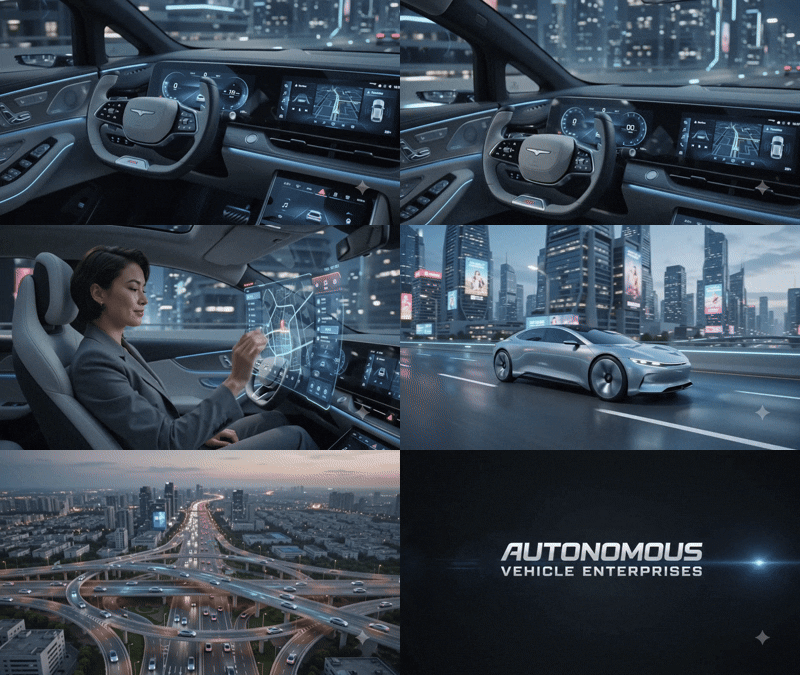
The global autonomous vehicle sector has entered a decisive era of commercial translation, shifting from the speculative prototyping of the previous decade into a formalized industrial ecosystem defined by rigorous safety standards, massive capital allocation, and sophisticated regulatory structures. As of late 2025, the industry is no longer characterized merely by technological potential but by the tangible integration of automated driving systems into the global supply chain and urban mobility networks. The market is projected to grow from an estimated 34.66 billion dollars in 2025 to approximately 237.12 billion dollars by 2035, exhibiting a compound annual growth rate of 21.2%.[1] More aggressive forecasts, accounting for the rapid convergence of generative artificial intelligence and high-performance edge computing, suggest the global market size could hit as high as 5,439.46 billion dollars by 2035 if Level 4 and Level 5 deployments scale across commercial and passenger sectors.[2]
For entrepreneurs and strategic planners, starting and growing a business within this ecosystem requires navigating an unprecedented complexity of technical, legal, and financial hurdles. The success of an autonomous vehicle startup in 2025 depends on the ability to identify high-growth niches—such as autonomous trucking, industrial logistics, and last-mile delivery—while concurrently managing the transition from human-centric liability models to system-centric product liability frameworks. This report provides an exhaustive analysis of the strategic imperatives for building a viable autonomous vehicle enterprise, synthesized from the latest market data, regulatory filings, and technological benchmarks.
Market Dynamics and High-Growth Vertical Analysis
The autonomous vehicle landscape is currently undergoing a structural bifurcation between passenger-centric services and commercial logistics. While much of the public discourse focuses on consumer-facing “robotaxis,” the immediate economic viability and growth are being driven by the transportation and logistics segments, which accounted for a staggering 93.41% of the total market value share in early 2025.[2]
Commercial Transportation and Autonomous Trucking
The pivot toward autonomous trucking represents the most significant shift in the industry’s focus. The “Middle Mile”—long-haul routes between distribution centers—presents a more manageable operational design domain than the chaotic environments of urban centers. In the United States, autonomous trucking is projected to reach up to 30% of new sales by 2035, driven by a persistent driver shortage and the need for fuel optimization.[3]
The economic incentives are profound. Advanced AI algorithms allow autonomous trucks to optimize acceleration and braking, resulting in a minimum 10% reduction in fuel consumption.[4] For the U.S. trucking sector, this efficiency gain is estimated to save approximately 4 billion gallons of fuel annually, valued at roughly 10 billion dollars.[4] Companies like Aurora Innovation and Kodiak Robotics are leading this charge, with Aurora launching commercial operations in Texas by late 2025.[4, 5, 6]
| Segment | Projected CAGR (2025–2035) | Primary Value Driver | Key Players |
|---|---|---|---|
| Autonomous Trucking | 16.8% – 34.8% | Fuel efficiency & labor savings | Aurora, Kodiak, Gatik [4, 5] |
| Shared Mobility (Robotaxis) | 36.3% | Urbanization & MaaS adoption | Waymo, Zoox, Uber [5, 7] |
| Industrial/Mining | High Growth | 24/7 uptime & safety | Bullwork, Rio Tinto partners [8, 9] |
| Last-Mile Delivery | Exponential | E-commerce demand | Nuro, Clevon, Robeff [5, 9] |
The Rise of Mobility-as-a-Service (MaaS)
In the passenger sector, the model of private vehicle ownership is increasingly being challenged by Mobility-as-a-Service platforms. By 2025, shared autonomous vehicles are projected to account for over 30% of the total vehicle market.[1] The market for robotaxis alone is expected to expand from 1.95 billion dollars in 2024 to 188.91 billion dollars by 2034.[3] This growth is facilitated by strategic partnerships between technology providers and ride-hailing giants. For example, the expansion of the Waymo and Uber partnership into cities like Austin and Atlanta demonstrates a scalable model where technology firms provide the “driver” while platform firms provide the customer base.[7]
Industrial and Niche Autonomy
Beyond public roads, the industrial segment is experiencing the fastest immediate growth. Environments like mines, construction sites, and agricultural fields offer controlled operational design domains where regulatory barriers are lower and the safety benefits are immediate. In mining, the adoption of autonomous trucks is essential for overcoming shortages of skilled labor and reducing workplace accidents.[8] Startups like Bullwork Mobility are targeting these sectors with AI-powered electric tractors and loaders, highlighting a trend toward the convergence of autonomy and electrification.[9]
The Founding Roadmap: Strategic Infrastructure for Startups
Growing an autonomous vehicle business in 2025 requires a sophisticated understanding of the “stack”—the layered architecture of hardware, software, and connectivity that enables machine perception and decision-making.
The Perception Stack and Sensor Fusion
The debate over the optimal sensor suite continues to define the strategic direction of major firms. While some manufacturers, such as Tesla and Kodiak Robotics, emphasize a camera-heavy or camera-only approach to maximize scalability and reduce hardware costs, the industry standard for high-level autonomy (Level 4 and 5) remains a fused approach involving LiDAR, radar, and cameras.[5, 7]
The cost of this hardware has historically been a barrier to entry. However, recent developments indicate a significant downward trend. Pony.ai’s Generation 7 robotaxi, unveiled in mid-2025, features a 70% reduction in hardware costs for its autonomous driving kit.[2] This deflationary trend in sensing technology is a critical enabler for startups looking to deploy large-scale fleets. Emerging startups like Omnitron Sensors are further pushing this boundary by developing micro-electromechanical systems (MEMS) sensing technology that promises even greater miniaturization and cost-efficiency.[9]
Edge AI and High-Performance Computing
The integration of artificial intelligence is the primary driver of the autonomous vehicle market, with the AI in automotive applications segment projected to grow at a CAGR of over 40%.[1] The shift toward “Edge AI” is central to this growth. Because autonomous systems require real-time decision-making with near-zero latency, processing must happen locally on the vehicle rather than in the cloud.[10]
The next cycle of innovation, dubbed the “era of AI inference,” focuses on specialized processors like Nvidia’s DRIVE Thor and Tesla’s Dojo chips, which are optimized for the massive data throughput required by neural networks.[4, 10, 11] Startups in this space, such as aidymo-cv, are differentiating themselves by offering non-deep learning computer vision technologies that reduce the computational demand, allowing for faster processing on lower-cost edge devices.[9]
Connectivity and Intelligent Infrastructure
The performance of an autonomous fleet is significantly enhanced by its integration into smart city infrastructure. Vehicle-to-Everything (V2X) communication allows vehicles to receive data from traffic signals, smart road signs, and other road users. This connectivity is essential for managing traffic flow and reducing congestion, which is a key driver of government support for the industry.[1, 12]
| Technology Component | Strategic Importance | Current Trend |
|---|---|---|
| LiDAR/Radar Fusion | Safety & precision | 70% reduction in hardware costs [2, 5] |
| Edge AI Computing | Real-time decision making | Shift toward on-device inference [10] |
| 5G/V2X | Cooperative awareness | 90% market adoption of C-V2X by 2034 [3] |
| Predictive Maintenance | Operational uptime | IoT/ML integration for fleet management [1, 4] |
Regulatory Compliance: Navigating the 2025 Frameworks
One of the most profound changes in 2025 is the formalization of regulatory pathways that provide developers with a clearer roadmap from testing to commercial deployment.
The U.S. National Framework: AV STEP and Sean Duffy’s Innovation Agenda
Under the leadership of Transportation Secretary Sean Duffy, the U.S. Department of Transportation (DOT) unveiled a new Automated Vehicle (AV) Framework in April 2025. This framework is built on three core principles: prioritizing safety, removing regulatory barriers, and enabling commercial deployment.[13, 14]
A central mechanism of this framework is the ADS-equipped Vehicle Safety, Transparency, and Evaluation Program (AV STEP). This voluntary program allows manufacturers and fleet operators to submit “safety cases” to NHTSA to receive exemptions from federal safety standards that were originally designed for human-driven vehicles—such as requirements for steering wheels and mirrors.[15, 16] In August 2025, NHTSA issued its first major exemption under this program, allowing a robotaxi manufacturer to operate purpose-built vehicles without manual controls on public roads.[16]
California: The Evolving Proving Ground
California remains the most influential jurisdiction for autonomous vehicle regulation. In late 2025, the California DMV released revised regulations that significantly impact both light-duty and heavy-duty vehicles. A major shift in these regulations is the removal of the requirement for “disengagement reports,” which were often criticized for being misleading. Instead, manufacturers must now report on “Dynamic Driving Task (DDT) system failures”.[17]
For startups, compliance in California requires:
- Strict Permit Phases: Moving from drivered testing to driverless testing typically requires logging at least 50,000 miles in the previous phase.[18]
- Liability Bonds: Manufacturers must provide evidence of a 5 million dollar insurance instrument or surety bond to operate.[19]
- Local Engagement: New rules require manufacturers to certify that they have notified local authorities in the areas where testing occurs.[19]
Global Regulatory Benchmarks: EU, China, and Japan
The “autonomous vehicles arms race” is a strategic priority for several nations. The European Union is targeting 2026 for the rollout of a unified regulatory framework to harmonize the current patchwork of 27 different national laws.[20, 21] This harmonization is seen as vital for European automakers like Mercedes-Benz and BMW to compete with U.S. and Chinese firms.[22, 23]
China has already positioned itself as a leader in urban testing, with over 20 cities allowing full Level 4 autonomy testing in designated zones.[21] Japan is focusing on the social utility of the technology, aiming for a nationwide rollout of Level 4 autonomous shuttles by 2027 to serve its aging population.[3, 20]
Capitalization and Financial Strategy: The VC Ecosystem in 2025
Starting an autonomous vehicle business is exceptionally capital-intensive. In 2023, mobility startups attracted 39 billion dollars in funding, and this momentum has continued into 2025, with 2.7 billion dollars raised in just the first two months of the year.[6, 24]
Investment Stages and Funding Benchmarks
Entrepreneurs must align their growth milestones with the expectations of specialized venture capital firms.
- Seed Stage (5M–20M Dollars): Focused on proof-of-concept and initial simulation results. Firms like Trucks Venture Capital and Alumni Ventures are active at this stage.[6]
- Series A (30M–100M Dollars): Aimed at beginning public road testing and securing initial permits. Sequoia Capital and Andreessen Horowitz (a16z) often lead rounds in this range.[6]
- Late-Stage Growth (200M+ Dollars): Required for mass manufacturing and commercial fleet expansion. SoftBank Vision Fund and Tiger Global are key players here, with SoftBank notably committing over 2 billion dollars to Cruise.[6]
Strategic Corporate Investment
A defining trend in 2025 is the role of “Strategic Investors”—automotive OEMs and Tier 1 suppliers who invest not just for financial return but for technological integration. Toyota AI Ventures, for instance, provides capital to startups that can enhance Toyota’s future mobility ecosystem.[6] These partnerships often provide startups with something as valuable as cash: access to automotive-grade supply chains and manufacturing expertise.
| VC Firm | Focus Area | Typical Check Size |
|---|---|---|
| Trucks Venture Capital | Autonomous Trucking & Logistics | $1M – $20M [6] |
| Sequoia Capital | Full-stack AV & Sensors | $10M – $200M+ [6] |
| SoftBank Vision Fund | Large-scale deployment | $100M – $2B+ [6] |
| Toyota AI Ventures | AI-powered mobility | $2M – $30M [6] |
| Trucks Venture Capital | Early-stage mobility | $1M – $20M [6] |
Insurance and Liability: Managing Risk in a Post-Driver World
The transition to autonomous vehicles is perhaps the most significant disruption to the insurance industry since its inception. Traditional models based on human driver behavior are becoming obsolete, as the vehicle itself becomes the “driver.”
Shifting the Burden of Liability
In Level 2 and Level 3 systems, where a human driver is still expected to intervene, liability remains shared between the driver and the manufacturer.[25, 26] However, as the industry moves toward Level 4 and Level 5—where the vehicle operates entirely independently—liability shifts almost exclusively to the OEM or the software developer.[25, 26]
This shift has given rise to new insurance models:
- Product Liability Insurance: Essential for developers to cover malfunctions in sensors or algorithms.[27]
- Hybrid Policies: These split coverage between the individual (for manual operation) and the manufacturer (for autonomous operation).[25]
- Telematics and Usage-Based Pricing: Insurers are using real-time data from vehicle sensors to price premiums based on the actual performance of the autonomous system.[25, 27]
Commercial Requirements
For startups operating commercial fleets (robotaxis or freight), the insurance requirements are stringent. In California, operators are required to hold a substantial insurance bond of at least 5 million dollars.[26] Many commercial entities find that policies of 5 million dollars or more are becoming the industry standard to cover potential third-party bodily injuries or property damage caused by fleet-wide software failures.[25, 27]
Operational Challenges: From Simulation to Scale
Growth in the AV sector is not merely about writing better code; it is about the “validation mile.” The industry consensus is that billions of miles of testing are required to prove safety, a feat that is physically impossible to achieve solely on public roads.
The Role of Simulation and Scenario Training
Virtual miles have become indispensable for validating autonomous systems. The simulation market is projected to grow to 2.8 billion dollars by 2034.[3] Modern simulation platforms use AI-generated scenarios to test “edge cases”—rare and dangerous events that a vehicle might not encounter in years of normal driving. Companies like Zoox and Aurora use extensive virtual testing environments to accelerate development, allowing them to iterate on their software daily rather than waiting for real-world incidents.[5, 11]
Smart City Infrastructure as an Operational Enabler
The NYC Smart City Testbed Program is a prime example of how municipal partnerships facilitate growth. By allowing private vendors to test technologies like LiDAR-based pedestrian counters and traffic analyzers on city-owned property for 6–9 months, the city helps firms validate their systems in one of the most complex urban environments in the world.[28]
Managing the Human-Machine Transition
A critical operational hurdle for 2025 is the “transition of control.” In Level 3 systems, the car must signal the human to take over when it reaches the edge of its operational design domain. This transition is a known safety risk, as human drivers may not be immediately attentive.[29, 30] Startups like May Mobility are addressing this by focusing on fixed, repeatable routes, which simplifies the technological challenge and reduces the frequency of these transitions.[5]
The Social Contract: Ethics, Privacy, and Public Sentiment
The long-term growth of the autonomous vehicle industry depends on public acceptance, which remains fragile. Over 70% of consumers express concern about hacking risks associated with self-driving cars.[3]
Cybersecurity and Data Sovereignty
As vehicles become “data centers on wheels,” they become high-value targets for cyberattacks. A single vulnerability could allow a hacker to manipulate vehicle functions or steal sensitive user data.[12, 31] In 2025, manufacturers are ramping up investments in multi-layered security strategies, including AI-driven threat monitoring and end-to-end encryption.[12]
Privacy is equally contentious. Autonomous vehicles collect vast amounts of data—not only about the driver but about pedestrians and other vehicles through their sensors. The European Data Protection Board has warned that high-resolution sensors could “inadvertently capture identifiable information,” leading to a debate over data sovereignty similar to the 5G era.[23] Companies like WeRide have responded by pledging to store all local user data in local compliance offices.[23]
The Ethics of Autonomous Decision-Making
The “trolley problem”—how an AI should choose between two unavoidable accidents—remains a foundational ethical dilemma. While these scenarios are rare in practice, they occupy a central place in the regulatory and public imagination. Governments are increasingly demanding transparency in how AI algorithms make emergency decisions, and the implementation of ethical guidelines is now a requirement for obtaining wider public support.[29]
Labor and Economic Impact
The move toward automation is viewed as both a “mobility multiplier,” potentially adding 26 trillion dollars to global GDP by 2030, and a threat to the livelihoods of millions of professional drivers.[3] In the U.S., some lawmakers have proposed bills requiring safety drivers in all autonomous commercial vehicles to mitigate the impact on labor.[32] Navigating these labor concerns is a vital part of the political strategy for any growing AV firm.
Strategic Outlook: Milestones for 2026–2035
The upcoming decade will see the transition from small-scale pilots to profitable, large-scale operations. Several key macro forces will reshape the landscape during this period.
- Workforce Transformation: As 3.4 million truck drivers reach retirement by 2029, the acceleration of freight automation will move from a technological choice to a demographic necessity.[3]
- Sustainability Mandates: Electric autonomous vehicles are projected to decrease transportation-related emissions by up to 20% by 2025.[1] Startups that align their autonomy goals with ESG (Environmental, Social, and Governance) targets will find it easier to secure capital and government grants.[1, 24]
- The Rise of Agentic AI: By 2027, multimodal AI solutions will allow vehicles to not only “see” but also understand complex, multi-step reasoning, drastically reducing the number of accidents caused by “perception errors”.[29, 33]
| Milestone Year | Expected Development | Strategic Implication |
|---|---|---|
| 2026 | EU Unified Framework Rollout | Market entry becomes easier across 27 member states [20, 21] |
| 2027 | Japan & South Korea L4 Commercialization | Shift in leadership toward Asian mobility norms [3, 34] |
| 2029 | Peak U.S. Driver Retirement | Critical window for autonomous trucking scale-up [3] |
| 2030 | L5 Limited Deployment Begins | Full autonomy achieved in specific, high-value domains [3] |
| 2035 | AV Market Valuation Peak | Full integration into global logistics and MaaS [1, 2] |
Conclusions for Professional Stakeholders
The commercialization of autonomous vehicles in 2025 has moved beyond the “hype cycle” and into the “execution phase.” For those starting or growing a business in this field, the narrative of success is no longer just about the sophistication of the neural network but about the robustness of the safety case and the scalability of the business model.
Entrepreneurial strategy should prioritize the “Middle Mile” and industrial niches where the return on investment is immediate and the regulatory environment is favorable. Startups must be proactive in engaging with new federal frameworks like NHTSA’s AV STEP, as early movers will likely set the standards for future binding regulations.
Furthermore, as the sector matures, the ability to manage the “data-privacy-security” triad will become a primary differentiator. In an era where trust is the most valuable currency, firms that prioritize transparency and ethical algorithm design will be best positioned to win public support and regulatory favor. The next decade promises a transformation of global mobility, but only for those enterprises that can successfully synthesize technical excellence with the complex social and legal realities of 2025.
——————————————————————————–
- Autonomous Vehicles Market Size, Share Report | Growth [2035] – Market Research Future, https://www.marketresearchfuture.com/reports/autonomous-vehicles-market-1020
- Autonomous Vehicle Market Size to Hit USD 5439.46 Billion by 2035, https://www.precedenceresearch.com/autonomous-vehicle-market
- Future of Autonomous Vehicles [2026-2035] – StartUs Insights, https://www.startus-insights.com/innovators-guide/future-of-autonomous-vehicles/
- Autonomous Freight & Logistics Market Size, Report 2025-2032 – DataM Intelligence, https://www.datamintelligence.com/research-report/autonomous-freight-and-logistics-market
- Top 20 US Autonomous Vehicle Companies (2025) – Fifth Level Consulting, https://fifthlevelconsulting.com/autonomous-vehicle-companies-in-the-u-s/
- 20 Active Self-Driving Car Investors & VCs in 2025 – Ellty, https://www.ellty.com/blog/autonomous-vehicle-investors
- Autonomous Vehicle Market 2025: Industry Report & Trends – Autofleet, https://autofleet.io/resource/state-of-autonomous-vehicles-2025s-av-push-toward-a-driverless-future
- Autonomous Vehicle Market Size Worth USD 4450.34 Billion by 2034 Driven by AI Growth, https://www.globenewswire.com/news-release/2025/09/09/3147087/0/en/Autonomous-Vehicle-Market-Size-Worth-USD-4-450-34-Billion-by-2034-Driven-by-AI-Growth.html
- 30 Autonomous Vehicle Startups to Watch (2025) | StartUs Insights, https://www.startus-insights.com/innovators-guide/autonomous-vehicle-startups-and-companies/
- THE 2025 EDGE AI TECHNOLOGY REPORT | Ceva, https://www.ceva-ip.com/wp-content/uploads/2025-Edge-AI-Technology-Report.pdf
- Top Autonomous Vehicles Companies to Watch in 2025 – AI Time Journal, https://www.aitimejournal.com/autonomous-vehicles-companies-to-watch/
- Must-Read: Top 10 Autonomous Vehicle Trends (2025) – Fifth Level Consulting, https://fifthlevelconsulting.com/top-10-autonomous-vehicle-trends-2025/
- Trump’s Transportation Secretary Sean P. Duffy Unveils New …, https://www.transportation.gov/briefing-room/trumps-transportation-secretary-sean-p-duffy-unveils-new-automated-vehicle-framework
- Report to Congress: NHTSA Research and Rulemaking Activities on Vehicles Equipped with Automated Driving Systems, https://www.nhtsa.gov/sites/nhtsa.gov/files/2025-07/report-congress-research-rulemaking-automated-driving-systems-july-2025-tag.pdf
- NHTSA Proposes New Autonomous Vehicle Program – Covington & Burling LLP, https://www.cov.com/en/news-and-insights/insights/2025/01/nhtsa-proposes-new-autonomous-vehicle-program
- Driving Into 2026: The State of NHTSA and the Future of Vehicle …, https://www.foley.com/insights/publications/2025/11/driving-into-2026-the-state-of-nhtsa-and-the-future-of-vehicle-safety-regulation/
- DMV Opens 15-Day Public Comment Period on Autonomous Heavy- and Light-Duty Vehicles, https://www.dmv.ca.gov/portal/news-and-media/dmv-opens-15-day-public-comment-period-on-autonomous-heavy-and-light-duty-vehicles/
- San Francisco County Transportation Authority Feedback on Proposed Regulations for the Testing and Deployment of Autonomous Vehicles (AVs) on California, https://www.sfcta.org/sites/default/files/2025-10/SFCTA_Comments_to_CA_DMV_Draft_AV_Regulations_2025-06-09.pdf
- Autonomous vehicles law and regulation in California, United States – CMS, https://cms.law/en/int/expert-guides/cms-expert-guide-to-autonomous-vehicles-avs/california-united-states
- How Different Countries are Regulating Autonomous Vehicles – Urban SDK, https://www.urbansdk.com/resources/how-different-countries-are-regulating-autonomous-vehicles
- Regulations for Autonomous Vehicles: Where Do Countries Stand in 2024-2030? (Global Policy Trends) | PatentPC, https://patentpc.com/blog/regulations-for-autonomous-vehicles-where-do-countries-stand-in-2024-2030-global-policy-trends
- Autonomous Vehicles: Europe at a Turning Point – Connected Automated Driving, https://www.connectedautomateddriving.eu/blog/autonomous-vehicles-europe-at-a-turning-point/
- How China’s self-driving cars could redefine Europe’s tech rules – ThinkChina.sg, https://www.thinkchina.sg/technology/how-chinas-self-driving-cars-could-redefine-europes-tech-rules
- Global VC Funding Trends in EV, Battery & Mobility Startups – Qubit Capital, https://qubit.capital/blog/vc-funding-trends-ev-battery-mobility-startups
- Impact of Autonomous Vehicles on Auto Insurance in 2025 | Inszone …, https://inszoneinsurance.com/blog/impact-of-av-on-auto-insurance
- How autonomous vehicles will change the future of car insurance | S&P Global, https://www.spglobal.com/automotive-insights/en/blogs/2025/08/autonomous-vehicles-future-of-car-insurance
- Personal Driverless Car Insurance: Policies & Coverage – Koop Technologies, https://www.koop.ai/blog/personal-av-insurance
- CTO Matthew Fraser Announces New NYC Smart City Testbed …, https://www.nyc.gov/content/oti/pages/press-releases/cto_fraser_announces_new_smart_city_testbed_pilots
- Challenges in Safety and Ethical Considerations for Autonomous Vehicles – IJFMR, https://www.ijfmr.com/papers/2025/3/40091.pdf
- The Future of Transportation: Ethical, Legal, Social and Economic Impacts of Self-driving Vehicles in the Year 2025 – NIH, https://pmc.ncbi.nlm.nih.gov/articles/PMC7286843/
- (PDF) Ethical Issues in Cyber-Security for Autonomous Vehicles (AV) and Automated Driving: A Comprehensive Review – ResearchGate, https://www.researchgate.net/publication/390856653_Ethical_Issues_in_Cyber-Security_for_Autonomous_Vehicles_AV_and_Automated_Driving_A_Comprehensive_Review
- 2025 Autonomous Vehicles Federal Policy Wrapped – The Eno Center for Transportation, https://enotrans.org/article/2025-autonomous-vehicles-federal-policy-wrapped/
- Technology Trends Outlook 2025 – McKinsey, https://www.mckinsey.com/~/media/mckinsey/business%20functions/mckinsey%20digital/our%20insights/the%20top%20trends%20in%20tech%202025/mckinsey-technology-trends-outlook-2025.pdf
- South Korea to deploy over 100 new self-driving cars for testing – Tech in Asia, https://www.techinasia.com/news/south-korea-to-deploy-over-100-new-self-driving-cars-for-testing
 Journal for Policy & Market Research
Leave a comment