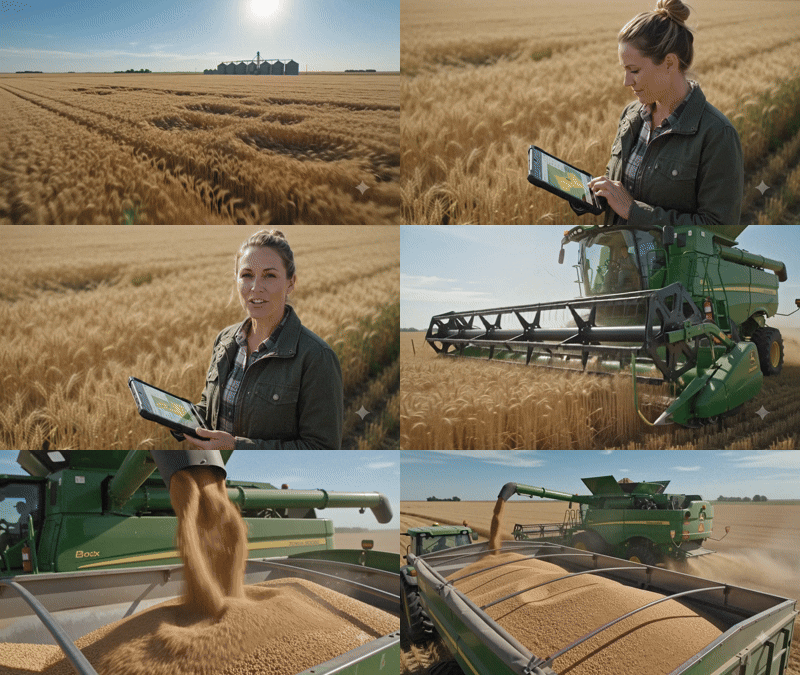
The global cereal crops sector remains the cornerstone of international food security and agricultural trade, having crossed a historic threshold with global production forecasts for 2025/26 exceeding 3 billion tonnes for the first time.[1] This surge in output, led by record-breaking corn and wheat harvests in the United States, Argentina, and the European Union, signifies a transition from a supply-constrained environment to a period of abundance characterized by record utilization and high stockpiles.[1, 2] For the modern agricultural entrepreneur, entering or growing a business within this sector requires navigating a landscape where commodity price volatility, geopolitical risks, and climate-driven variability demand a shift from traditional farming to data-driven, vertically integrated agribusiness management.[2, 3]
The industry is currently defined by a confluence of rising demand for human consumption, animal feed, and industrial applications such as biofuels.[2, 4] While human food consumption accounts for 45% of the market share, the rapid expansion of the ethanol sector—growing by 22% over the past decade—has fundamentally altered the value proposition of corn and sorghum production.[2, 4] Concurrently, the emergence of climate-smart commodity markets and precision agriculture technologies offers new avenues for profitability by optimizing input efficiency and capturing sustainability premiums.[5, 6]
Foundational Agronomics and Environmental Site Selection
The establishment of a cereal crop enterprise begins with a deep analysis of environmental parameters and biological requirements. Cereal crops are broadly categorized into cool-season and warm-season varieties based on their photosynthetic pathways and thermal requirements for germination and maturation.[7] Cool-season grains, including wheat, barley, oats, and rye, typically utilize the C3 photosynthetic pathway, germinating at soil temperatures as low as 35–40 °F and exhibiting high frost tolerance.[7] In contrast, warm-season grains like corn, sorghum, and millet utilize the C4 pathway, requiring a minimum soil temperature of 50–55 °F for successful germination and thriving in high-heat, high-light environments.[7, 8]
Wheat remains the most versatile and geographically dispersed cereal, capable of cultivation from sea level to over 3,050 meters.[9] While it is highly adaptable, optimal yields require well-drained fertile soils with a minimum of 10 inches of annual rainfall.[9] Rice, providing the primary caloric intake for over half the world’s population, demands specialized warm, water-intensive conditions, often requiring flooded fields and clay-rich subsoils to maintain water levels.[7, 10] Barley and rye offer strategic advantages for marginal lands, as they can thrive in less fertile soils than wheat.[9]
Soil Chemistry and Nutrient Management Architecture
Soil health management is the primary determinant of long-term yield stability. A rigorous soil testing program must assess pH levels, cation exchange capacity (CEC), and nutrient availability before any planting occurs.[7, 11] Most cereal crops require a pH range of 6.0 to 7.0 for optimal nutrient uptake.[7] The presence of organic matter, or humus, is critical for soil structure and water retention.[9] Nutrient management plans must be calibrated to the specific removal rates of the crop; for instance, corn production in the Heartland region is increasingly governed by nitrogen application rates derived from the corn-to-nitrogen price ratio to ensure economic efficiency.[12, 13]
| Crop Species | Photosynthetic Type | Ideal Soil pH | Min. Germination Temp | Major Producing Regions (USA) |
|---|---|---|---|---|
| Wheat (Winter) | C3 | 6.0 – 7.5 | 39 °F | Kansas, Oklahoma, Texas |
| Corn (Maize) | C4 | 5.8 – 7.0 | 50 °F | Illinois, Nebraska, Iowa |
| Rice | C3 | 5.0 – 6.5 | 60 °F | Arkansas, Louisiana, California |
| Barley | C3 | 6.0 – 8.0 | 38 °F | North Dakota, Montana |
| Oats | C3 | 5.5 – 7.0 | 35 °F | South Dakota, North Dakota, Iowa |
| Sorghum | C4 | 6.0 – 7.5 | 60 °F | Kansas, Texas |
Field preparation techniques, particularly tillage, must balance the need for a firm, uniform seedbed with the preservation of soil structure.[7, 14] Conventional tillage using moldboard or disc plows effectively incorporates crop residue and manages compaction, yet it increases the risk of soil erosion and moisture loss.[14, 15] Conservation tillage and no-till systems maintain at least 30% residue cover, promoting soil moisture retention and the development of earthworm canals that facilitate water penetration.[7, 14]
Strategic Financial Planning and Capital Allocation
The capital intensity of cereal farming necessitates a sophisticated financial framework. Starting a professional-scale operation requires substantial upfront investment in land, heavy machinery, and specialized infrastructure.[16, 17] Analysis of sustainable 5-hectare operations suggests a total capital expenditure (CAPEX) starting at approximately $345,000, with land acquisition and primary equipment like tractors representing the largest outlays.[16]
Operational Expenditure and Cash Flow Management
Operational expenses (OPEX) in grain farming are characterized by high variable costs for inputs such as seeds, fertilizers, and herbicides, alongside fixed overheads for land leases and labor.[12, 16] For a small-to-mid-sized enterprise, the monthly burn rate can hit $38,000 pre-revenue, necessitating a robust working capital buffer to survive the multi-month gap between planting and harvest.[16] In regions like Iowa, 2024 budgets for corn production reflect seed costs of approximately 102–128 per acre and nitrogen costs exceeding $100 per acre, depending on rotation effects and yield targets.[12]
| Expense Category | Typical Cost Unit | 2024/25 Est. (Per Acre) | Implication for Scalability |
|---|---|---|---|
| Seed | Per 1,000 kernels | $102 – $147 | High density increases cost but maximizes yield potential |
| Nitrogen (N) | Per pound ($0.60) | $76 – $116 | Fluctuates with natural gas prices; requires efficiency |
| Phosphate (P) | Per pound ($0.67) | $42 – $60 | Essential for early root and crown development |
| Herbicides | Per acre | $45 | Essential for no-till/conservation systems |
| Crop Insurance | 80% Coverage | $15 – $19 | Critical for risk mitigation against weather events |
| Harvest Mach. | Combine/Haul | $57 – $70 | Scale allows spreading fixed machinery costs |
Financing Gateways and Government Support Programs
Accessing capital is facilitated by USDA Farm Service Agency (FSA) programs. Direct Farm Operating Loans, with a maximum limit of $400,000, are designed to cover the costs of seed, fertilizer, and farm supplies.[18] For beginning or small-scale producers, the Microloan Program offers a simplified application for up to $50,000.[19] Furthermore, the USDA’s Farmer Bridge Assistance Program, announced in late 2025, provides a $12 billion pool to support producers of major row crops like corn and wheat who are affected by income volatility and trade disruptions.[20]
Producers can also improve their energy efficiency and reduce long-term costs through the Rural Energy for America Program (REAP). This program provides grants covering up to 50% of the cost of energy-efficient grain dryers or irrigation systems, which are often the largest energy consumers on a cereal farm.[21, 22, 23]
Technological Integration and Precision Agronomy
The modern cereal enterprise is increasingly defined by the integration of “Smart Farming” technologies, which leverage Artificial Intelligence (AI), the Internet of Things (IoT), and Unmanned Aerial Vehicles (UAVs) to optimize every square foot of the field.[24, 25] Precision agriculture methodologies allow farmers to treat different sections of a large field uniquely based on real-time data.[25]
Aerial Intelligence and Remote Sensing
UAVs (drones) equipped with multispectral, hyperspectral, and thermal sensors provide high-resolution data that surpasses traditional satellite imagery.[25, 26] These sensors capture light in the near-infrared band, allowing for the creation of Normalized Difference Vegetation Index (NDVI) maps that identify crop stress, disease, or nutrient deficiency before symptoms are visible to the naked eye.[25, 27] AI algorithms on edge processors—such as the NVIDIA Jetson Nano—enable these drones to autonomously detect weeds or pests and even perform precision spraying, which can reduce pesticide use by up to 35% while improving yields by 18%.[24, 26]
Automation and Variable Rate Technology (VRT)
The application of Variable Rate Technology (VRT) allows for the precise delivery of seeds and fertilizers according to localized soil potential. This approach has been shown to cut input waste by 40–60% while stabilizing yields in heterogeneous fields.[4, 24] Autonomous machinery, including GPS-guided tractors and robotic harvesters, addresses critical labor shortages and reduces overall production costs by approximately 25%.[24]
| Technology | Hardware/Software | Benefit for Cereal Farms | ROI Impact |
|---|---|---|---|
| Multispectral Drones | DJI P4 / Agras T30 | Stress detection & spot spraying | 30–40% yield/waste efficiency |
| Soil Sensors | IoT moisture probes | Optimized irrigation/N application | 40–60% water savings |
| AI Analytics | CNN/SVM Models | Yield forecasting/disease ID | >90% accuracy in planning |
| Autonomous Tractors | RTK GPS / LiDAR | Reduced labor & fuel consumption | 25% cost reduction |
Operational Management: From Planting to Harvest
Efficient field operations are governed by the biological clock of the crop and the mechanical requirements of the equipment. Successful stand establishment requires precise calibration of planters or seed drills to ensure uniform depth and spacing.[7, 15] For corn, uniform emergence is critical; uneven stands can lead to “inter-plant competition,” where late-emerging plants are treated as weeds by earlier, more dominant plants, significantly reducing overall yield potential.[7, 8]
In-Season Crop Protection and IPM
Integrated Pest Management (IPM) is the standard for modern cereal production, emphasizing cultural, biological, and mechanical controls over broad-spectrum chemical application.[28, 29] IPM strategies include:
- Monitoring and Scouting: Systematic field walks to identify pests like Hessian fly in wheat or corn rootworm in maize.[30, 31]
- Economic Thresholds: Applying chemical treatments only when the potential for crop damage exceeds the cost of the intervention.[28, 30]
- Biological Control: Conserving natural enemies, such as spiders and ladybugs, which can keep pest populations below damaging levels.[32]
- Genetic Resistance: Utilizing Bt-traited corn hybrids and resistant wheat varieties to manage specific insect and fungal threats.[30]
In-season management also involves tracking Growing Degree Days (GDD). Wheat development follows a predictable thermal pattern, with stem elongation and heading stages requiring specific heat units to progress.[31, 33] If high temperatures follow low temperatures rapidly shortly after planting, “vernalization” (the cooling requirement for flowering) may be compromised in winter wheat varieties.[33]
Harvest Readiness and Mechanical Optimization
Harvesting represents the final opportunity to preserve grain quality. Grains must reach a moisture level suitable for both mechanical harvest and long-term storage, typically around 15–20%.[34, 35] Combine settings must be meticulously tuned to the specific grain type—utilizing corn heads for maize and draper headers for small grains to minimize shatter loss.[7] Threshing, the act of removing the grain from its casing (chaff), and winnowing, the separation of edible grain from inedible residue, are now largely automated within modern combines.[34]
Post-Harvest Logistics and Storage Engineering
The capability to store grain effectively is a strategic differentiator for cereal businesses. Storage allows producers to bypass harvest-time market lows, where supply abundance typically suppresses prices, and wait for market recovery.[35, 36]
Commercial vs. On-Farm Storage Dynamics
Producers must choose between on-farm storage in private bins and commercial storage at country elevators.[35, 37] On-farm storage offers lower long-term costs and higher marketing flexibility, allowing for “identity preservation” of specialty grains.[38] However, it requires a high initial investment—up to 600,000foramodernsilosystem—anddemandsprofessionalmanagementoftemperature,humidity,andpests.[39]Commercialstorageinvolvesmonthlyfees(0.02–$0.05 per bushel) but provides professional grading, aeration, and easier access to bulk transportation networks.[35]
| Storage Structure | Material/Design | Best For | Technical Considerations |
|---|---|---|---|
| Flat Bottom Silo | Corrugated Steel | Long-term bulk storage | Requires unloading tunnels and sweep augers |
| Hopper Bottom Silo | Steel/Concrete | Temporary/Wet storage | Facilitates rapid unloading; gravity-fed |
| Grain Bins | Galvanized Steel | On-farm versatility | Modular designs allow for easy expansion |
| Underground Pits | Concrete | High-volume/Low-cost | Minimal temperature fluctuation; higher moisture risk |
Grain Handling and The Elevator System
The grain elevator system serves as the logistical backbone of the supply chain, moving crops from local “country” elevators to larger “subterminal” and “terminal” facilities at ports.[35, 40]
- Arrival and Testing: Inbound trucks are weighed on digital scales and probed for moisture, foreign material, and test weight.[35]
- Elevation: A bucket system scoops grain from the unloading “boot” and elevates it to distribution gates.[35]
- Blending: Elevators perform “intentional blending” to mix different grain lots to meet specific contract requirements for export, such as protein levels or “falling numbers” in wheat.[40]
- Bulk Transport: Terminal elevators utilize shuttle loaders to fill 110-car trains, which offer significantly lower variable transport costs compared to traditional rail service.[41]
Market Dynamics and Financial Risk Management
The cereal market is inherently volatile, with prices influenced by global production shocks, trade disruptions, and exchange rate fluctuations.[2, 42] Managing this volatility is essential for business growth and sustainability.
Market Planning and Price Objectives
A professional grain marketing plan begins by establishing “price objectives” based on the actual cost of production.[36] The plan must account for both price risk (fluctuations in market value) and yield risk (production shortfalls).[36] Tools for managing these risks include:
- Cash Forward Contracts: Agreeing on a price and delivery date with a local buyer in advance.[3, 43]
- Hedging with Futures: Taking a “short” position in the futures market to offset the risk of falling cash prices.[3]
- Options on Futures: Purchasing “Put Options” to set a price floor or “Call Options” to maintain a position in a rising market without physical storage.[3, 37]
- Basis Trading: Exploiting the difference between the local spot price and the nearest futures contract.[36, 43]
Global Supply/Demand Outlook and Strategic Shifts
As of late 2025, global cereals landscapes are characterized by record supply and historically high demand.[2] Corn production in the United States has reached all-time highs due to an 8% expansion in planted area and yield improvements of 4%.[2] However, sluggish economic growth in major importing nations like China remains a variable that can impact global trade flows.[2]
The industry is also seeing a shift toward sustainable farming practices, with Integrated Crop Management (ICM) systems showing yield improvements of 10–30% over conventional methods.[4] Organic cereal production, though currently only 4% of the market, is growing at a 7.5% CAGR as consumers demand pesticide-free and sustainably sourced grains.[4]
Value-Added Strategies and Identity Preservation
For many small-to-mid-sized operations, competing in the bulk commodity market is unsustainable. Growth is often found through value-added agriculture, which involves processing or branding to capture a higher percentage of the consumer dollar.[44, 45]
On-Farm Processing and Specialty Milling
Transforming raw grain into processed products—such as milling wheat into flour or malting barley for breweries—can fundamentally change the profit margin of a farm.[44, 45] The case of Small Valley Milling demonstrates how converting to organic production and processing grains on-farm allowed a family operation to bypass commodity markets and build a regionally branded business.[46]
Identity Preservation (IP) systems are critical for this model. IP involves the physical segregation of grain lots to maintain their unique characteristics, such as specific genetics or production methods.[38, 44] Utilizing containerized shipping instead of bulk vessels helps prevent contamination and maintains the high quality of these specialty grains from the farm to the final destination.[38, 47]
The Biorefinery Approach and By-Product Valorization
Innovative enterprises are increasingly looking at cereal by-products as revenue streams. Rice bran, corn germ, and spent brewer’s grains are rich in dietary fibers, vitamins, and antioxidants.[48] The “biorefinery approach” extracts these high-value compounds for use in the food, bakery, and nutraceutical industries, reducing waste and increasing the total value extracted per hectare.[4, 48]
| Cereal By-Product | Target Compound | Health/Industrial Benefit | Market Application |
|---|---|---|---|
| Rice Bran | Vitamin E, Proteins | Antioxidant / Hypoallergenic | Health supplements |
| Corn Fiber | Insoluble Fiber | Cardiovascular health | Functional foods |
| Oat Bran | β-glucan | Cholesterol reduction | Bakery / Pharmaceuticals |
| Wheat Germ | Arabinoxylans | Prebiotic effects | Weight management foods |
Regulatory Compliance and Environmental Stewardship
Cereal enterprises must operate within a complex regulatory environment that balances food safety with environmental protection.
Food Safety Modernization Act (FSMA) Compliance
The FSMA has transformed the U.S. food safety system from a reactive to a proactive framework.[49]
- Raw Agricultural Commodity (RAC) Exemption: Establishments “solely engaged” in holding or transporting RACs (other than fruits and vegetables) are generally exempt from the most rigorous FSMA Preventive Controls and Current Good Manufacturing Practices (CGMP).[50, 51] This includes traditional grain elevators that fumigate, clean, and dry grain without transforming it into a processed food.[51]
- Facility Requirements: Any operation that processes grain, such as a flour mill, is considered a “facility” and must comply with the Preventive Controls for Human Food Rule.[52] This requires a written Food Safety Plan developed by a “Preventive Controls Qualified Individual” (PCQI), incorporating hazard analysis, sanitation controls, and a recall plan.[52, 53]
EPA Regulations and Nutrient Runoff
Agricultural runoff is identified as a leading source of impairment for rivers, lakes, and wetlands in the United States.[54] Producers are increasingly required to adopt conservation systems that “avoid, trap, and control” runoff.[54] Key regulations include:
- Nutrient Management Plans: Managing fertilizer and manure application to maximize plant uptake and minimize leaching.[54]
- Clean Water Act Compliance: National Pollutant Discharge Elimination System (NPDES) permits are required for certain large-scale operations that discharge to waters of the U.S..[55]
- PFAS and Biosolids: Emerging EPA draft risk assessments may restrict the use of biosolids as fertilizer if they contain even trace amounts (1 ppb) of perfluorooctanoic acid (PFOA), posing potential cost and liability challenges for farmers.[56]
Future Outlook: Climate-Smart Commodities and Sustainability Premiums
The future of cereal farming growth is deeply tied to the “Climate-Smart Commodities” initiative. The USDA has invested over $3 billion in 135 projects aimed at creating a market-based network for grains with verified climate benefits.[6] These programs incentivize practices such as cover cropping, no-till, and nutrient management, which sequester carbon and reduce greenhouse gas emissions.[57, 58]
By 2025, over 3.2 million acres were enrolled in these practices, with many producers receiving “scope 3” insetting premiums from corporate buyers looking to reduce their environmental footprint.[6, 58] For the growing cereal business, participating in these pilots provides not only financial support but also the data infrastructure needed to access high-end, sustainability-linked global trade flows.[4, 5]
Conclusion: Synthetic Strategies for Competitive Advantage
The path to starting and growing a successful business in cereal crops is no longer defined by simple expansion of acreage, but by the strategic integration of agronomic science, financial risk management, and technological innovation. The modern grain entrepreneur must operate as a systems manager, navigating a landscape where soil biology, precision engineering, and global macroeconomics converge.
A resilient business model in this sector is built upon:
- Precision Establishment: Utilizing GDD modeling and soil sensing to ensure optimal stand uniformity and resource efficiency.
- Diversified Financial Architecture: Balancing CAPEX investments with USDA credit programs like REAP and Bridge Assistance.
- Sophisticated Risk Mitigation: Moving beyond “selling at harvest” to utilize futures, options, and basis trading to protect margins in a period of global abundance.
- Value-Addition and Identity Preservation: Capturing higher margins through IP systems, specialty milling, and the biorefinery approach to by-products.
- Regulatory Proactivity: Mastering FSMA and EPA compliance to ensure market access and minimize liability exposure.
As the industry faces the dual challenge of record global production and increasing environmental scrutiny, the most successful cereal enterprises will be those that leverage data to produce “more with less,” turning sustainability from a compliance burden into a competitive advantage in the global marketplace. The transition to a “Climate-Smart” future represents the next major evolution in the history of grain farming, offering a roadmap for producers to achieve both environmental stewardship and long-term economic prosperity.
——————————————————————————–
- FAO Cereal Supply and Demand Brief | Food and Agriculture Organization of the United Nations, https://www.fao.org/worldfoodsituation/csdb/en
- Global cereals markets: Record supply, demand dynamics, and the growing weight of geopolitics | Miller Magazine, https://millermagazine.com/blog/global-cereals-markets-record-supply-demand-dynamics-and-the-growing-weight-of-geopolitics-6516
- AEC-96: Introduction to Futures Hedging for Grain Producers, https://publications.mgcafe.uky.edu/sites/publications.ca.uky.edu/files/aec96.pdf
- Cereal Crops Market Size, Share & Forecast Report, 2025-2034, https://www.gminsights.com/industry-analysis/cereal-crops-market
- Partnership for Climate-Smart Commodities – Legacy Site – USDA, https://www.usda.gov/climate-solutions/climate-smart-commodities
- USDA Highlights Success of Historic Partnerships for Climate-Smart Commodities Initiative, https://www.usda.gov/about-usda/news/press-releases/2024/10/17/usda-highlights-success-historic-partnerships-climate-smart-commodities-initiative
- Grain Farming: Complete Guide to Growing & Managing Grain, https://agtech.folio3.com/blogs/ultimate-guide-to-grain-farming/
- Commodity Overview, Production Cycles and Descriptions – U.S. Grains Council, https://grains.org/wp-content/uploads/2018/02/Complete-Importer-Manual.pdf
- Cereal farming | Overview & Facts – Britannica, https://www.britannica.com/topic/cereal-farming
- Cereal Farming in the USA: How to Start, Crops, Production, A Step-By-Step Guide, https://www.agrifarming.in/cereal-farming-in-the-usa-how-to-start-crops-production-a-step-by-step-guide
- Land Preparation – Cropnuts, https://cropnuts.com/think-agronomy-january-2024/
- 2024 Estimated Costs of Crop Production in Iowa – Iowa State …, https://www.extension.iastate.edu/agdm/crops/pdf/a1-20-2024.pdf
- Estimated Costs of Crop Production in Iowa – 2025 | Ag Decision Maker, https://www.extension.iastate.edu/agdm/crops/html/a1-20.html
- Land Preparation – Seed Co Kenya | Field Crops, https://seedcogroup.com/ke/fieldcrops/land-preparation/
- Agrownet Essential Steps in Land Preparation for Rye farming, https://www.agrownet.com/contents/en-us/d342727_Rye_cultivation_Land_preparation.html
- Sustainable Agriculture Startup Costs: $345K CAPEX Budget; – Financial Models Lab, https://financialmodelslab.com/blogs/startup-costs/sustainable-agriculture
- Plan Your New Farm Operation | Farmers.gov, https://www.farmers.gov/your-business/beginning-farmers/business-plan
- Farm Operating Loans – Farm Service Agency – USDA, https://www.fsa.usda.gov/resources/farm-loan-programs/farm-operating-loans
- Programs and Support for Small and Mid-Sized Farmers | USDA, https://www.usda.gov/farming-and-ranching/resources-small-and-mid-sized-farmers/programs-and-support-small-and-mid-sized-farmers
- What America’s New Farmer Bailout Means for the Food on Our Tables, https://www.nycfoodpolicy.org/what-americas-new-farmer-bailout-means-for-the-food-on-our-tables/
- Rural Energy for America Program Renewable Energy Systems & Energy Efficiency Improvement Guaranteed Loans – USDA Rural Development, https://www.rd.usda.gov/programs-services/energy-programs/rural-energy-america-program-renewable-energy-systems-energy-efficiency-improvement-guaranteed-loans
- Rural Energy For America Program (REAP), https://www.rd.usda.gov/inflation-reduction-act/rural-energy-america-program-reap
- Rural Energy for America Program (REAP), https://energyfundsforall.org/rural-energy-for-america-program/
- The role of modern agricultural technologies in improving agricultural productivity and land use efficiency – PMC – PubMed Central, https://pmc.ncbi.nlm.nih.gov/articles/PMC12481170/
- Precision Agriculture With Drone Technology – Insights – DJI, https://enterprise-insights.dji.com/blog/precision-agriculture-drones
- Smart Agriculture Through AI-Powered Drone Systems For Precision Farming – IJCRT.org, https://ijcrt.org/papers/IJCRT2507789.pdf
- AI-Powered Drones Boost Precision Farming In Florida – Farmonaut, https://farmonaut.com/usa/revolutionizing-agriculture-how-ai-powered-drones-are-transforming-precision-farming-in-florida
- Integrated Pest Management (IPM) | NC State Extension Publications, https://content.ces.ncsu.edu/extension-gardener-handbook/8-integrated-pest-management-ipm
- Integrated Pest Management: An Update on the Sustainability Approach to Crop Protection, https://pmc.ncbi.nlm.nih.gov/articles/PMC11465254/
- Integrated Pest Management for Corn Insects – Bayer Crop Science, https://www.cropscience.bayer.us/articles/cp/integrated-pest-management-for-corn-insects
- IPM Practices for Small Grains – Cornell CALS, https://cals.cornell.edu/field-crops/small-grains/ipm-practices-for-small-grains
- IPM Modules: ICAR-National Research Institute for Integrated Pest Management, New Delhi, https://nriipm.res.in/ipmmodules.aspx
- Southern Small Grains Resource Management Handbook – CAES Field Report, https://fieldreport.caes.uga.edu/publications/B1190/southern-small-grains-resource-management-handbook/
- Grain Farming Process: From the Field to the Bin to Planning Next Year’s Season – TAM Systems, https://www.tamsystems.com/blog/grain-farming-process-from-the-field-to-the-bin-to-planning-next-years-season/
- How Does a Grain Elevator Work? Complete Guide 2025 – Agri-Systems, https://agri-systems.com/how-does-a-grain-elevator-work/
- The Farmer’s Grain Marketing Guide – AgEcon Search, https://ageconsearch.umn.edu/record/15814/files/er040001.pdf
- Grain storage strategies favor on-farm solutions – Farm Progress, https://www.farmprogress.com/marketing/analysts-on-farm-storage-beats-commercial-costs-as-market-favors-delayed-grain-sales
- IDENTITY PRESERVED GRAIN – Logistical Overview – Agricultural Marketing Service, https://www.ams.usda.gov/sites/default/files/media/Identity-Preserved%20Grain%E2%80%94Logistical%20Overview.pdf
- US Grain Storage Silos Market | 2019 – 2030 – Ken Research, https://www.kenresearch.com/united-states-grain-storage-silos-market
- From elevators to export centers – Washington Grain Commission, https://wagrains.org/articles/from-elevators-to-export-centers/
- Grain and Soybean Industry Dynamics and Rail Service – Northwestern University Transportation Center, https://transportation.northwestern.edu/docs/research/featured-reports/analytical-models-full-report.pdf
- USDA Agri-Food Supply Chain Assessment: Program and Policy Options for Strengthening Resilience – Agricultural Marketing Service, https://www.ams.usda.gov/sites/default/files/media/USDAAgriFoodSupplyChainReport.pdf
- Grain Marketing Plans for Farmers – Coffey County Extension Office, https://www.coffey.k-state.edu/farm-management/Grain%20Marketing%20Plans%20for%20Farmers.pdf
- Value-Added Agriculture: Enhancing Farm Opportunities, https://extension.psu.edu/value-added-agriculture-enhancing-farm-opportunities
- Value Addition in Cereals – International Journal of Current Microbiology and Applied Sciences (IJCMAS), https://www.ijcmas.com/special/6/P.%20R.%20Patil,%20et%20al.pdf
- Case Study: Small Valley Milling, The Evolution of a … – GrowNYC, https://www.grownyc.org/files/gmkt/Grains/SmallValleyMilling_Web_small.pdf
- Containerized Grain Logistics Processes for Implementing Sustainable Identity Preservation, https://www.mdpi.com/2071-1050/14/20/13352
- Sustainable Applications for the Valorization of Cereal Processing By-Products – PMC, https://pmc.ncbi.nlm.nih.gov/articles/PMC8775229/
- Food Safety Modernization Act (FSMA) – FDA, https://www.fda.gov/food/guidance-regulation-food-and-dietary-supplements/food-safety-modernization-act-fsma
- Draft Guidance for Industry: Application of the “Solely Engaged” Exemptions in Parts 117 and 507 – FDA, https://www.fda.gov/media/108360/download
- FSMA and Grain Elevators – Janzen Schroeder Ag Law, https://www.aglaw.us/schroeder-ag-law-blog/2017/4/10/fmsa-and-grain-elevators
- FSMA Final Rule for Preventive Controls for Human Food – FDA, https://www.fda.gov/food/food-safety-modernization-act-fsma/fsma-final-rule-preventive-controls-human-food
- Food Safety Modernization Act – Preventive Controls for Human Food Rule, https://extension.psu.edu/food-safety-modernization-act-preventive-controls-for-human-food-rule
- Nonpoint Source: Agriculture | US EPA, https://www.epa.gov/nps/nonpoint-source-agriculture
- Laws and Regulations that Apply to Your Agricultural Operation by Farm Activity | US EPA, https://www.epa.gov/agriculture/laws-and-regulations-apply-your-agricultural-operation-farm-activity
- The Evolving Regulatory Landscape of PFAS and Biosolids in Agriculture, https://www.shb.com/intelligence/newsletters/fblu/2025/fblu-840
- Partnerships for Climate-Smart Commodities – USDA, https://www.usda.gov/about-usda/general-information/priorities/climate-solutions/partnerships-climate-smart-commodities
- Partnerships for Climate-Smart Commodities Project Summaries – USDA, https://www.usda.gov/partnerships-climate-smart-commodities-project-summaries
 Journal for Policy & Market Research
Leave a comment