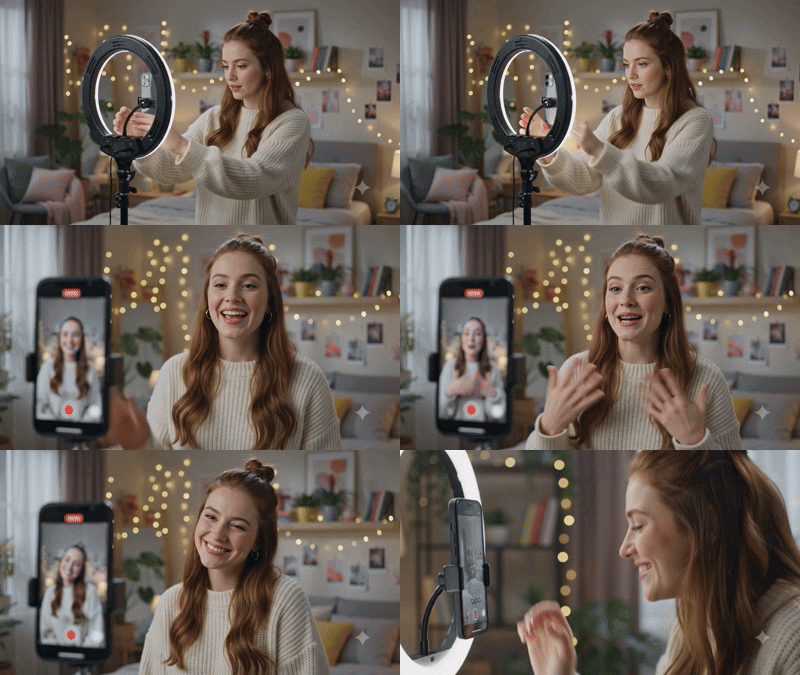
The contemporary global economy is currently witnessing a structural shift where individual creative output has evolved from a decentralized hobbyist movement into a institutionalized powerhouse of economic value. This sector, known as the creator economy, encompasses a class of digital entrepreneurs, including independent publishers, podcasters, video producers, and niche influencers, who leverage digital infrastructure to monetize proprietary content.[1] In 2025, the North American market for the creator economy was valued at approximately US34.12 billion, with a projected trajectory to reach US277.41 billion by 2032, representing an aggressive compound annual growth rate of 34.9%.[1] On a global scale, the valuation stands at roughly US191.55 billion, with estimations indicating a surge to US528.39 billion by 2030.[2, 3] This growth is not merely a reflection of increased internet penetration or smartphone usage; it represents a fundamental migration of consumer attention and advertising expenditure toward personalized, trust-based media channels.
The Macroeconomic Context of Professional Creation
The sheer scale of this industry is evidenced by the participation of over 207 million individuals globally who identify as content creators.[2] Within the United States, which serves as the primary engine for this economy, there are 162 million creators, of whom approximately 45 million operate at a professional level.[2] The professionalization of this field is highlighted by the fact that nearly half (46.7%) of all creators are now engaged in full-time content production, signaling that the industry has moved beyond the “side-hustle” paradigm into a legitimate vocational path.[2]
Demographic data for 2025 reveals that the average creator in the United States is 36.6 years old, with approximately 65% of the population being under the age of 40.[2, 3] There is a significant gender shift occurring, as female creators now represent between 51% and 64% of the market, although longitudinal financial studies suggest that the highest-earning brackets still show a male-dominated distribution.[2, 4] Educational attainment remains a strong predictor of professional success in this field, with 74% of creators holding at least a bachelor’s degree.[3] This high level of education facilitates the sophisticated brand management and financial technicality required to navigate the complex monetization landscape.
| Market Metric | 2025 Value | 2030/2032 Projection | CAGR |
|---|---|---|---|
| North America Market Size | $34.12 Billion | $277.41 Billion (2032) | 34.9% |
| Global Creator Economy Value | $191.55 Billion | $528.39 Billion (2030) | 22.5% |
| Influencer Marketing Market | $23.59 Billion | $70.86 Billion (2032) | 16.5% |
| Global Creator Count | 207 Million | N/A | N/A |
| U.S. Professional Creators | 45 Million | N/A | N/A |
The financial reality for the majority of participants involves a significant “monetization barrier” at the US15,000annualrevenuemark.[4]Evidencesuggeststhatcreatorswhosurpassthisthresholdoftenexperienceanaccelerationingrowthduetoimprovedaccesstobrandpartnershipsandtheabilitytoreinvestinproductioninfrastructure.[4]However,thetoptierofthemarketremainshighlyconcentrated,withonlyabout4100,000 annually.[2] This concentration underscores the necessity of moving away from a “social-first” strategy toward an “entrepreneurial-first” business model.
Structural Paradigms: Social-First vs Entrepreneurial Creation
A critical distinction has emerged in 2025 between creators who operate primarily on social platforms and those who treat their presence as a structured business. Social-First creators typically build their business on “borrowed land,” relying almost exclusively on platform payouts and brand partnerships.[5] This model is inherently volatile; platform payouts have seen a reported 26% decrease, and brand deal revenue has dropped by nearly 48% for some segments in the last year.[5] The uncertainty of platform dependency was exemplified by the temporary instability of TikTok in early 2025, which served as a systemic wake-up call for creators regarding the risks of algorithmic gatekeeping.[5]
In contrast, Entrepreneurial creators—often referred to as Creator CEOs—prioritize audience ownership and diversified revenue streams. These individuals use social media as a marketing funnel rather than a primary income source, investing in their own products such as digital courses, coaching programs, and membership communities.[5] The financial and psychological outcomes of this shift are stark. Entrepreneurial creators are 20% more likely to report higher self-esteem and better creative freedom compared to their social-first counterparts.[5] Those who leverage specialized commerce platforms like Kajabi report earning significantly more than those reliant solely on platform distributions.[5]
| Revenue Channel Performance (2025) | Growth/Decline Rate | Implications for Business Strategy |
|---|---|---|
| Platform Payouts | -26.0% | High risk; requires diversification |
| Brand Deals | -48.0% | Shift toward direct consumer sales |
| Podcast Revenue | +34.0% | Strong engagement in long-form |
| Digital Download Sales | +15.0% | High-margin scalability |
| Educational Content | +9.0% | Monetizing expertise over entertainment |
| Membership Groups | +4.0% | Stable recurring revenue |
The current trajectory indicates that for a content creator to achieve professional longevity, they must adopt the mindset of a small business owner. This involves managing finances through business-specific accounts, as currently 86% of creators still utilize personal funds for their work, leading to complications in tax reporting and liability management.[6] Furthermore, as payment delays impact roughly 26% of content production schedules, the implementation of professional invoicing and cash-flow management is no longer optional for scaling enterprises.[6]
Foundational Business Structuring and Tax Compliance
The transition from a hobby to a business is defined by the IRS and other tax authorities primarily through the lens of “profit motive”.[7] To be classified as a business rather than a hobby, a creator must demonstrate an intention to earn a profit, typically evidenced by maintaining meticulous records and showing a profit in three out of the last five years.[8] This classification is vital because it allows for the deduction of business expenses, which can significantly reduce the taxable income of a content creation enterprise.
Legal Entity Selection: LLC vs S-Corporation
Most content creators begin as sole proprietors by default, which creates no legal distinction between the individual and the business.[9] This exposes the individual’s personal assets—such as homes and savings—to business-related risks, including copyright lawsuits or contract disputes.[9] Forming a Limited Liability Company (LLC) provides a necessary “corporate veil,” protecting personal assets and enhancing professional credibility with brand sponsors.[7, 9]
For high-earning creators, typically those consistently netting over US75,000toUS100,000 in annual profit, the S-Corporation tax election becomes a powerful strategic tool.[7] By electing S-Corp status, a creator can pay themselves a “reasonable salary” and take the remaining business income as a distribution.[7] This structure allows the distributions to avoid the 15.3% self-employment tax, potentially saving the enterprise thousands of dollars annually in federal obligations.[7]
| Business Entity | Asset Protection | Tax Reporting | Strategy Level |
|---|---|---|---|
| Sole Proprietorship | None | Schedule C (Form 1040) | Beginner/Hobbyist |
| Single-Member LLC | High | Schedule C (Form 1040) | Professional/Standard |
| S-Corp (Election) | High | Form 1120-S | Scaling/High-Earner |
| Partnership | Limited | Form 1065 | Collaborative Teams |
Comprehensive Tax Obligations and Deductions
Content creators must navigate a complex array of federal and state tax requirements. In the United States, creators are responsible for self-employment tax, which covers Social Security and Medicare.[8] This is calculated on Schedule SE and is based on the net profit reported on Schedule C.[7] Furthermore, creators must be aware of the 1099-NEC form, which is issued by platforms or brands for any payments exceeding US$600 in a calendar year.[7, 8] Even in the absence of a 1099 form, all income must be reported to maintain compliance and avoid audits.[8]
The ability to deduct business expenses is a primary advantage of professional structuring. Deductible categories for creators include equipment (cameras, microphones, lighting), software subscriptions (Adobe Creative Cloud, Riverside.fm), marketing costs (website hosting, business cards), and professional development (online courses, creator conferences).[7] A home office deduction may also be claimed on Form 8829, provided the workspace is used exclusively and regularly for business purposes.[7]
Strategic Niche Analysis and Market Positioning
Success in content creation is increasingly predicated on “aggressive specialization”.[10] Generalist creators often struggle with lower rates and high competition, whereas specialized creators can command fees that are 2-4 times higher.[10] For example, a generalist writer may earn US0.10perword,whileatechnicalwriterfocusedonSaaSproductlaunchescancommandUS0.50 or more.[10]
High-Growth Clusters in 2025-2026
Market analysis identifies several “growth clusters” where audience demand is outpacing creator supply. Media and Entertainment, and Faith and Spirituality are among the fastest-growing niches, with creator-owned stores in these categories doubling in the last year.[3] Fitness and Yoga remain the strongest performers in terms of average revenue, with top creators in this space earning nearly US$12,000 per month on specialized video platforms.[3]
B2B (Business-to-Business) and finance creators on platforms like LinkedIn also exhibit high revenue potential due to the “buying authority” of their audiences.[11] While lifestyle and entertainment niches build broad reach, B2B niches build high-margin revenue through premium sponsorships and consulting services.[11]
| High-Performance Niche | Growth Indicator | Primary Monetization Strategy |
|---|---|---|
| Fitness/Wellness | $11,939 Avg. Monthly Rev | Memberships & Digital Plans |
| Faith & Spirituality | 50% Rise in Live Streams | Donations & Subscriptions |
| B2B / LinkedIn | 35% Earn $31k+ | Brand Deals & Fractional Work |
| Media/Ent | 100% Increase in Stores | Ad Revenue & Merchandise |
| Education/Trade | Strong ROI on LinkedIn | Courses & Certification |
Brand Voice and Identity Framework
Developing a distinctive brand voice is a competitive necessity in an oversaturated market. A powerful brand voice builds trust and recognition, particularly on platforms where attention is a scarce resource.[12] The framework for brand voice development in 2025 centers on the “3 C’s”: Clarity, Consistency, and Character.[12] Clarity ensures the message is intelligible; Consistency maintains a uniform tone across platforms; and Character defines the brand’s unique personality, whether it be authoritative, playful, or rebellious.[12, 13]
Creators should select 3-5 core traits that embody their brand and create a “brand voice chart” to guide their content production.[14] This chart should include specific behavioral “Do’s and Don’ts” to ensure the voice remains authentic and relatable to the target persona.[14] For instance, a brand focusing on “eco-consciousness” must avoid vague green claims and instead highlight specific sustainable practices and ingredients to maintain trust.[14]
The Production Infrastructure: Equipment and Software Ecosystems
Professional content production in 2025 is defined by a “flight to quality”.[15, 16] While audiences may forgive imperfect video, they will rapidly disengage from content with poor audio quality.[16] Consequently, the selection of equipment should be viewed as a strategic investment in audience retention.
Video Production and Stabilization
The backbone of most modern content is high-definition video. Mirrorless cameras like the Sony A7 IV or Canon EOS R6 are the industry standard for professional-grade visuals due to their superior autofocus and 4K capabilities.[17] However, the current generation of smartphones, such as the iPhone 16 Pro, has reached a level of sophistication—including the ability to record in Apple Log for advanced color grading—that makes them viable tools for high-end mobile content.[17]
Stabilization is another key differentiator. Gimbals such as the DJI Ronin-S for mirrorless cameras or the Hohem iSteady X2 for smartphones eliminate shaky footage, providing a cinematic quality that separates professional work from amateur uploads.[17]
| Equipment Category | Budget (Starter) | Mid-Tier (Advanced) | Pro-Grade (Enterprise) |
|---|---|---|---|
| Camera | Smartphone (Current Gen) | DJI Osmo Pocket 3 | Sony A7 IV / Canon EOS R6 |
| Audio | Mini Mic Pro ($30) | DJI Mic Mini ($169) | Shure SM7B + Interface |
| Lighting | Phone LED Clip ($36) | Neewer Softbox Kit ($50) | Lume Cube 18″ Ring Light |
| Stability | EUCOS Tripod ($30) | DJI Gimbal ($90) | DJI Ronin Series |
Audio Engineering and Podcasting Gear
The technical requirements for audio are increasingly sophisticated. For podcasters and streamers, the choice between USB and XLR microphones is fundamental. USB mics like the Shure MV6 are ideal for beginners due to their plug-and-play simplicity.[18] Scaling to an XLR setup, which requires an audio interface such as the Focusrite Scarlett 2i2, offers a significantly cleaner and richer sound profile, allowing for more granular control over gain and vocal tone.[18, 19]
In the field of remote interviews, platforms like Riverside.fm and SquadCast have become essential.[18] These services record high-quality audio and video locally on each participant’s device, bypassing the compression and glitches common with standard video conferencing tools like Zoom.[18]
Organic Growth and Algorithmic Strategy in 2025
The social media landscape is no longer just about viral trends; it is about “search intent” and “attention depth”.[20] Algorithms on major platforms like Instagram and TikTok have evolved to prioritize content that is not only engaging but also highly searchable.[20]
Platform-Specific Optimization Tactics
Instagram’s 2025 algorithm favors “SEO-optimized captions” where searchable phrases are used in place of generic hashtags.[20, 21] Short-form video (3-5 second Reels) and value-packed carousels that provide step-by-step educational content are currently outperforming aesthetic, “polished” posts.[20] On LinkedIn, the focus is on “employee advocacy” and professional discussions; content shared by personal profiles often receives 8 times more engagement than that from corporate pages.[21]
TikTok remains a hub for “reaction content” and “micro-storytelling”.[22] The most successful creators on this platform use pattern interrupts in the first 2 seconds—such as starting with a controversial statement—to increase watch time by up to 40%.[22]
| Platform | Core Algorithm Driver | Winning Content Format | Optimization Hack |
|---|---|---|---|
| Shares, Saves, Searchability | Educational Carousels | SEO-rich captions | |
| TikTok | Watch Time, Completion Rate | Reaction/Behind-the-scenes | 2-second pattern interrupts |
| Discussions, Direct Networking | Native text-based posts | Reply to all comments < 30m | |
| YouTube | Watch Time, CTR | Long-form Video / Shorts | Engagement-focused intros |
| X (Twitter) | Recency, Threads | High-value Threads | High frequency (2-8x/day) |
The emerging trend for 2025 is “Generative Engine Optimization” (GEO), which focuses on how AI models like ChatGPT and Perplexity discover and cite content.[23] As Large Language Models (LLMs) change how users discover brands, creators must optimize their websites for “AI-readability”.[23] This involves using declarative language, structured data (schema markup), and creating “snippet-friendly” passages that AI can easily quote in its answers.[24, 25]
The 7-Step GEO Strategy for 2026
To stay visible in the age of AI search, creators should implement a specific GEO action plan:
- Technical Foundation: Ensure the site is crawlable and indexable for AI bots.[23]
- SEO Basics: Continue ranking in traditional search as AI models often ground their answers in these results.[23, 25]
- Structure for Extraction: Use clear headings, bulleted lists, and summaries for complex topics.[23]
- Citations and Co-Occurrences: Aim to get mentioned alongside competitors in industry roundups and forums like Reddit and Quora.[23]
- Multi-Platform Presence: Be active where AI tools look for information, including YouTube and LinkedIn.[23]
- Trust Signals (E-E-A-T): Demonstrate experience, expertise, authoritativeness, and trust through cited sources and author bios.[23]
- Monitor AI Visibility: Use tools like Peec AI or Profound to track how and when LLMs are citing your brand.[23, 26]
Scaling from Solo Creator to Media Enterprise
The transition from an individual operation to a scalable media business requires the implementation of repeatable systems and strategic outsourcing. Unlike traditional businesses that scale by adding resources linearly, creator businesses scale through leverage: automation, systematization, and collaborating with freelancers.[10]
Operational Efficiency and Automation
The first phase of scaling involves “breaking down the content process into micro-steps”.[27] By identifying every task—from keyword research to graphic design—a creator can determine which parts of the workflow can be automated.[27] Tools like Zapier and Make are essential for connecting disparate apps, such as automatically creating a Google Drive folder and project brief whenever a new client is added to a database like Airtable.[28]
Administrative tasks that require human oversight but not the creator’s unique expertise should be outsourced to a Virtual Assistant (VA). A VA can handle tasks such as creating social media graphics from templates, updating content trackers, and managing repetitive communications.[28]
| Scaling Lever | Action | Target Outcome |
|---|---|---|
| Automation | Use Zapier/Make for admin | 10-20 hrs/week reclaimed |
| Systematization | Create SOPs and Templates | Consistent quality with less effort |
| Outsourcing | Hire VA for graphics/admin | Focus on high-value creation |
| Repurposing | 1 core piece -> 10 micro-assets | Multi-platform reach |
Content Repurposing and Batching
To increase output without increasing burnout, creators should adopt a “repurposing” strategy. A single long-form piece of content—such as a 30-minute podcast or an in-depth blog post—can be transformed into multiple micro-assets: 3-5 short Reels/TikToks, an infographic, a LinkedIn post, and a series of X threads.[27, 29] Batch-creating content (producing multiple pieces in a single session) further optimizes time by keeping the creator in a consistent “flow state” and providing a content buffer for future weeks.[29, 30]
Long-Term Sustainability and Risk Mitigation
The primary threat to the longevity of a content creator business is not algorithmic change, but human burnout. Research indicates that 75% of full-time creators have experienced burnout, a state of chronic stress that lead to emotional exhaustion and a decline in performance.[30, 31]
Burnout Prevention and Mental Fortitude
Resilience in content creation is built through intentional business design. Professional advice emphasizes that “burnout isn’t a badge of honor” and that sustainable systems are those where stress is managed daily.[32, 33] Key strategies for preventing burnout include setting realistic, incremental goals rather than impossible standards, and establishing strict physical and temporal boundaries between “work” and “personal life”.[32]
Creators are also encouraged to build a “solid support network” of peers who understand the unique pressures of the digital landscape.[32] Furthermore, diversifying revenue streams acts as a psychological buffer, reducing the financial uncertainty that is consistently identified as a primary stressor for entrepreneurs.[32, 33]
| Burnout Risk Factor | Manifestation | Preventive Strategy |
|---|---|---|
| Platform Dependency | Anxiety over algorithm shifts | Own your audience (Email lists) |
| Content Treadmill | Pressure to produce daily | Batching and repurposing |
| Isolation | Loneliness/Imposter Syndrome | Build a creator support group |
| Work-Life Blur | Neglecting self-care/Offline time | Designated workspace & hours |
| Financial Volatility | Paycheck-to-paycheck stress | Diversified income streams |
Intellectual Property and Legal Protection
Protecting the enterprise’s creative output through Intellectual Property (IP) law is essential for long-term valuation. Copyright protection is automatic upon creation, but formal registration is a prerequisite for pursuing monetary damages in court.[34, 35] Trademarks should be pursued for unique brand elements, such as logos or catchphrases, to prevent copycat brands from diluting the creator’s identity.[36]
Contracts and licensing agreements are the final layer of protection. A strong contract for brand deals should clearly outline how content may be used, the duration of use, and the specific compensation, ensuring the creator retains control over their persona and creative rights.[36] As creators increasingly collaborate with teams and AI, clear ownership clauses in all contracts are paramount to prevent future legal disputes over “work for hire” versus joint authorship.[37]
Conclusion: The Trajectory of the Digital Entrepreneur
The content creation business in 2025-2026 is a sophisticated intersection of media production, technical SEO, and institutional financial management. The shift from “Social-First” to “Entrepreneurial” models is the defining trend of this era, as creators recognize that true wealth and wellness come from audience ownership rather than platform reliance.[5] By building a business on a foundation of legal protection, specialized niches, and automated workflows, creators can transition from precarious influencers into resilient media company CEOs.[10, 11]
The evolution toward Generative Engine Optimization and the institutionalization of creator revenue streams suggests that the industry is only in its nascent stages of professionalization. Those who treat their content as a primary asset, protect it through intellectual property safeguards, and manage their human capital through burnout prevention will be the ones to capture the projected US$528 billion global market by 2030.[2] The architect of digital attention is no longer a solo artist, but the leader of a technological and creative enterprise that sits at the center of the modern economy.
——————————————————————————–
- North America Creator Economy Market Size & Share, 2025-2032, https://www.coherentmarketinsights.com/industry-reports/north-america-creator-economy-market
- 32+ Creator Economy Statistics of 2025 (Market Size Data) – DemandSage, https://www.demandsage.com/creator-economy-statistics/
- Creator economy statistics: 2025 growth and earnings – Uscreen, https://www.uscreen.tv/blog/creator-economy-statistics/
- Creator Earnings Report 2025 – Influencer Marketing Hub, https://influencermarketinghub.com/creator-earnings-report-2025/
- State of Creator Commerce Report 2025 | Kajabi, https://kajabi.com/state-of-creator-commerce-25
- Monetized: Visa 2025 Creator Report, https://corporate.visa.com/en/solutions/commercial-solutions/knowledge-hub/2025-visa-creators-report.html
- Filing Taxes as a Content Creator: Your 2025 Guide – Found, https://found.com/resources/accounting-and-taxes/tax-checklist-content-creators
- Tax Tips for Content Creators – TurboTax – Intuit, https://turbotax.intuit.com/tax-tips/self-employment-taxes/tax-tips-for-content-creators/L85bpVMLH
- The Essential Guide to Setting Up an LLC for Content Creators – LLC Attorney, https://llcattorney.com/industries/content-creators
- How to Scale a Freelance Business: Step-by-Step Guide – Lovable, https://lovable.dev/guides/how-to-scale-freelance-business-guide
- The 2025 monetization report – Creator Spotlight, https://www.creatorspotlight.com/p/monetization-report-2025
- Brand Voice Strategies for 2025: Social Media & Email Marketing – Skrapp.io, https://skrapp.io/blog/brand-voice/
- Build a Strong Brand Voice in 2025 | Ultimate Guide – Social Champ, https://www.socialchamp.com/blog/brand-voice/
- A Complete Roadmap For Brand Voice Development – SmashBrand, https://www.smashbrand.com/articles/brand-voice-development/
- Level Up Your Content Creation: Must-Have Gear for 2025 – AMR Digital Marketing, https://amrdigital.com/blog/level-up-your-content-creation-must-have-gear-for-2025
- Must-Have Video Content Creator Tools of 2025 – Real Marketing Solutions, https://realmarketingsolutions.net/must-have-video-content-creator-tools/
- Top 10 Essentials for Content Creation in 2025: The Ultimate Tool Guide for Malaysian Creators – The Creative Pistachio Productions, https://www.thecreativepistachio.com/post/top-10-essentials-for-content-creation-in-2025-the-ultimate-tool-guide-for-malaysian-creators
- The Best Podcast Setup For Beginners in 2025: Complete Guide – Red 11 Media, https://www.red11media.com/blog/best-podcast-setup-for-beginners
- Best audio interface 2025: For home recording, podcasting, and streaming – MusicRadar, https://www.musicradar.com/news/the-best-audio-interfaces
- What’s actually working for organic growth on Instagram in 2025? : r/socialmedia – Reddit, https://www.reddit.com/r/socialmedia/comments/1oi72is/whats_actually_working_for_organic_growth_on/
- Mastering Your Organic Social Media Strategy in 2025 – The CMO, https://thecmo.com/demand-generation/organic-social-media-strategy/
- Stop Creating Content Nobody Watched: Here’s what works in 2025 : r/SocialMediaMarketing – Reddit, https://www.reddit.com/r/SocialMediaMarketing/comments/1ia11xo/stop_creating_content_nobody_watched_heres_what/
- Generative Engine Optimization (GEO): How to Win in AI Search, https://backlinko.com/generative-engine-optimization-geo
- Generative Engine Optimization: Boost AI Visibility 2026 – Primotech, https://primotech.com/generative-engine-optimization-7-proven-geo-tactics-for-2026/
- How To Win in Generative Engine Optimization (GEO), https://www.searchenginejournal.com/win-generative-engine-optimization-peecai-spa/550612/
- Top Generative Engine Optimization (GEO) Tools 2026 – NoGood, https://nogood.io/blog/generative-engine-optimization-tools/
- How to Scale Content Creation: A Step-by-Step Guide (2025) – Increv, https://increv.co/academy/scale-content/
- Freelance Scaling Strategies: When to Automate vs. When to Outsource – command + create, https://command-create.com/freelance-scaling-strategies/
- 5 Tips for Scaling Up Your Content Creation – Fleximize, https://fleximize.com/articles/391967/5-tips-for-scaling-up-your-content-creation
- How to Deal with Content Creator Burnout Syndrome | Elastic Email, https://elasticemail.com/blog/how-to-deal-with-the-content-creator-burnout-syndrome
- Reignite Your Creative Spark: Overcoming Burnout – Passion.io, https://passion.io/blog/overcoming-creator-burnout
- Avoiding Creator Burnout: Sustainable Tips | TubeBuddy, https://www.tubebuddy.com/blog/avoid-creator-burnout/
- How to Master Resilience and Protect Your Mental Health – Entrepreneur, https://www.entrepreneur.com/living/how-to-master-resilience-and-protect-your-mental-health/493458
- How Intellectual Property Rights Protect Your Business | The Law Offices of Steven E. Springer, https://www.springerlawfirm.com/blog/how-intellectual-property-rights-protect-your-business/
- Social Media and Intellectual Property Rights: Protect Your Digital Creations – BOAG LAW, https://www.boagip.com/social-media-and-intellectual-property-rights-protect-your-digital-creations/
- IP for Content Creators: What Intellectual Property to Protect, https://emanus.com/intellectual-property-for-content-creators/
- What is Copyright? | U.S. Copyright Office, https://www.copyright.gov/what-is-copyright/
 Journal for Policy & Market Research
Leave a comment