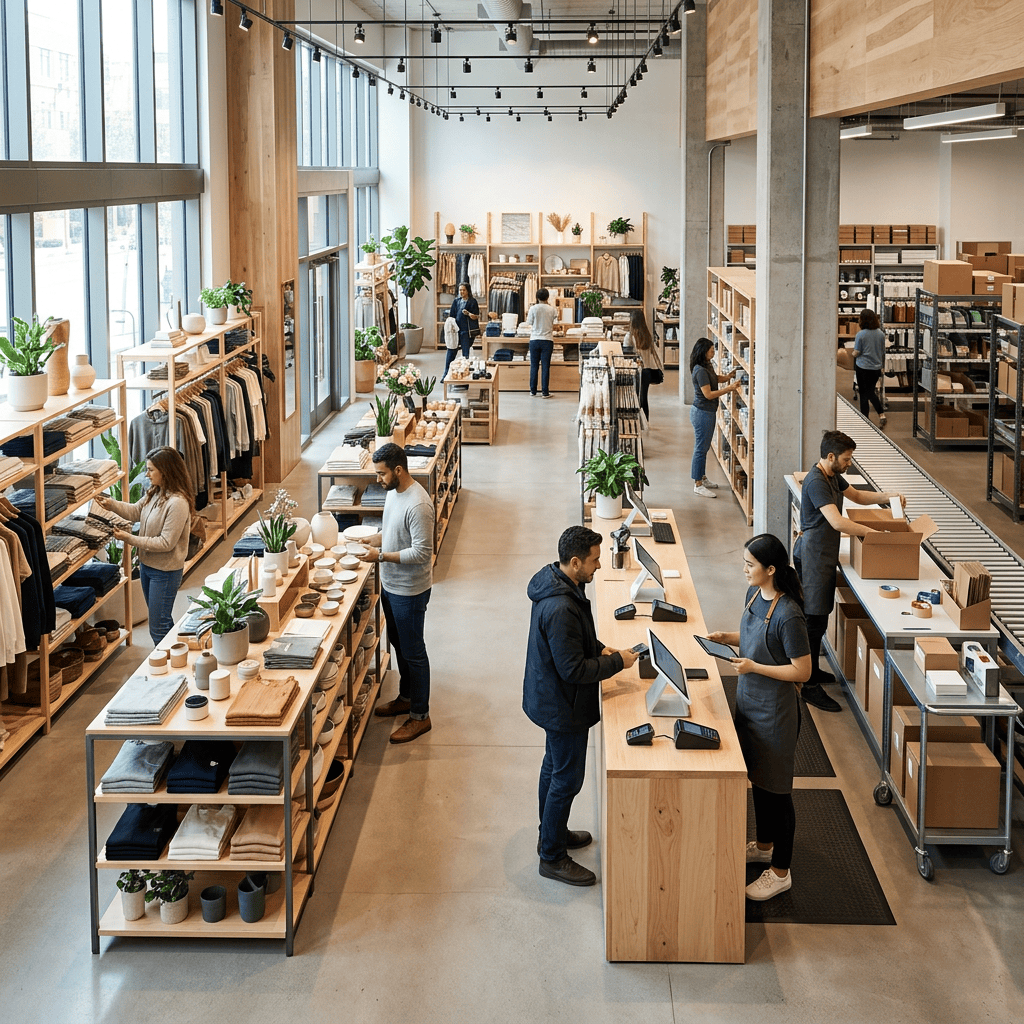
The retail sector in 2026 has moved beyond the traditional supply-driven mass market model into a data-driven, hyper-personalized “micro” experience characterized by the convergence of physical and digital spheres.[1] Successful entry and sustained growth within this landscape require a sophisticated understanding of foundational planning, regulatory compliance, technological infrastructure, and strategic expansion. The following analysis examines the critical components of the modern retail enterprise, from the initial conceptualization to the implementation of complex multi-unit scaling strategies.
Foundational Strategic Planning and Market Entry
The initiation of a retail business in the current economic climate demands a shift from intuitive decision-making toward rigorous data validation. The primary step involves identifying a niche that addresses underserved customer segments or identified gaps in the current market.[2] Defining a unique selling proposition (USP) is no longer a peripheral marketing task but a central pillar of the business model, ensuring that the brand can maintain relevance amidst high competition and value-seeking consumer behaviors.[1, 2]
Market Research and Conceptual Validation
Modern market research leverages a combination of quantitative and qualitative data to establish a foundation for the business plan. Tools such as Google Trends, data from the U.S. Census Bureau, and social media analytics provide essential insights into demographic shifts and evolving consumer preferences.[3] The research indicates that entrepreneurs who skip deep demographic analysis risk failing to clarify their mission and the specific problems their business intends to solve for the customer.[3]
Testing concepts with target customers through focus groups or digital surveys allows for the refinement of the brand positioning before significant capital is deployed.[2] This phase often utilizes the framework of market orientation, where customer-centric decision-making and market-trend orientation are prioritized to ensure the long-term sustainability of the small business beyond the initial five-year window.[4]
Comprehensive Business Plan Architecture
A robust business plan serves as both an internal roadmap and a critical document for securing funding. It must encompass a detailed business description, market analysis, and a strategic competitive assessment.[2] Beyond operational details, it is increasingly recommended that retailers consider an exit strategy—such as acquisition, family succession, or a public offering—from the outset to build the enterprise with long-term purpose and valuation in mind.[3]
The financial component of the business plan must account for both immediate startup costs and the ongoing cost-to-serve. Typical expenses in the 2026 landscape include physical location buildouts, inventory procurement, and the significant costs associated with implementing a modern retail technology stack.[2, 5]
| Financial Component | Primary Considerations | Strategic Impact |
|---|---|---|
| Initial Capital | Savings, SBA loans, or private equity | Dictates the speed of early growth |
| Fixed Costs | Lease deposits, renovations, and insurance | Defines the break-even threshold |
| Variable Costs | Inventory, utilities, and digital marketing | Affects monthly cash flow and margins |
| Contingency Fund | Reserves for supply chain or market disruptions | Essential for resilience in volatile markets |
Regulatory Framework and Administrative Infrastructure
Navigating the legal requirements for a retail business involves a multi-layered process of registration and permitting at the federal, state, and local levels. The choice of legal structure—be it a sole proprietorship, partnership, limited liability company (LLC), or corporation—carries profound implications for tax obligations, management hierarchies, and the level of personal liability protection afforded to the owners.[6, 7]
Core Legal and Identity Registration
The administrative foundation begins with the acquisition of an Employer Identification Number (EIN) from the IRS, which functions as a social security number for the business entity and is required for hiring employees, opening business bank accounts, and filing tax returns.[6, 8] If the business operates under a name other than the owner’s legal name, a “Doing Business As” (DBA) or trade name registration is required.[8]
The registration process often involves state-specific platforms, such as Louisiana’s GeauxBIZ, which assists in producing a checklist of required federal, state, and local licenses.[9, 10] Maintaining accurate records of all transactions is critical, as failure to comply with employment, sales, and income tax requirements can result in significant fines and legal penalties.[7]
Facility and Operational Compliance
For physical storefronts, the Certificate of Occupancy (CO) is a mandatory document issued by local governments, certifying that the building complies with building codes and is safe for public use.[6, 8] Zoning permits are also required to ensure that the retail activities are permitted within specific geographic areas.[6]
Additional industry-specific licenses may be necessary. For instance, retail businesses involved in food service require health permits and food handler’s permits for staff, while those selling alcohol must navigate the lengthy process of obtaining liquor licenses.[8]
| Permit Type | Purpose | Regulatory Level |
|---|---|---|
| General Business License | Authorization to operate within a jurisdiction | State/Local |
| Sales Tax Permit | Registration to collect and remit sales tax | State |
| Seller’s Permit | Authorization to sell taxable goods | State |
| Sign Permit | Regulation of commercial signage style/lighting | Local |
| Health Permit | Verification of safety for food-related retail | Local |
Risk Mitigation and Insurance Architecture
Retailers must protect their assets through a tailored insurance portfolio. Workers’ Compensation and Unemployment Insurance are legally mandated in nearly all states once a business hires its first employee.[11, 12] These policies provide benefits for workplace injuries and protect the business from litigation.[11, 12]
General Liability Insurance is fundamental, covering third-party bodily injury and property damage that may occur on the premises or as a result of business operations.[11, 13] For businesses involved in the manufacturing or distribution of physical goods, Product Liability Insurance is vital to protect against claims arising from defective items.[13, 14] Advanced risk management may also include Cyber Liability Insurance to address the financial losses associated with data breaches and digital service interruptions.[13]
Physical Footprint and Location Intelligence
The selection of a retail location has transitioned from an intuition-based process to a sophisticated exercise in data analytics and location intelligence.[15] Modern retailers evaluate potential sites based on population density, community needs, demographic profiles, and proximity to competitors.[15]
Data-Driven Site Selection
AI-driven platforms allow real estate teams to evaluate five times more potential sites than traditional manual methods by automating the qualification and evaluation process.[15] Major retailers like Target and ALDI utilize customized sales forecasting models and location intelligence to pinpoint spots that best meet community needs while managing site constraints.[15]
The decision regarding a physical location must also account for the shift toward unified commerce. Stores are increasingly viewed not just as sales points but as micro-fulfillment centers for online orders.[1] Consequently, location selection must consider accessibility for delivery services and the proximity to the core customer base to minimize the cost-to-serve in the last-mile delivery phase.[1, 5]
Physical Store Design and Compliance
Physical stores must be designed to enhance the customer experience while maintaining strict compliance with local ordinances. Commercial sign permits regulate the size and lighting of storefront branding, and health permits ensure that the physical space meets safety codes for both employees and the public.[8] A “grand opening” strategy often involves a ribbon-cutting ceremony to create a lasting community impact, but success is predicated on the thorough planning that precedes the event.[15]
The Modern Retail Technology Stack
In the 2026 environment, the technology stack is the central nervous system of the retail operation. It facilitates the synchronization of data across online and offline channels, providing a unified view of inventory, sales, and customer behavior.[16, 17]
Ecommerce Platform Foundations
An ecommerce platform acts as the bedrock of the digital sales strategy, handling product displays, secure payment processing, and order management.[16] Shopify is widely recognized as a leader for its ease of use, integrated hosting, and powerful AI tools like “Shopify Magic” for design and “Sidekick” for business advice.[16] BigCommerce offers a more open-source approach suitable for enterprise-level scaling, while Wix provides a drag-and-drop interface for smaller, less technical teams.[16, 18]
Security is a primary concern for modern platforms. Standard requirements include PCI-compliant payment processing, SOC 2 Type II certifications, and granular staff permissions to prevent unauthorized data access.[16]
Unified Point-of-Sale (POS) Systems
A modern POS system must be natively unified with the ecommerce platform to avoid the data synchronization delays common with legacy systems.[16] A unified commerce architecture ensures that inventory levels are automatically updated across all locations—physical and digital—as soon as a sale, return, or exchange occurs.[16] Cloud-based POS systems offer the flexibility to run the business and take payments using any mobile device, which is essential for reducing wait times in physical stores through mobile POS (mPOS) setups.[16]
Customer Relationship Management (CRM) and Automation
CRMs for retail have evolved to power loyalty and drive revenue through smart segmentation and personalization.[19] By unifying data across the entire customer journey, these systems allow retailers to launch automated marketing campaigns tailored to specific customer segments.[16, 19]
Automation features within CRMs reduce administrative burdens by logging customer interactions and scoring leads based on behavioral triggers.[16] Analytical CRMs capture data to assess the effectiveness of marketing campaigns and identify areas for employee development through satisfaction scores and sales history.[16]
| Tech Component | Core Function | Leading Examples |
|---|---|---|
| Ecommerce Platform | Digital storefront and transactions | Shopify, BigCommerce, Wix |
| POS System | In-person sales and inventory sync | Shopify POS, Lightspeed |
| CRM | Customer data and marketing automation | Salesforce, HubSpot, Zoho |
| OMS | Multi-channel order fulfillment | ShipBob, Netsuite |
| IMS | Real-time stock and demand forecasting | Stocky, Linnworks |
Sourcing and Supply Chain Architecture
The selection of a sourcing model profoundly influences a retailer’s profit margins, capital requirements, and brand control. Retailers typically choose between wholesale procurement, dropshipping, or direct manufacturing.[20, 21]
Comparative Sourcing Models
Wholesale involves purchasing goods in bulk from manufacturers or distributors and storing them for resale.[20, 22] This model offers higher profit margins and allows for quality control and personalized branded packaging.[20, 23] However, it requires significant upfront capital and entails the risk of holding unsold inventory.[22, 23]
Dropshipping is a low-risk model where the retailer acts as a middleman, transferring customer orders directly to a supplier who handles shipping and fulfillment.[20, 22] While this requires minimal startup costs and no inventory management, the profit margins are lower, and the retailer has limited control over product quality and shipping times.[22, 24]
Direct manufacturing offers the highest level of control and the ability to white-label products under the brand’s own name, but it is the most capital-intensive and requires mastering complex production and logistics capabilities.[21, 24]
| Feature | Wholesale | Dropshipping | Manufacturing |
|---|---|---|---|
| Initial Capital | High | Low | Very High |
| Profit Margins | High | Low | Maximum |
| Brand Control | Moderate/High | Minimal | Absolute |
| Inventory Risk | High | Zero | High |
| Logistics Load | High | Zero | Very High |
Supplier Directories and Relationship Management
Finding reliable suppliers is essential for maintaining a stable supply chain. Directories like SaleHoo, Worldwide Brands, and Alibaba connect retailers with thousands of vetted manufacturers and wholesalers.[25, 26, 27] Specialized platforms like Spocket focus on high-quality US and EU suppliers, providing faster shipping times for those markets.[25, 26]
In the current environment, supplier management also includes a deep understanding of environmental and social practices. Retailers increasingly use SMETA audits to ensure ethical trade and social compliance within their operations and supply chains.[28]
Omnichannel Strategy and Market Development
The modern customer journey is non-linear, often beginning with product discovery on social media and ending with an in-store purchase or home delivery.[29, 30] An omnichannel retail strategy integrates these multiple touchpoints into a single, seamless experience.[29]
Integrating Online and Offline Channels
A successful omnichannel strategy relies on a unified customer data model built on first-party data.[29] This allows retailers to bridge the gap between digital and physical shopping, enabling features such as checking real-time store inventory online or returning an online purchase to a physical store.[31, 32]
Personalization plays a significant role in this strategy. By leveraging unified data, retailers can create dynamic segments for targeted marketing, showing personalized recommendations based on the customer’s browsing and purchase history across all platforms.[29, 32] This approach not only improves the customer experience but is shown to increase sales and customer lifetime value (CLV).[29, 32]
Performance Analytics and Benchmarking
Retailers must track key metrics to evaluate the health of their omnichannel operations. The average ecommerce conversion rate (CVR) in 2026 typically ranges between 2% and 4%, though this varies significantly by industry.[33]
| Industry Sector | Average Conversion Rate (2025) | Market Context |
|---|---|---|
| Personal Care & Beauty | 6.8% | High repeat purchase and brand loyalty |
| Food & Beverage | 4.9% – 6.1% | Frequent orders and impulse buying |
| Electronics | 3.6% | High-ticket with long research phase |
| Fashion & Apparel | 1.6% – 3.0% | Sizing concerns and high return rates |
| Luxury & Jewelry | 0.9% – 1.2% | Extensive research and long cycles |
| Home & Furniture | 1.2% – 1.4% | Significant price/quality trust barriers |
Conversion rates are also heavily influenced by the device used. Desktop sessions typically convert at a higher rate (3.9%) than mobile sessions (1.8%), although mobile accounts for the majority of traffic share.[34, 35, 36]
Customer Loyalty and Retention Frameworks
Building long-term customer relationships is more cost-effective than constant new customer acquisition. Loyalty programs serve as the primary mechanism for this retention, categorized into points-based, tiered, and subscription models.[37, 38]
Points-Based and Tiered Systems
Points-based systems focus on immediate gratification, rewarding every purchase with a currency that can be redeemed for discounts or free products.[37] Tiered loyalty programs, however, aim for long-term engagement by offering escalating benefits as customers move through different levels based on their cumulative spending.[37, 39]
Tiered programs create a sense of exclusivity and appreciation, potentially prompting lower-tier customers to increase their spending to reach higher statuses.[39, 40] Successful examples include the Sephora Beauty Insider program and Starbucks Rewards, which use aspirational tiers to earn the trust of their most reliable members.[39, 40]
Subscription and Experiential Models
Subscription-based loyalty models involve charging a fee for premium benefits, such as express delivery or exclusive product access.[38, 41] Experiential subscriptions, such as those offered by Beauty Pie or Public Lands, emphasize community building and workshop access over traditional discounts, fostering a sense of informality and community among members.[41]
Designing an effective loyalty program requires understanding customer demographics and purchase habits. Successful programs are characterized by simplicity and transparency, ensuring that the rules for earning and redeeming rewards are easily understood by the participants.[37, 38, 40]
Scaling Strategies and Multi-Unit Growth
Growth in retail often necessitates the transition from a single-unit operator to a multi-unit or franchise enterprise. This process requires a fundamental shift in leadership, from working in the business to working on the business.[42, 43]
The Roadmap to Multi-Unit Success
Before expanding, a retailer must ensure that their initial unit is consistently profitable and that robust, replicable systems are in place.[44, 45] Scaling successfully beyond a few units depends on having the right management team—people who are empowered to lead and make decisions without constant owner oversight.[42]
Multi-unit operators leverage economies of scale to negotiate bulk pricing on inventory and optimize operations across locations.[45] However, this expansion requires significant capital and the implementation of standardized operating procedures (SOPs) to ensure consistent quality and customer experience across all units.[43, 44, 46]
Diversification and Horizontal Integration
Diversification is another strategy for retail growth, involving expansion into new product lines or categories.[47, 48] Concentric diversification adds similar products to the existing business, while horizontal diversification introduces unrelated products to existing consumers.[47]
Retailers also scale through geographic diversification and horizontal integration—the process of acquiring or merging with rivals.[49] These strategies allow firms to capitalize on additional revenue sources and spread risk across different product areas or markets.[48, 49]
2026 Industry Trends and Future Outlook
The retail sector in 2026 is defined by several converging trends, including the integration of AI, the elevation of sustainability, and the management of global supply chain risks.[1, 28, 50]
The Proliferation of AI and Generative AI
AI is no longer a futuristic concept but a concrete operational tool. Seven in ten retail executives expect to have AI capabilities in place within the year to personalize customer experiences.[1] AI is used for demand forecasting, inventory management, and even dynamic pricing—adjusting storefront prices in real-time based on competitive data and current demand.[1, 50]
Retailers using Gen AI tools, such as chatbots and digital shopping assistants, have reported conversion rate improvements of 15% during major sales events.[1] However, the key challenge remains building shopper trust, as consumers may become wary of dynamic pricing if they feel it is manipulative.[50]
Sustainability and Circular Economy Priorities
Sustainability has transitioned from a compliance requirement to a strategic profit driver. The secondhand market is projected to reach $82 billion by 2026, growing 11 times faster than traditional retail clothing sales.[28] Major retailers are launching resale platforms to capture this segment, which also helps meet evolving environmental and social regulations.[28]
Consumers are increasingly deprioritizing brands that do not offer transparent ethical and environmental credentials.[28] Grocery retailers, in particular, are focusing on food waste mitigation through AI-powered inventory systems that predict demand with greater precision, minimizing the billions of tons of food wasted annually.[28]
Supply Chain Resilience and Geopolitical Risks
Supply chain risk management remains a top priority for CEOs in 2026.[5] Geopolitical tensions and economic shifts, such as tariff increases exceeding 25% on key consumer goods, have forced retailers to adjust their ordering timelines and implement advanced visibility tools.[28]
To mitigate these risks, many retail executives are pursuing alternative sourcing in markets like Mexico, Vietnam, and India, reducing their reliance on China.[28] Gaining visibility deep into the supply chain—down to Tier 4 suppliers—is now fundamental for identifying bottlenecks and ensuring compliance with forced labor and environmental regulations.[5, 28]
The retail industry in 2026 presents a landscape of significant challenges but also profound opportunities for those who can balance speed with strategic intelligence.[50] Successful brands will be those that effectively leverage AI and data analytics not just to react to market changes, but to proactively shape the customer experience and build a resilient, sustainable business model.
——————————————————————————–
- 2025 US Retail Industry Outlook | Deloitte Insights, https://www.deloitte.com/us/en/insights/industry/retail-distribution/retail-distribution-industry-outlook.html
- How To Start a Retail Business: 2026 Guide | Square, https://squareup.com/us/en/the-bottom-line/starting-your-business/start-retail-business
- How To Start A Business: A Step by Step Guide For 2025 – Business News Daily, https://www.businessnewsdaily.com/4686-how-to-start-a-business.html
- Implementing Product Diversification Strategies for Small and Medium Retail Businesses’ Sustainability – ScholarWorks | Walden University Research, https://scholarworks.waldenu.edu/cgi/viewcontent.cgi?article=6423&context=dissertations
- Six supply chain trends to watch in 2025 – KPMG International, https://kpmg.com/us/en/articles/2025/supply-chain-trends-2025.html
- How to Open a Retail Store: Starting a Retail Store Checklist (2025 Guide) – Toast POS, https://pos.toasttab.com/blog/on-the-line/how-to-start-a-retail-store
- 8 Legal Steps in Starting a Retail Business in Louisiana | Niswanger Law, https://niswangerlaw.com/8-legal-steps-starting-retail-business-louisiana/
- Licenses and Permits Needed To Open A Retail Store (2025), https://pos.toasttab.com/blog/on-the-line/retail-licenses
- Create a Business License Checklist – Louisiana Secretary of State, https://www.sos.la.gov/BusinessServices/StartABusiness/CreateABusinessLicenseChecklist/Pages/default.aspx
- Small Business Licenses and Permits in Louisiana – Tailor Brands, https://www.tailorbrands.com/start-a-business/louisiana/licenses-permits
- Workers’ Compensation vs. General Liability Insurance | AmTrust Financial, https://amtrustfinancial.com/blog/small-business/workers%E2%80%99-compensation-vs-general-liability-insuran
- General Liability Insurance vs. Workers Compensation Insurance, https://www.travelers.com/resources/business-topics/insuring/general-liability-vs-workers-compensation
- Which Types of Business Insurance Do I Need? | New York Life, https://www.newyorklife.com/articles/types-of-business-insurance
- 12 Legal Requirements for Starting a Small Business – FreshBooks, https://www.freshbooks.com/hub/startup/starting-small-business-legal-requirements
- Grand Opening Guide: How to Plan a Successful Store Launch in 2025 – GrowthFactor’s AI, https://www.growthfactor.ai/blog-posts/grand-opening-ultimate-guide
- How to Build Your Ultimate Retail Tech Stack (2025) – Shopify, https://www.shopify.com/retail/retail-tech-stack
- How to Build the Best Ecommerce Tech Stack in 2025? – identixweb, https://www.identixweb.com/build-ecommerce-tech-stack/
- How to Build the Ultimate Ecommerce Tech Stack in 2025 – The Retail Exec, https://theretailexec.com/platform-management/ecommerce-tech-stack/
- Best CRM Software for Retail | 2025 Platform Comparison – Voyado, https://voyado.com/resources/blog/best-crm-software-for-retail/
- Dropshipping vs. Wholesale: What’s the Difference? – Shopify, https://www.shopify.com/blog/dropshipping-vs-wholesale
- Guide: Product Sourcing In 2026 | Wonnda, https://wonnda.com/magazine/product-sourcing-strategies/
- Dropshipping vs Wholesale: Which One is Right For You? – ZIK Analytics’ Blog, https://www.zikanalytics.com/blog/dropshipping-vs-wholesale/
- Dropshipping vs. Wholesale: Which Business Model Fits Your Online Store? – BuckyDrop, https://blog.buckydrop.com/dropshipping-vs-wholesale-which-business-model-fits-your-online-store/
- Understanding Different Types of Suppliers – SourceReady, https://www.sourceready.com/blog/understanding-different-types-of-suppliers-manufacturer-distributor-dropshipper-and-wholesaler
- 17+ Best Dropshipping Suppliers for eCommerce (2025 Review) – EComposer, https://ecomposer.io/blogs/dropshipping/best-dropshipping-suppliers
- The 10 Best Dropshipping Directories in 2025 (Free & Paid), https://dodropshipping.com/best-dropshipping-directories/
- 16 Best Dropshipping Suppliers in 2026 – SaleHoo, https://www.salehoo.com/learn/directories-for-the-best-dropshipping-wholesale-suppliers
- Retail Trends & Supply Chain Due Diligence 2025 – Sedex, https://www.sedex.com/blog/retail-trends-supply-chain-due-diligence-2025/
- Omnichannel Retailing Strategy: Benefits and Examples (2024) – Shopify, https://www.shopify.com/enterprise/blog/omni-channel-retail-strategy
- Omnichannel Retail Strategy for Growth & Sales – Pitney Bowes, https://www.pitneybowes.com/us/blog/omnichannel-retail.html
- Omnichannel Retail Strategy: Key Benefits and Trends for 2025 – Salesmate, https://www.salesmate.io/blog/omnichannel-retail-strategy/
- Omnichannel Retail: Definition, Strategies & Tactics | SAP Emarsys, https://emarsys.com/learn/blog/omnichannel-retail-strategy/
- Ecommerce Conversion Rate by Industry: 2025 Benchmarks and Insights – Skai Lama, https://www.skailama.com/blog/ecommerce-conversion-rate-by-industry
- Ecommerce Conversion Rate Benchmarks 2025 | Shopify CRO – Blend Commerce, https://blendcommerce.com/blogs/shopify/ecommerce-conversion-rate-benchmarks-2025
- Average Ecommerce Conversion Rate: Industry Data for 2025 – Red Stag Fulfillment, https://redstagfulfillment.com/average-conversion-rate-for-ecommerce/
- E-commerce conversion rate benchmarks – 2025 update – Smart Insights, https://www.smartinsights.com/ecommerce/ecommerce-analytics/ecommerce-conversion-rates/
- 8 Best Tiered Loyalty Program Examples for Customer Retention | SAP Emarsys, https://emarsys.com/learn/blog/best-tiered-loyalty-programs/
- The Ultimate Guide to Choosing the Right Points Model for Your Loyalty Program, https://merchant.loyalnsave.com/blog/the-ultimate-guide-to-choosing-the-right-points-model-for-your-loyalty-program/
- Tiered Loyalty Programmes Explained (with Examples) – Incentivesmart, https://www.incentivesmart.com/blog/tiered-loyalty-programs/
- Do tiered loyalty programs work? – Mastercard, https://www.mastercard.com/global/en/news-and-trends/Insights/2024/do-tiered-loyalty-programs-work.html
- How Retailers are Redefining Loyalty Programs in the Subscription Economy. – Kadence, https://kadence.com/en-us/knowledge/how-retailers-are-redefining-loyalty-programs-in-the-subscription-economy-2/
- The Smart Way to Scale From Single- to Multi-Unit Ownership – Entrepreneur, https://www.entrepreneur.com/franchises/the-smart-way-to-scale-from-single-to-multi-unit-ownership/494112
- Multi-Unit Franchise Growth Strategies That Work, https://www.fmsfranchise.com/multi-unit-franchise-growth-strategies-that-work/
- The Path to Multi-Unit Franchise Success: From Single Store to Empire, https://americasbestfranchises.com/blog/the-path-to-multi-unit-franchise-success-from-single-store-to-empire/
- Multi-Unit Franchise Growth: How to Scale Successfully – The Rawls Group, https://seekingsuccession.com/multi-unit-franchise-growth/
- 8 Tips for Managing a Multi Location Retail Business – Lightspeed, https://www.lightspeedhq.com/blog/multi-location-business/
- Product Diversification – Corporate Finance Institute, https://corporatefinanceinstitute.com/resources/management/product-diversification/
- Leveraging Product Diversity to Unlock Growth for Industrial Brands – Catsy, https://catsy.com/blog/product-diversity/
- 8.3 Diversification – Strategic Management – Pressbooks at Virginia Tech, https://pressbooks.lib.vt.edu/strategicmanagement/chapter/8-3-diversification/
- 2025 Retail Industry Predictions: Expert Insights & Trends | RELEX Solutions, https://www.relexsolutions.com/resources/the-2025-outlook-key-predictions-from-industry-leaders/


Leave a comment