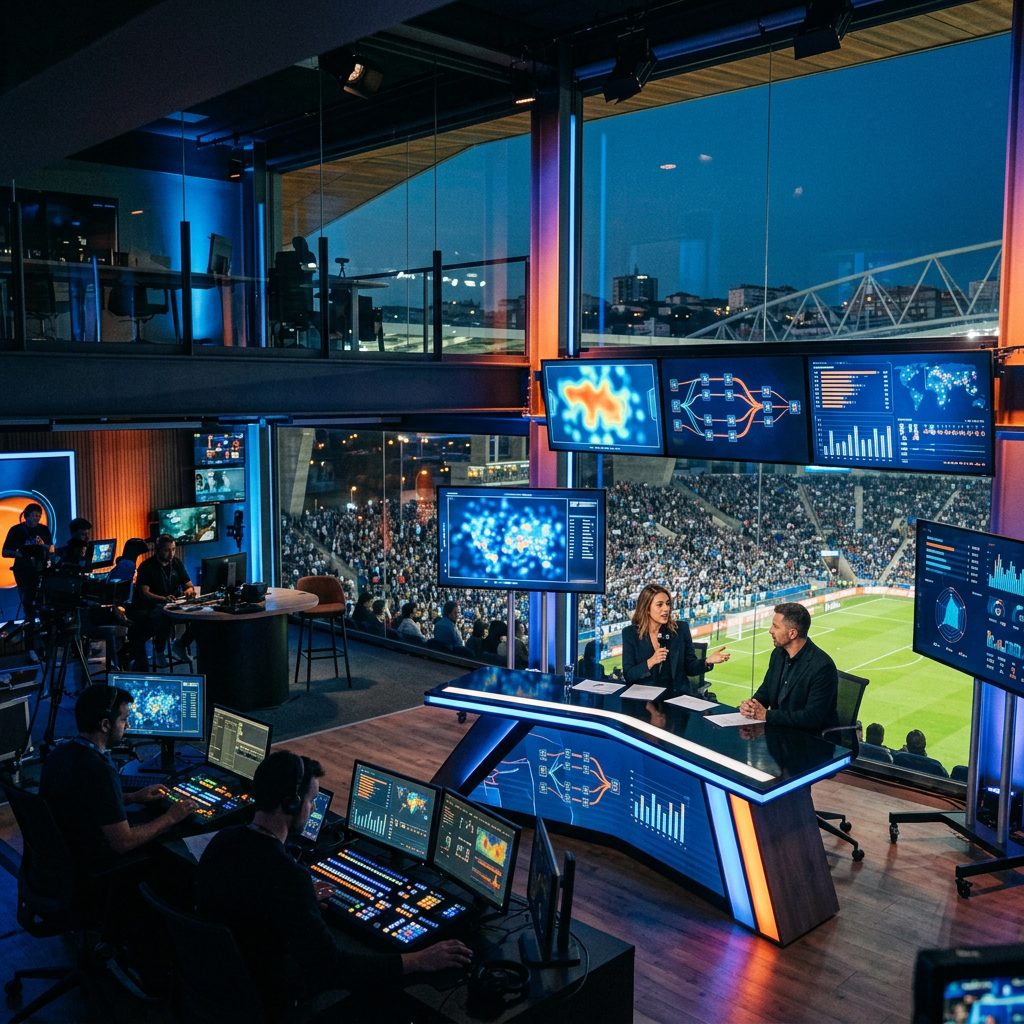
The sports media industry in 2025 has undergone a structural transformation, evolving from a centralized broadcast model into a fragmented, multi-modal ecosystem where content creators, athletes, and specialized technology platforms dictate the terms of fan engagement. This shift is characterized by an unprecedented intensity in fan engagement and a fundamental change in how viewers consume live and ancillary content.[1] The traditional barriers to entry—massive capital requirements for satellite and cable transmission—have been replaced by complex technical hurdles related to low-latency streaming, sophisticated intellectual property management, and a highly competitive struggle for proprietary fan data.[2]
Success for a new sports media enterprise in this landscape requires a synthesis of editorial authenticity and technical precision. The current environment favors “creator-led” brands that can navigate the nuances of athlete-driven influence while scaling their technical infrastructure to meet the demands of a global, always-on audience.[3] As major leagues like the NBA and MLB continue to unlock hundreds of millions of dollars in media value through postseason excitement and global stars like Shohei Ohtani, the opportunity for independent startups to capture niche segments of this value has never been greater.[1]
The Strategic Macro-Environment and Audience Viewership Dynamics
The sports media landscape in 2025 is defined by a “growing intensity of fan engagement,” which has fueled fierce competition among traditional broadcasters and digitally native streamers.[1] A primary driver of this growth is the diversification of the sports fan’s interests. While American football remains a dominant force, soccer has ascended to become the fourth largest fanbase in the United States, reaching 62 million fans ahead of the FIFA World Cup 2026™.[1] This demographic shift is not isolated; baseball, golf, basketball, and softball are all strengthening their fanbases, creating a multifaceted market for specialized media coverage.[1]
A secondary trend is the massive surge in “off-season” engagement through streaming sports documentaries. Viewing minutes for this genre reached 16,937 million in 2024, a 113% increase from 2021, with 2025 on pace for similar totals.[1] This suggests that a sports media business can no longer rely solely on live event coverage; it must build a narrative engine that sustains fan interest throughout the year.[2] The consumption habits of younger generations, specifically Gen Z and Millennials, further complicate this, as 90% of these fans engage with sports via social media clips and highlights rather than full-game broadcasts.[2]
| Sport/Content Type | US Audience Size/Impact (2025) | Growth Trajectory |
|---|---|---|
| Soccer | 62 Million Fans | Rapid (US Top 4) |
| Sports Documentaries | 16,937 Million Minutes (2024) | 113% Increase since 2021 |
| NBA/MLB Media Value | $515 Million (Sponsorships) | High Engagement Value |
| Women’s Sports | Record Viewership & Investment | Explosive Growth Sector |
The maturation of streaming services has reached a tipping point where providers are moving beyond simple video delivery to offer immersive, real-time integrations. Features such as in-game betting, seamless merchandising, and social experiences are becoming the standard expectation for fans.[2] This evolution requires media startups to view themselves not just as publishers, but as technology platforms capable of delivering hyper-personalized experiences driven by advanced data analytics.[4, 5]
Structural Entity Selection and Corporate Governance
The foundational decision for any sports media startup is the selection of a legal entity, which dictates tax obligations, management structures, and the ability to attract external investment. In 2023, Limited Liability Companies (LLCs) accounted for the majority (70.6%) of incorporations in the U.S. due to their operational flexibility and “pass-through” taxation.[6] This structure allows profits and losses to pass through to the personal income of members, avoiding the double taxation inherent in C-corporations.[7, 8]
However, the “startup endgame”—whether it be an IPO, a major acquisition, or a venture capital round—often necessitates a Delaware C-corporation. Institutional investors and venture capitalists overwhelmingly prefer C-corps because of their familiar governance rules, the ability to issue preferred stock, and the tax benefits associated with Qualified Small Business Stock (QSBS).[6, 9] While an LLC is “low-maintenance” and suitable for bootstrapped or lifestyle businesses, a C-corp provides the rigid hierarchy—shareholders, a board of directors, and officers—that provides transparency and trust for high-growth scaling.[9]
| Criteria | Limited Liability Company (LLC) | Delaware C-Corporation |
|---|---|---|
| Taxation | Pass-through to owners | Double (Corporate & Individual) |
| Governance | Flexible Operating Agreement | Fixed Board/Officer Structure |
| Equity | Membership/Profit Interests | Stock/Options (Standardized) |
| Scaling | Best for lifestyle/boutique | Best for VC/IPO/Acquisition |
| IP Assets | Can be fragmented (Series LLC) | Centralized Ownership |
For multi-vertical media companies, the “Series LLC” offers a modular approach, allowing for different “series” or compartments for separate verticals—such as a podcast network, a data licensing arm, and a merchandise division—all under one parent entity.[10] However, this modularity can complicate fundraising, as many investors require conversion to a traditional C-corp before issuing a term sheet to ensure a “clean” cap table and intellectual property ownership.[10]
Intellectual Property, Signal Rights, and the Fair Use Doctrine
Navigating the legalities of sports footage is perhaps the most precarious operational challenge for a media startup. The use of sports clips is governed by “signal rights”—an entrepreneurial right that protects the investment made by broadcasters in capturing the event, rather than a “creative right” like that found in film or literature.[11] This distinction is critical: copyright in sports broadcasts protects the investment, meaning that taking even a qualitatively substantial part of a broadcast—such as a key highlight or wicket—can constitute infringement, regardless of the clip’s duration.[11]
The “Fair Use” doctrine (U.S.) and “Fair Dealing” (U.K.) are often invoked by startups but are rarely a blanket protection. While “citizen journalism” and “reporting current events” are valid categories for these exceptions, courts have ruled that if the primary purpose of sharing a clip is its “intrinsic interest and value” rather than actual reporting, the fair dealing defense will fail.[11] Furthermore, federal laws give organizations like the USOPC extensive rights to control their IP, prohibiting the use of terms like “Olympic” or “Paralympic” in product names or advertising without express consent.[12]
| Jurisdictional Nuance | Policy on Sports Clips/Short Extracts |
|---|---|
| United Kingdom | “Qualitative substantiality” test; highlights infringe signal rights. |
| United States | Fair use must be considered; case-by-case “reporting” defense. |
| Germany | Smallest excerpts protected; commercial interests do not justify use. |
| Italy | Short news reports (90s) allowed within 48-hour windows. |
| France | Extracts allowed in info programs, but not before original broadcast ends. |
Media startups must also distinguish between “editorial use”—which provides context to a news broadcast or journalistic article—and “commercial use,” which promotes or publicizes the news outlet itself.[12] Using USOPC or league IP to simulate a partnership or to sell merchandise without a license is a direct violation that frequently leads to litigation.[12]
Operational Protocol: Media Credentialing and Field Access
Growth in sports media often depends on the ability to secure media credentials for live events, providing the enterprise with the status required for original reporting and athlete access. Credentialing is not a right, but a privilege reserved for editorial members of the “working media” who are employed by established news outlets.[13] For independent blogs and startups, the application process requires demonstrating a “consistent history of legitimate sports coverage” and providing bylined articles published within the previous six months.[14]
Most major event organizers, such as SportAccord or the International Foundation of Employee Benefit Plans, prioritize organizations that are primarily in the business of “news gathering” rather than commercial ventures or personal fan pages.[15, 16] A standard application for an independent startup might include:
- A formal letter of assignment on company letterhead signed by the editor-in-chief.[13, 16]
- Verification of traffic data (e.g., 20,000+ monthly visitors) and a paid reporting staff.[17]
- Documentation of an established track record covering the specific industry or sport for at least six months.[17]
Credentialed media are expected to act with “professional decorum” and must strictly adhere to student privacy laws like FERPA when covering youth or collegiate athletics.[14, 15] Misuse of credentials—such as live-streaming entire games without authorization—results in immediate revocation and permanent denial of future access.[14]
The NIL Content Engine: Leveraging Student-Athlete Influence
The 2021 Name, Image, and Likeness (NIL) ruling has created a multibillion-dollar sub-industry, transforming college athletes into “entrepreneurs before they even graduate”.[18] By 2025, NIL deals have become a standard part of the sports ecosystem, with social media promotion serving as the primary vehicle for 72% of these agreements.[18] For a sports media business, NIL represents a new way to generate high-engagement content by partnering directly with athletes who have “highly engaged audiences” in specific local or niche markets.[18]
Marketplaces such as Opendorse, NIL Club, and Learfield’s Compass platform facilitate these connections, allowing media brands to “hire” athletes for podcast guest spots, video tutorials, or branded content series.[19, 20] Pricing in these marketplaces varies significantly based on the athlete’s “NIL Score” and social reach.
| Athlete/Niche | Starting Price (Example) | Primary Platform/Reach |
|---|---|---|
| Madison Booker (W. Basketball) | From $38 | High Engagement (Texas) |
| Rebekah Allick (Volleyball) | From $20 | 50k+ Followers (Nebraska) |
| Kyson Brown (Football) | From $25 | 12k+ Followers (Arizona St) |
| Prince Dorbah (Football) | From $23 | 7.4k+ Followers |
Beyond simple endorsements, companies like Learfield are scaling “NIL Content Days,” where athletes are brought into specialized stations to create a “season’s worth of NIL value” in a single day of access.[21] This efficiency is critical for media startups that want to maximize their content output while minimizing the “in-season demands” on the athletes they partner with.[21]
Monetization Frameworks: Subscriptions, OTT, and Betting Affiliates
The monetization of sports media in 2025 is no longer dependent on a single revenue stream. A “multi-revenue” approach is necessary to achieve sustainability, combining SVOD, AVOD, PPV, and specialized affiliate commissions.[22]
OTT and Video Monetization
The sports OTT market is projected to reach $343 billion by 2025, with subscription models (SVOD) serving as the backbone.[22] By 2025, 65% of sports fans are willing to pay for premium subscriptions that offer exclusive access to behind-the-scenes content and highlights.[22] Pay-Per-View (PPV) remains the preferred model for high-impact, one-time events like championship finals or combat sports, with revenue in this sector growing at 18% annually.[22]
The Newsletter Business Model: Substack vs. Beehiiv
For media startups focused on written content and community building, newsletters have become a primary monetization vehicle. Substack offers a “closed ecosystem” that is ideal for beginners due to its built-in discovery network and simplicity.[23] However, Substack takes a perpetual 10% fee from all subscription revenue, which becomes a significant barrier as the business scales.[24, 25]
Beehiiv has emerged as the “dynamic and modern alternative,” offering an “SEO-first architecture” and a flat-fee model where the creator keeps 100% of their subscription revenue.[24, 25] Beehiiv also offers a native ad network and “boosts” for cross-promoting with other newsletters, making it the preferred choice for those building a “real and sustainable media business” rather than just a hobbyist blog.[24]
| Feature | Substack | Beehiiv |
|---|---|---|
| Revenue Split | 10% Fee to Platform | 0% Fee (Flat Monthly Rate) |
| Discovery | Internal Recommendation Engine | SEO-focused & Boost Marketplace |
| Integrations | Limited/Closed | Open API & Zapier Support |
| Data/Analytics | Limited Insights | Full-Funnel Analytics/Segmentation |
| Customization | Minimal Branding | Custom Website & Branding |
Sports Betting Affiliation
The legalization of sports betting in the U.S. has opened a highly lucrative affiliate market. Media sites can earn commissions by referring users to legal sportsbooks, but this requires navigating a state-by-state licensing regime.[26]
| State | License Requirement | Application/Renewal Fee | Notes |
|---|---|---|---|
| Arizona | Required (Ancillary) | $1,500 / $500 | Stringent for Rev-Share |
| Colorado | Required (Vendor Minor) | $350 | Simpler for CPA models |
| Pennsylvania | Required (Registered) | $2,500 App / $5,000 Lic | Extensive background check |
| Tennessee | Vendor Registration | $500 | Online-only market |
| Michigan | Vendor Registration | $200 | Flat-fee (CPA) model |
Affiliates generally choose between a flat-fee “CPA” model (Cost Per Acquisition) and a “Revenue Share” model. Revenue share agreements often require a more rigorous “Ancillary CSIE” or “Vendor Major” license, necessitating fingerprinting and extensive personal history disclosures.[27, 28]
Technical Infrastructure and the Real-Time Data Challenge
The technical requirements for a sports media platform in 2025 are dictated by the fan’s demand for “instantaneousness.” Latency is the primary technical hurdle; a delay of even a few seconds can ruin the viewing experience if social media spoils the action.[29, 30]
The Latency Debate: Consistency vs. Speed
While “ultra-low latency” (ULL) of less than 500 milliseconds is essential for live betting applications, it is not always a one-size-fits-all solution for global broadcasts.[29, 31] Massive events like the Super Bowl or World Cup face the challenge of millions of simultaneous viewers, where slightly higher, consistent latency (5–10 seconds) is necessary to ensure stream stability and buffering safeguards.[29]
To manage these spikes, sports media platforms rely on Content Delivery Networks (CDNs) and edge computing. Edge computing brings processing closer to the end-user, reducing the number of “network hops” and achieving lower latency for real-time updates.[30, 32] Technologies like WebRTC enable near-instant data exchange, while low-latency HLS (HTTP Live Streaming) optimizes delivery for global audiences.[31]
Sports Data APIs for Startups
Providing live scores and stats requires integration with sports data APIs. For startups, the cost and breadth of these APIs vary.
| Provider | Pricing | Ideal For | Key Features |
|---|---|---|---|
| TheSportsDB | Free / $1/mo | Prototypes/Personal | JSON API for major leagues |
| API-SPORTS | Free Tier / Scalable | Real-time apps | Live scores every 15 seconds |
| Highlightly | Flexible / Discounted | Media-rich platforms | Video highlights & AI predictions |
| OddsAPI | Free / REST-based | Betting/Odds widgets | Comparison tools; fast integration |
| Sportradar | B2B/Negotiated | Enterprise/Broadcasters | Reliable; play-by-play commentary |
Startups often start with “plug-and-play” options like OddsAPI or API-SPORTS to launch quickly before negotiating custom contracts with enterprise providers like Sportradar or StatsPerform as they scale.[33, 34]
Audience Growth: Personalization and Community-Led Marketing
Growth in sports media is no longer about mass-market reach; it is about “hyper-personalization” and building “community-led” movements.[4] By leveraging data analytics, media brands can deliver customized content that appears curated for the individual fan.[4]
Community and UGC Strategies
Fans increasingly seek a “sense of belonging,” making community the driving force behind modern sports brands.[35] Successful strategies include:
- User-Generated Content (UGC): Sharing fan-created photos and stories on official channels enhances authenticity and motivates long-term engagement.[36, 37]
- Interactive Posts: Quizzes, voting polls, and Q&A sessions with athletes capture attention and foster a sense of loyalty.[36]
- Social Listening: Monitoring fan conversations allows brands to gain insight into spending habits and evolve their content to match fan demands.[35]
The Role of Athlete Personal Brands
Athletes have become influential personal brands that resonate more deeply than traditional teams.[36] Leveraging an athlete’s social media presence can significantly amplify a startup’s reach.[36] “Athlete takeovers” of team accounts or collaborations on behind-the-scenes content humanize the athletes and build emotional connections with the fans.[36, 38]
Case Study: The Growth Trajectory of Jomboy Media and The Athletic
The trajectories of Jomboy Media and The Athletic provide critical lessons in building and scaling a sports media business.
Jomboy Media: The Creator-Led Explosion
Jomboy Media, a brand built on “creator-led sports content,” reached over 20 million followers by 2024 through a series of “made-up sports competitions,” podcasts, and viral breakdown videos.[3] Their success is driven by capturing the “coveted 18-to-34-year-old male” demographic (80% of their audience).[3] A key factor in attracting major sponsors like T-Mobile and Corona was their ability to maintain an “enthusiastic” tone without resorting to “hot takes or controversy for the sake of it,” ensuring “brand safety” for advertisers.[3]
The Athletic: The Subscription Revolution
The Athletic was founded in 2016 to “replace the sports page in every single city” through a subscription-based, ad-free model.[39, 40] Their strategy focused on “poaching” respected sportswriters who already had loyal followings, effectively transferring their readership to the new platform.[40] By 2024, under the ownership of The New York Times, The Athletic hit nearly 5 million subscribers and achieved operating profitability.[41, 42] This transition from an “independent startup” to a “microcosm of The New York Times strategy” illustrates the eventual need for mature media companies to combine powerful subscription models with high-margin digital advertising.[42]
Synthesis and Strategic Outlook for 2026
The sports media enterprise of the 2026 era must be a “technical publisher”—an entity that is equally proficient in editorial storytelling and data infrastructure. The industry is moving toward a future where AI-automated camera workflows, decentralized eco-friendly production, and highly personalized virtual advertising will transform the cost-efficiency of sports media.[43]
As the market fragments, the businesses that will thrive are those that own their audience data and can offer a seamless, synchronized experience across multiple screens and platforms.[29, 44] The evolution of NIL and the rise of the athlete-influencer ensure that the most successful media brands will be those that collaborate with talent as partners rather than treating them as subjects.[4, 18] Finally, the maturation of sports betting and the integration of immersive technologies like “shared reality” will create new revenue frontiers for those willing to navigate the complex regulatory and technical landscapes of the coming decade.[2]
By synthesizing the structural integrity of a Delaware C-corp, the editorial reach of a multi-platform social strategy, and the technical reliability of an edge-computing-driven OTT service, a sports media business can move beyond mere “audience growth” toward true “audience sustainability”.[25] The objective is to turn the “roar” of the digital crowd into a tangible, long-term business asset.[38]
——————————————————————————–
- Tops of Sports – Media trends shaping sports marketing for 2026 …, https://www.nielsen.com/insights/2025/tops-of-sports-2026/
- 2025 sports industry outlook | Deloitte Insights, https://www.deloitte.com/us/en/insights/industry/technology/technology-media-telecom-outlooks/sports-industry-outlook.html
- Big brands seeing interest in Jomboy Media’s demo, editorial …, https://www.sportsbusinessjournal.com/Articles/2024/07/18/jomboy-media-advertising-success/
- Uncovering the top 5 sport marketing trends 2025 has to offer – MCI, https://www.wearemci.com/en/thoughts/sport-marketing-trends-2025
- Top Nine Sports Marketing Trends to Watch in 2025, https://onlinesportmanagement.ku.edu/community/sports-marketing-trends
- Should I incorporate my startup as an LLC, an S corp or a C corp? – SeedLegals, https://seedlegals.com/us/resources/should-i-incorporate-my-startup-as-an-llc-an-s-corp-or-a-c-corp/
- LLC vs. corporation: Here’s how to decide which to form for your startup – Stripe, https://stripe.com/resources/more/should-you-form-an-llc-or-a-corporation-for-your-startup
- C corp vs. LLC: Differences, similarities, and how to choose between them – Stripe, https://stripe.com/resources/more/c-corp-vs-llc
- LLC vs C Corp for Startups: Which to Choose? – Haven Tax, https://www.usehaven.com/blog-posts/llc-vs-c-corp-for-startups
- Top 5 Startup Legal Structures: Series LLC Vs. C-Corp Guide, https://techandmedialaw.com/startup-legal-structure-series-llc-vs-ccorp/
- Is Social Media Sharing of Sports Clips Copyright Infringement …, https://www.klgates.com/Is-Social-Media-Sharing-of-Sports-Clips-Copyright-Infringement-05-05-2016
- Commercial and Brand Usage Guidelines – USOPC, https://www.usopc.org/commercial-and-brand-usage-guidelines
- Credentialing Guidelines – OFC, https://www.ofcconference.org/news-media/media-and-analysts/credentialing-guidelines/
- Media Credentialing for RCS Athletic Events – Rutherford County Schools, https://www.rcschools.net/apps/pages/index.jsp?uREC_ID=524097&type=d&pREC_ID=2714415
- Press Credential Policy and Guidelines, https://www.ifebp.org/resources—news/news-and-regulatory-updates/press-room/press-credential-policy-and-guidelines
- Media approval process – SportAccord World Sport & Business Summit 2024, https://www.sportaccord.sport/2024-wsbs/media-approval-process/
- Media Credential Guidelines – BlueGreen Alliance Foundation, https://www.bgafoundation.org/media-credential-guidelines/
- Student-Athlete Sponsorships in 2025: NIL Trends to Watch – Business of College Sports, https://businessofcollegesports.com/other/student-athlete-sponsorships-in-2025-nil-trends-to-watch/
- Best NIL Deals for College Athletes in 2025: Top Campaigns to Know, https://nilclub.com/blog/best-nil-deals-for-college-athletes-in-2025-top-campaigns-to-know
- Tracker: NIL Marketplaces for Student Athletes – Business of College Sports®, https://businessofcollegesports.com/tracker-nil-marketplaces-for-student-athletes/
- Learfield Studios Launches NIL Content Days at Top Athletic Programs Across the Country, https://www.learfield.com/2025/06/learfield-studios-launches-nil-content-days-at-top-athletic-programs-across-the-country/
- Maximize Revenue with 6 Proven Sports OTT Monetization … – Gizmott, https://gizmott.com/sports-ott-monetization-strategies/
- Beehiiv vs Substack: Which Newsletter Platform Is Right for You in 2025?, https://redefiningretirement.io/p/beehiiv-vs-substack-newsletter-platform-comparison
- Substack vs beehiiv: Compare Top Competitors and Alternatives, https://www.beehiiv.com/comparisons/substack
- Inside the Newsletter Evolution of 2025 From Substack to Scalable Infrastructure – Beehiiv, https://www.beehiiv.com/blog/inside-the-newsletter-evolution-of-2025?via=1111
- USA Affiliate / B2B License — Fast & Easy Process – Legarithm, https://legarithm.io/license/affiliate/usa/
- Betting Affiliate Programs: States That License Affiliates – Betting USA, https://www.bettingusa.com/affiliate/
- Media Affiliate Gaming Betting & Sports Betting License, USA – GBO Licensing, https://gbo-licensing.com/media-affiliate-gaming/
- The Latency Debate in Live Sports: Consistency vs. Speed | Dolby OptiView, https://optiview.dolby.com/resources/blog/sports/the-latency-debate-in-live-sports-consistency-vs-speed/
- Why low latency is essential for sports, media, and entertainment companies trying to deliver realtime updates at scale – Ably, https://ably.com/blog/why-low-latency-is-essential-for-sports-media-and-entertainment-companies
- Why AI-powered ultra-low-latency can help sport seize the opportunities of the streaming revolution – SportsPro, https://www.sportspro.com/interviews/broadcast-ott/gcore-cdn-tech-streaming-ultra-low-latency/
- The Evolution of Live Sports Streaming Through CDN Innovations – CacheFly, https://www.cachefly.com/news/the-evolution-of-live-sports-streaming-through-cdn-innovations/
- Top Sports data APIs in 2025 – Highlightly, https://highlightly.net/blogs/top-sports-data-apis-in-2025
- Top 5 Sports Betting APIs Shaping the Future of Digital Wagering in 2025 – SportsFirst, https://www.sportsfirst.net/post/top-sports-betting-apis-future-of-digital-wagering-2025
- Social media and sports | Deloitte Digital, https://www.deloittedigital.com/us/en/insights/perspective/social-media-strategies-sports.html
- Boost Fan Engagement with Top Sports Social Media Strategies …, https://slateteams.com/blog/sport-social-media
- 5 Sports Community Content Strategy Tips for 2024 – Arena.im, https://arena.im/online-communities/sports-community-content-strategy-tips/
- How to Build a Social Media Marketing Plan for Sports Teams – Emplifi, https://emplifi.io/resources/blog/social-media-marketing-for-sports/
- Fast-growing startup aims to ‘replace the sports page’ – Columbia Journalism Review, https://www.cjr.org/business_of_news/the-athletic-sports-news.php
- The Athletic – how two start-up founders changed sports media, https://behindtheathletes.substack.com/p/the-athletic-how-two-start-up-founders
- Behind the Brand: The Athletic’s Ascent Amidst Acquisition – Brandingmag, https://www.brandingmag.com/mordy-oberstein/behind-the-brand-the-athletics-ascent-amidst-acquisition/
- The Athletic just hit 5m newsletter subscribers – here’s how (and why it matters) | The Drum, https://www.thedrum.com/news/the-athletic-just-hit-5m-newsletter-subscribers-here-s-how-and-why-it-matters
- Full article: Forecasting the future of sports media production: a Delphi study on the role of emerging technologies – Taylor & Francis Online, https://www.tandfonline.com/doi/full/10.1080/16184742.2025.2559953
- Losing the lag: Why sports streaming is one of the biggest victims of delay – FEED magazine., https://feedmagazine.tv/signal/latency-in-sports-losing-the-lag/


Leave a comment