-
Pip: Welcome to Journal for Policy and Market Research — where the topics range from who owns your neighborhood to who owns the concept of knowledge itself, which is either a very broad editorial mandate or a sign that Administrator has not slept in weeks. Mara: Administrator has been busy. This episode covers the structural…
-

The 2026 sales landscape prioritizes strategic, insight-driven partnerships over traditional transactional models. Modern sales professionals must possess advanced skills in emotional intelligence, financial literacy, and executive engagement. Continuous learning and AI integration are crucial for developing high-performing sales agents, shifting focus towards consultative selling and deeper relationship-building techniques.
-

The housing market in 2026 reflects a K-shaped divergence, with high prices and interest rates hindering homeownership for many while benefiting institutional investors. Major factors include a serious supply deficit, labor shortages, and escalating costs. Policymakers are seeking solutions through technological innovations and global social housing models to address the crisis.
-

The operational and conceptual boundaries of public service in 2025 have undergone a radical transformation, shifting from a centralized bureaucratic model to a decentralized, mission-oriented ecosystem. This evolution is characterized by a seamless integration of government agencies, non-profit organizations, and international non-governmental entities, all of which are increasingly reliant on data-driven policy and digital transformation.[1,…
-

The agribusiness landscape in 2025 is transforming, blending traditional production with technological innovation in response to population growth and climate change. Financial mechanisms are evolving from simple debt to complex capital structures focusing on sustainability, ESG compliance, and innovative funding models. This shift is essential for enhancing food security and industry resilience.
-

In late 2025, AI has transitioned from “generative experimentation” to “agentic execution,” marking a shift to autonomous systems capable of multi-step planning. Innovations include enhanced memory frameworks and reason-and-search loops, while hardware is evolving towards custom accelerators. The socio-economic impact involves workforce transformation and stringent regulatory developments guiding AI’s future.
-

Modern goods market management integrates classical economic theories, operational logistics, and advanced digital technologies to facilitate value exchange between producers and consumers. This comprehensive approach encompasses product classifications, strategic decisions, market dynamics influenced by supply and demand, and the essential role of logistics in ensuring efficiency and customer satisfaction.
-

This report examines the evolution of African intellectual history, highlighting its resilience and richness. It delves into various philosophical systems like Ubuntu and Yoruba concepts, critiques colonial perspectives on African knowledge, and emphasizes the integration of Indigenous Knowledge Systems in contemporary society. The narrative underscores the importance of redefining African identity and sovereignty.
-
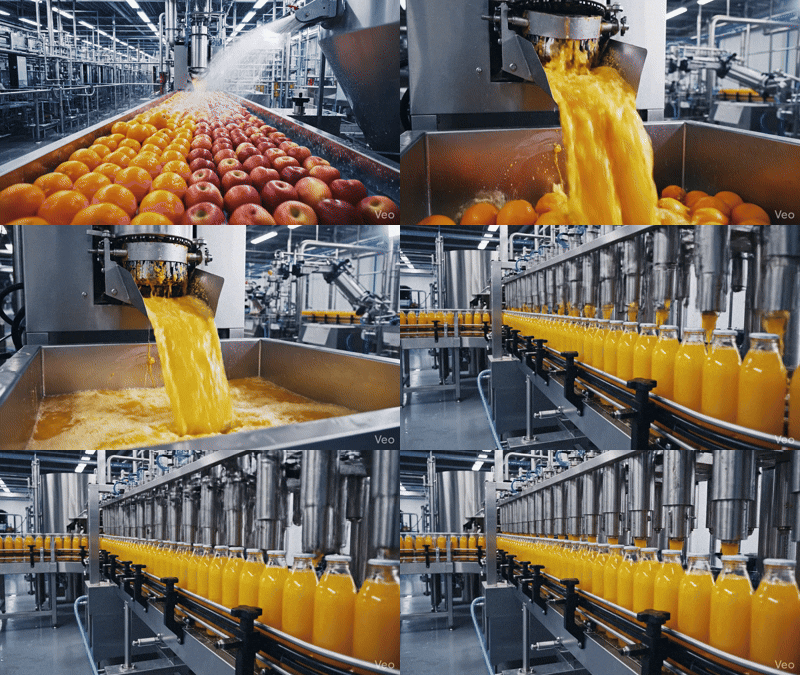
The agricultural landscape in 2026 is undergoing a significant transformation through the integration of technologies like AI, IoT, and blockchain, marking the shift to Agriculture 5.0. This evolution focuses on data-driven practices to increase productivity and sustainability, addressing challenges like food security and environmental impact amid climate change concerns.
-

The global labor market is projected to experience structural disequilibrium until 2040, driven by technology, demographics, and economic shifts. By 2030, 170 million jobs may be created, but 92 million will be displaced, exposing a significant skills gap. Reskilling and adapting to evolving workplace values will be crucial for workforce resilience.
-
Subscribe
Subscribed
Have a WordPress.com account? Log in now.

