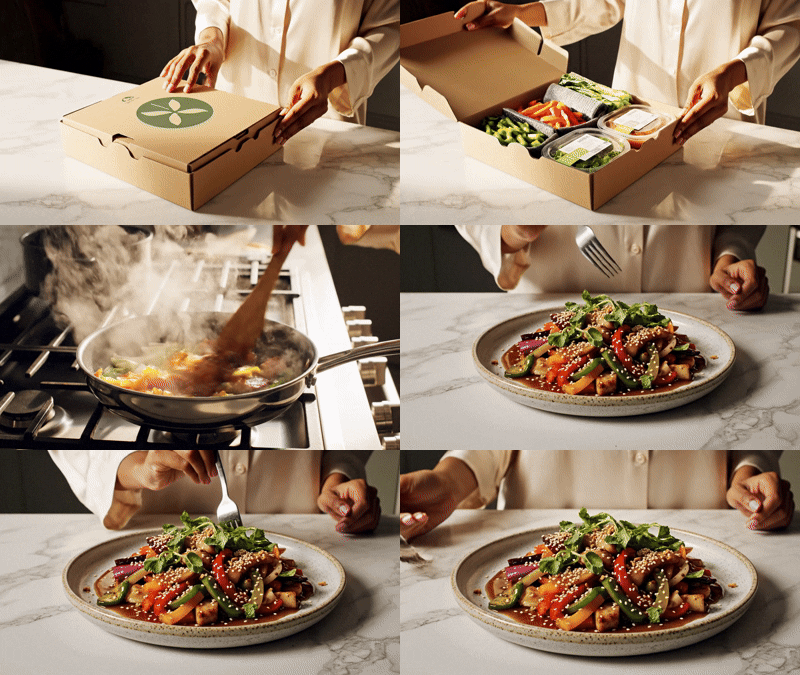
The global food subscription industry has reached a pivotal juncture in 2026, transitioning from a discretionary convenience service to a fundamental component of the urban household economy. This structural shift is characterized by a rapid expansion in market valuation, a sophisticated integration of artificial intelligence, and an unprecedented focus on the circular economy. As the traditional boundaries between grocery retail, restaurant dining, and home preparation continue to blur, subscription meal solutions have emerged as the primary mechanism for managing domestic nutritional needs in an era defined by time-poverty and macroeconomic volatility. The global food subscription market is estimated to be valued at approximately USD 6.11 billion in 2025, with projections suggesting a trajectory toward USD 11.61 billion by 2032, exhibiting a compound annual growth rate (CAGR) of 9.61%.[1] Other industry assessments, focusing more broadly on the meal kit delivery segment, provide even more aggressive figures, estimating the market at USD 25.69 billion in 2025 and forecasting a climb to USD 88.97 billion by 2033.[2] This discrepancy in valuation often arises from the inclusion or exclusion of ready-to-eat prepared meals, snack subscriptions, and “super-app” delivery models, yet the overarching trend remains consistent: a massive migration of consumer capital toward recurring, technology-enabled food solutions.[1, 2, 3]
Macroeconomic Drivers and the Financial Psychology of the Modern Subscriber
The adoption of subscription meal solutions is not merely a response to convenience but a strategic financial maneuver by consumers facing a complex inflationary environment. The Consumer Price Index (CPI) data for 2025 indicates that food prices have consistently risen faster than overall inflation. Specifically, food prices in August 2025 were 3.2% higher than in the preceding year.[4] Within this inflationary context, the cost of “food-away-from-home” (restaurant and foodservice purchases) increased by 3.9%, while “food-at-home” (grocery purchases) rose at a slower rate of 2.7%.[4, 5] This differential creates a significant market opportunity for meal kit providers who occupy the middle ground between the high-cost, high-margin restaurant sector and the time-intensive grocery sector.
The financial justification for subscriptions is increasingly rooted in predictability. Fixed-menu subscriptions, which eliminate the need for weekly decision-making, are projected to hold a dominant 62.3% share of the market in 2025.[1] By offering a set price per serving—typically ranging from $6 to $13 depending on the provider and volume—meal kits provide a hedge against the price volatility seen in grocery stores.[6, 7, 8] Comparative research into grocery pricing indicates that services like Instacart have engaged in pricing experiments that result in cost swings of up to 23% for identical items at the same store, potentially costing a family of four an additional $1,200 per year.[9] In contrast, the subscription model provides transparency and shields consumers from the impulse-buying traps inherent in modern supermarket layouts.[10, 11]
| Economic Indicator (2025) | Value / Percentage | Impact on Subscription Demand |
|---|---|---|
| Overall Food Price Inflation (YoY) | 3.2% [4] | Consumers seek cost-predictive solutions. |
| Food-Away-From-Home CPI Increase | 3.9% [4] | Restaurant dining becomes less accessible. |
| Food-At-Home CPI Increase | 2.7% [4] | Grocery cooking remains cheapest but time-intensive. |
| Average Weekly Grocery Spend (US) | $235 [12] | Households look to optimize per-serving costs. |
| Instacart Price Experiment Swings | Up to 23% [9] | Lack of retail transparency drives subscription trust. |
| Fixed Menu Market Share | 62.3% [1] | Demand for routine and budgetary consistency. |
The “time-is-money” calculation is particularly prevalent among the 169.8 million working professionals in the United States, a demographic that grew by 2.9 million between 2021 and 2022.[13] For these individuals, the $8 to $12 per serving cost of a meal kit is frequently viewed as a discount compared to the opportunity cost of the two or more hours required for planning, shopping, and prepping a comparable meal from scratch.[11, 14] Furthermore, meal kits significantly reduce food waste, with the average household wasting 38% less food when using pre-portioned ingredients compared to bulk-purchased supermarket goods.[15] This reduction in waste acts as a “hidden” cost saving, mitigating the premium paid for the service.
Taxonomy of Service Models: From Culinary Instruction to Prepared Convenience
The subscription meal industry is broadly bifurcated into two primary operational models: Cook-and-Eat meal kits and Heat-and-Eat prepared meals. In 2024, the “Cook & Eat” segment accounted for 60.3% of the market revenue, driven by consumers who still value the ritual of cooking but wish to outsource the logistical burdens.[16] This segment is led by players like HelloFresh, Blue Apron, and Home Chef, who emphasize fresh, raw ingredients and “chef-crafted” recipes.[17, 18] The “Heat & Eat” segment, however, is the fastest-growing category, with an anticipated CAGR of 9.2% through 2033.[16] This acceleration is fueled by the rise of “single delivery” services tailored for solo diners and busy professionals who prioritize speed above all else.[13, 16]
The Culinary Education Model: Cook-and-Eat Kits
Providers in this space, such as HelloFresh and Blue Apron, have positioned themselves as more than just food vendors; they are “culinary academies” for the home cook. HelloFresh, for instance, offers over 100 weekly options across categories like “Fit & Wholesome,” “Family Friendly,” and “Under 20 Minutes,” explicitly aiming to teach subscribers “how to cook with confidence”.[17] Blue Apron takes a more sophisticated approach, often including “luxe” ingredients like duck breast or beef tenderloin and offering specialized wine pairings to elevate the home dining experience.[17, 19, 20] The appeal here is the balance of convenience and achievement; the consumer still performs the labor of cooking, which maintains the psychological reward of “providing” a home-cooked meal while eliminating the friction of ingredient sourcing.
The Performance and Medical-Grade Model: Prepared Meals
The Heat-and-Eat segment has evolved far beyond the “TV dinners” of the 20th century. Modern prepared meal services like Factor (formerly Factor75) and CookUnity focus on high-quality, fresh-never-frozen proteins and dietitian-designed nutritional profiles.[21, 22, 23] Factor, for example, offers six distinct menus including Keto, Calorie Smart, and Vegan & Veggie, targeting athletes and those on performance-based diets.[22] CookUnity operates as a chef-driven marketplace, where meals are attributed to specific culinary professionals, such as Esther Choi, and often feature complex flavor profiles like Korean Beef Bulgogi or Lobster Risotto.[23, 24, 25]
Specialized players have also moved into therapeutic nutrition. BistroMD offers nutritionist-designed frozen meals specifically for gluten-free, heart-healthy, diabetic-friendly, and even menopause-specific diets.[6] This indicates a shift toward “food as medicine,” where the subscription becomes a tool for managing chronic health conditions or life-stage-specific nutritional requirements.
| Provider Model | Key Example | Target Demographic | Core Value Proposition |
|---|---|---|---|
| Generalist Meal Kit | HelloFresh | Families, Novice Cooks | Variety, Accessibility, Confidence [17, 26] |
| Gourmet Meal Kit | Blue Apron | Foodies, Couples | Unique Ingredients, Education, Wine [19, 27] |
| Custom Meal Kit | Home Chef | Picky Eaters, Families | Ingredient Swaps, Oven-Ready [26, 28] |
| Performance Prep | Factor | Athletes, Biohackers | High-Protein, Keto, No-Prep [21, 22] |
| Chef Marketplace | CookUnity | Urban Professionals | Restaurant-Quality, Gourmet Variety [6, 23] |
| Therapeutic Prep | BistroMD | Medical/Life-Stage Needs | Diabetic-Friendly, Menopause Support [6] |
| Plant-Based | Purple Carrot | Vegans, Eco-Conscious | 100% Plant-Based, Ingredient Quality [6, 7] |
Technological Integration: AI, IoT, and the Intelligent Kitchen Ecosystem
The industry’s rapid evolution is inextricably linked to its digital infrastructure. By 2025, meal subscription services are no longer just logistics companies; they are high-tech platforms utilizing artificial intelligence (AI), the Internet of Things (IoT), and augmented reality (AR) to enhance user experience and operational efficiency. The integration of AI has become a “non-negotiable” standard in food delivery apps, moving from simple recommendation engines to proactive nutrition assistants.[29]
AI-Powered Personalization and Demand Forecasting
AI is deployed across the entire value chain. At the consumer interface, platforms like MyFoodPlanit utilize an AI feature named “Orion” to generate customized meal plans based on a user’s health goals, previous preferences, and even ingredient availability in their pantry.[30] HelloFresh and Blue Apron employ machine learning to flag allergens and suggest new recipes based on historical order data, increasing customer retention by making the experience feel uniquely tailored.[31, 32]
On the backend, predictive algorithms have revolutionized supply chain management. Traditional forecasting often fails to account for external variables like weather patterns or holiday surges. AI-driven systems now analyze these data points to optimize inventory, reducing food waste by up to 20% in large-scale European distribution centers.[32] This is critical for maintaining margins in an industry where ingredients are highly perishable.
The IoT and Smart Device Convergence
The convergence of meal kits and smart kitchen hardware represents the next frontier of “frictionless” domestic labor. A prominent example is the integration between Home Chef and the Tovala smart oven.[31, 33] Tovala meals are delivered fresh and raw; the consumer simply scans a QR code on the packaging, and the smart oven automatically executes a multi-step cooking cycle involving steam and convection, precisely calibrated for that specific recipe.[33, 34] This removes the possibility of human error and ensures restaurant-quality results in a home setting.
Furthermore, integration with wearables like Apple Health, Google Fit, and MyFitnessPal has become standard for services like Factor and HelloFresh.[22, 31] This allows subscribers to automatically sync the caloric and macro-nutrient data of their meals into their fitness tracking ecosystems, providing a holistic view of their health without manual data entry.
Future Technological Trajectories: AR and Drones
Augmented Reality (AR) is being tested to transform the cooking experience itself. Some providers are exploring AR overlays that guide users through complex knife techniques or plating styles in real-time, effectively placing a “virtual chef” on the user’s countertop.[31, 35] In logistics, drone delivery has moved from pilot programs to functional testing in suburban markets. Flytrex, for example, operates drone services in the US, delivering meals from local hubs to customers’ yards to bypass traffic congestion and reduce delivery times.[36] Autonomous sidewalk robots, such as those from Starship Technologies and Nuro, are also becoming a common sight in urban areas, offering a lower-carbon alternative to traditional delivery vans.[3, 36, 37]
| Technology Type | Key Feature | Primary Provider Use Case | Implication for Consumer |
|---|---|---|---|
| AI Recommendation | Taste/Allergy Matching | CookUnity, HelloFresh | Reduced decision fatigue. [31, 32] |
| IoT Integration | Smart Oven Syncing | Tovala, Home Chef | Guaranteed cooking quality. [33, 34] |
| Wearable Sync | Health App Integration | Factor, Purple Carrot | Automated macro tracking. [22, 31] |
| Machine Learning | Predictive ETA | Home Chef | Increased delivery reliability. [31] |
| Augmented Reality | 3D Meal Previews | Home Chef, StackFood | Visual certainty before ordering. [31, 35] |
| Supply Chain AI | Waste Reduction | European Providers | Lower costs, higher sustainability. [32] |
The Sustainability Mandate: Material Science and Circular Packaging
The environmental impact of single-use packaging has historically been a major point of criticism for meal kit companies. In response, 2025 has become a “watershed moment” for sustainability, as providers align their ESG (Environmental, Social, and Governance) goals with stricter Extended Producer Responsibility (EPR) laws enacted in several US states.[38] Today, 90% of American consumers are more likely to purchase from a brand that uses eco-friendly packaging, and nearly half of Gen Z and Millennials are willing to pay a premium for “green” solutions.[39]
Innovation in Material Science
The industry is moving away from petroleum-based plastics and Styrofoam in favor of “paperization” and biomass-based materials. HelloFresh, for instance, has implemented “Box Fit” algorithms to ensure that the smallest possible box is used for each order, which increased the use of small boxes from 12% to 50% in winter months, thereby reducing the volume of delivery vehicles needed.[40, 41]
Specific packaging innovations include:
- ClimaCell and TempGuard: Fully curbside-recyclable, plant-based insulation foams and liners that replace traditional silver Mylar or Styrofoam.[40, 42]
- Bagasse: Used by companies for bulk meal prep containers, this material is made from sugarcane byproduct and is 100% compostable, breaking down within 30 to 90 days.[43, 44]
- Denim Insulation: Sunbasket utilizes 100% reclaimed denim insulation during summer months to maintain safe temperatures while ensuring the material remains recyclable through specific programs.[45, 46]
- Seaweed Coatings: Companies like Notpla have developed seaweed-based, grease-resistant coatings for paperboard boxes, eliminating the need for plastic films in hot meal containers.[44, 47]
Institutional Sustainability Targets
The major market players have committed to time-bound sustainability targets to be met by the end of 2025. Blue Apron aims for 100% of its meal kit boxes to be recyclable, reusable, or compostable, while also targeting a 75% post-consumer recycled content rate by weight.[48, 49, 50] HelloFresh has already reported a 63% reduction in carbon emissions at its production facilities since 2019 and diverted 80% of its operational waste from landfills in 2024.[15, 41] Furthermore, life cycle assessments (LCA) indicate that HelloFresh meals generate 25% fewer carbon emissions than identical meals prepared with ingredients purchased from traditional supermarkets, primarily due to the streamlined supply chain that bypasses retail warehouses.[15, 51]
| Sustainable Material | Derived From | End-of-Life | Provider Usage |
|---|---|---|---|
| ClimaCell / TempGuard | Plant fibers / Recycled paper | Curbside Recyclable | HelloFresh, Sunbasket [40, 42] |
| Bagasse | Sugarcane byproduct | Commercial Compost | General Takeout/Bulk [43, 44] |
| Reclaimed Denim | Recycled textiles | Textile Recycling | Sunbasket [45, 46] |
| Seaweed Coating | Marine algae | Fully Biodegradable | Notpla (Innovation Phase) [44, 47] |
| PHA Bioplastics | Microbial fermentation | Biodegradable | Emerging Standard [44] |
| Molded Fiber | Recycled paper base | Compostable | Sunbasket Egg Trays [45] |
Strategic Competitive Landscape: The Battle for Market Domination
The market is characterized by a high degree of consolidation among the “Big Three” in North America, while niche players compete on culinary specialization and specific dietary efficacy.
HelloFresh: The Infrastructure Powerhouse
HelloFresh has maintained its position as the global leader through an aggressive multi-brand strategy. By owning Green Chef (premium organic), EveryPlate (value), and Factor (prepared), the HelloFresh Group captures a wide spectrum of the market.[3, 6, 15] Their strategic advantage lies in their “make-to-order” business model, which minimizes inventory overhead and allows for a 100% renewable electricity commitment across their production facilities.[15, 41]
Blue Apron: The Experience Brand
Blue Apron has pivoted toward a “wellness and education” platform. They are notably the first major US meal kit company to use only drain-safe frozen gel packs and to achieve a high degree of transparency with the “How2Recycle” labeling system.[49, 50] Their recent elimination of subscription requirements indicates a strategic move toward the “on-demand” economy, attempting to lower the barrier to entry for casual users who fear commitment.[7, 27]
Home Chef: The Customization Specialist
Owned by the grocery giant Kroger, Home Chef leverages a “Customize It” machine-learning tool that allows for unprecedented menu flexibility. This feature allows subscribers to swap, alter, or double up on proteins in almost any dish—an essential feature for households with varying dietary needs or picky eaters.[26, 28, 52] Home Chef also caters to the “convenience gap” by offering oven-ready meals that require zero prep, utilizing foil trays that can go directly from the box to the oven.[18, 52]
The Prepared Meal Market: Quality vs. Scale
In the ready-to-eat space, the competition is increasingly focused on the “fresh-never-frozen” value proposition. CookUnity has successfully marketed its chef-driven model, offering over 200 weekly options, which dwarfs Factor’s 45-meal rotation.[23] However, Factor remains superior in macro-nutrient precision and reliability for the fitness-conscious consumer.[22, 23, 25] Meanwhile, smaller players like Hungryroot offer a hybrid model, acting as an AI-driven grocery service that provides 5-minute meal kits consisting of pre-prepped sauces, grains, and proteins.[6, 21, 27]
Consumer Psychographics and Behavioral Economic Trends
The consumer behavior driving the 2025 market is defined by “decision fatigue” and a desire for “curated discovery.” With more than half of US consumers now considering food delivery an essential part of their life, the psychology of the “subscriber” has shifted from novelty-seeking to efficiency-seeking.[53]
The Decline of the “Grocery Chore”
Urban professionals increasingly view the traditional grocery store trip as an inefficiency. Research shows that grocery shopping is prone to “impulse buys,” whereas meal kits provide exactly what is needed—no more, no less—minimizing both financial and food waste.[11] This is particularly evident in the rise of “single-service” offerings, which now hold 58.6% of the market share, catering to the growing number of individuals living alone or those who do not share meals with other household members.[2, 54]
The Rise of Ghost Kitchens and Suburbia
Ghost kitchens—delivery-only facilities with no physical dining space—are no longer limited to high-density metropolitan areas. In 2025, they are expanding into suburbs and smaller cities, fueled by the demand for a wider variety of menus without the overhead of a full-service restaurant.[29, 35] Companies like Kitchen United and CloudKitchens provide the infrastructure for virtual brands to launch quickly, often integrating directly with subscription platforms to provide local “heat-and-eat” options that are fresher than those shipped cross-country.[35, 36, 37]
The “Ugly Produce” and Anti-Waste Movement
Eco-conscious consumers are flocking to services that prioritize food waste reduction at the source. Apps like “Too Good to Go” and “Feedie” allow users to purchase soon-to-expire items from local partners at a discount.[55] Subscription services have integrated this by utilizing “ugly produce” in their kits—vegetables that might be rejected by grocery retailers for aesthetic reasons but are nutritionally identical. This not only appeals to the consumer’s values but also allows providers to source ingredients at a lower cost, improving overall margins.[3, 55]
Operational Logistics and the Cold Chain Frontier
The “last mile” remains the most complex and expensive component of the subscription meal journey. Maintaining the “cold chain”—ensuring that fresh proteins and produce stay below 40°F until the customer arrives home—is the primary logistical hurdle. In 2025, this is managed through a combination of high-tech insulation and real-time tracking.
Packaging Configuration and Dynamic Ice Levels
Providers like Blue Apron and HelloFresh use “dynamic packaging” algorithms that calculate the precise amount of ice and insulation needed based on the customer’s ZIP code and the forecasted local weather.[15, 49, 56] This prevents “over-packaging” in winter months while ensuring safety during summer heatwaves. For example, HelloFresh’s “Dynamic Packaging Configurator” uses metadata on the shapes and dimensions of ingredients to calculate the volume-level requirements for every individual order.[15]
The Temperature Safety Crisis
Despite these advancements, temperature control remains a frequent point of failure. Reddit community reviews and Trustpilot ratings for services like CookUnity and Factor often cite boxes arriving at 60°F or higher, particularly in regions far from the distribution hubs.[25, 34, 57] To combat this, the industry is seeing a shift toward “hyper-local” delivery hubs and partnerships with local couriers who can provide faster delivery windows.[37, 58]
Food Safety and Compliance Infrastructure
The regulatory landscape for meal kits has become increasingly stringent. Services must now comply with the Food Safety Modernization Act (FSMA) 204, which requires rigorous traceability for high-risk foods.[29] Companies are adopting ERP (Enterprise Resource Planning) suites that automate safety checks and HACCP (Hazard Analysis and Critical Control Points) plans across their supply chains, ensuring that any potential recall can be executed with precision across multi-location hubs.[29, 54]
Future Outlook (2026–2032): The Convergence of Food and Pharma
As the industry moves toward 2032, the distinction between a “food company” and a “health company” will likely vanish. We are entering the era of “hyper-personalized nutrition,” where the subscription meal kit is just one part of a larger wellness ecosystem.
AI-Driven Nutrition Coaching
The next generation of apps will evolve into personal dietitians. By utilizing biometric data from continuous glucose monitors (CGMs) or genetic testing, meal kit platforms will be able to adjust the carbohydrate or fiber content of a subscriber’s meals in real-time to optimize their blood sugar response or athletic recovery.[31] Purple Carrot and Factor are already pioneering this by integrating with fitness trackers to align meals with workout intensity.[31]
3D Food Printing and Customization
The emergence of 3D food printing technology allows for the creation of meals with customized textures and shapes, tailored to specific dietary needs such as dysphagia or childhood neurodiversity.[36] In the future, subscription services may deliver “ink cartridges” of fresh food purees that are printed into customized meals in a smart kitchen appliance, representing the ultimate fusion of technology and nutrition.
Drone and Autonomous Maturation
By 2030, autonomous delivery is expected to be the standard in most urban areas. The reduction in labor costs associated with robotic delivery will likely drive down the price of subscriptions, making them more competitive with traditional grocery shopping for lower-income households.[3, 37] This “democratization of convenience” will be a key driver in reaching the USD 330 billion global market valuation projected for 2032.[3]
Strategic Synthesis and Resilience in the Subscription Era
The subscription meal industry has proven its resilience by evolving from a “luxury box” to a functional necessity. Its success in 2025 and beyond depends on its ability to solve the fundamental tension between convenience, cost, and sustainability. Market leaders who successfully integrate AI to reduce waste, adopt circular packaging to meet ESG targets, and utilize IoT to ensure cooking quality will dominate the landscape.
The data indicates that consumers are increasingly uncommitted to single retailers, spreading their dollars across multiple platforms based on promotions and current dietary goals.[59] Therefore, the winners in this space will be those who offer the highest degree of “optionality”—allowing users to skip weeks, swap ingredients, and move between meal kits and prepared meals seamlessly. In this dynamic environment, the subscription meal solution is no longer just a product; it is a technology-enabled service that manages the most fundamental human need: the reliable delivery of high-quality nutrition.
Summary of Market Value Forecasts (2024–2034)
| Forecast Source | 2024 Base | 2025 Projection | 2032-2034 Target | Estimated CAGR |
|---|---|---|---|---|
| Fortune Business Insights | USD 5.70 Bn | USD 6.19 Bn | USD 11.78 Bn (2032) | 9.63% [13] |
| Coherent Market Insights | USD 5.57 Bn | USD 6.11 Bn | USD 11.61 Bn (2032) | 9.61% [1] |
| Stellar Market Research | USD 150.3 Bn | — | USD 330.2 Bn (2032) | 9.6% [3] |
| Market.us (Meal Kit Focus) | USD 18.25 Bn | USD 25.69 Bn | USD 88.97 Bn (2033) | 14.2% [2] |
| GM Insights | USD 22.8 Bn | USD 26.1 Bn | USD 67.4 Bn (2034) | 14.5% [54] |
| Business Research Co. | USD 18.04 Bn | USD 20.71 Bn | USD 41.11 Bn (2029) | 18.7% [14] |
The variation in these figures emphasizes the breadth of the sector. While some reports focus strictly on the “Meal Kit” (ingredients + recipe), others include the broader “Food Subscription” market including snack boxes, wine clubs, and grocery subscriptions. Regardless of the specific lens, the consensus points to a market that will double or triple in size over the next decade, fundamentally rewriting the rules of the global food supply chain.
——————————————————————————–
- Food Subscription Market Size & Opportunities, 2025-2032 – Coherent Market Insights, https://www.coherentmarketinsights.com/industry-reports/food-subscription-market
- Meal Kit Delivery Services Statistics 2025 By Time, Growth, Duration – Market.us Scoop, https://scoop.market.us/meal-kit-delivery-services-statistics/
- Global Food Subscription Market to Hit USD 330.2 Bn by 2032 | Meal Kits, Plant-Based, Keto & AI Delivery Trends – EIN Presswire, https://www.einpresswire.com/article/858281891/global-food-subscription-market-to-hit-usd-330-2-bn-by-2032-meal-kits-plant-based-keto-ai-delivery-trends
- Food Price Outlook – Summary Findings | Economic Research Service – ERS USDA, https://www.ers.usda.gov/data-products/food-price-outlook/summary-findings
- How Much Have Food Prices Gone Up, and How Can I Save?, https://www.ncoa.org/article/how-much-have-food-prices-gone-up-and-how-can-i-save/
- The 8 Best Meal Delivery Services of 2025, Tested & Reviewed, https://www.foodandwine.com/lifestyle/kitchen/best-meal-delivery-services
- Best Meal Delivery Services of 2025: Top Prepared Meals & Meal Kits We Tested – CNET, https://www.cnet.com/health/nutrition/best-meal-kit-delivery-service/
- Blue Apron vs. HelloFresh: Which Meal-Kit Delivery Service Reigns Supreme? | PCMag, https://www.pcmag.com/comparisons/blue-apron-vs-hellofresh-which-meal-kit-delivery-service-reigns-supreme
- Same Cart, Different Price: Instacart’s Price Experiments Cost Families at Checkout, https://groundworkcollaborative.org/work/instacart/
- Saving Money in 2025: More Home Cooked Meals! – Plan to Eat, https://www.plantoeat.com/blog/2025/01/saving-money-in-2025-more-home-cooked-meals/
- Meal Kit vs Groceries: Which is Best | Daily Harvest, https://daily-harvest.com/blogs/nutrition/meal-kits-vs-buying-groceries-a-complete-comparison
- How Much Do Groceries Really Cost in 2025? – Beehive Meals, https://beehivemeals.com/blogs/trending-topics/how-much-do-groceries-really-cost-in-2025
- Food Subscription Market Size, Share & Trends | Report [2032] – Fortune Business Insights, https://www.fortunebusinessinsights.com/food-subscription-market-111770
- Meal Kit Global Market Report 2025 – The Business Research Company, https://www.thebusinessresearchcompany.com/report/meal-kit-global-market-report
- ESG | HelloFresh SE, https://www.hellofreshgroup.com/en/esg/
- Meal Kit Delivery Services Market Size & Share Report, 2033 – Grand View Research, https://www.grandviewresearch.com/industry-analysis/meal-kit-delivery-services-market
- Everything You Need to Know About Meal Kits – HelloFresh, https://www.hellofresh.com/eat/food-guide/meal-kits
- Blue Apron vs Hello Fresh vs Home Chef (2025) | Garage Gym …, https://www.garagegymreviews.com/blue-apron-vs-hello-fresh-vs-home-chef
- 5 Incredible Subscription Meal Delivery Platforms for 2025 – Strikingly, https://www.strikingly.com/blog/posts/5-incredible-subscription-meal-delivery-platforms-2023
- Hello Fresh vs Blue Apron vs Home Chef Review – Kath Eats, https://www.katheats.com/hello-fresh-vs-blue-apron-vs-home-chef-review
- 10 Best Meal Delivery Services, Reviewed By An R.D. (2025) | Garage Gym Reviews, https://www.garagegymreviews.com/best-meal-delivery-service
- 7 Best Meal Delivery Services for 2026: Tested by Us – Healthline, https://www.healthline.com/nutrition/best-meal-delivery-service
- CookUnity vs. Factor (I Tried Both): Who Wins In 2025? – Revgear Sports, https://blog.revgear.com/cookunity-vs-factor/
- What Types of Meals Can I Expect from a Meal Delivery Service?, https://lacuisinepcs.com/what-types-of-meals-can-i-expect-from-a-meal-delivery-service/
- List all of the companies you’ve tried and rank them best to worst : r/ReadyMeals – Reddit, https://www.reddit.com/r/ReadyMeals/comments/1j9ke7e/list_all_of_the_companies_youve_tried_and_rank/
- The 23 Best Meal Subscription Boxes of 2025, https://www.mysubscriptionaddiction.com/best-subscription-boxes/best-meal-kit-delivery-services
- Best Meal Kit Delivery Services 2025 – Forbes Vetted, https://www.forbes.com/sites/forbes-personal-shopper/article/best-meal-kit-delivery-service/
- Hello Fresh Vs. Home Chef 2025 Full Comparison – The Meal Kit Review, https://www.themealkitreview.com/compare/hello-fresh-vs-home-chef/
- Top 20 Food Delivery Trends To Watch In 2025 – Folio3 FoodTech, https://foodtech.folio3.com/blog/top-20-food-delivery-trends/
- AI Driven Meal Planning Apps Market Report 2025, Growth, Segment, https://www.thebusinessresearchcompany.com/report/ai-driven-meal-planning-apps-global-market-report
- Best Meal Kit & Food Subscription Apps And Services In 2025: A UX …, https://siit.co/blog/best-meal-kit-and-food-subscription-apps-and-services-in-2025-a-ux-and-tech-review/48416
- TF #083: AI in the Kitchen: How Technology is Shaping the Future of Meal Planning and Delivery – MealTrack, https://www.mealtrack.com/blog/tf-083-ai-in-the-kitchen-how-technology-is-shaping-the-future-of-meal-planning-and-delivery
- No cooking meets no compromise. – Tovala, https://start.tovala.com/tovala-vs-factor
- CookUnity vs Tovala : r/ReadyMeals – Reddit, https://www.reddit.com/r/ReadyMeals/comments/1nla9xz/cookunity_vs_tovala/
- Food Delivery Industry Trends: What Restaurants Must Know in 2025 – StackFood, https://stackfood.app/blog/food-delivery-industry-trends-in-2025/
- 7 Food Delivery Industry Trends for Food Businesses in 2025 – Enatega, https://enatega.com/food-delivery-industry-trends/
- Innovative Food Delivery App Business Models to Watch in 2025 – A3Logics, https://www.a3logics.com/blog/food-delivery-app-business-models/
- 2025 Sustainable Packaging Trends Report, https://sustainablepackaging.org/wp-content/uploads/2025/04/2025-Packaging-Innovations-Trends-Report_SPC_03_compressed.pdf
- The 2025 Sustainable Packaging Consumer Report, https://www.shorr.com/resources/blog/sustainable-packaging-consumer-report/
- Recycling and Packaging | HelloFresh, https://www.hellofresh.com/about/sustainability/packaging
- Sustainability – HelloFresh, https://www.hellofresh.com/about/sustainability/sustainability
- Sun-sational sustainable packaging for meal kit, https://www.packworld.com/leaders-new/machinery/material-handling/article/13375023/sunsational-sustainable-packaging-for-meal-kit
- Sustainable Packaging Solutions for Restaurants & Food Service Businesses, https://www.splashpackaging.com/blog/sustainable-packaging-solutions-for-food-service-businesses/
- Eco-friendly Food Packaging Market | Industry Report, 2030 – Grand View Research, https://www.grandviewresearch.com/industry-analysis/eco-friendly-food-packaging-market-report
- Our Recyclable and Compostable Packaging – Sunbasket, https://sunbasket.com/recycle/
- Frequently Asked Questions – FAQ – Sunbasket, https://sunbasket.com/faq/
- Food Brands Leading with Sustainable Packaging, https://ibexpackaging.com/food-brands-with-sustainable-packaging/
- Untitled, [https://www.businesswire.com/news/home/20210708005242/en/Blue-Apron-Sets-New-Sustainable-Packaging-Goals#:
:text=NEW%20YORK%2D%2D(BUSINESS%20WIRE,by%20the%20end%20of%202025.](https://www.businesswire.com/news/home/20210708005242/en/Blue-Apron-Sets-New-Sustainable-Packaging-Goals#::text=NEW%20YORK%2D%2D(BUSINESS%20WIRE,by%20the%20end%20of%202025.) - Blue Apron Sets New Sustainable Packaging Goals – Nasdaq, https://www.nasdaq.com/press-release/blue-apron-sets-new-sustainable-packaging-goals-2021-07-08
- Blue Apron aims for fully sustainable meal kit boxes by 2025 – Packaging Gateway, https://www.packaging-gateway.com/news/blue-apron-meal-boxes/
- Sustainability at HelloFresh, https://www.hellofresh.co.uk/about/sustainability
- Blue Apron Vs. Home Chef 2025: Meal Kit Comparison, https://www.themealkitreview.com/compare/blue-apron-vs-home-chef/
- Deliverect US | Global Food Delivery in 2025: Growth & Market Trends, https://www.deliverect.com/en-us/blog/trending/the-state-of-the-food-delivery-industry-worldwide
- Meal Kit Delivery Services Market Size, Growth Report 2034 – Global Market Insights, https://www.gminsights.com/industry-analysis/meal-kit-delivery-services-market
- Top 20 Food Delivery App Ideas That Are Trending in 2025 | TrangoTech, https://trangotech.com/blog/food-delivery-app-ideas/
- Blue Apron Sets New Sustainable Packaging Goals – BXP Magazine, https://bxpmagazine.com/blue-apron-sets-new-sustainable-packaging-goals/
- Has anyone tried other meal service (like Factor)? : r/Tovala – Reddit, https://www.reddit.com/r/Tovala/comments/1h0kw0f/has_anyone_tried_other_meal_service_like_factor/
- How Smart Food Delivery Apps Are Transforming the Industry in 2025 – VentaGenie, https://www.ventagenie.com/blog/smart-food-delivery-apps-2025-industry-trends-innovation/
- Upside: Grocery Shoppers Are Spreading Their Spend – NACS, https://www.convenience.org/Media/Daily/2025/December/16/5-Upside-Grocery-Shoppers_Research
 Journal for Policy & Market Research
Leave a comment