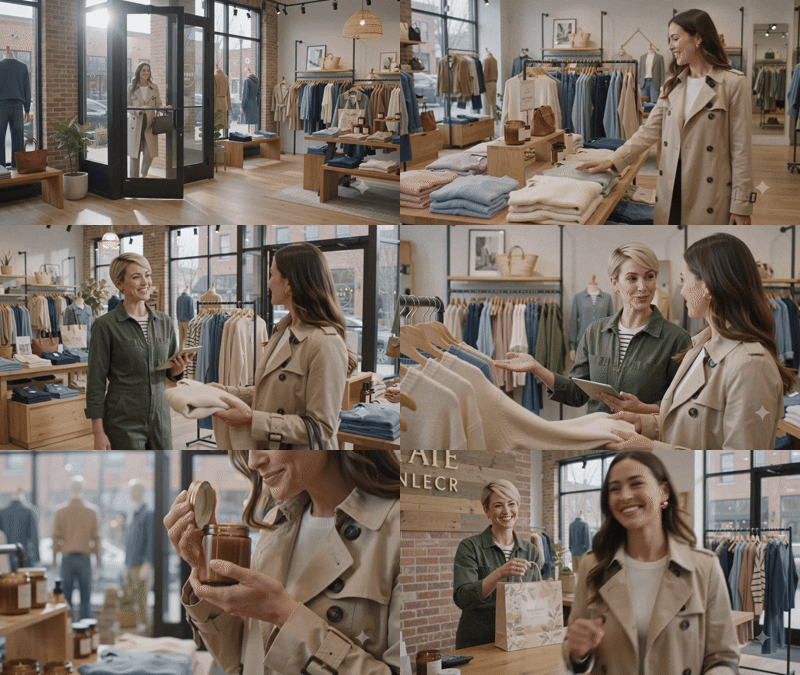
The physical retail landscape in 2026 is undergoing a fundamental metamorphosis, transitioning from a purely transactional environment into a high-impact, sensory-driven hub for brand storytelling and omnichannel fulfillment. Despite the proliferation of digital commerce, empirical data indicates a resilient return to physical storefronts, particularly among digitally native cohorts such as Generation Z, 81% of whom express a distinct preference for in-person shopping experiences.[1, 2] This resurgence is not a return to the status quo but rather an evolution toward a “phygital” reality, where the physical store acts as the critical interface between the digital brand and the tangible consumer experience.[1, 3] Establishing and growing a business within this modern context requires a sophisticated synthesis of traditional business planning, advanced location analytics, rigorous financial engineering, and a nuanced understanding of local regulatory and real estate landscapes.
Conceptualization and the Architectures of Planning
The genesis of a successful brick-and-mortar enterprise lies in the transition from a conceptual idea to a rigorous strategic roadmap. A well-constructed business plan serves as the essential blueprint, providing the foundation for operational reality and the primary mechanism for securing external capital.[4, 5] Within the professional retail domain, this plan is viewed as a dynamic document that must anticipate market shifts and define the unique value proposition that justifies a physical footprint in an increasingly digital world.[6, 7]
The architectural components of a retail business plan must be sufficiently granular to address the high overhead and logistical complexities inherent in physical storefronts.[8, 9] This includes an executive summary that distills the mission and financial trajectory, a detailed company description that boasts of competitive strengths such as prime location or proprietary expertise, and a comprehensive market analysis that identifies specific underserved demographics.[8, 10]
| Business Plan Component | Strategic Focus | Operational Implication |
|---|---|---|
| Executive Summary | Mission statement and financial high-level growth plans. | Sets the tone for investor engagement and internal alignment.[8] |
| Company Description | Unique selling propositions (USPs) and problem-solving capacity. | Defines the brand’s space in the market and its “why”.[8, 9] |
| Market Analysis | Industry outlook, target demographics, and competitive benchmarking. | Validates the chosen market and identifies competitive edges.[8, 10] |
| Organization & Management | Legal structure and leadership team experience. | Clarifies governance and minimizes operational risk.[8, 11] |
| Product & Service Line | Product lifecycle and intellectual property strategy. | Details the physical goods and value-added services offered.[8, 9] |
| Marketing & Sales Strategy | Customer acquisition and retention mechanisms. | Outlines the transition from awareness to transaction.[6, 8] |
| Financial Plan | Projected P&L, cash flow, and break-even analysis. | Provides the quantitative basis for sustainability.[7, 9] |
The planning phase is also the stage where the business model is tested against the “phygital” requirement. Modern retail plans must explicitly account for how the physical space will support digital interactions, such as online ordering for in-store pickup (BOPIS) or handling returns from e-commerce channels.[12, 13] This transformation of the storefront into a multi-functional logistics node is a primary driver of modern retail viability.[13]
Legal Structures and the Mitigation of Liability
One of the most consequential decisions for any retail entrepreneur is the selection of a legal structure, as this choice determines the parameters of personal liability, taxation, and the capacity for future capitalization.[14, 15] In the brick-and-mortar sector, where premises liability and inventory loss are constant risks, structural protections are not merely administrative but strategic.[15, 16]
For many independent retailers, the Limited Liability Company (LLC) has become the preferred vehicle, offering a balance of liability protection and tax flexibility.[16, 17] Unlike a sole proprietorship or a general partnership, where personal assets such as homes and savings are exposed to business-related legal claims or bankruptcy, the LLC shields the individual owner by establishing the business as a separate legal entity.[16, 18]
| Business Structure | Liability Protection | Tax Treatment | Strategic Suitability |
|---|---|---|---|
| Sole Proprietorship | None (Personal assets at risk). | Pass-through (Personal rates). | Low-risk, individual test concepts.[15, 18] |
| General Partnership | Shared unlimited personal liability. | Pass-through (Individual rates). | Family-owned or co-managed boutiques.[15, 18] |
| LLC | Limited personal liability. | Flexible (Pass-through or Corporate). | Most small to medium retail startups.[16, 17] |
| S-Corporation | Limited personal liability. | Pass-through (Avoids double tax). | Profitable firms optimizing self-employment tax.[16, 18] |
| C-Corporation | Limited personal liability. | Double taxation (Corporate/Dividend). | Firms seeking VC or large-scale expansion.[15, 16] |
The selection process must consider long-term goals. While a corporation involves more administrative complexity—such as maintaining a board of directors and holding annual meetings—it is often necessary for businesses seeking outside investment or those planning to issue different classes of stock.[15, 16] Conversely, smaller retailers focusing on local community impact may find the simplicity of an LLC or an S-corp more aligned with their operational capacity.[16, 18]
Regulatory Navigation: Zoning, Permits, and Local Compliance
A physical storefront is bound by the local geography’s regulatory framework, which dictates not only what can be sold but how the physical space can be modified and utilized.[19, 20] Zoning laws are the primary instrument of local governance, designed to segregate land uses to maintain neighborhood character.[19, 20] For the retail entrepreneur, these laws can be a significant barrier to entry or an unexpected source of operational disruption.[19]
Before committing to a lease, it is imperative to verify that the property’s zoning category—whether commercial, industrial, historical, or aesthetic—permits the intended retail activity.[19, 21] In many urban environments, converting a space from one use to another, such as an office to a retail boutique, requires a “Change of Use” permit.[21] This process can be lengthy and expensive, as it often triggers requirements for increased parking capacity, upgraded fire suppression systems, or compliance with current accessibility standards.[21]
| Regulatory Requirement | Function | Strategic Risk |
|---|---|---|
| Zoning Variance | Allows for non-conforming use of land. | High cost and public hearing uncertainty.[20, 21] |
| Change of Use Permit | Approves a shift in the building’s function. | Triggers mandatory and costly facility upgrades.[21] |
| Seller’s Permit | Grants authority to collect sales tax. | Legal requirement for product-based retail.[20, 22] |
| Certificate of Occupancy | Confirms the building is safe for use. | Essential for insurance and opening doors.[21] |
| Home Occupation Permit | Regulates business run from a residence. | Restricts noise, traffic, and signage in residential areas.[20] |
The permitting process is not static. Retailers must also secure federal and state tax ID numbers (EINs) to facilitate payroll and tax filings, and apply for specific operational licenses that vary based on the nature of the products, such as food service permits or specialized retail licenses.[14, 20] Engaging with local council offices and neighborhood councils early in the process can mitigate political risks and foster community support for the launch.[21]
Financial Engineering: Startup Economics and Capital Allocation
The capital intensity of brick-and-mortar retail necessitates a sophisticated approach to financial modeling. Data for the 2024-2025 period indicates that the average cost to establish a retail storefront is approximately $40,000, although this figure can fluctuate between $50,000 and $150,000 depending on the store’s footprint, industry, and geographic location.[22, 23, 24]
Modeling Startup Costs
Startup costs are categorized into one-time launch capital and the recurring operating expenses required to sustain the business until it achieves profitability, a period that typically ranges from six to twelve months.[9, 23]
| Cost Category | Estimated Range | Key Variables |
|---|---|---|
| Business Registration | $50 – $550 | State filing fees and legal structure choice.[23, 25] |
| Real Estate (Monthly Rent) | $2,000 – $8,000+ | Market demand and foot traffic density.[23, 26] |
| Store Build-out/Renovations | $4,000 – $50,000 | Condition of space and aesthetic requirements.[22, 25] |
| Equipment & POS | $10,000 – $30,000 | Number of terminals and hardware complexity.[9, 23] |
| Initial Inventory | $5,000 – $50,000 | Product type and anticipated turnover rate.[23, 26] |
| Marketing & Branding | $500 – $3,000 | Scale of grand opening and digital ad spend.[23, 27] |
| Insurance Premiums | $600 – $1,200/year | Risk profile and employee count.[22, 26] |
The “learning curve” for new employees is a frequently overlooked financial factor. Store owners should budget between $1,500 and $4,000 per employee to account for the initial 20-40 hours of training before they reach full productivity.[23] Furthermore, labor remains the single largest recurring expense, with a small team of 3-5 hourly employees at $15/hour costing upwards of $15,000 monthly when taxes and benefits are included.[23]
Strategic Funding and Grant Programs
To mitigate the risk of high initial debt, savvy retailers utilize a diversified “capital stack” that includes personal savings (“skin in the game”), business loans, and equity financing.[9, 15] In 2025, specialized funding sources have emerged to support small physical businesses.
| Grant/Funding Source | Award Amount | Targeted Business Type |
|---|---|---|
| Amex Shop Small Grant | $20,000 | Established storefronts with <20 employees.[28] |
| Faire Small Business Grant | $5,000 | New retail stores (within 1 year) for inventory.[28, 29] |
| Verizon Digital Ready Grant | $10,000 | Small businesses completing digital training.[29, 30] |
| Amber Grant | $10,000+ monthly | Woman-owned business ventures.[30] |
| Shopify Capital | Variable | Revenue-based financing for platform users.[9] |
Grants are often industry-specific or demographic-specific, focusing on sustainability, underrepresented entrepreneurs, or community-impact projects.[28, 31] The application process for these funds requires a solid business plan and an explicit understanding of how the capital will be deployed to achieve the grantor’s mission.[31]
Market Intelligence: Catchment Analysis and Site Selection
The adage of “location, location, location” has been superseded by “data, data, data.” In 2025, site selection is a high-precision discipline that leverages Geographic Information Systems (GIS), foot traffic heat maps, and catchment area analysis to predict a storefront’s performance before a single dollar is spent on rent.[32, 33, 34]
Precision Site Selection Metrics
Modern retailers must look beyond simple pedestrian counts to understand the quality and movement of the people passing their potential storefront.[33, 35]
- Foot Traffic Patterns: Beyond raw numbers, analytics tools reveal visit duration (“dwell time”), peak hours, and movement patterns through the neighborhood.[33, 35]
- Catchment Area Mapping: This moves beyond a simple radius to a dynamic map of real-world travel patterns, showing where customers actually travel from and identifying physical barriers like highways or transit gaps that might impede access.[2, 33]
- Competitive Saturation: Identifying not just direct competitors (those selling the same products) but indirect competitors (those competing for the same consumer dollar and time).[32, 36]
- Cross-Visitation Trends: Analyzing how often potential customers visit neighboring businesses to identify synergistic opportunities, such as placing an athletic apparel store near a popular fitness center.[2, 34]
The Role of Analytical Tools
The shift toward automated, real-time data collection has replaced manual counting. Tools such as people counters using infrared or thermal imaging provide anonymous but accurate data on store visits and conversion rates.[35] Geofencing technology allows retailers to track mobile signals (with consent) to understand how the “surrounding trade area” interacts with the physical site, enabling hyper-localized advertising triggers.[27, 37]
The Real Estate Asset: Lease Negotiation and Structural Mechanics
For a brick-and-mortar business, the commercial lease is more than a cost; it is a critical operational variable. Poorly negotiated leases can result in hidden fees that consume 5% to 15% of total revenue, creating unsustainable financial pressure.[38, 39]
Deciphering the Triple Net (NNN) and Operating Expenses
Retailers must master the nomenclature of commercial real estate to avoid common pitfalls.[40, 41]
| Lease Structure | Tenant’s Direct Costs | Strategic Advantage |
|---|---|---|
| Triple Net (NNN) | Base Rent + Property Taxes + Insurance + Maintenance (CAM). | Lower base rent; high transparency but variable costs.[40, 41] |
| Gross Lease | Single flat monthly payment. | Maximum predictability for budgeting purposes.[40, 41] |
| Modified Gross | Base Rent + selected utilities or taxes. | Middle ground for multi-tenant urban buildings.[40, 41] |
| Percentage Lease | Base Rent + % of gross sales above a threshold. | Aligns landlord’s interests with tenant’s sales success.[40] |
Common Area Maintenance (CAM) charges are often the most contentious aspect of a retail lease.[42, 43] These fees cover the shared expenses of the property, such as snow removal, landscaping, and management fees. A professional negotiation strategy involves requesting a “CAM cap”—limiting the annual increase in these fees to 3% to 5%—and establishing explicit audit rights to review the landlord’s calculations.[42, 43, 44]
Negotiating Leverage and Concessions
Everything in a commercial lease is negotiable, provided the tenant has “BATNA” (Best Alternative To a Negotiated Agreement)—the ability to walk away to another viable space.[39]
- Tenant Improvement (TI) Allowance: A per-square-foot dollar amount provided by the landlord to fund the customization of the space. In 2025, typical arrangements range from $30 to $80 per square foot.[38, 42]
- Rent Abatement: Negotiating “free rent” periods (often 3 to 6 months) for the duration of the build-out allows the business to preserve cash flow before it begins generating revenue.[39, 42]
- Assignment and Subletting: Securing the right to transfer the lease to another party is essential for an exit strategy or if the business is sold.[42, 45]
- HVAC Responsibility: Tenants should avoid accepting full responsibility for structural systems. A better approach is to cap the tenant’s repair costs and leave major replacements to the landlord.[41, 45]
Operational Frameworks: POS, Inventory, and Integrated Technology
Operational excellence in physical retail is driven by a technology stack that unifies front-of-house customer service with back-of-house logistics.[11, 13] The goal is to eliminate friction and maximize the productivity of both staff and square footage.[46, 47]
The Integrated Point of Sale (POS) Ecosystem
In 2026, a POS is no longer just a cash register; it is the “brain” of the retail operation. Modern systems like Shopify POS or Square for Retail provide a single platform that manages every part of the business.[11, 27]
- Flexible Checkout Options: Utilizing handheld devices, self-ordering kiosks, and guest-facing terminals reduces wait times and allows staff to assist customers anywhere on the floor.[11]
- Unified Inventory: A single, real-time view of stock across both the physical store and the online shop is the “bedrock” of modern retail.[13] This enables features like “Buy Online, Pick Up In-Store” (BOPIS) and “Ship from Store,” capturing sales that might otherwise be lost to out-of-stock scenarios.[13]
- SmartScan and Barcode Integration: Moving products “from scan to shelf in seconds” using automated scanning tools minimizes the labor required for inventory management.[11]
- Retail-Enhanced Dashboards: Real-time tracking of trends and cost-tracking reports allow managers to make data-driven decisions on pricing and restocking.[11, 48]
Strategic Inventory Management
Inventory is a physical asset that ties up significant capital. Managing the “Sell-Through Rate” and “Stock Turnover” is critical for maintaining cash flow.[48, 49]
- Sell-Through Rate: This measures how much of the received inventory is sold within a period.Sell-Through Rate=(Units ReceivedUnits Sold)×100
- Stock Turnover: This identifies how many times inventory is sold or used over a specific period. A low turnover suggests overstocking or weak sales, while high turnover indicates efficient management.[49]
- Shrinkage Control: Tracking the loss of inventory due to theft, administrative errors, or fraud is essential. In 2025, the “Shrinkage Rate” is a key indicator of operational discipline.[48, 50]
Human Capital: Recruitment, Retention, and the Service Interface
In a physical store, the staff is the physical embodiment of the brand. As retail faces chronic high turnover rates, the focus has shifted toward “skills-based hiring” and “employee experience” to build high-performing teams.[51, 52]
The Recruitment Landscape of 2026
Top retail talent is no longer attracted solely by hourly wages. Recruiters must focus on a “contiguous candidate journey” that mirrors the customer experience.[23, 52]
- Skills-Based Hiring: Recruiters are five times more likely to search for candidates based on skills rather than educational background.[52] Assessing communication, adaptability, and problem-solving through structured interviews is now the standard.[51, 52]
- AI-Powered Sourcing: Platforms use semantic search and predictive analytics to find qualified candidates who may not be actively searching for jobs but are a perfect fit for a boutique’s specific culture.[51]
- Transparency in Pay: Voluntarily including pay ranges in job postings is a growing trend, utilized by 46% of organizations in 2025 to build trust and attract serious applicants.[53]
Onboarding and the “5 C’s” for Success
A structured onboarding process—rather than a “one-day event”—is the primary defense against early-tenure turnover.[23]
- Compliance: Handling all legal paperwork (tax forms, I-9s) digitally before the first day so the start can focus on the job.[23]
- Clarification: Explicitly detailing responsibilities and setting clear goals for the 30, 60, and 90-day milestones.[23]
- Culture: Sharing the “real story” of the company and its approach to customer service.[23]
- Connection: Introducing new hires to the team and assigning a “buddy” for the first several weeks.[23]
- Check-back: Scheduling formal feedback sessions at day 30, 60, and 90 to catch problems early.[23]
Continuous learning through “microlearning” platforms—offering bite-sized, mobile-accessible training on specific tasks like “replenishing perishables”—ensures that staff remain sharp without being overwhelmed.[54, 55] Gamification, such as sales challenges with leaderboards and digital badges, can boost productivity by as much as 48% and foster a more engaged work environment.[55]
Market Activation: Grand Openings and Localized PR
The launch of a physical storefront is a critical “moment of truth” that establishes the brand’s identity within the community.[56, 57] Successful grand openings in 2026 utilize a “soft launching” strategy—inviting a small group of loyal fans or neighbors first to iron out operational issues and gather photos and reviews for the official public event.[57, 58]
The Grand Opening Toolkit
| Tactic | Objective | Strategic Impact |
|---|---|---|
| Ribbon-Cutting | Public photo opportunity. | Engaging local leaders and media for free PR.[57, 59] |
| Gift with Purchase | Driving day-one activity. | Turning early customers into “brand ambassadors” with swag.[58, 59] |
| Local Business Partnership | Community trust. | Leveraging the star power of a loved local bakery or coffee shop.[57, 60] |
| In-Store Experiential Event | Sensory engagement. | Book signings, live music, or cocktail demos that fit the niche.[56, 59] |
| Fundraising/Charity Tie-in | Brand values. | Establishing the business as a charitable member of the neighborhood.[56, 57] |
| Viral Social Promotion | Reach and excitement. | Using TikTok or Instagram Reels to create a viral “countdown”.[58, 59] |
Post-opening growth is sustained by “experiential retail”—moving beyond the “buy-and-leave” model.[61, 62] This includes “phygital” elements such as AR mirrors that let shoppers virtually try on clothes or smart kiosks that offer personalized coupons via spin-to-win games.[3, 63] These experiences drive “dwell time,” which has a direct correlation with increased conversion rates and customer loyalty.[1, 2]
Local SEO and Digital Dominance
For a physical store, the “front door” is increasingly found on a mobile search screen. Local SEO is the vital mechanism that converts “near me” searches—which have grown by 900% in recent years—into actual foot traffic.[64, 65]
The 2026 Local Search Hierarchy
Google’s ranking for the “Local Pack” is determined by three core pillars: Relevance (how well you match the query), Distance (how close you are to the searcher), and Prominence (how well-known and trusted you are).[64, 66]
- Google Business Profile (GBP) Mastery: This is the “digital storefront on steroids”.[65] Retailers must choose hyper-specific categories (e.g., “Handmade Jewelry Store” vs. just “Store”), post weekly updates, and upload high-quality imagery, which can increase profile views by 35%.[65, 67]
- Citation Consistency: The business name, address, and phone number (NAP) must be 100% consistent across Google, Yelp, Bing, Facebook, and the company website.[64, 65, 68]
- The Review Loop: Positive reviews are the strongest social proof. Retailers should train staff to naturally ask for reviews after positive interactions and respond to every single review, including negative ones, to signal to Google that they are an active community member.[64, 67]
- Local Content Strategy: Creating neighborhood-specific landing pages and blog posts that use local landmarks or district names helps search engines anchor the business to a specific geographic community.[64, 65]
- Schema Markup: Adding “LocalBusiness” structured data to the website’s code allows search engines to instantly identify hours, geolocation, and specific service areas.[64, 66]
Growth Acceleration: Omnichannel Loyalty and Data-Driven Personalization
Growth in the brick-and-mortar sector is no longer achieved by opening more stores but by increasing the “Customer Lifetime Value” (CLV) within existing locations through omnichannel integration.[13, 47]
The Omnichannel Advantage
Customers who shop across multiple channels are 30% more valuable than single-channel shoppers.[13] A truly effective growth strategy places the customer at the center, ensuring that every touchpoint—from the mobile app to the physical shelf—delivers a unified brand experience.[13, 69]
- BOPIS and Curbside Pickup: These solutions yield documented improvements in conversion rates and often lead to additional impulse purchases when the customer enters the store.[12, 13]
- Unified Customer Profiles: Stitching together data from website visits, social media interactions, and in-store purchases gives a complete picture of the customer, allowing staff to offer genuine personalization upon greeting.[2, 13]
- Omnichannel Loyalty Programs: Modern programs allow customers to earn and redeem rewards anywhere—scanning a code in-store or applying points at an online checkout.[12, 69] This builds an “emotional bond” rather than just a points-based system.[69]
- Visual Search and AR: Implementing image-based discovery (allowing customers to upload photos to find products) can increase sales by 15%, while AR-enhanced store visits allow for virtual room planning or deep-dive product information scans.[27]
Quantitative Governance: The Retail KPI Hierarchy
To manage a brick-and-mortar business “like a boss,” owners must transition from intuitive management to “quantitative governance”.[48, 70] Monitoring a “measurement spine” of key performance indicators (KPIs) allows for the identification of revenue opportunities and operational inefficiencies in real time.[2, 48]
Core Sales and Operational KPIs
| KPI Domain | Specific Metric | Strategic Relevance |
|---|---|---|
| Space Efficiency | Sales per Square Foot | Compares revenue to floor space; indicates productivity of the asset.[46, 48, 50] |
| Transaction Success | Conversion Rate | Buyers / Total Foot Traffic; measures effectiveness of layout and staff.[47, 48] |
| Profitability | Gross Profit Margin | (Net Sales – COGS) / Net Sales; ensures production/purchase costs are managed.[48, 49] |
| Inventory Health | Stock Turnover | Measures how many times stock is replaced; prevents overstock/stockouts.[48, 49] |
| Employee Performance | Sales per Employee | Guides staffing levels and identifies training needs.[48, 50] |
| Customer Sentiment | Net Promoter Score (NPS) | Measures satisfaction and likelihood of brand advocacy.[37, 47] |
| Growth Potential | Customer Lifetime Value (CLV) | Total profit expected from one account; prioritizes marketing spend.[47, 48] |
Monitoring the “Shrinkage Rate”—loss due to shoplifting or admin errors—is equally vital for financial stability.[48, 50] By applying the SMART framework (Specific, Measurable, Achievable, Relevant, Time-bound) to these KPIs, a retailer can set concrete targets, such as increasing the conversion rate from 2.5% to 3.5% by the end of a specific quarter.[47]
Strategic Synthesis and Outlook
The future of brick-and-mortar retail in 2026 and beyond is defined by the “resurgence of the physical,” but only for those businesses that successfully integrate technology with human connection.[2, 3] The storefront has become a logistics-marketing-experience hybrid. Success requires a commitment to iterative learning—treating the business as a continuous growth cycle of “Measure, Learn, and Repeat”.[2] By mastering the nuances of commercial real estate, adhering to the rigors of local zoning, engineering a sound financial foundation, and utilizing advanced data analytics, entrepreneurs can establish brick-and-mortar businesses that act as powerful anchors for both their communities and their brands. Growth is no longer about physical footprint alone; it is about the depth of the customer relationship and the precision of the omnichannel experience.
——————————————————————————–
- Experiential Retail – Examples & Strategies – TruRating, https://trurating.com/blog/experiential-retail/
- Retail Location Analytics Tips to Drive Sales in 2025 – Voyado, https://voyado.com/resources/blog/retail-location-analytics/
- Inside The Store, Outside The Box: 3 Experiential Retail Trends Dominating 2025, https://www.bdssolutions.com/inside-the-store-outside-the-box-3-experiential-retail-trends-dominating-2025/
- Plan your business | U.S. Small Business Administration, https://www.sba.gov/business-guide/plan-your-business
- Starting a Business Guide | Georgia.gov, https://georgia.gov/starting-business-guide
- High-level retail business plan examples – Solink, https://solink.com/resources/industry-insights/business-plan-examples-retail/
- Business Plan Template for a Startup Business – SCORE, https://www.score.org/resource/template/business-plan-template-a-startup-business
- Write your business plan | U.S. Small Business Administration, https://www.sba.gov/business-guide/plan-your-business/write-your-business-plan
- How to Write a Retail Store Business Plan (+ Examples) in 2025 …, https://www.shopify.com/retail/retail-store-business-plan
- How To Conduct Market Research for the Retail Industry – Quantilope, https://www.quantilope.com/resources/glossary-conduct-market-research-retail
- How to Write a Retail Store Business Plan in 2025 (Free Template), https://pos.toasttab.com/blog/on-the-line/retail-store-business-plan
- The Power of Omnichannel Retail in Fashion – JWU Online, https://online.jwu.edu/blog/the-power-of-omnichannel-retail-in-fashion/
- Discover Top Omnichannel Retail Solutions for Seamless Growth – Toki, https://www.buildwithtoki.com/blog-post/omnichannel-retail-solutions
- Launch your business | U.S. Small Business Administration, https://www.sba.gov/business-guide/launch-your-business
- Choosing the Right Business Structure for Your Retail or Service Business – Welch LLP, https://welchllp.com/insights/knowledge/choosing-the-right-business-structure-for-your-retail-or-service-business/
- What Business Structure Should I Select? – Cobb Cole, https://cobbcole.com/blog/what-business-structure-should-i-select/
- Choose a business structure | U.S. Small Business Administration, https://www.sba.gov/business-guide/launch-your-business/choose-business-structure
- Choosing a Business Structure | Guide – The Hartford Insurance, https://www.thehartford.com/business-insurance/strategy/business-structure
- What You Need to Know About Small Business Zoning Laws – Lendio, https://www.lendio.com/guides/small-business-zoning-laws
- Understanding Zoning, Licensing, and Permits – Dummies.com, https://www.dummies.com/article/business-careers-money/business/small-business/general-small-business/understanding-zoning-licensing-and-permits-199052/
- Starter Kit for Retail | LA Business Navigator, https://business.lacity.gov/plan-business/starter-kits/starter-kit-retail
- How Much it Costs to Open a Retail Store in 2025 – Shopify, https://www.shopify.com/retail/how-much-it-costs-to-open-a-retail-store-in-2025
- How Much Does It Cost to Start a Business? [2025 Guide] – Homebase, https://www.joinhomebase.com/blog/how-much-does-it-cost-to-start-a-business
- Average Cost Of Starting A Small Business | Bankrate, https://www.bankrate.com/loans/small-business/small-business-average-cost/
- How much does it cost to open a retail store? – Helcim, https://www.helcim.com/guides/how-much-does-it-cost-to-open-a-retail-store/
- How Much It Costs to Start a Retail Store in 2025 – Lightspeed, https://www.lightspeedhq.com/blog/how-much-does-it-cost-to-start-a-retail-store/
- The Top 8 Retail Business Trends of 2025 | ASD Market Week, https://asdonline.com/blog/retail-news/retail-trends-medium-sized-retailers/
- Free Grants and Programs for Small Business | CO- by US Chamber of Commerce, https://www.uschamber.com/co/run/business-financing/small-business-grants-and-programs
- 5 Small Business Grants to Apply for Right Now [December 2025], https://smallbusinessxchange.com/news/5-small-business-grants-to-apply-for-right-now/132756/
- Small Business Grants: 32+ Funding Opportunities for 2025 – LegalZoom, https://www.legalzoom.com/articles/small-business-grants-2025
- Grants for Small Business: 40+ Free Funding Options (2026) – Shopify, https://www.shopify.com/blog/small-business-grants
- Retail Location Scouting: How to Find the Ideal Space for Your Shop, https://ebgtx.com/commercial-broker-services/business-broker-services/business-owners-resources/retail-location-scouting-how-to-find-the-ideal-space-for-your-shop/
- 7 essential metrics for smarter retail location strategy | Echo Blog, https://www.echo-analytics.com/blog/7-essential-metrics-for-smarter-retail-location-strategy
- Retail Foot Traffic Analysis: A Comprehensive Guide | AlphaMap, https://www.alphamap.com/blog/retail-foot-traffic-analysis-a-comprehensive-guide
- Retail Foot Traffic: How to Measure and Optimize Store Traffic – Shiftlab, https://www.shiftlab.io/blog/retail-foot-traffic-how-to-measure-and-optimize-store-traffic
- Conducting Market Research for Your Retail Business – Ankorstore, https://blog.ankorstore.com/conducting-market-research/
- How To Do Market Research For Retail Companies (Pro Tips), https://www.driveresearch.com/market-research-company-blog/7-market-research-options-for-retail-market-research-company/
- Lease Negotiation Tips for Small Business Success, https://smallbusinessxchange.com/news/lease-negotiation-tips-for-small-business-success/133334/
- Commercial Real Estate Negotiation Tips: Win 2025 – The Signature Realty, https://thesignaturerealty.com/commercial-real-estate-negotiation-ultimate-guide/
- 12 tips for negotiating a commercial lease – BDC, https://www.bdc.ca/en/articles-tools/money-finance/buy-lease-commercial-real-estate/how-to-negotiate-commercial-lease-effectively
- Commercial Lease Negotiation Strategies for Landlords, https://toljcommercial.com/commercial-lease-negotiation
- The Complete Guide to Commercial Lease Negotiations for Corporate Occupiers in the USA, https://www.vestian.com/news/the-complete-guide-to-commercial-lease-negotiations-for-corporate-occupiers-in-the-usa
- Negotiating a Commercial Lease Agreement: A Guide For Landlords, https://www.re-leased.com/lease-tenant-management/commercial-lease-negotiation-guide-for-cre-landlords
- How to Avoid Costly Lease Mistakes with Trusted Negotiation Specialists – Hughes Marino, https://hughesmarino.com/blog/2025/12/09/how-to-avoid-costly-lease-mistakes-with-trusted-negotiation-specialists/
- Commercial Lease Do’s & Don’ts – Renaud Consulting, https://renaudconsulting.net/news/2024/11/commercial-lease-dos-and-donts-best-practices-for-tenants/
- 8 Important Metrics for Retail Industry KPIs | Tableau, https://www.tableau.com/learn/articles/retail-industry-metrics-kpis
- The Ultimate Guide to Retail KPIs & Metrics for 2025 – Improvado, https://improvado.io/blog/retail-kpi
- 40 of the most important retail KPIs to track – Solink, https://solink.com/resources/industry-insights/kpis-for-retail-stores/
- For retail store businesses selling products to consumers, tracking the right Key Performance Indicators (KPIs) is crucial for, https://sbpi.hbscny.org/wp-content/uploads/Key-performance-indicators-KPIs-for-a-retail-store-1-1.pdf
- Top 25+ Retail KPIs and Metrics for 2025 Reporting – insightsoftware, https://insightsoftware.com/blog/retail-kpis-and-metrics-for-reporting/
- Retail Recruitment Strategies In 2025 : A Complete Guide | Go Perfect, https://www.goperfect.com/blog/retail-recruitment-strategies-that-work-in-2025
- What Should Your Hiring Strategy Be in 2025? – Workday Blog, https://blog.workday.com/en-us/what-should-your-hiring-strategy-be-in-2025.html
- Amid Hiring Challenges, Organizations Are Turning to More Creative Solutions to Fill Positions – SHRM, https://www.shrm.org/topics-tools/research/2025-talent-trends/recruiting-strategies
- Top 6 Ideas And Examples To Boost Retail Staff Training – Elucidat, https://www.elucidat.com/blog/retail-staff-training-ideas/
- How to Improve Employee Engagement in Retail (2025) – ThriveSparrow, https://www.thrivesparrow.com/blog/employee-engagement-in-retail
- 29 Proven Grand Opening Ideas For Small Businesses – Sling, https://getsling.com/blog/grand-opening-ideas/
- 10 of the Best Grand Opening Ideas for Retail Stores – V-Count, https://v-count.com/10-of-the-best-grand-opening-ideas-for-retail-stores/
- 11 Grand Opening (And Reopening) Ideas For Any Business | Ecommerce Fastlane, https://ecommercefastlane.com/11-grand-opening-and-reopening-ideas-for-any-business/
- 21 Grand Opening Ideas to Launch Your Business in 2026 – Shopify, https://www.shopify.com/blog/grand-opening-ideas
- 20 Grand Opening Ideas for Your New Business | Paperless Post, https://www.paperlesspost.com/blog/grand-opening-ideas/
- The Rise of Experiential Retail: Why Pop-Ups Are the Future of Shopping – OgmentO, https://ogmento.io/blog/the-rise-of-experiential-retail-why-pop-ups-are-the-future-of-shopping/
- The Top 5 Retail Trends You Can t Afford to Ignore in 2025 – TEAMSable, https://www.teamsable.com/the-top-5-retail-trends-in-2025/
- Retail Promotion Ideas: Maximizing Customer Engagement in 2025 – Toast POS, https://pos.toasttab.com/blog/on-the-line/retail-promotion-ideas
- Local SEO: The Definitive Guide for 2025 (+ Free Toolkit) – Backlinko, https://backlinko.com/local-seo-guide
- The Free Ultimate Local SEO Checklist for 2025 – LAv1, https://lav1.com/the-free-ultimate-local-seo-checklist-for-2025/
- Local SEO Checklist [2025] | + Free Template – Digital Nomads HQ, https://digitalnomadshq.com.au/blog/local-seo-checklist-2025/
- Local SEO Checklist to Boost Visibility in 2025 – Search Atlas – Advanced SEO Software, https://searchatlas.com/local-seo-checklist/
- Local SEO Checklist 2025: 11 Powerful Must-Do Steps for Success – Blurbpoint, https://www.blurbpoint.com/local-seo-checklist/
- Omnichannel Loyalty Strategies Every Brick-and-Mortar Merchant Should Know, https://merchant.loyalnsave.com/blog/omnichannel-loyalty-strategies-brick-and-mortar-merchants/
- Business Guide | U.S. Small Business Administration, https://www.sba.gov/business-guide


Leave a comment