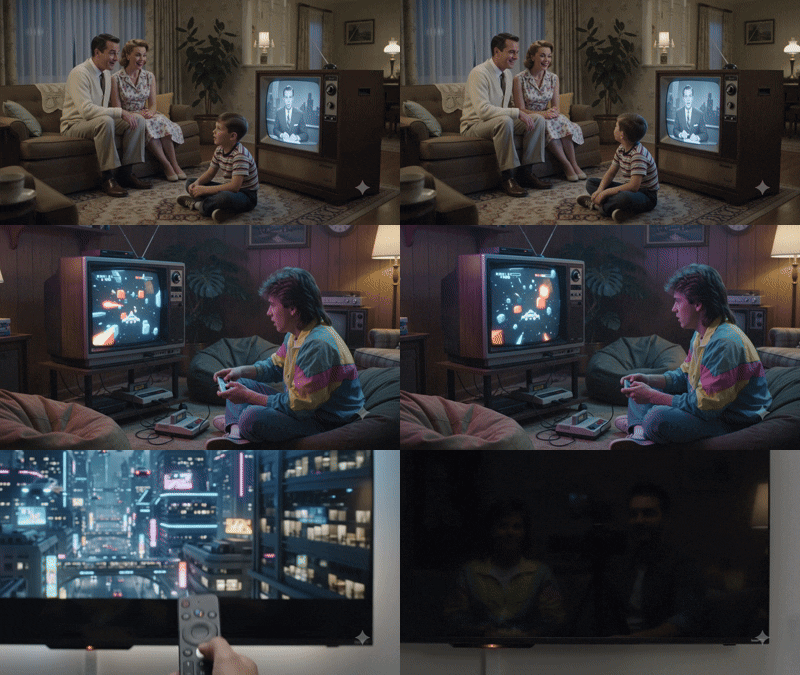
The broadcast television landscape in 2026 represents a sector in the midst of a radical reset, where legacy economic models are colliding with the imperatives of a digital-first distribution architecture. For the strategic investor or entrepreneur, starting and growing a television station no longer merely involves the management of a terrestrial signal; it requires navigating a multifaceted ecosystem of regulatory compliance, high-capital infrastructure, and a bifurcated revenue model that balances traditional advertising against the high-stakes world of retransmission consent. The current era is defined by the “pay TV singularity,” a structural inflection point where traditional linear reach is losing its status as a guaranteed mass-market utility, forcing a transition toward the ATSC 3.0 standard and the monetization of data as much as content.[1]
Regulatory Framework and the FCC Licensing Environment
The inception of a broadcast television business is governed primarily by the Federal Communications Commission (FCC) and the strictures of the Communications Act of 1934, as amended. This regulatory foundation ensures that all licensees operate as “public trustees,” a model that mandates that the station serves the public interest, convenience, and necessity.[2, 3] In 2026, the process of starting a station is managed through the Television Branch of the Video Services Division, which handles construction permits, license renewals, and the assignment of licenses.[2]
A critical transition occurring in 2026 is the modernization of the FCC’s filing infrastructure. The legacy Consolidated Database System (CDBS) is being fully phased out in favor of the Licensing and Management System (LMS). This shift has led to a renaming of standard forms, which is essential for new entrants to understand to avoid administrative delays.[4]
| Transaction Type | Old CDBS Form | New LMS Schedule (2025) | Regulatory Purpose |
|---|---|---|---|
| Construction Permit | Form 301 | Form 2100, Schedule 301 | Approval for new facilities or major changes |
| License Renewal | Form 303-S | Form 2100, Schedule 303-S | Periodic validation of station operations |
| License Assignment | Form 314 | Form 2100, Schedule 314 | Approval for the sale of a station |
| Children’s TV Report | Form 398 | Form 2100, Schedule H | Documentation of educational programming |
The “public interest” requirement is not a vague suggestion but a set of measurable operational burdens. Every station must maintain an Online Public Inspection File (OPIF) that includes quarterly Issues/Programs Lists. These documents must describe the programming that provided the station’s “most significant treatment of community issues”.[5] Failure to maintain these records with precision—including the title, duration, and summary of each segment—can lead to significant fines or the denial of license renewal.[5]
Low Power Television and 2026 Regulatory Updates
For many new entrants, the Low Power Television (LPTV) service provides a more accessible entry point due to lower capital requirements and a more flexible regulatory environment compared to full-power stations. However, the FCC significantly tightened the rules for the LPTV service in late 2025.[6, 7] The December 2025 Report and Order introduced a formal requirement that all LPTV stations broadcast an operational video signal, clarifying that test patterns or still slides with unrelated audio are insufficient for maintaining a license.[7] This rule prevents “spectrum squatting” and ensures that the airwaves are utilized for active community service.
Furthermore, the FCC established a new method for stations to change their community of license (COL). A station’s protected signal contour must now overlap the boundary of its chosen COL, and stations have a six-month window from the rule’s effective date to file for a compliant COL.[6, 7] Minor modifications to facilities, such as antenna relocation, are now limited to a maximum distance of 49.1 kilometers (approximately 30.5 miles) from the existing reference coordinates, a slight increase from previous limits intended to give broadcasters more leeway in site selection.[7]
Operational Compliance and Children’s Programming
Compliance with the Children’s Television Act is a major hurdle for new station managers. Stations are required to air an average of three hours per week of “core” children’s programming, which must be at least 30 minutes in length and specifically designed to meet the educational and informational (E/I) needs of children aged 16 and under.[5] This programming must be identified with the “E/I” on-air bug and listed in annual reports filed by January 30th of each year.[5] The documentation must be robust; the FCC has historically issued fines to stations that fail to provide adequate proof of compliance or that omit necessary certifications during the license term.[5]
Technical Infrastructure and Capital Expenditure
Building a television station in 2026 is a high-cost endeavor that requires a deep understanding of both RF (radio frequency) engineering and modern IT systems. The transition to the ATSC 3.0 standard has introduced a layer of complexity where the transmission system must function essentially as a wireless broadband pipe.[8, 9]
Transmission and Tower Assets
The most significant physical asset is the transmission tower and its associated hardware. For a full-power digital station, the capital investment can easily exceed $3.5 million.[10] Given the liability and maintenance expenses, many stations choose to rent space on existing towers rather than build their own, with monthly rental rates averaging around $2,000.[11]
| Transmission Component | Estimated 2025 Cost | Function and Strategic Importance |
|---|---|---|
| Tower (1,500 ft, guyed) | $1,800,000 | Primary structure for signal propagation [10] |
| ATSC 3.0 Transmitter | $325,000 – $950,000 | Converts content into RF signals [10] |
| Transmission Line | $85,000 – $340,000 | Carries signal from transmitter to antenna [10] |
| Broadcast Antenna | $50,000 – $375,000 | Radiates signal to the viewing area [10] |
| Tower Foundation | $200,000 | Ensures structural integrity in wind/ice [10] |
| Frequency Reference | $3,500 | Maintains signal stability and sync [10] |
| Line Dehydrator | $3,000 | Prevents moisture buildup in transmission lines [10] |
When selecting a location for a transmitter, “higher is better” remains the golden rule to ensure maximum line-of-sight coverage.[12] Broadcasters must also adhere to strict RF exposure limits, keeping antennas away from human-occupied areas and ensuring the site is properly grounded to protect against lightning and power surges.[12]
Studio and Production Technology
The production side of a television station has undergone a software-driven revolution. While traditional studio cameras still command prices as high as $450,000 per unit for top-tier models, many stations are adopting Pan-Tilt-Zoom (PTZ) cameras.[10, 13] These remote-controlled systems allow a single operator to manage several cameras, dramatically reducing labor costs.[13] The “core” of the studio is the video mixer (switcher), which manages sources and transitions. Modern software mixers like vMix or cloud-based solutions are becoming the preferred choice for smaller or niche stations due to their lower price point and flexibility for external live streams.[13]
Master control and playout systems are the final link in the chain before transmission. These systems, which range from $100,000 to $250,000, automate the scheduling of programs and commercials.[10] Integration with Media Asset Management (MAM) systems is vital for cataloging and retrieving digital files across a multi-platform operation.[14] Furthermore, stations must invest in Non-Linear Editing (NLE) software (such as Adobe Premiere or Avid) and specialized Character Generator (CG) systems for creating on-screen graphics and news banners.[14]
Economic Drivers: Retransmission and Advertising
The financial viability of a broadcast station rests on two primary pillars: retransmission consent fees and spot advertising. In the 2026 market, these streams are facing significant structural challenges as the media landscape shifts from linear cable to over-the-top (OTT) streaming.
The Retransmission Fee Crisis
Retransmission consent fees are the per-subscriber payments made by cable and satellite providers (MVPDs) to local broadcasters. For many stations, this has been the most reliable revenue stream, often contributing 50% or more of total income.[15] However, as pay TV penetration has collapsed from 80% in 2011 to just 34.4% in late 2024, the total revenue pool is shrinking.[1]
The “Retransmission Fee Trap” is a dual-edged threat. As the subscriber base evaporates, national networks (ABC, CBS, NBC, Fox) are simultaneously demanding higher “reverse compensation”—a share of the retransmission fees—from their local affiliates.[1, 16] This leaves local stations with a smaller slice of a dwindling pie. Some station owners, such as Gray Media, reported a 6% year-over-year decline in retransmission revenue in 2026, signaling that the growth era for this model may be over.[1]
Advertising Dynamics and Market Rates
Traditional spot advertising remains cyclical, heavily influenced by political spending and major events like the Olympics. In 2026, a non-election year, core local spot revenue is projected to decline by roughly 4% to $7.66 billion.[1] National spot advertising is falling even faster, with a 4.3% decline projected as advertisers shift their budgets toward digital platforms like YouTube and Connected TV (CTV).[1, 17]
| Market Tier (DMA Rank) | 30-Second Local Ad Rate | Prime Time (7-11 PM) |
|---|---|---|
| Top 10 (NYC, LA, CHI) | $5,000 – $50,000+ | $50,000 – $100,000+ |
| Large (11-50) | $2,000 – $10,000 | $15,000 – $50,000 |
| Mid-Sized (51-150) | $500 – $3,000 | $5,000 – $15,000 |
| Small (151-210) | $200 – $1,500 | $2,000 – $5,000 |
To combat these declines, stations are increasingly selling multi-platform bundles. These include traditional over-the-air (OTA) spots combined with digital ads and CTV inventory. The BIA forecasts that total local TV revenue (including digital) will reach $18.3 billion in 2025, a slight increase from $16.8 billion in 2024, driven by the growth of digital revenue streams.[18]
Human Capital and Organizational Architecture
Growing a television business requires a sophisticated organizational structure that can balance editorial, technical, and commercial demands. In 2026, the average annual salary for a television station employee is $60,594, but this figure is highly dependent on market size and role.[19]
Departmental Structure
A standard television station is divided into several key departments, each with its own leadership and specific operational goals.[20]
- Executive Leadership: Led by a General Manager (GM) or CEO who oversees the station’s strategic direction and ensures all departments are aligned with corporate goals.[20, 21]
- News Department: The most visible arm of the station, responsible for news gathering, production, and telecast. It is led by a News Director and includes anchors, reporters, and producers.[20, 21]
- Sales and Marketing: This department generates revenue through ad sales and sponsorships. Account Executives manage relationships with advertising agencies, while the Marketing team focuses on brand awareness.[21]
- Engineering and IT: Critical for the 2025 environment, this team maintains the technical infrastructure, from the studio cameras to the transmitter and the station’s cybersecurity systems.[21, 22]
- Programming: Responsible for acquiring syndicated content (e.g., talk shows, game shows) and scheduling it to maximize ratings and ad revenue.[21]
Labor Costs and Union Rates
For stations producing original content or commercials, labor costs are a significant factor. The SAG-AFTRA rates for 2025 provide a benchmark for performer costs in both programs and commercials.[23]
| Performer Category (2025 Rates) | Day Rate | Weekly Scale |
|---|---|---|
| Major Role (Budget > $2M) | $1,246 | $4,326 |
| Small Budget Performer (50K−300K) | $249 | N/A |
| Series Regular (13 Episodes) | N/A | $4,326 – $5,205 |
| 30-Sec Comm. (On-Camera, 13 Wks) | $2,100 | N/A |
| 30-Sec Comm. (Off-Camera, 13 Wks) | $1,575 | N/A |
The use of “multi-skilled journalists” (MSJs) is a growing trend to control labor costs, particularly in smaller markets. These individuals are responsible for reporting, filming, and editing their own stories, which streamlines the news-gathering process but increases the technical burden on individual employees.[24]
The ATSC 3.0 (NextGen TV) Pivot
The long-term growth of the broadcast industry is increasingly tied to the transition to ATSC 3.0. This new standard allows broadcasters to transmit Internet Protocol (IP) packets, effectively turning the station into a wireless data provider.[8, 9]
Datacasting and New Business Models
The potential for “datacasting” opens up revenue streams that are entirely separate from traditional video advertising. Broadcasters can sell their bandwidth for a variety of services:
- Broadcast Positioning System (BPS): This serves as a backup to GPS, which is a matter of national security. ATSC 3.0’s resilient signal can deliver precise timing and location data even in environments where satellite signals are weak.[25]
- Automotive and IoT Updates: Delivering software updates to millions of connected cars or devices simultaneously is more efficient via broadcast than through cellular networks.[9, 25]
- Dynamic Ad Insertion (DAI): Because the signal is IP-based, stations can use server-side ad insertion to deliver targeted, personalized commercials to different viewers watching the same program, similar to how ads function on YouTube or Hulu.[26]
Strategic Challenges to ATSC 3.0
Despite the promise, the 3.0 transition is fraught with challenges. The standard is not backward-compatible, and the “simulcast” requirement—where a station must continue to broadcast in the old 1.0 format while launching 3.0—is a significant drain on bandwidth and resources.[8, 27] Furthermore, the lack of an FCC mandate for 3.0 tuners in new television sets has slowed consumer adoption, with some manufacturers even removing the tuners from their latest models due to royalty and patent disputes.[28]
Programming Strategy and Syndication
For independent stations or those with weak network affiliations, programming is the primary driver of audience share. Historically, syndicated shows like “Wheel of Fortune” or “Judge Judy” provided the “cross-subsidies” that allowed stations to fund expensive news departments.[16] However, as viewers move to digital platforms, these reliable audience-grabbers are losing their potency.
In 2025, the cost for syndicated content is often based on the population served and the “run” of the show. For themed programming, license fees can range from $1,250 for short-form content to over $4,250 for high-end, year-long commercial use.[29]
| Content Duration | Non-Commercial License (2025) | Commercial Use License (2025) |
|---|---|---|
| < 5 Minutes | $1,250 | $1,500 |
| 5 – 23 Minutes | $2,000 | $2,250 |
| 23 – 30 Minutes | $3,000 | $3,250 |
| 30 – 60 Minutes | $3,500 | $3,750 |
| 60+ Minutes | $3,750 | $4,250 |
Strategic growth in programming now involves “hyper-local” content that cannot be easily replicated by national streaming services. This includes local high school sports, council meetings, and culturally specific programming.[30, 31] Some proponents suggest that the ATSC 3.0 IP-layer could be used to revive public access television, creating “dedicated civic streams” that provide community-specific information that commercial outlets typically ignore.[31]
Market Valuation and M&A Activity
The broadcast sector in 2026 is a market of extremes. Large station groups are consolidating to gain bargaining power, while smaller players are struggling to find capital. Valuing a television station involves a mix of its physical assets, its audience share, and its spectrum potential.[32]
Valuation Heuristics
Several rules of thumb are used by industry analysts to provide a quick benchmark for station value [32]:
- EBITDA Multiples: Standalone stations typically trade between 6x and 10x EBITDA. Stations in smaller, fragmented markets may trade lower, at 4x to 6x.[32]
- Revenue Multiples: Healthy, profitable stations often trade between 1x and 3x annual gross revenue.[32]
- DMA Reach: In large markets, a station may be valued at $1 to $3 per total TV household in its Designated Market Area (DMA).[32]
The M&A Climate
In 2025, merger and acquisition (M&A) activity is poised for a significant uptick. This is driven by a shift toward more favorable financing conditions and a potential relaxation of broadcast ownership rules by the FCC.[33, 34] The current national ownership cap of 39% is being re-evaluated, as broadcasters argue it is an “outdated regulatory distortion” in a world where streaming services face no such reach limitations.[16, 35]
| Key Private Equity Firm | Focus Area in 2026 | Strategic Influence |
|---|---|---|
| Thoma Bravo | Software and Media Tech | Focus on “buy-and-build” software strategies [36] |
| Hellman & Friedman | Large-scale Equity | Concentrated portfolio approach with management [36] |
| Leonard Green & Partners | Service-driven sectors | Emphasis on operational improvements and cash flow [36] |
| Novacap | Media Measurement | Recently acquired Integral Ad Science for $1.9B [37] |
Acquisitions in 2026 are increasingly focused on “horizontal mergers,” where traditional media companies acquire digital ad agencies or demand-side platforms (DSPs) to offer advertisers a more comprehensive set of tools.[34]
Conclusions and Future Outlook
Growing a broadcast television business in the late 2020s requires a departure from the “analog economics” of the past. The evidence suggests that a station’s value is no longer just in its ability to air a 30-second commercial but in its ability to serve as a high-bandwidth, IP-capable data node within its community.
To succeed, new entrants should prioritize technical infrastructure that is ATSC 3.0-ready, even if the current consumer market is not yet fully mature. They must also move beyond a dependency on retransmission fees, which are structurally doomed as the pay-TV singularity takes hold. Instead, the focus must shift to first-party data development, digital bundling, and the exploitation of the IP-layer for datacasting and interactive services. By positioning themselves as local technology hubs rather than just video broadcasters, television stations can navigate the “radical reset” of the industry and build a sustainable, growth-oriented enterprise.
Strategic Recommendations
- Embrace Multi-Platform Sales: Sales strategies must move away from “spot-only” models toward “total video” bundles that include digital, CTV, and linear impressions.[18]
- Monitor Regulatory Shifts: The move to LMS and the new COL rules for LPTV stations are just the beginning. Broadcasters must stay current with the FCC’s quadrennial ownership reviews to identify M&A opportunities.[7, 35]
- Invest in Data Capabilities: The true value of ATSC 3.0 is the ability to track and target viewers. Stations that develop robust first-party data will command premium CPMs in a market that is increasingly data-driven.[18, 26]
- Prepare for a High-Interest Rate Environment: While the Fed may cut rates in late 2025, capital for the broadcast sector remains selective. Companies should focus on “capital recycling” and partnership-driven expansion to avoid overextending their balance sheets.[33, 34]
The television broadcast industry is not going extinct; it is evolving. For the entrepreneur who can master the transition to NextGen TV while maintaining the community trust inherent in the local broadcast model, the opportunities for growth and scale remain significant.
——————————————————————————–
- The Local TV Reckoning: How Pay TV “Singularity” Threatens …, https://www.tvrev.com/news/pay-tv-singularity-threatens-american-broadcasting
- Television | Federal Communications Commission, https://www.fcc.gov/media/television/television
- National Association of Broadcasters | Research Starters – EBSCO, https://www.ebsco.com/research-starters/communication-and-mass-media/national-association-broadcasters
- Broadcast Station Rule Updates – Federal Register, https://www.federalregister.gov/documents/2025/03/24/2025-03115/broadcast-station-rule-updates
- Broadcast Station Filings Due in January 2025 – Online Public File Reminder, https://www.dwt.com/blogs/broadband-advisor/2024/12/fcc-broadcast-station-filings-due-january-2025
- This Week in Regulation for Broadcasters: December 15, 2025 to December 19, 2025, https://www.broadcastlawblog.com/2025/12/articles/this-week-in-regulation-for-broadcasters-december-15-2025-to-december-19-2025/
- FCC Approves Changes to Rules Governing LPTV, TV Translator, and Class A Stations, https://www.wiley.law/alert-FCC-Approves-Changes-to-Rules-Governing-LPTV-TV-Translator-and-Class-A-Stations
- FCC’s ATSC 3.0 rules would slow transition to Next Gen TV broadcasting – Current.org, https://current.org/2025/11/fccs-atsc-3-0-rules-would-slow-transition-to-next-gen-tv-broadcasting/
- UNCOVERING ATSC 3.0 REVENUE, https://cdn.rohde-schwarz.com.cn/pws/dl_downloads/dl_common_library/dl_brochures_and_datasheets/pdf_1/ATSC_3.0_eBook_Final_approved_1.pdf
- TV Channels Cost PDF | PDF | High Definition Television | Computer Monitor – Scribd, https://www.scribd.com/document/469508565/TV-CHANNELS-COST-pdf
- The cost and profitability of starting a new FM station? : r/radio – Reddit, https://www.reddit.com/r/radio/comments/1c8z940/the_cost_and_profitability_of_starting_a_new_fm/
- Broadcast Automation & Emergency AlertsTV Station Equipment – OpenBroadcaster, https://www.openbroadcaster.com/products/tv-station-equipment-list/
- Video Production Equipment-TV & Video Studio equipment-TEKO, https://www.tekobroadcast.com/en/video-studio-equipment
- Main tools and Equipment in TV Broadcasting – Samim Group, https://www.samimgroup.com/blog/overview-main-tv-broadcast-equipment/
- Gauging The Business Risks Of Local U.S. TV Broad | S&P Global …, https://www.spglobal.com/ratings/en/regulatory/article/250327-gauging-the-business-risks-of-local-u-s-tv-broadcasters-2025-update-s101617332
- Broadcast Ownership, Retransmission, and the Case for Comprehensive Reform, https://laweconcenter.org/resources/broadcast-ownership-retransmission-and-the-case-for-comprehensive-reform/
- TV Commercial Costs in 2025: Full Guide – Simulmedia, https://www.simulmedia.com/blog/how-much-do-tv-ads-cost
- 2025 Local TV Strategies Playbook with AI, Data, Video – BIA …, https://www.bia.com/blog/2025-local-tv-strategies-playbook-with-ai-data-video/
- Television Stations Salary: Hourly Rate December 2025 USA – ZipRecruiter, https://www.ziprecruiter.com/Salaries/Television-Stations-Salary
- Topic: 01 Departmental Structure / Working of TV Station | PDF | News | Television – Scribd, https://www.scribd.com/document/429362523/Working-of-TV-Station
- Broadcast Network Structures | TV Management Class Notes, https://fiveable.me/tv-management/unit-3/broadcast-network-structures/study-guide/bcB77w8CupsVrX6u
- Broadcast Media Organizational Structure – OpsDog, https://opsdog.com/categories/organization-charts/broadcast-media
- Essential Guide to SAG-AFTRA Rates 2025 – Wrapbook, https://www.wrapbook.com/blog/essential-guide-sag-rates
- News Analysts, Reporters, and Journalists : Occupational Outlook Handbook, https://www.bls.gov/ooh/media-and-communication/reporters-correspondents-and-broadcast-news-analysts.htm
- Rohde & Schwarz on ATSC 3.0 & NextGen TV | NAB 2025 – YouTube, https://www.youtube.com/watch?v=89br-dk-1pU
- How ATSC 3.0 Transforms Advertising – 2025 Trends – Oxagile, https://www.oxagile.com/article/how-atsc-3-0-transforms-advertising/
- October 7, 2025 FCC FACT SHEET∗ Authorizing Permissive Use of the “Next Generation” Broadcast Television Standard Fifth Fu, https://docs.fcc.gov/public/attachments/DOC-415053A1.pdf
- FCC rolls out new guidance and RFC from ATSC 3 (“NextGen” TV) : r/Broadcasting – Reddit, https://www.reddit.com/r/Broadcasting/comments/1o191yt/fcc_rolls_out_new_guidance_and_rfc_from_atsc_3/
- 2025 PPIHC Licensing Types and Rate Card Information, https://ppihc.org/wp-content/uploads/2025-PPIHC-Licensing-Types-and-Rate-Card.pdf
- Television Network Market Size, Share & Analysis, 2025-2032 – Coherent Market Insights, https://www.coherentmarketinsights.com/industry-reports/television-network-market
- How ATSC 3.0 Could Reinvent Local Media Access – TVREV, https://www.tvrev.com/news/nextgen-tv-needs-a-civic-bargain
- 2025 Television Stations Rules of Thumb | DealStream Guide, https://dealstream.com/industry-guides/television-stations/rules-of-thumb
- Media and telecommunications: US Deals 2026 outlook – PwC, https://www.pwc.com/us/en/industries/tmt/library/telecom-media-deals-outlook.html
- Local Media Poised for Transformation: M&A Expectations for 2025 – BIA Advisory Services, https://www.bia.com/blog/local-media-poised-for-transformation-ma-expectations-for-2025/
- NAB calls for broadcast ownership rule modernization following Senate FCC hearing – NCS, https://www.newscaststudio.com/2025/12/17/nab-calls-for-broadcast-ownership-rule-modernization-following-senate-fcc-hearing/
- Top Private Equity Firms to Watch in 2025 – Dakota, https://www.dakota.com/resources/blog/top-ten-private-equity-firms-to-watch-in-2025
- IAS Announces Completion of Acquisition by Novacap – PR Newswire, https://www.prnewswire.com/news-releases/ias-announces-completion-of-acquisition-by-novacap-302648755.html


Leave a comment