The global food manufacturing sector stands at a critical inflection point, with revenue projections reaching US$10.07 trillion by 2024 and maintaining a steady annual growth trajectory of 6.53%.[1] This expansion is not merely quantitative; it represents a qualitative shift in how food is conceptualized, produced, and distributed. As the industry moves through 2026, the successful establishment and growth of a food processing business require more than just culinary innovation; they demand a sophisticated integration of regulatory acumen, advanced mechanical engineering, and a deep understanding of the hyper-personalized consumer landscape. The confluence of evolving health priorities, such as gut health and precision wellness, with technological breakthroughs like Artificial Intelligence (AI) and automated robotics, has created a fertile but complex environment for both startups and scaling enterprises.[2, 3]
Strategic Niche Identification and the 2026 Consumer Paradigm
The genesis of a successful food processing venture lies in the rigorous identification of a market niche that aligns with emerging global megatrends. In 2026, the consumer profile has shifted from passive consumption to proactive wellness management. The industry has witnessed the rise of “Precision Wellness,” where food is leveraged as a functional tool to address specific physiological needs, from metabolic health to beauty-enhancing nutrition.[2] This trend is characterized by a 10% annual growth in products making weight management claims and a 15% surge in skin health-related food launches.[2]
Functional Nutrition and the Gut Health Revolution
Gut health has transitioned from a specialized dietary concern to a mainstream market driver. The demand for fermented foods, such as kimchi, kefir, miso, and natto, is driven by an increasing body of research linking the microbiome to immunity and mental clarity.[4, 5] For the processor, this necessitates a mastery of fermentation kinetics and the management of live cultures, which introduces unique challenges in batch consistency and shelf-life stability.[6]
The Evolution of Alternative Proteins and Clean Label Demands
While plant-based proteins continue to dominate the alternative segment, the market is pivoting away from highly processed meat analogs toward simpler, “clean-label” formulations. Consumers are increasingly favoring proteins derived from fava beans, almonds, and lentils over complex soy or wheat isolates.[2] This shift reflects a broader skepticism toward ultra-processed foods and a preference for “Ingredients and Beyond,” where differentiation is achieved through ingredient quality, freshness, and naturalness.[2]
Table 1: 2026 Strategic Market Drivers and Niche Opportunities
| Trend Category | Market Driver | Projected Growth/Statistic | Target Product Examples |
|---|---|---|---|
| Precision Wellness | Personalization and tailored nutrition | 10% growth in weight management claims [2] | Fortified functional snacks, life-stage specific meals |
| Gut Health | Microbiome focus and probiotic demand | Projected as a primary 2025 trend [2, 4] | Fermented beverages, prebiotic fibers, yogurt parfaits |
| Alternative Proteins | Clean label and high-protein demand | 60% consumer preference for plant-based [5] | Fava bean isolates, algae-based snacks, mushroom-based jerky |
| Beauty-from-Within | Convergence of cosmetics and nutrition | 15% growth in skin health claims [2] | Collagen-infused waters, antioxidant-rich berry powders |
| Nostalgia Reimagined | Comfort food with health benefits | Major segment in confectionery and snacks [1, 4] | High-protein mac-and-cheese, low-sugar dark chocolate |
The identification of a niche also requires a granular analysis of competitor strategies and pricing. In 2024, confectionery and snacks represented the largest industry segment, accounting for US$1.77 trillion in volume.[1] Small manufacturers can gain a competitive edge by identifying gaps that large-scale corporations overlook, such as regional flavor profiles or specific allergen-free certifications like those mandated by the FASTER Act of 2021.[1, 7]
Regulatory Architecture and Compliance Strategy
Navigating the regulatory landscape is the most significant barrier to entry in food processing. In the United States, authority is bifurcated between the Food and Drug Administration (FDA) and the United States Department of Agriculture (USDA), with jurisdictional boundaries often determined by the specific percentage of ingredients.[8, 9]
Jurisdictional Nuances: FDA vs. USDA
The USDA’s Food Safety and Inspection Service (FSIS) primarily oversees meat, poultry, and processed egg products. This includes products containing at least 2% cooked meat/poultry or 3% raw meat/poultry.[9, 10] Conversely, the FDA regulates more than 80% of the U.S. food supply, including seafood, dairy, produce, and all other packaged foods.[9]
Table 2: Comparative Regulatory Framework for U.S. Food Processing
| Feature | FDA Jurisdiction | USDA Jurisdiction |
|---|---|---|
| Primary Commodities | Dairy, seafood, fruits, vegetables, shelf-stable goods | Meat, poultry, processed egg products, catfish [9, 10] |
| Inspection Frequency | Risk-based, periodic surveillance | Continuous, physical presence during processing [10] |
| Labeling Requirements | Post-market surveillance; manufacturer-led development | Pre-market approval often required for labels [9] |
| Primary Legislation | Food Safety Modernization Act (FSMA) | Federal Meat Inspection Act (FMIA) [11] |
| Facility Registration | Mandatory under Bioterrorism Act and FSMA [7] | Mandatory under FSIS guidelines [9] |
The Food Safety Modernization Act (FSMA) and Traceability
Under FSMA, the focus has shifted from reactive contamination response to proactive prevention. Facilities must develop a Hazard Analysis and Critical Control Points (HACCP) plan that identifies biological, chemical, and physical hazards.[12, 13] The FSMA 204 Traceability Rule is particularly impactful in 2026, requiring enhanced record-keeping for high-risk foods to ensure rapid identification of sources and recipients in the event of a recall.[14, 15] This “one up, one down” system is essential for maintaining operational integrity and consumer trust.[7]
Labeling and Allergen Declarations
Manufacturers bear the legal responsibility for developing labels that are truthful and not misleading.[7] Key requirements include the disclosure of major food allergens under the Food Allergen Labeling and Consumer Protection Act (FALCPA) and the FASTER Act, which added sesame to the list of major allergens in 2023.[7] For startups, utilizing tools like the USDA Agricultural Research Service Food Data Central can assist in developing accurate nutrition information without the immediate expense of private laboratory testing.[7]
Operational Infrastructure and Facility Engineering
The design and construction of a food processing facility are governed by the International Building Code (IBC) and the FDA Food Code, emphasizing the prevention of cross-contamination and the facilitation of thorough sanitation.[16]
Site Selection and External Environmental Factors
Site selection must account for zoning laws, topography, and utility accessibility. For rural startups, the absence of public sewer systems may necessitate the installation of expensive septic systems or drain fields.[16] Furthermore, a liability assessment or brownfield assessment is critical to ensure that previous industrial uses of the site have not left soil or groundwater contaminants that could compromise food safety.[16]
Sanitary Facility Design and Engineering Standards
The internal architecture of the plant must support a hygienic environment. This includes the use of smooth, non-porous walls and “coved” (rounded) joints between the wall and floor to prevent the accumulation of organic matter.[17, 18]
Table 3: Sanitary Infrastructure Standards for Small-Scale Processing
| Structural Component | Engineering Standard | Rationale |
|---|---|---|
| Flooring | High-quality concrete with a slope to central drainage | Facilitates hosing and prevents stagnant water pooling [17] |
| Walls and Ceilings | Washable, non-absorbent, and light-colored materials | Allows for easy sanitation and visual inspection of dust/debris [17] |
| Lighting | Shatter-proof bulbs or protective encasements | Prevents glass contamination in the event of bulb breakage [17] |
| Drainage | Integrated traps and iron gratings with wire mesh | Prevents backflow of sewage and rodent ingress [17, 19] |
| Utility Lines | Elevated and away from processing water sources | Reduces electric shock risk and simplifies floor cleaning [17, 19] |
The operational flow should ideally follow a linear path, with raw ingredients entering at one end and finished, packaged goods exiting at the other.[17] This separation of “dirty” and “clean” zones is fundamental to mitigating the risk of pathogen transfer.
Advanced Processing Machinery and Technical Specifications
Selecting the appropriate machinery is a strategic decision that balances capital expenditure against long-term operational efficiency and product quality. Modern food processing equipment must be constructed from food-grade materials, primarily 304 or 316 stainless steel.[18]
Material Science in Equipment Selection
- 304 Stainless Steel: This grade is suitable for dry environments and general holding tanks where exposure to corrosive agents is limited.[18]
- 316 Stainless Steel: Containing molybdenum, this grade is essential for processing acidic products (e.g., tomatoes), chloride-rich foods (e.g., salted meats), or any environment requiring heavy sanitation with caustic chemicals.[18]
Equipment must also meet 3-A Sanitary Standards, which dictate surface roughness (Ra) of less than 0.8μm to ensure that microbial life cannot adhere to the metal surface.[18]
Core Unit Operations and Mechanical Innovations
Table 4: Unit Operations and Associated Processing Equipment
| Operation | Equipment Type | Technical Application |
|---|---|---|
| Size Reduction | Slicers, Grinders, Impact Mills | Reducing particle size for flours or ground meats [20, 21] |
| Thermal Processing | Convection Ovens, Continuous Fryers | Culinary transformation and pathogen destruction [20] |
| Homogenization | Colloid Mills, High-Shear Mixers | Creating stable emulsions for sauces or dressings [14, 21] |
| Preservation | Pasteurizers, HPP Chambers, Sterilizers | Extending shelf life while maintaining nutritional profile [20, 22] |
| Forming | Extruders, Tableting Equipment | Shaping snacks, cereals, or confectioneries [21] |
| Separation | Centrifuges, Membrane Filters | Isolating liquids from solids or grading by density [18, 22] |
One notable innovation in 2026 is High-Pressure Processing (HPP), which uses enclosed chambers to apply extreme pressure to packaged foods. This method inactivates pathogens without the use of heat, thereby preserving the fresh taste and nutritional value of juices and deli meats.[22] Additionally, ultrasonic slicing technology has revolutionized the cutting of delicate products like cakes or chocolate bars, providing a clean cut without the deformation caused by traditional rotary blades.[20]
Supply Chain Strategy and Strategic Sourcing
The quality of the final processed product is inextricably linked to the integrity of its raw materials. Strategic sourcing in 2025 involves more than simple procurement; it requires the development of “Food Value Chains” characterized by transparency, fairness, and mutual risk management.[23]
Contract Farming and Regional Integration
Contract farming—pre-harvest agreements between producers and purchasers—has emerged as a robust mechanism for stabilizing supply and ensuring ingredient specificity. In the United States, approximately 40% of the annual agricultural value is produced under contract.[24] These contracts can vary from simple marketing agreements to complex production management contracts, which often result in 16.6% higher technical efficiency for the farmer.[24, 25]
Supplier Validation and Strategic QC
Processors must implement a rigorous supplier validation program. This includes on-site audits to verify that the supplier’s Quality Management System (QMS) aligns with the processor’s safety standards.[13, 26] Key performance indicators for suppliers include:
- Compliance Documentation: Timely provision of COAs and proof of third-party audits (e.g., ISO 9001 or GMP).[26, 27]
- Batch Consistency: Adherence to technical specifications for moisture content, purity, and microbial levels.[13, 27]
- Responsive Logistics: Reliability in meeting delivery windows and responsiveness to quality claims.[27, 28]
Scaling the Enterprise: Transitioning to Large-Scale Production
Scaling a food business from a small-batch operation to high-volume manufacturing is a multi-stage process that often involves moving from a home kitchen (under cottage food laws) to a commercial rental, and eventually to a proprietary facility or a co-manufacturer.[4, 6]
The Strategic Use of Co-Packers (Contract Manufacturers)
Co-packers offer small brands the ability to scale without the capital investment required for building a facility. They provide specialized expertise in specific product categories, such as perishables, allergen-managed goods, or shelf-stable pouches.[29, 30] However, the relationship must be governed by a firm contract that specifies quality standards, MOQs, and intellectual property (IP) protection for proprietary recipes.[28, 31]
Table 5: Financial Benchmarks for Scaling Food Processing
| Scale of Operation | Estimated Startup Capital | Key Milestone/Infrastructure |
|---|---|---|
| Small-Scale / Pilot | $50,000 – $250,000 | Commercial kitchen rental; local retail focus [6, 12] |
| Mid-Size / Regional | $250,000 – $1,000,000 | Licensed proprietary facility; regional distribution [12] |
| Large-Scale / National | $1,000,000+ | Automated lines; partnership with co-packers or broadline distributors [12] |
Automation and Industry 4.0 Integration
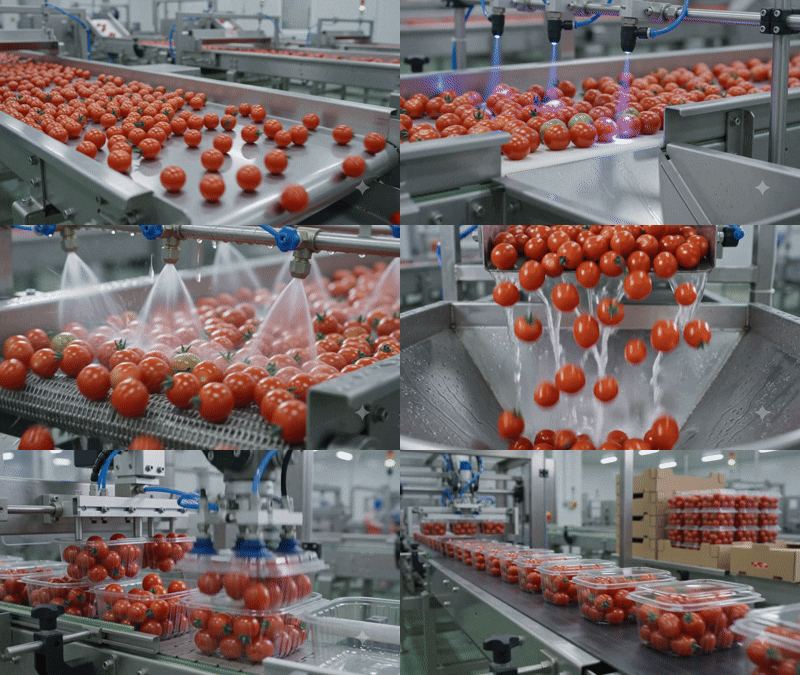
As labor challenges intensify, automation has become a necessity for scaling. Automated sorting machines, equipped with optical vision and multispectral cameras, can grade products by size, color, and defect detection at speeds unattainable by human labor.[20] Collaborative robots (cobots) are increasingly deployed to work alongside humans in packing and palletizing, enhancing efficiency while maintaining safety.[14, 20]
Distribution and Market Access Channels
A multifaceted distribution strategy is essential for reaching diverse consumer segments. The value chain typically follows a path from Producers to Processors, then to Wholesalers/Distributors, and finally to Retailers or Foodservice Operators.[15]
Wholesale, Foodservice, and Institutional Segments
- Broadline Distributors: Companies like Sysco and US Foods act as one-stop shops for restaurants and hospitals, competing on economies of scale and vast logistics networks.[15]
- Specialty Distributors: Focus on high-touch niches like fresh produce, organic items, or ethnic ingredients, often providing expertise in “ripeness management” or temperature-sensitive handling.[15]
- Foodservice Redistributors: These entities buy in bulk from manufacturers and break shipments into smaller lots for regional distributors who lack the volume for direct-from-factory purchasing.[15]
- Institutional Markets: Selling to schools, hospitals, and government agencies requires participating in formal bidding or Request for Proposal (RFP) processes, which prioritize quantitative purchasing commitments and supply chain transparency.[23, 32]
The rise of e-commerce has also enabled a “Direct-to-Consumer” (DTC) model, allowing small manufacturers to bypass traditional wholesale and capture higher margins by selling directly through platforms like Shopify or Amazon.[1, 6]
Digital Marketing and Brand Positioning in 2026
In 2026, marketing for food brands is less about polished “food porn” and more about authentic connection and community ownership. The digital landscape is dominated by short-form video content and AI-driven personalization.[33, 34, 35]
Authentic Content and Social Commerce
The “Raw and Real” movement emphasizes lo-fi video content, behind-the-scenes footage of the processing floor, and “Build in Public” strategies where audiences vote on new flavors or packaging designs.[34, 35] Social commerce integration now allows consumers to purchase products directly within platforms like TikTok or Instagram Reels, a segment projected to account for 17% of global e-commerce transactions by 2026.[33]
AI Personalization and Search Optimization
Food brands are increasingly using machine learning to predict consumer behavior. For example, a customer who frequently views plant-based recipes might receive targeted ads for a processor’s new fava bean snack.[33] Furthermore, as AI search engines like SearchGPT gain traction, brands must shift from “keyword stuffing” to producing high-quality, expert-driven content that demonstrates Experience, Expertise, Authoritativeness, and Trustworthiness (E-E-A-T).[34]
Sustainability and Environmental Stewardship
Environmental compliance is no longer a peripheral concern; it is a core operational requirement governed by the EPA. The “Wasted Food Scale” prioritizes prevention and upcycling, encouraging processors to find higher-value uses for byproducts rather than sending them to landfills.[36, 37]
Circular Economy and Resource Recovery
Processors can implement technologies like anaerobic digestion to convert organic waste into biogas for energy or high-quality soil amendments.[36, 37] For hazardous materials, such as specific cleaning chemicals, facilities must comply with the Resource Conservation and Recovery Act (RCRA), which mandates strict testing and record-keeping to minimize environmental impact.[38] Proactive environmental management not only ensures compliance but also aligns with the 57% of consumers who seek detailed information on the environmental impact of their food purchases.[5]
Conclusion: Strategic Imperatives for the Future
The food processing industry in 2026 offers profound opportunities for those who can synchronize culinary creativity with technological and regulatory precision. The pathway from a startup to a scaled enterprise is defined by a commitment to rigorous planning—from the initial niche validation and recipe standardization to the engineering of a sanitary facility and the implementation of a tech-enabled marketing strategy. By leveraging innovations in alternative proteins, automation, and AI-driven personalization, and by adhering to the highest standards of safety and sustainability, a food processing business can build the resilience necessary to thrive in a global US$10 trillion market. The ultimate success of the modern food processor lies in their ability to translate these complex operational requirements into a brand story that resonates with the wellness-focused and ethically conscious consumer of 2026.
——————————————————————————–
- How to Start a Small Food Manufacturing Business: All you Need to Know – Craftybase, https://craftybase.com/blog/how-to-start-food-manufacturing-business
- Top food trends 2025. Explore the latest food and beverage trends – Innova Market Insights, https://www.innovamarketinsights.com/trends/top-food-trends-2025/
- 2025 Food Industry Trends: What Small Manufacturers Need to Know, https://brightpathassociates.com/2025-food-industry-trends-what-small-manufacturers-need-to-know/
- How to Build a Resilient Food Business in 2025 – Dephna, https://www.dephna.com/insights/how-to-build-a-resilient-food-business/
- Food Trends 2025 – Penn State Extension, https://extension.psu.edu/food-trends-2025
- How to Start a Food Business: A Step-by-Step Guide – United Food …, https://unitedfoodlabs.com/2025/07/23/how-to-start-a-food-business-a-step-by-step-guide/
- How to Start a Food Business | FDA, https://www.fda.gov/food/food-industry/how-start-food-business
- Markets, Regulation, and Policy – Food Safety – ers.usda.gov, https://www.ers.usda.gov/topics/food-safety/markets-regulation-and-policy
- USDA vs. FDA Food Labeling – Eurofins USA, https://www.eurofinsus.com/food-testing/resources/usda-vs-fda-food-labeling/
- USDA vs. FDA: A Comparative Study of Food Product Regulation – SGS Digicomply, https://www.digicomply.com/blog/usda-vs.-fda-a-comparative-study-of-food-product-regulation
- Formal Agreement between USDA and FDA Relative to Cooperation and Coordination, https://www.fda.gov/food/international-interagency-coordination/formal-agreement-between-usda-and-fda-relative-cooperation-and-coordination
- How to Start a Food Manufacturing Business [2025 Guide: 10 Steps …, https://www.serif.ai/start-a-business/how-to-start-a-food-manufacturing-business-2025-guide-10-steps-free-business-plan
- Food Quality Best Practices for Sourcing Raw Materials – iMonitor Manufacturing Software, https://www.imonitor.net/blog-posts/food-quality-best-practices-for-sourcing-raw-materials
- 9 Food Manufacturing Trends Reshaping The Industry In 2025 – Folio3 FoodTech, https://foodtech.folio3.com/blog/latest-food-manufacturing-trends/
- How the Food Distribution Industry Works | Umbrex, https://umbrex.com/resources/how-industries-work/agriculture-and-food/how-the-food-distribution-wholesaling-industry-works/
- Designing Food Facilities: Planning, January 2022 – Agricultural …, https://www.ams.usda.gov/sites/default/files/media/Designing_Food_Facilities_Planning.pdf
- INFRASTRUCTURE – FAO Knowledge Repository, https://openknowledge.fao.org/server/api/core/bitstreams/e23a5a5f-1d6c-452a-89a9-8e81a345b4b9/content
- The Ultimate Guide to Food Processing Equipment: Types, Materials, and Industries, https://wasinc.com/ultimate-guide-to-food-processing-equipment-types-materials-industries/
- Sanitation Performance Standards Compliance Guide – Food Safety and Inspection Service, https://www.fsis.usda.gov/inspection/compliance-guidance/sanitation-performance-standards-compliance-guide
- What Types of Industrial Food Processing Machines Should You …, https://mae-innovation.com/en/choosing-your-industrial-food-processing-machine-equipment-and-profitability/
- Types Of Food Processing Equipment – Plant Automation Technology, https://www.plantautomation-technology.com/articles/types-of-food-processing-equipment
- Processing Equipment – PMMI ProSource Directory, https://www.prosource.org/category/processing-equipment
- Satiating the demand: Planning for alternative models of regional food distribution, https://www.foodsystemsjournal.org/index.php/fsj/article/download/145/139/272
- Optimal strategies for contract farming supply chain with government subsidies under e-commerce assistance to farmers – PMC – NIH, https://pmc.ncbi.nlm.nih.gov/articles/PMC11521263/
- Contract farming for improving farmers’ incomes: from Resource-Based View – Frontiers, https://www.frontiersin.org/journals/sustainable-food-systems/articles/10.3389/fsufs.2025.1585843/full
- The Fundamentals of Supplier Quality Management (SQM) – Kodiak Hub, https://www.kodiakhub.com/blog/supplier-quality-management
- Raw Material Quality Control Guide for Food Importers – Seedea, https://seedea.pl/raw-material-quality-control/
- 9 Essential Purchasing Practices for Food Companies – JustFood ERP, https://www.justfooderp.com/blog/9-essential-purchasing-practices-for-food-companies/
- How to Choose the Right Co-Packing Company (2025 Guide) – Buske Logistics, https://www.buske.com/blog/co-packing-companies-strategies-for-selecting-a-provider
- The Complete Guide to Co-Packing: What It Is and Why It Matters for Your Business, https://www.alcsource.com/blog/the-complete-guide-to-co-packing-what-it-is-and-why-it-matters-for-your-business/
- How To Find A Co-Packer For Your Product: A Step-By-Step Guide – T.H.E.M., https://them.net/how-to-find-a-co-packer-for-your-product-a-step-by-step-guide/
- Food Service Toolkit | Farm to Institution New England, https://www.farmtoinstitution.org/food-service-toolkit
- 2025 Digital Marketing Predictions for Food and Beverage Brands, https://themissingingredient.com/2025-digital-marketing-predictions-for-food-and-beverage-brands
- Top 2025 Marketing Trends for Food & B2B Success – Mayes MarCom, https://mayesmarcom.com/marketing-trends-for-2025-what-food-b2b-businesses-need-to-know/
- The No-BS Guide to Social Media Strategy for Food Brands in 2025 – Giovanni Gallucci, https://gallucci.net/blog/the-no-bs-guide-to-social-media-strategy-for-food-brands-in-2025
- Sustainable Management of Food | US EPA, https://www.epa.gov/sustainable-management-food
- Sustainable Management of Food Basics | US EPA, https://www.epa.gov/sustainable-management-food/sustainable-management-food-basics
- Environmental Compliance – FedCenter, https://www.fedcenter.gov/programs/compliance/


Leave a comment